Category Archives: Advent

Sacred Candlelight

Such a sacred act, lighting a candle. That concentrated energy in the spark of the wooden match striking the flint, a small explosion of illumination, lighting the wick that burns the tallow. Like many things of wonder, it is an act that is potentially dangerous, and yet, kept in control, a thing of extreme beauty. So many of our sacred nights here at our home are illuminated by candlelight. (Perhaps they all are sacred: for months now, since this time of isolation began, Seth has been lighting candles at the dinner table each night.)

As I write this today, it is the Feast of Our Lady of Guadalupe, and in the overnight hours as this day becomes the next, Sankta Lucia will arrive, too, with a wreath of candles upon her head, illuminating the dark cold night, this night that “walks with heavy steps.” I can picture all of the glass Guadalupe candles that are so ubiquitous in shops here in Lake Worth––from Botanica shops to the grocery store aisles––illuminated, too. Some folks are lighting Chanukah candles, and on the Advent wreath this Sunday, we illuminate two purples candles and the rose candle, too, for it is Gaudete Sunday, the Sunday of Advent where we add a measure of joy to our time of reflection. It is difficult to contain the joy that we know is coming with Christmas, and so the colors for this next week of Advent take on the joyful color of rosy pink, rather than somber purple.

And so here we are, practically midway through December already. The Feast of Our Lady of Guadalupe on the 12th of December is sacred to all the countries of Latin America, but most especially to Mexico. As the story goes, in 1531, a fellow named Juan Diego was on a hill near Mexico City and there he saw an apparition of a woman. She asked him to build a church in her honor there on the hill. She spoke to him in his native Nahuatl language and he recognized her, by the things she told him, as the Virgin Mary. And it was on 12th of December in that year that the iconic image of Our Lady of Guadalupe that we know so well miraculously appeared inside Juan Diego’s cloak: on one of his visits to the hill, Mary told Juan Diego to go to the barren top of the hill, but when he got there, he found it not at all barren but covered with roses, all in bloom. He and Mary gathered the roses and she arranged them inside his cloak. And on this, her feast day, Juan Diego opened his cloak before the bishop of Mexico City. When he did, the flowers all fell to the floor, revealing the image of the Virgin of Guadalupe. The bishop took it as a sign. The church was built, and the image from Juan Diego’s cloak, or tilma, hangs still inside the Basilica of Our Lady of Guadalupe on Tepeyac Hill, Mexico City.

The 13th, a Sunday this year, brings St. Lucy’s Day: the Feast of Santa Lucia in Italy (where Lucia is pronounced loo-chee-a) and Sankta Lucia in Sweden (where the C is soft: loo-see-a). Lucia is sacred to both countries; she was born and lived and died in Sicily, but––perhaps because the nights are so dark in Sweden in December––she was long ago taken up there and celebrated. Lucia = Light, and light is a precious commodity to come by near the Arctic Circle around this time of the approaching Midwinter Solstice.

In Italy, children will wake up in the morning to find tiny presents tied to their shoelaces, as long as they’ve left hay and carrots in their shoes before they went to bed, for Santa Lucia’s donkey. Santa Lucia follows St. Nicholas as the next of the Midwinter gift bearers. In Sweden, typically there are processions on this night in celebration of Sankta Lucia: in churches, in schools, in city streets, on national television. Each features a Lucia, donning a wreath of glowing candles upon her head, with scores of her attendants: boys and girls dressed all in white, each bearing a candle, and then the Star Boys, each carrying stars on poles and donning tall white conical caps. It is one of the most beautiful sights of these ever-darkening nights on the approach to the solstice. In homes, too, Lucia will come in the early morning darkness, wreath glowing upon her head, delivering strong coffee and saffron scented buns, lussekatter, to all in the household.

It is a time that gets jumbled up in our home (and perhaps many other places, too) with things both Italian and Swedish. Even the music for this night is jumbled, for the song that is sung throughout Sweden this night (click here to listen) is Italian in origin, an old Neapolitan melody, transformed and rewritten for a place where, at this darkest time of the year, the night is vast:

The night walks with heavy steps around farm and cottage.
Around the earth, forsaken by the sun, shadows are lowering.
Then into our dark house she treads with lighted candles,
Sankta Lucia, Sankta Lucia.

The night is vast and mute. Now here reverberate
in all silent rooms a rustle as of wings.
See, on our threshold stands––whiteclad, lights in her hair––
Sankta Lucia, Sankta Lucia.

“The darkness will soon take flight from the valleys of earth.”
Thus she a wonderful word to us speaks.
The day shall again, reborn, rise from a rosy sky,
Sankta Lucia, Sankta Lucia.

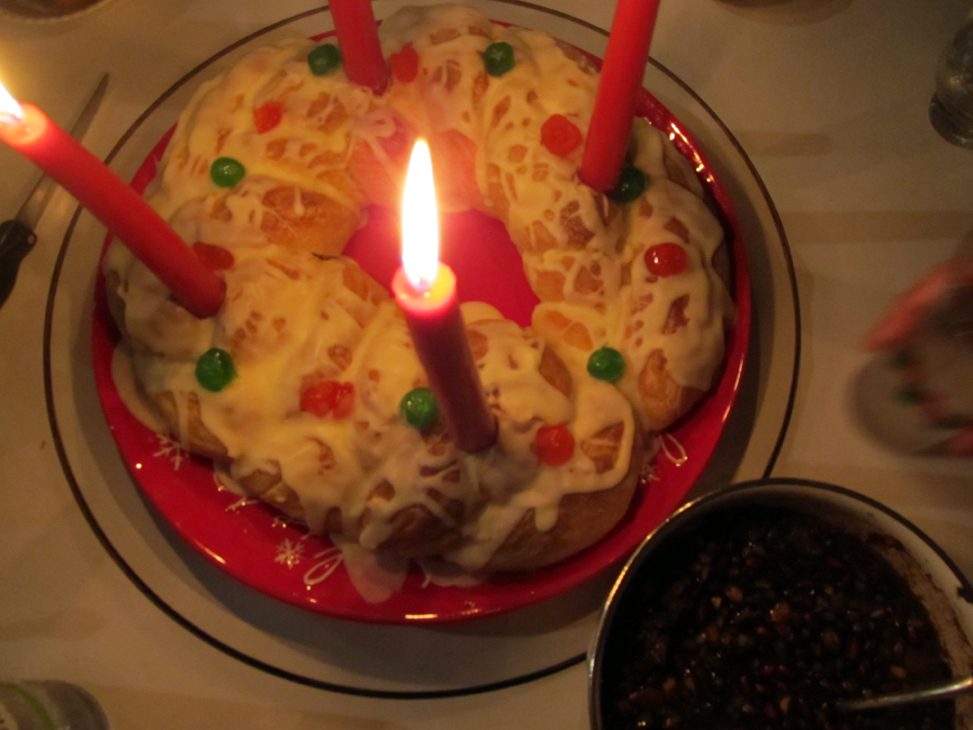
On Sunday morning, my sister will make her Santa Lucia wreath––a sweet yeast bread, braided and round, a never ending circle like the circle of days, dotted with candied cherries and illuminated with four red candles. Another simple yet delicious treat we have but once each year, and we’ll enjoy it tonight with coffee after dinner. This is our Santa Lucia way.

All of us here––my mom, my sister, Seth and me––we wish you light and peace on these sacred illuminated midwinter nights.

Image: My sister Marietta’s Santa Lucia Bread. I wish we could pour you some coffee and cut a slice for you!

 

Tagged , ,

Make Our House Fair as We are Able

This weekend, we’ll clean the windows and put an electric candle on the sill inside each to illuminate the night. It’s a winter tradition that Seth brings from his family, and one that has come to signify the start of Advent in this house. Pure white light piercing the darkness; one of the simple pleasures I love about this time of year as we begin our time of expectation for Christmas.

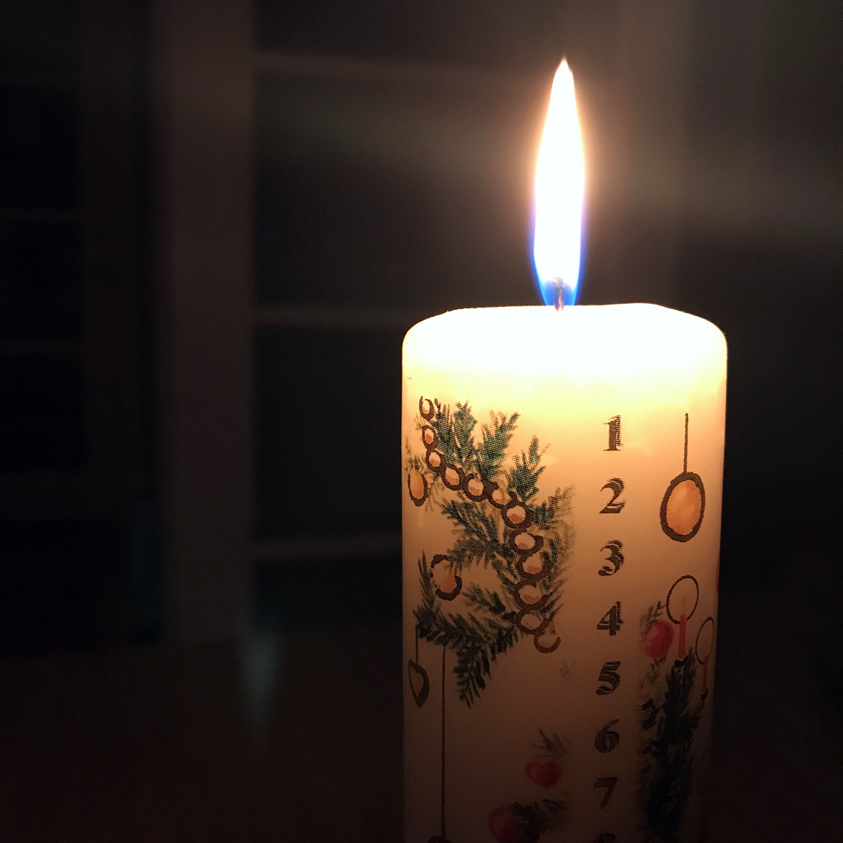
And while we will begin lighting our daily Advent candle and opening each night a window on our Advent calendar on the First of December, the actual Advent season arrives a bit earlier this year: Sunday brings the First Sunday of Advent. The Advent ring is center for each of the four Sundays to come: a ring of four candles in a wreath of pine. In the Catholic tradition, three of the candles are purple and one is rose. Purple, the color of penitence and rose the color of joy. It is a time of expectation and preparation and of making our house as fair as we are able, as a French Advent carol goes… the “house” being not just the literal house but the figurative one, as well: the heart, the soul––the need to feel joy before we start singing all those songs of joy once Christmas actually arrives. And so on this First Sunday of Advent we will light one purple candle. The following Sunday, two purple candles. The Third Sunday, which is called Gaudete Sunday, we light the two purple candles and we add the rose candle, too, as that third week focuses on the joy of anticipation. And finally, on the last Sunday before Christmastime, we light all four candles.

The candle colors vary among traditions. Some denominations use blue and white candles, for instance, others, all white and others, red. But the concept remains the same: that in this time of increasing darkness, as the nights get longer and longer on the road to the solstice of Midwinter, we respond with ever increasing light of our own. If you are religious, it will represent the light of Christ. If you are not, let those candles represent the light within: your own light, your compassion and kindness: Hide not your light under a bushel.

Advent serves another purpose, too: It is part of what we have come to call the Slow Christmas Movement, which to me is about setting the stage to make a proper welcome for the yuletide season that arrives once Christmas Eve begins. But it’s been a tough year, hasn’t it? Lord knows we’ve all set the stage for needing joy over the course of this entire year. You do what’s right for you. Here, we will still follow these old ways, for that is what makes us happiest. What matters is we find joy where we can, and share it with others. That’s the whole point of hiding not your light.

It’s not too late to order from our selection of sparkly Advent calendars from Germany and our daily Advent candles from England! We ship Priority Mail (2 days to most US destinations) AND we’re running a sale: It’s our Christmas Stock-Up Sale: $10 off your purchase of $75 plus free domestic shipping; use discount code STREETFAIR at checkout. Or earn free domestic shipping with your purchase of $50 (no code required). “Yule” find many great gift ideas at our online catalog!


Stir Up, We Beseech Thee, the Pudding in the Pot

I love a bit of perfect timing, and today, we get just that. It begins with a prayer, and here it is:

Stir up, we beseech thee, o Lord, the wills of thy faithful people;
that they, plenteously bringing forth the fruit of good works,
may of thee be plenteously rewarded; through Jesus Christ our Lord. Amen.

Or something to that effect. The language is often updated nowadays, replacing the thees and the plenteouslies with more contemporary words, but I think you get the general idea. It is the collect––the prayer––after communion in the Anglican Church this last Sunday in ordinary time before we shift to the Four Sundays of Advent, our annual time of preparation for Christmas: the time when we make our houses as fair as we are able. The timing of this prayer each year happens to coincide nicely with the ideal timing for the preparation of some traditional English yuletide desserts: in particular, steamed puddings and fruitcakes, which require a good four weeks to age and become sufficiently brandy-soaked to reach their best depth of flavor.

And so, since at least the 1830s, this day has been known as Stir-Up Sunday, both for the collect and also for the celebratory kitchen tasks. Ask folks in the congregation and they may very well have their own version of the collect, which goes more along these lines:

Stir up, we beseech thee, the pudding in the pot,
Stir up, we beseech thee, and keep it all hot.

This is not something we are particularly aware of in my family, Catholics as we are, and Italians, too. But my sister does make a good fruitcake most Christmases, brandy-soaked like the best of them, and she does make it early, long before Christmas’s arrival. Same goes for her delicious Pfeffernüsse, the spicy German cookie that requires weeks to develop its flavors. It is said, though, that a good British Christmas pudding should contain thirteen ingredients––one for Jesus and each of his disciples––no more and no less. And when it is prepared on Stir-Up Sunday, each member of the family should give the pudding a stir, making a wish as they do. The stirring must be from east to west: the same direction the Magi traveled to visit the newborn child.

It is, as well, this 22nd of November, St. Cecilia’s Day. Cecilia, patron saint of musicians. It is traditional to attend a concert on her day, a custom since at least the 16th century in France. This year, though, we know that is not in our best collective interest, and so we wait for perhaps next St. Cecilia’s Day for this particular tradition. Tomorrow, the 23rd, brings my grandfather Arturo’s birthday––at least we think so. His birthday may possibly have been on the 21st. Nonetheless, we always celebrated on the 23rd, which also happens to be St. Clement’s Day, and another rhyme comes to mind:

Oranges and lemons,
Say the bells of St. Clement’s.
You owe me five farthings,
Say the bells of St. Martin’s.

St. Clement’s Day in times past was a time to go “Clementing”–– kind of like trick or treating, only on the 23rd of November. Kids would knock on doors, hoping for treats in exchange for singing rhymes like the one above. Old Clem is a patron saint of blacksmiths and metal workers, though, and they had their own mysterious song for Old Clem’s Night, which certainly involved ale:

Come, all you Vulcans, strong and stout,
Unto St Clem I pray turn out;
For now St Clem’s going round the town:
His coach and six goes merrily round.

I am reminded, too, each year on this approach to Thanksgiving, that there is an old, mostly forgotten begging tradition of New York in which kids would go door to door on Thanksgiving Day. My mom, who never went trick-or-treating at Hallowe’en, does remember doing this when she was a little girl in Brooklyn. I often wonder if there is some connexion between this and the Clementing of November 23, especially since, some years, Thanksgiving falls on St. Clement’s Day.

Here in our home, we’ll soon be dusting off music for the Advent season, the time of preparation before Christmas that I love perhaps as much as Christmastime itself. I am, at heart, a guy who loves anticipation. I think of St. Cecilia each year as the figure who reminds us that it is time to do this, to bring in the music that was put away once Christmas Eve arrived last year.

Speaking of anticipation: it is, by the way, a good time to order Advent candles and calendars from our Convivio Book of Days Catalog! Especially if you feel a bit rushed by Christmas, even before Thanksgiving has come. A simple thing like an Advent candle that you light each night or an Advent calendar that you open a door on each day can really help bring some perspective to things. Ours are the traditional kinds, made in Europe, where these traditions began, and it’s all part of what we call the Slow Christmas Movement. We always offer free domestic shipping when you spend $50, and this year, since we won’t be showing in all the local Christmas markets, we’re running a bigger sale: It’s our Christmas Stock-Up Sale: spend $75 on anything and everything in our catalog, and save $10 plus get free domestic shipping: a savings of $18.50. Just use discount code STREETFAIR at checkout. We’ve got lots of wonderful things to choose from, and more to come: lots of your favorite German artisan goods for Christmas are on their way and should be restocked this week.

Image at top: “The Christmas Pudding” by Robert Seymour. Etching for The Book of Christmas by Thomas K. Hervey, 1836.

Join me this Wednesday (November 25) at 11 AM EST on Instagram Live: my friend Manal Aman of Hello Holy Days! will be chatting with me about the things we do at Convivio Bookworks and some of the great things we offer at our catalog (including Manal’s beautiful cards for Ramadan). Manal is the creator of #purpleramadan and the fictional #ramadandrummer and an all-around fine person. Find Manal on Instagram @helloholydays and us, of course, @conviviobookworks.

3 PM EST that same day, join me for Book Arts 101: Thanksgiving. It’s a live Zoom session featuring some pretty amazing artists’ books from the Jaffe Center for Book Arts. You’ll be able to register for it come Monday by visiting the EVENTS page at www.jaffecollection.org. You may also view a simulcast on Facebook Live at the Facebook page of the Jaffe Center for Book Arts, or catch the video later at the Jaffe Center’s Vimeo Channel.