Happy New Year, everyone. Two days into 2024, and we are now firmly into the second half of our Christmas journey of twelve days (six days in the old year, six in the new). Once we pass New Year’s Day, the ceremonious aspects of the Twelve Days begin to wind down. Chalk that up, perhaps, to the abundance of celebration that comes with the first seven days… I think by this, the Eighth Day, people need a little normalcy. In our house, it is usually back to work at this point. The Twelve Days of Christmas is very much a tradition that comes out of medieval times. In the contemporary day, employers tend to frown upon twelve days without work. (I think even the rehabilitated Ebenezer Scrooge that we meet in the closing chapters of A Christmas Carol would bristle at the idea of giving his clerk Bob Cratchit twelve whole days leave from the office.) And while it is back to work for most of us, these are still nights that find us in this house tending toward reading books and watching old Christmas movies. But though the Twelve Days of Christmas are winding down, Old Father Christmas is not one to exit each year quietly; he traditionally goes out with a big boisterous celebration, and this celebration is known as Twelfth Night, followed the next day by the arrival of the Magi on Epiphany. These quiet days and nights between New Year’s Day and Twelfth Night are good ones to begin preparations for this grand finale.
EIGHTH DAY of CHRISTMAS
January 2: St. Macarius’s Day
And so the Second of January brings the Eighth Day of Christmas, which is St. Macarius’s Day. Macarius was a dour old chap in his old age, an ascetic hermit who lived in the Egyptian desert, surviving on raw vegetables and, on only the most special days, a bit of bread dipped in olive oil. (I can picture my grandmother, holding up her thumb pressed against her index and middle fingers, begging him to just mangia something more than carrots.) But before he became such a stick in the mud, Macarius, in his younger days, operated a confectionary in Alexandria. It is Macarius the Confectioner we remember most these days, and this is why he is a patron saint of cooks, confectioners, and pastry chefs. And for certain his is not the easiest name to pronounce; for this reason he has also been known over the ages as St. Macaroon (perhaps St. Macaron in France?)––fitting enough for a confectioner, I’d say. Anyway, his feast day, falling as it does within the extraordinary time of the Twelve Days of Christmas, has become a day to enjoy sweets (as if you’ve not been doing that already for the first Seven Days of Christmas).
NINTH DAY of CHRISTMAS
January 3: St. Genevieve’s Day
We celebrate St. Genevieve on the Third of January, the Ninth Day of Christmas. She is a patron saint of Paris, founder there in 475 of Saint-Denys de la Chapelle, which stands today as part of the Basilica of St. Denis. Another of the saints we celebrate this dark time of year that is associated with light, Genevieve’s was a light that never went out. It is said that even as the devil would, each night, attempt to interrupt her prayers by blowing out her candle, Genevieve had the power to relight it without use of flint nor fire. She just willed it to happen. Talk about a light bearer. And while there are no particular customs (that I am aware of, anyway) associated with this Ninth Day of Christmas, there are plenty of us who love the food and culture of France. I think today, St. Genevieve’s Day, is a fine day to enjoy those things fully and to wish those we meet joyeux noël et bonne année!
TENTH DAY of CHRISTMAS
January 4: St. Titus’s and St. Gregory’s Day
This Tenth Day of Christmas brings the Feast Day of St. Titus and St. Gregory, and it’s also St. Rigobert’s Day and St. Ramon’s Day. Titus was a disciple of St. Paul in the first century, and Gregory was a bishop in the sixth century. Rigobert had a trying time of it as an early Archbishop of Reims––political matters mostly––and he is held up as a model of patience. He kept a goose as a pet; in my experience, that’s something that would take some patience, too. Ramon is particularly difficult to know; he was a bishop and he appears in the Chambers Bros. Book of Days on January 4 for the year 1869, but I have found no mention of him since in more contemporary sources.
With no particular customs associated with the Tenth Day of Christmas, I take it as good day to prepare for the celebrations to come in the next couple of days: Twelfth Night and Epiphany. To that end, I’m going to include today the recipe I give you most years on the blog ahead of Epiphany: our recipe for Three Kings Cakes, steeped in the ancient flavors of that old desert land where the Christmas story first unfolded. With Twelfth Night and Epiphany, our focus shifts outward––toward the Magi who traveled to see the child and outer yet, to the star they followed on their journey. Stars make us think of larger things: far distances, light, the galaxy and the universe beyond. Christmas itself is close to the heart, but Epiphany brings the story to a wider audience: we follow that star, and as the universe expands, so, too, do our hearts at Epiphany.
Twelfth Night, which comes on the evening of January 5, the Eleventh Day of Christmas, is traditionally a cracking good party, a proper send off for Yule and old Father Christmas. In the overnight hours, la Befana, one of the last of the midwinter gift bearers, will make her way through Italy on a broom bringing small presents to good children and delicious sweet coal to naughty ones––so it’s hard to choose which is better. We Italians like to keep things ambiguous. In Spain and Latin America, los Tres Reyes will be delivering presents. The stories of la Befana and los Tres Reyes are intertwined… the three kings stopped at la Befana’s on their way to visit the Christ child and invited her along, but she, like most Italian women I know, had far too much to do, so she declined their invitation, and then later had misgivings about that decision. Still to this day she searches for the child each Epiphany Eve.
Here at home, we bring out illuminated paper star lanterns come Twelfth Night and we make Christmas sweets that, no matter how much we try to bake earlier, never seem to get made until the last few days of the Christmas season. Maybe it is a subconscious decision, for these baked goods feel older, more influenced by ancient flavors, flavors old and familiar to the Magi: Baklava flavored with honey and walnuts, and our friend Paula’s Kourambiedes cookies, each studded with a clove, and our Three Kings Cakes, flavored with honey, rose water, currants, and dates––flavors of the desert, of our ancient past, of that very first Christmas. The cakes are a contemporary riff on old flavors, but the Baklava and the Kourambiedes have a much longer history, the stuff of time immemorial. It’s easy to imagine that our friend St. Macarius, the fourth century confectioner that we discussed earlier and celebrated on the Eighth Day of Christmas, was making these very same things in his shop in Old Alexandria.
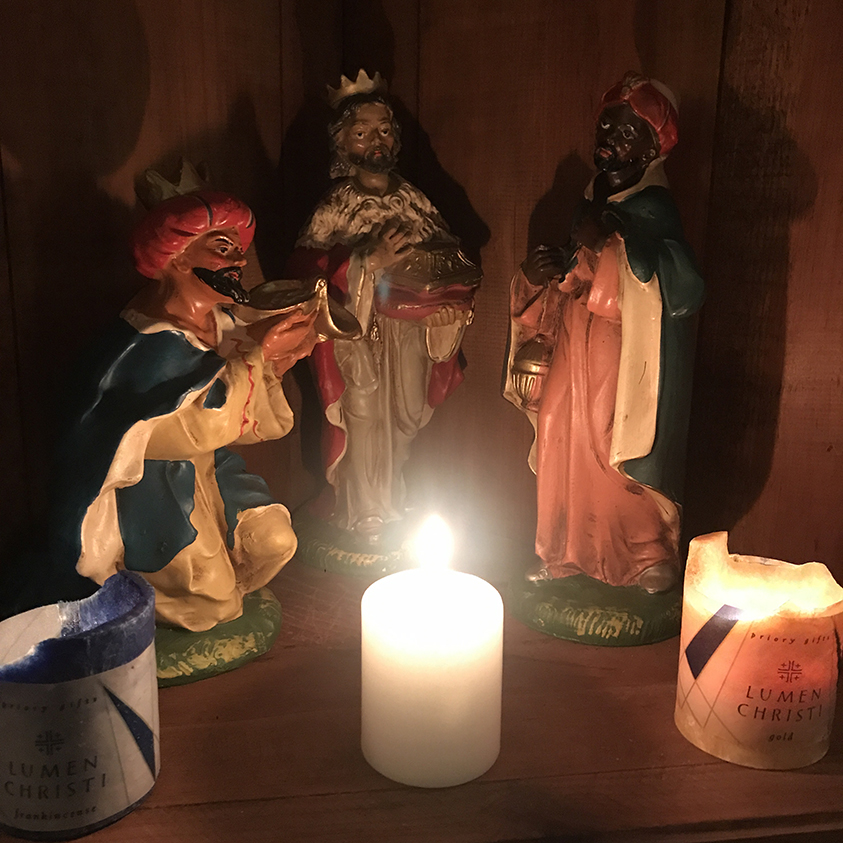
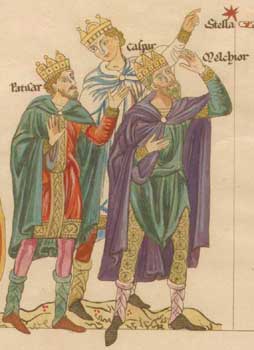
So, while there are no particular customs for this Tenth Day of Christmas, mine has become the making of these delicious Three Kings Cakes, so they are ready for Twelfth Night and Epiphany, and perhaps this is the best custom of the day. The recipe yields three cakes, cakes you will prepare in three loaf pans. You will end up with one cake for each of the Magi, who have traditionally been called Caspar, Melchior, and Balthasar, though no one knows who they were really. As the story goes, it took the Magi all this time to travel through the desert, from Christmas Night to Epiphany, and seeing the child lying in the straw was their great epiphany. Rose water is the main flavoring, mysterious and familiar all the same in the way that only ancient flavors can be. We happen to sell a wonderful rose water made at the Sabbathday Lake Shaker Community in Maine; it is perfect for these cakes.
This recipe began with Jeff Smith, and while he certainly was a problematic figure, I’ve altered the recipe over the years to make it more my own. Most recently, I’ve cut down a bit on the currants, but added in some chopped dates. Again, more of the flavors of that desert land. I do think yule love these cakes! (Sorry, I get a big kick out of that. You can rest easy now that that’s probably the last time I’ll get to use yule that way this Christmastime.)
*
T H R E E K I N G S C A K E S
makes three cakes
For the Batter
1 cup butter or shortening
generous 3/4 cup sugar or monk fruit
2 eggs
2 teaspoons vanilla
2 cups currants
1 cup chopped dates (pits removed, of course)
3 cups applesauce
1/2 teaspoon salt
1 tablespoon baking soda
1 teaspoon cinnamon
1/2 teaspoon ground cloves
4 cups flour
Preheat oven to 300 degrees. Cream together the butter and the sugar, then add the eggs and vanilla. Beat smooth before adding the remaining ingredients. Grease 3 loaf pans (about 8″ x 4″ x 3″ or so) and divide the batter amongst the pans. Bake for one hour, or until a toothpick poked into the center of each cake comes out dry. Let the cakes cool in their pans on a rack.
For the Syrup
1/2 cup honey
1/2 cup sugar
1/2 cup water
1 cinnamon stick
6 whole cloves
2 tablespoons rose water
Once the cakes are baked, combine the syrup ingredients, except for the rose water, in a saucepan over medium heat. Once the sugar dissolves, add the rose water. Remove the cinnamon stick and the cloves and then pour the hot syrup over the cakes in their pans, divided equally amongst the three cakes. The syrup will soak into the cakes. Allow to cool completely before unmolding from the pans. Serving the three cakes on three platters makes for a nice presentation on Epiphany Day or on Twelfth Night.
TWELVE DAYS of CHRISTMAS SALE
At our online shop, our Twelve Days of Christmas Sale continues and brings you automatic markdowns on most of our authentic German handmade nutcrackers, pyramids, and incense smokers. We are running the sale for the full Twelve Days of Christmas, through the Sixth Day of January. If there are things you wanted that Santa couldn’t fit in his sleigh, well, we’re here to help (and to offer you our best prices of the year, too). CLICK HERE to shop!
Image: “The Three Magi,” an illustration from the reproductions of Herrad of Landsberg’s Hortus Deliciarum by Christian Moritz Engelhardt, 1818. [Public domain] via Wikimedia Commons. The original book, known in English as The Garden of Delights, was made by Herrad of Landsberg, a 12th century nun and abbess of Hohenburg Abbey. The original perished in the burning of the Library of Strasbourg in 1870 during the Franco-Prussian War, but luckily we do have Engelhardt’s 19th century reproductions.