
Category Archives: Epiphany

Of Rose Water, Cloves, & Honey

TENTH DAY of CHRISTMAS
St. Titus’s and St. Gregory’s Day

Again today, like yesterday, there are no particular customs associated with this, the Tenth Day of Christmas. It is the Feast Day of St. Titus and St. Gregory. Titus was a disciple of St. Paul in the first century, and St. Gregory was a bishop in the sixth century. It’s also St. Rigobert’s Day and St. Ramon’s Day.

If you still have it in you to celebrate another grand event or two, well, very soon will come Twelfth Night and Epiphany. In this house, we sometimes mark these closing days of the Yuletide season quietly, and sometimes with a big meal and a gathering of family and friends. Whatever you decide, this Tenth Day of Christmas is a good one to use for preparations. With Twelfth Night and Epiphany, our focus shifts a bit toward the Magi and the star that they followed. We bring out the illuminated paper star lanterns and we make Christmas sweets that, no matter how much we try to make earlier, we never seem to get made until the last few days of Christmas. Maybe it is a subconscious decision, for these baked goods feel older, more influenced by ancient flavors, flavors the Magi were probably familiar with: Baklava flavored with honey and walnuts, our friend Paula’s Kourambiedes cookies, each studded with a clove, and our Three Kings Cakes, flavored with honey, rose water, and currants.

For years now on the blog on this Tenth Day of Christmas, we’ve been giving you our recipe for Three Kings Cakes with the idea that it is a very good day to bake them. Perhaps this is the best custom around for the day! The recipe yields three cakes, cakes you will prepare in three loaf pans. You will end up with one cake for each of the Magi, who have traditionally been called Caspar, Melchior, and Balthasar, though no one knows who they were really. As the story goes, it took the Magi all this time to travel through the desert, and seeing the child lying in the straw was their great epiphany. We happen to sell a wonderful rose water made at the Sabbathday Lake Shaker Community in Maine. If you’re local and you need some to bake these cakes, let me know and together we’ll find a way to get you a bottle in time, even if it means meeting up in a parking lot somewhere!

*

THREE KINGS CAKES
makes three cakes

For the Batter
1 cup butter
generous 3/4 cup sugar
2 eggs
2 teaspoons vanilla
2 1/2 cups currants
3 cups applesauce
1/2 teaspoon salt
1 tablespoon baking soda
1 teaspoon cinnamon
1/2 teaspoon ground cloves
4 cups flour

Preheat oven to 300 degrees. Cream together the butter and the sugar, then add the eggs and vanilla. Beat smooth before adding the remaining ingredients. Grease 3 loaf pans (about 8″ x 4″ x 3″ or so) and divide the batter amongst the pans. Bake for one hour, or until a toothpick poked into the center of each cake comes out dry. Let the cakes cool in their pans on a rack.

For the Syrup
1/2 cup honey
1/2 cup sugar
1/2 cup water
1 cinnamon stick
6 whole cloves
2 tablespoons rose water

Once the cakes are baked, combine the syrup ingredients, except for the rose water, in a saucepan over medium heat. Once the sugar dissolves, add the rose water. Remove the cinnamon stick and the cloves and then pour the hot syrup over the cakes in their pans, divided equally amongst the three cakes. The syrup will soak into the cakes. Allow to cool completely before unmolding from the pans. Serving the three cakes on three platters makes for a nice presentation on Epiphany Day or on Twelfth Night.

Image: Our pottery studio, still a work in progress… but finished enough that Seth hung a fir wreath on the door this Christmas. This has nothing at all to do with St. Titus or St. Gregory, I realize, or St. Rigobert or Ramon, for that matter. But I am very excited about the project, and I’m hopeful that 2018 is the year that Seth Thompson gets back to making pottery. He’s awfully good at it.
 

Faith & Hope & Sweet Release

TWELFTH DAY of CHRISTMAS:
Epiphany

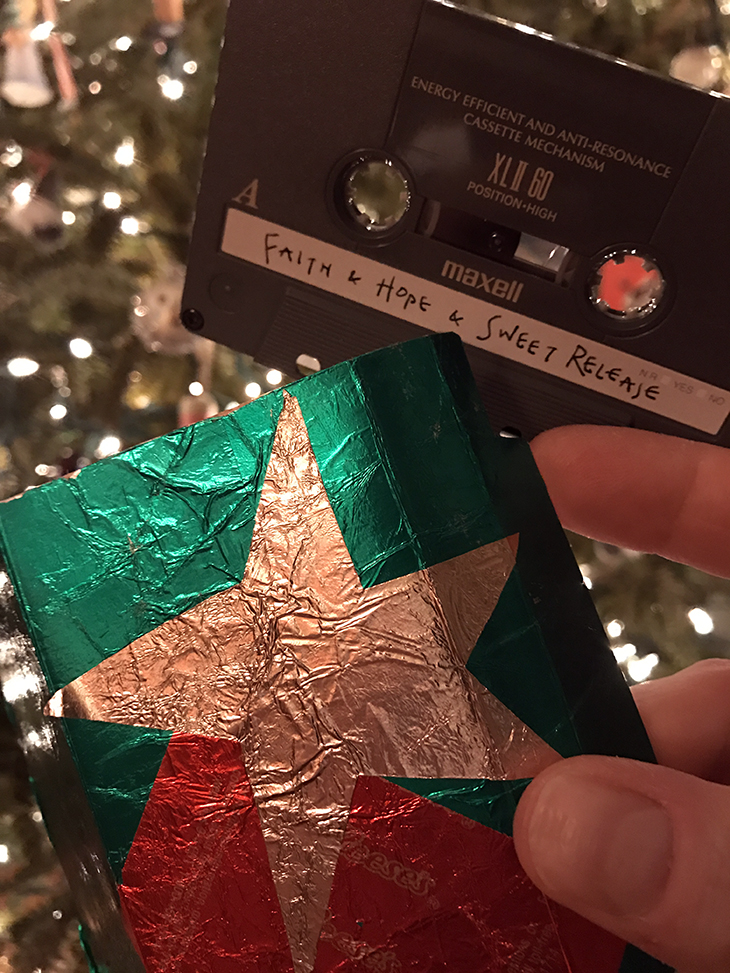
I have always, since I can remember, been fascinated with the foil that is wrapped around chocolates. The process is always the same: I unwrap the chocolate, pop it in my mouth, and while I’m eating it, I take the foil wrapping and smooth it out with my fingertips against the table or any smooth surface I happen to be near. I like watching the foil transform from crinkled to smooth. Sometimes I save the smoothed-out foils. Sometimes I use them in projects, like the cover for the Christmas mixtape I recorded for Seth after I first met him, back in December of 1995. I miss mixtapes for many reasons… not the least of which is the artwork I’d get to do on the covers. A star of foil seemed just right for this tape that went to Seth and to a few other select friends I was missing that Christmas over 20 years ago.

The star is central to Christmas and to the journey of the Magi. As such, it is central to Epiphany, the celebration of this Twelfth Day of Christmas, which is traditionally considered the day the Magi arrived at the stable in Bethlehem. And with Epiphany, our Christmas celebration comes to a close. The Magi, those three old men, have traversed the desert, following that star, and they have arrived at the stable to bring gifts to the child. La befana, the kind Italian witch, has made her rounds, too. As the story goes, at that first Christmas oh so long ago, the Magi stopped at la befana’s house and asked her to join them on their journey, but she declined the invitation. “I have so much housework to do!” she told them. And so the Magi left her home and continued on their way.

But as she swept her floors, la befana began to feel a bit remorseful, and once she finished her sweeping, she set out to find the Magi. But she never did find them, nor the child they had told her about. She searched and searched but to no avail. Still, to this day, on each Twelfth Night, la befana sets out upon her broom to seek them. As she makes her rounds, searching high and low for the child and the three kings, la befana leaves small presents for all the sleeping children. And now, on Epiphany, she resumes her sweeping, and sweeps Christmas away for another year.

Tradition would have us remove all the Christmas greenery today. But if you are not yet ready to part with your tree or other decorations, we can offer you another older tradition to follow, for some would consider Christmas to last until the First of February, which is Candlemas Eve. There is some strong basis for this in the Pagan tradition, as it is on the First of February that Yule gives way to Imbolc in the wheel of the seasonal round: it is a cross-quarter day, the midway point between the winter solstice and the spring equinox.

In our home, we close the celebration of Christmas on Epiphany night with a simple ceremony at the front door, outside on the front porch. We will gather up all who are in the home and we will each take turns writing with chalk on the lintel above the front door the numbers and letters and symbols of a traditional inscription. This year, it will read as follows: 20+C+M+B+17. These are the initials of each of the Magi (C for Caspar, M for Melchior, B for Balthasar), punctuated by crosses, blanketed on either side by the year. For me, the inscribing is always accompanied by a silent prayer that no one will be missing when we gather next to write the inscription again. All the year through, though Christmas be gone, still the inscription is there to remind us of Christmas’s presence as we pass each day through that portal. The inscription is a magic charm of sorts, protecting the house and those who pass through that doorway, harboring the goodwill and spirit of Old Father Christmas.

And so we follow that star. May it always be in our sights and in our hearts and in our dealings with our fellow companions on this old earth. And one last time this year, we say unto you: “Merry Christmas.”


I called that 1995 mixtape “Faith & Hope & Sweet Release.” There was so much new and wonderful music that year: “Now it is Christmas Eve” from Garrison Keillor, “By the Fireside” from Turtle Island String Quartet, and an original song for Christmas by Jane Siberry whose lyrics lent the mixtape its title. Our old pick up truck has a cassette player and we still listen to that mixtape each Christmas. It never grows old.


Singing Round the Star

ELEVENTH DAY of CHRISTMAS:
Twelfth Night, Epiphany Eve

We’re coming to the close of Christmastide. Epiphany, tomorrow, is a celebration even older than Christmas itself, marking the day the Magi arrived at the stable to worship the child who was born on Christmas Night, for the Church celebrated Epiphany years and years before it began celebrating the birth of Christ. But tonight brings Twelfth Night. It is the Eve of the Epiphany. It is a cause for celebration that unfortunately doesn’t gather much attention here in the States, but what a lovely custom it is. In some places, Twelfth Night and Epiphany are celebrations that rival Christmas itself. And why shouldn’t it be so? We spend so much time and energy preparing for Christmas. It is right and good to send Christmas off in a grand way. This is the value of Twelfth Night and Epiphany.

We sometimes call it Little Christmas in my family. Convivio Book of Days reader Natalie Kavanagh wrote last year to tell me that where she comes from, on the Outer Banks of North Carolina, it’s known as Old Christmas. (Thanks for sharing your story, Natalie!) This is the night that the Three Kings, los tres reyes, deliver presents to children in Latin America. There’s always a big Tres Reyes street celebration here in Miami. In Italy, this is the night la befana, the good witch, makes her rounds on her broom, bringing presents to good girls and boys. The naughty ones get sweet coal, and even that is not so bad. The Three Kings and la befana are the last of the midwinter gift bearers. When the gifts are all delivered, la befana hops off her broom and gets back to her sweeping. She sweeps and sweeps until Christmas is swept away once more.

With Epiphany, tomorrow, Christmas will come to a close. But if you are among those who dearly love the season and can’t bear to part just yet with your tree and your lights, I have good news: there is another old tradition that keeps Christmas going all the way to February 2. More on that, and the reasoning behind it (it’s very good, actually!), tomorrow, if I have it in me to write about it on Twelfth Night.

A merry Twelfth Night to you all.
John

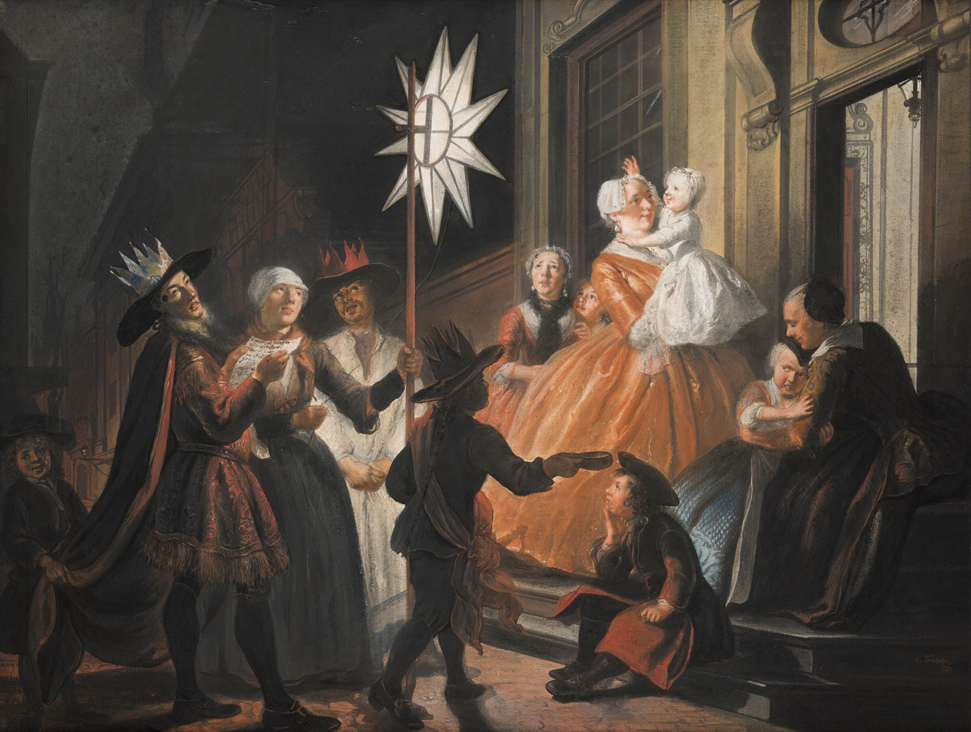
Image:  Such a fair way to send Father Christmas on his way: “Singing Round the Star on Twelfth Night” by Cornelis Troost. Pastel and brush in gouache on paper, 1740. [Public domain] via Wikimedia Commons.