Category Archives: Midwinter

Sankta Lucia

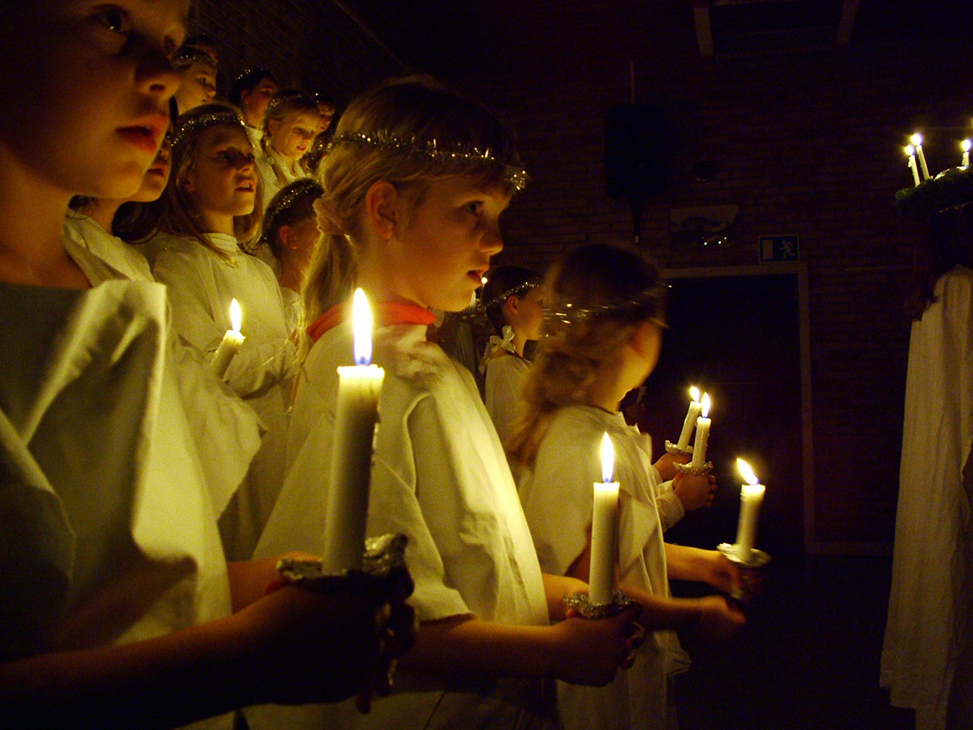
December 13, and the solstice of Midwinter is but a week away. Until then, the nights grow deeper, longer, darker. In the midst of that growing darkness, we welcome today the next of the Midwinter gift bearers: Saint Lucy, the light bearer, patron saint of those with vision problems and of the blind. She was from Sicily and so she is sacred to Italy, where she is known as Santa Lucia (pronounced loo-chee-a). But she is perhaps best known in Sweden, of all places, where she is called Sankta Lucia (pronounced with a soft C, loo-see-a). For many in Sweden, breakfast today was served in the darkness, which is long there near the Arctic Circle, by a Lucia dressed in white, walking through the house with a wreath of lit candles upon her head, delivering coffee and saffron buns, lussekatter, to the drowsy household. She is usually the oldest daughter.

Our neighbor old Mr. Solderholm, when his young granddaughter was visiting one winter, told her about the tradition of the Sankta Lucia. She was cool about it and didn’t seem too impressed by his tales of what Decembers used to be like, but she did surprise him all the same the next morning, at his bedroom door, in the still and holy darkness, bearing a flashlight, a Coca-Cola, and two Pop Tarts on a platter. Afterwards, he had a splitting headache clear through to lunchtime, but he could not stop talking about this fine thing that his granddaughter had done for him. It is a lovely thing to have this gift of light bestowed upon you.

In Sweden, where Mr. Solderholm’s family is from, there are processions throughout the country tonight celebrating Sankta Lucia, in churches, in schools, in city streets, on national television. The Lucia will be wearing a crown of lit candles on her head, just like the Lucias that delivered breakfast this morning. The processions can get quite large, with scores of attendants to the Lucia: boys and girls each bearing a candle, and then the Star Boys, each carrying stars on poles and donning huge white conical caps. Everyone is dressed in white––“White,” Jane Siberry says, “the color of truth.” The sounds of the procession are a symphony of bells and the Neapolitan melody “Santa Lucia,” but with Swedish lyrics, my favorite part being Natten går tunga fjät, which translates to “The night walks with heavy steps.” Such a beautiful image, and such a beautiful song. You can feel it warming the air, you can feel it bearing light in the darkness. That light and its spirit is what we wish you on this night of heavy steps. And––if you happen to have a Swedish bakery nearby––we wish you lussekatter, as well.


Image: “Sankta Lucia Procession in Denmark.” Photograph by Per Palmkvist Knudsen, 2006 [Creative Commons via Wikimedia Commons].
 

Almost Christmas

So much hustle and hubbub for so long––weeks, months––and then Christmas Eve comes and with it, a wash of calm. It is the calm of reality: what is not yet done is probably not going to get done, and there is a certain beauty to that. We accept our humanity and the fact that we are not perfect and we understand that all is well, no matter what is done or not done. Once again, it is Christmas.

Beyond Christmas Eve and Christmas Day are the twelve days of the year that complete Christmastide. They are days that stand traditionally outside ordinary time; six days in the old year, six days in the new. Here in this house, we know these as days filled with music and warmth, days when we can make our Christmas greetings and send them out to the world, days when we can bake once-a-year treats, days when we can read books and watch Christmas movies, days that evolve into nights when we can celebrate with mulled wine and roasted chestnuts and visit with family and friends. They are days that help me appreciate all we have, days when we count our blessings, and know that they are abundant.

The books I’ll be reading are most likely going to be old and most likely about Christmas. There is a long tradition of the Christmas ghost story––think of Charles Dickens and his Christmas Carol and all the spirits that appear in that tale. My mom and sister confided in Seth and me just tonight, in slow, hushed voices, that our great niece Joy––my sister’s little 3-year old granddaughter and my mom’s great-granddaughter––was in my old room at my family’s home with her mom just the other day and quietly announced to her mom that, “Oh, there’s Pop.” Pop, her name for my dad, her buddy. She loved him something crazy and if she can see him looking after her, well, who are we to discredit what she sees? Kids seem to be better connected to possibilities than adults. The ancient Celts thought of all these spokes in the wheel of the year––Midwinter the one we’re at now––as times when the bridge between the physical world and the spiritual world was more easily crossed.

I like to think of myself as open to these things, and so the story did not surprise me, but rather made me smile. I’ve felt Dad’s presence myself, and if he’s watching over me, certainly he’s watching over his little great-granddaughter, too. And certainly at Christmastime. It is part of the magic of this night and of this season. The nights are at their longest and darkest. The lights we illuminate, candles and electric bulbs alike, pierce the darkness, call down the light. The music and foods, carried down through the centuries, connect us to the past and the future. The stories, especially that of the child born in a barn amongst the animals on a cold winter’s night, are bridges, as well. We gather those we love and pull them close, as close as we can. We laugh, we cry, we sing, we pray. We bask in the glowing radiance of the light piercing the powerful darkness. If we allow the spirit to carry us, nothing, when we get right down to it, feels like these days feel. I’ll be with you, if I can muster the energy each day (and I think I can), through all Twelve Days of Christmas, writing about each of them. “You’ll be visited by three spirits,” Jacob Marley’s ghost tells Ebenezer Scrooge, but I guess in my version of the story, you’ll be visited by twelve. I pray you’ll make me welcome, much like Father Christmas himself, who comes each year, welcome or welcome not. But for now, to all of you: A very merry Christmas.

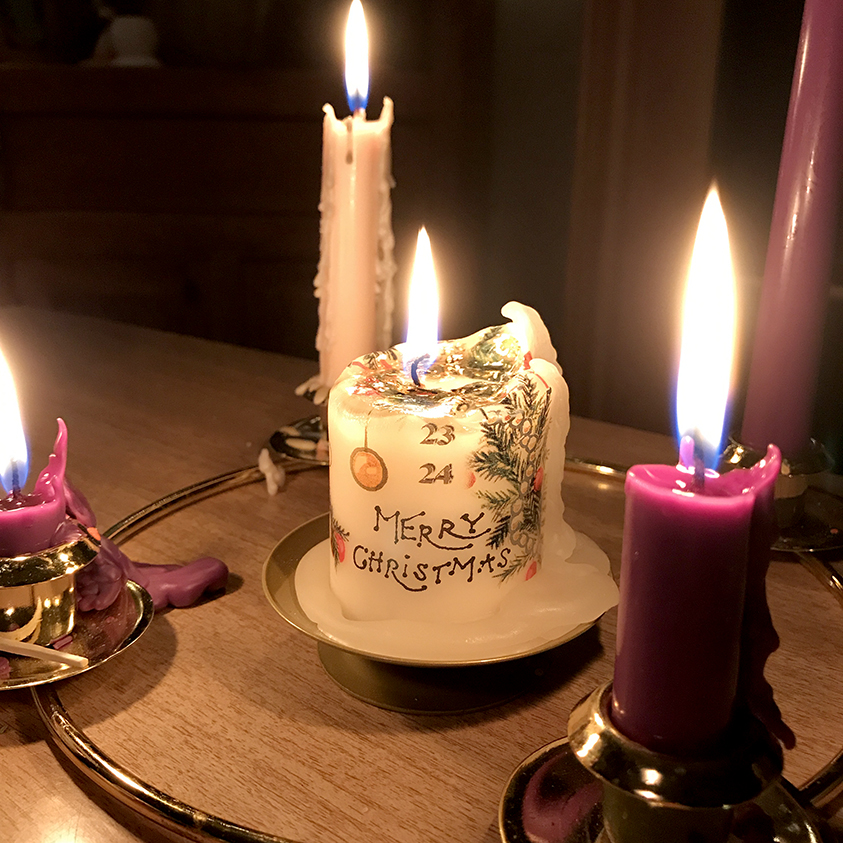
The advent candles are almost burnt down. On Sunday morning, we light three purple candles and one rose. By evening, though, it will already be Christmas Eve. And our daily advent candle, burning for a few hours each night, is ready soon to announce Christmas’ arrival.


Darkest Night, Deepest Joy

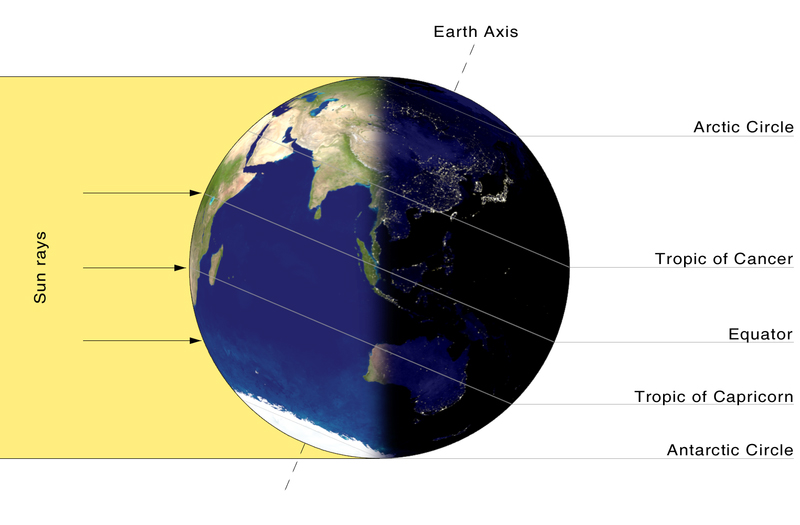
Ask a child to draw our spherical planet on a piece of paper or on a chalkboard and most likely what they’ll draw is a circle. How perfect is the circle? No beginning, no end. The shape that best describes our seasonal round. The seasons, a result of our planet’s tilt on its axis. Scientific evidence suggests that some four and a half billion years ago an object the size of Mars collided with our planet. This incredible, explosive impact resulted in a huge chunk of the Earth spinning off into space, becoming the satellite we call the Moon. The collision also knocked our planet dramatically off kilter, causing the Earth to orbit the sun on a slant. It is that slant––about 23.5 degrees––that creates our seasons.

And at this particular juncture tomorrow on the 21st of December––the Midwinter Solstice in the Northern Hemisphere––the North Pole is tilted the farthest from the sun as it will get. It is our hemisphere’s longest night. The South Pole is tilted the closest to the sun as it will get, creating for the Southern Hemisphere the longest day. There, it is the Midsummer Solstice.

The precise moment of this event this year is at 11:28 AM Eastern Standard Time on December 21. If you are one who watches the travels of the sun in the sky, it will appear for a few days like the sun is standing still, getting no lower or higher, and this is the source of the word solstice, from the Latin sol stetit, “sun stands still.” In reality, things are slowly shifting. Already tomorrow the days in our Northern Hemisphere will begin to increase in length proportionately with their decrease in the Southern Hemisphere. It is the constant sway back and forth, the constant exchange between hemispheres… the explanation behind our seasonal round that helps us count our days and years and gives us grounding as humans on Planet Earth.

The changing seasons, subtle as the change is here in Lake Worth, have fascinated me since I can remember. This great mechanical clockwork fascinates me, too. And so on the 21st in our particular spot on this amazing spinning planet––26.6168º North, 80.0684º West––Seth and I will light a fire to mark the solstice night. Seth will build the fire in the copper fire bowl in the back yard, fueled by the remnants of our Christmas tree from last year, which we brought out to a corner of the yard some time after Twelfth Night last January. It’s sat there all these months, shedding needles, drying, and still for all the world smelling like Christmas, even through spring and summer and fall, and it is good, it is right to have this reminder of Old Father Christmas in our lives all the year long. We will sit at the fire that he provides under the starry night sky and toast him with mulled wine and roasted chestnuts. In this small way we pull down the celestial mechanics of our planet and bring it directly to our tiny dot in this universe, and into our hearts, too: the old Yuletide illuminating and welcoming the new, connecting us with the past as we continue to forge that circle, no beginning, no end. With it, we know that Christmas is surely almost here. And so we welcome Yule.

Image: The particular beauty of the science of the Winter Solstice, depicted in a chart created by Przemyslaw “Blueshade” Idzkiewicz. It is the Illumination of Earth by Sun on the Day of Winter Solstice on Northern Hemisphere [CC 2005 via Wikimedia Commons]. By the time the Earth progresses another six months on its annual journey around the sun, the sun will be illuminating the North Pole and the South will be experiencing darkness; that will be Midsummer Solstice in the North. Back and forth again and again… the subtle daily shift, the constant rearrange.