Category Archives: The Gift Bearers

Like Comets Through the Sky

Creche

In Italy, there is a common saying, a bit of yuletide advice: Natale con i tuoi; Pasqua con chi vuoi: “Christmas with your family; Easter with whomever you like.” This saying sailed across the Atlantic with my grandparents and is even heard amongst my English-speaking family. It’s spoken in Italian, perhaps to stress its importance and wisdom.

I understood its wisdom only by disregarding it. One Christmas, influenced by the romance of Washington Irving’s writings about Old Christmas, I decided to spend Christmas away from family… and while I did forge some cherished memories and friendships that snowy Christmas night at an inn in North Carolina, it was, overall, a pretty miserable Christmas for me. Natale con i tuoi; Pasqua con chi vuoi resonates with me now, and rings true.

Decorations in Italy center on the creche, and this year, I made a point of venturing deep into the attic of my family home and finding the box labeled “Old Nativity.” It’s from Italy, from the 1950s, probably. My mom made a special trip by train into New York City to purchase it, but it hasn’t been out of that box in the attic in many decades. The stable is wooden and the pieces are plaster, painted by hand. Many of them are broken after all these years (we’re down to one magi). One of the pieces is a shepherd playing pipes, and looking at it, I think of my grandmother, who used to tell me about the zampognari, the bagpipers, who would come down from the mountains on Christmas Eve to play their ancient, almost mournful tunes in the villages, traditional Italian Christmas carols like Tu Scende Dalle Stelle, “You Come Down from the Stars.”

Tonight, we will be celebrating here, with family, as the wisdom of that saying suggests. The mad rush will be over; we’ll settle in for a dinner of seven fishes (another Italian custom), and then go to midnight mass to be with everyone else who has eaten too much and stayed up too late but still has come to hear the old, old story again. In the morning, we will open presents, and here is my present to you: It’s one of my favorite Convivio Dispatches from Lake Worth. It was originally sent out on Christmas Eve, 2011. It’s titled “Like Comets Through the Skies.” Merry Christmas. ––jlc

*

CONVIVIO DISPATCH: LIKE COMETS THROUGH THE SKY

And so again we enter into Christmas, again the old year passes. Here in Lake Worth we are having one of our warm and summery Christmases. But this is okay. Always here at Christmastime there are folks who begin to feel a bit wistful for cold. A white Christmas is all they want. “It’s just not Christmas without snow,” they say, or, “It doesn’t feel much like Christmas when it’s 80 degrees outside.”

Our neighbor Margaret likes to wave her hand at these people and remind them that the first Christmas tree was a palm. This is a saying that was popular on Christmas cards here when I was a boy. A barefoot Santa might be in shorts and an open shirt, relaxing on a hammock strung between two cocoanut palms with a simple “Merry Christmas from Florida!” greeting, but if it was a manger scene, Jesus, Mary and Joseph and the wise men and the shepherds would be surrounded by cocoanut palms––not that there are a lot of cocoanuts to be had in Bethlehem––and inside, the greeting always was the same: “The first Christmas tree was a palm,” which seemed to suggest that we, somehow, were doing things right… and this, admittedly, is not what typically comes to mind when folks think of Florida.

Still, it’s not easy to get past this idea of Christmas being a celebration in cold weather. Pirko Suoma sings “White Christmas” each year at the annual Christmas concert at the Finnish Lutheran Church on the south side of town, and this year was no different. She sings it in Finnish, so for those of us who do not speak Finnish, we listen to her and we follow along in English, in our heads, the words chiseled into our memory. Her solo usually comes about midway through the concert, and she stands up there in front of the rest of the choir and she sings in Finnish and tears begin to well in the eyes of some of the choir members, they miss Finland and snow and a cold Christmas so much. What brought them to Lake Worth? They’ve come to live in a virtual sauna.

Christmas in Finland will most likely be white, and perhaps it will be for you, as well. But for us this time around, it will be beach weather. There is at least one Father Christmas who seems to like it this way: We’ve had numerous Santa Claus sightings in Lake Worth over the course of the past month. I saw him first riding a bicycle past the house, donning the traditional red fur-lined hat and shorts and a t-shirt, which is not unusual around here at Christmastime, except this guy looked like the real thing, with a big white beard. I saw him again driving an old Volkswagen convertible down Federal Highway, this time in full Santa regalia, with presents piled in the back of the car, and when I mentioned this to Seth, he said he had seen Santa driving through town another day earlier in the week. I have news for you: Santa’s a bit of a speed demon.

Over at St. Bernard’s, Father Seamus has put in a special request for midnight mass with Sister Kathleen, the reluctant organist. It’s a traditional American folk hymn that he found in The Sacred Harp, and he’s asked Sister Kathleen to work it into the service. Seamus knew the words, because he is a man who memorizes and recites poetry, though he couldn’t have told you why he knows them, and yet here they were in this old American hymnal. He was overjoyed at his discovery, and the next day, he passed the book along to Sister Kathleen with the suggestion that the song be sung a cappella, no organ. “To preserve the spirit of the hymn,” he said. He wants it pure, simple, and with none of the extra notes that Sister Kathleen is apt to add through no fault of her own. The song is “Wondrous Love.” Do you know it?

What wondrous love is this, oh my soul!
What wondrous love is this that caused the Lord of bliss
To send this perfect peace to my soul, to my soul,
To send this perfect peace to my soul.

Two additional verses follow, with winged seraphs and millions joining the theme. And it is this simple song that Seamus is looking forward to more than anything this Christmas, his gift to himself. He’s not a White Christmas kind of guy, Father Seamus. He didn’t have many white Christmases in Ireland, and he’s not so fond of Bing Crosby’s vocal stylings. Pirko Suoma’s solo at last week’s concert at the Finnish Lutheran Church may have inspired a few tears, and Wondrous Love will certainly do the same, at least for Seamus. But he won’t be alone. He never is. Something about the right combination of incense and old hymns manages to squeeze a tear or two out of people, even the ones you’d think have not a drop of water to spare. We sit there in that dark church and reflect and think on all the wrongs we’ve done and we resolve that next Christmas, things will be different. And so Christmases come and go, and the years go by, and always we do the best we can, and that’s not so bad, is it?

And whether in a sleigh or in a Volkswagen Cabriolet, in comes Father Christmas. “In comes I, old Father Christmas, welcome or welcome not. I hope old Father Christmas will never be forgot. Christmas comes but once a year, And when it comes it brings good cheer. Roast beef, plum pudding, strong ale, mince pie: And who likes that better than I?”

Merry Christmas. May Christmas Eve and Christmas Day and the Twelve Days of Christmas that follow all be filled with good cheer and happiness for you and for those you love.
John

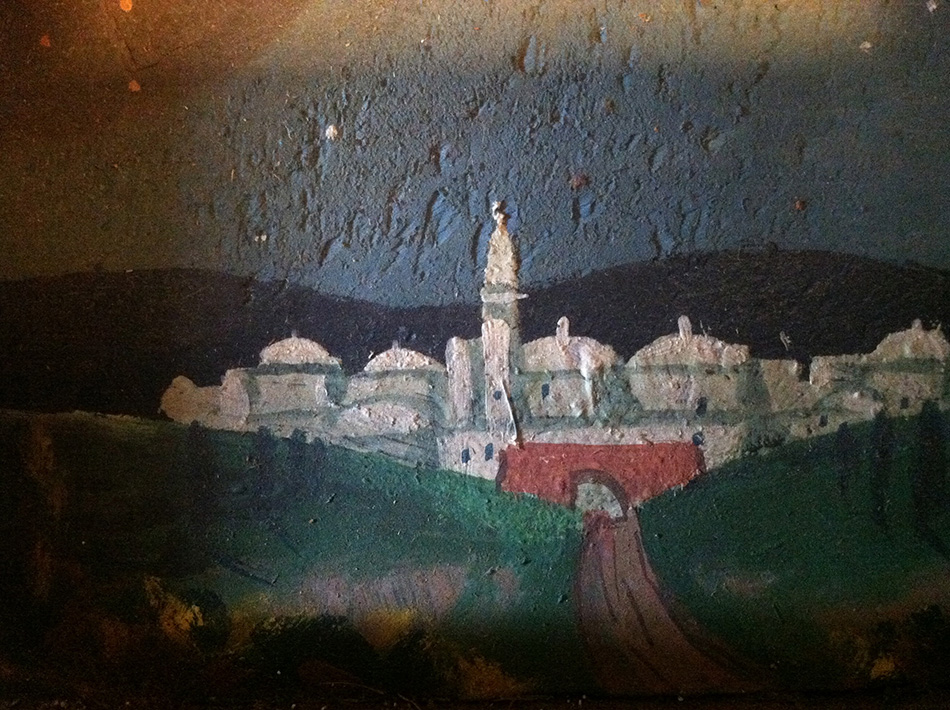
Image: The painted background of the stable of that 1950s creche from Italy.
Saffron & Light: Santa Lucia

Lucia

By now, the 13th of December, the Northern Hemisphere is well cloaked in the darkness of winter. The solstice, that turning point when the sun shifts from waning to strengthening, is, this year, still eight days away. And so enters St. Lucy, Santa Lucia, whose name comes from light: lux and lucis, the Latin words for light. Her feast day is today, the 13th of December. Centuries ago, before the Gregorian reform of the calendar, her day used to coincide with the Winter Solstice, so the connections between Santa Lucia and light overcoming dark are profound and powerful indeed.

Lucia was a fourth century Sicilian woman who worked ardently to protect her Christian virtue. She rejected numerous marriage offers and suitors. The story best known about the woman herself involves an admirer who was captivated by her eyes. Lucia, mortified, gouged her eyeballs from their sockets and had them delivered to her suitor on a platter. Did Lucia have a flare for the dramatic? Perhaps. Lucia was martyred for her Christian beliefs and steadfastness, and she is invoked today as a patron saint to help those afflicted with poor eyesight and diseases of the eye.

Lucia is sacred to Italy and to Sweden. The Italian connection is plain: aside from the fact that she was Sicilian, she is also known to have intervened in a terrible famine in 1582, when a flotilla of grain appeared mysteriously in a Sicilian harbor on her feast day. Palermo and Syracuse both lay claim to the arrival of the flotilla, and who knows, perhaps Santa Lucia sent a flotilla to both harbors. Be that as it may, that day in 1582, the people were so hungry, they didn’t even bother to mill the wheat from the ships into flour, but rather boiled the grains whole and ate them that way. Still, to this day, every 13th of December, the diet of the entire island of Sicily changes and people eat traditional dishes made of cooked whole grain wheat, rather than pasta. The traditions made their way to the Italian mainland from Sicily and Santa Lucia became one of Italy’s most venerated saints. Her day is celebrated with great festivity throughout Italy, and in some parts of the country, Santa Lucia is another of the winter gift bearers, and children may awake on Santa Lucia’s Day to find tiny sweets tied to the laces of their shoes if they leave their shoes the night before on the kitchen windowsill along with a bit of hay for Lucia’s donkey.

In Italy, Lucia is pronounced “loo-chee-a,” while in Sweden the C is soft: “loo-see-a.” Lucia apparently intervened in the midst of a famine in Sweden at some point, as well. Whether this is true or not, the fact is you’d also be hard pressed to find a darker place than Sweden this time of year, so a celebration of light seems quite natural there, too. Other Scandinavian countries celebrate Santa Lucia, as well, but it is Sweden where the celebrations are heartiest. Traditionally it is the eldest daughter of the household who rises early in the morning, fixes a breakfast of coffee and pepparkakor (traditional ginger biscuits) and saffron buns called lussekatter. Saffron, for the golden color of sunlight. She delivers them throughout the house while donning a wreath of candles on her head, a beacon of light in the early morning darkness. Electric candles nowadays help avoid hot melted wax from dripping on the head of these modern day Lucias, though strong traditionalists still wear real candles. It is, for sure, a beautiful sight, this illuminated angelic vision, dressed in white with a red sash, bringing you coffee and saffron buns on a cold winter’s morning.

In our house, if there is time (and there is almost always time to be found, even under protest), my family eats a wonderful concoction for Santa Lucia’s Day, which, of course, is made from whole grains of boiled wheat. Added to the wheat are pomegranate seeds, chopped almonds, and chocolate (also chopped), swimming in a pool of a special syrup we brew each year from the juice of grapes. The syrup, in my family’s Lucera dialect, is called cutto, something that Italian housewives have made since time immemorial from the must leftover from autumnal winemaking. The juice is cooked down to a thick spicy brew, and, for this Santa Lucia dessert, is made even headier with the addition of cinnamon, cloves, and nutmeg. We call the dish chicci cutto, and although we sometimes eat it at Halloween and I Morti, it really is a tradition that comes out of Santa Lucia Day celebrations, as is confirmed by the prominence of the chicci––the whole grains of wheat––boiled, just as it was on that astounding Santa Lucia Day in Sicily in 1582.

Santa Lucia reminds us that although things may be dark, it takes but a little light to begin to overcome it.


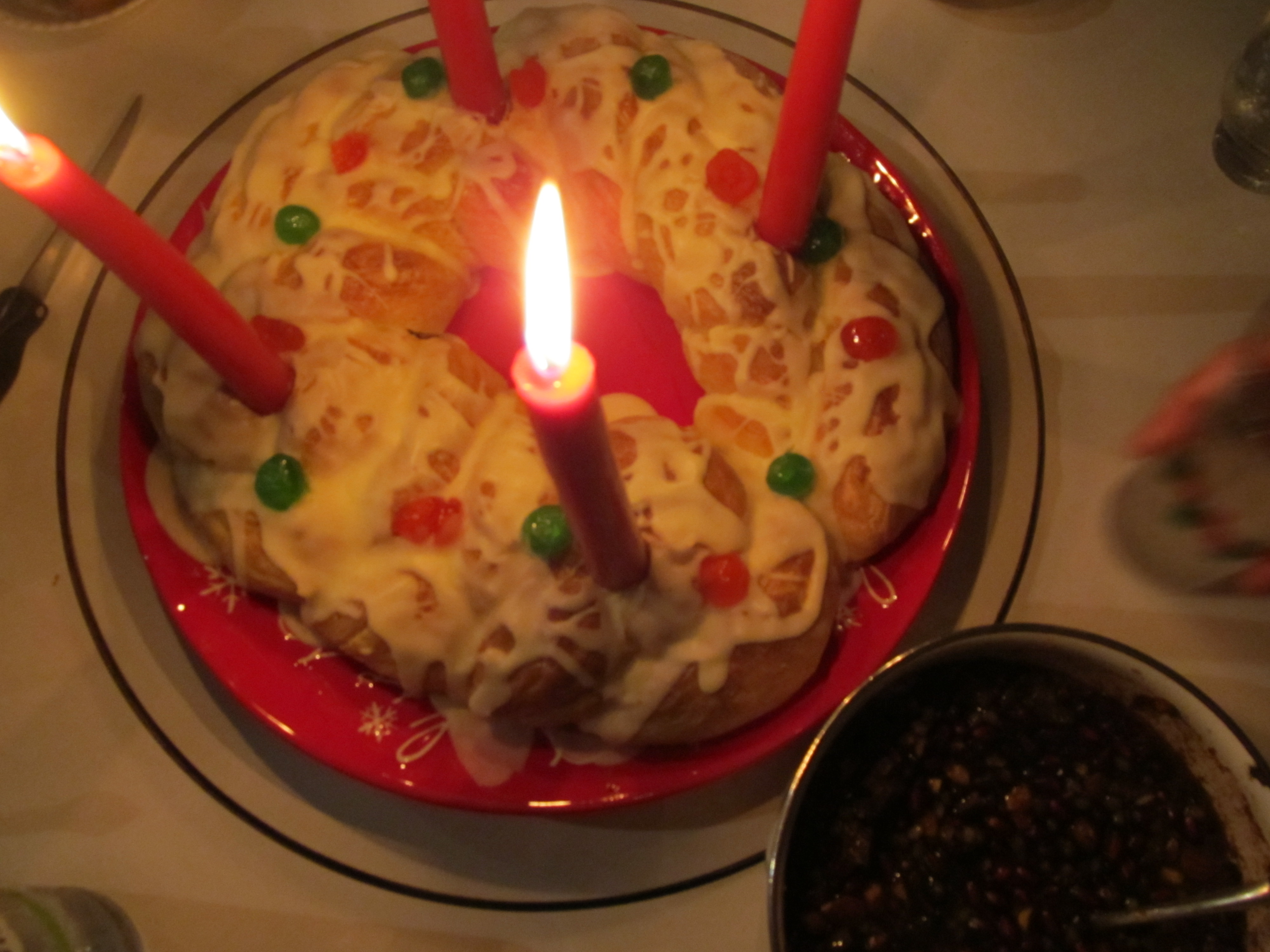
Chicci cutto rarely photographs well, but what it lacks in good looks it certainly makes up for in taste: it is bizarre and delicious. Last year, for Santa Lucia’s Day, my mom and my sister made this very beautiful sweet yeast bread, too, and naturally they stuck four candles in it to symbolize the light of Lucia. The chicci cutto is there to the right, looking homely yet delicious. We oohed and aahed over both.

Enter the Gift Bearers

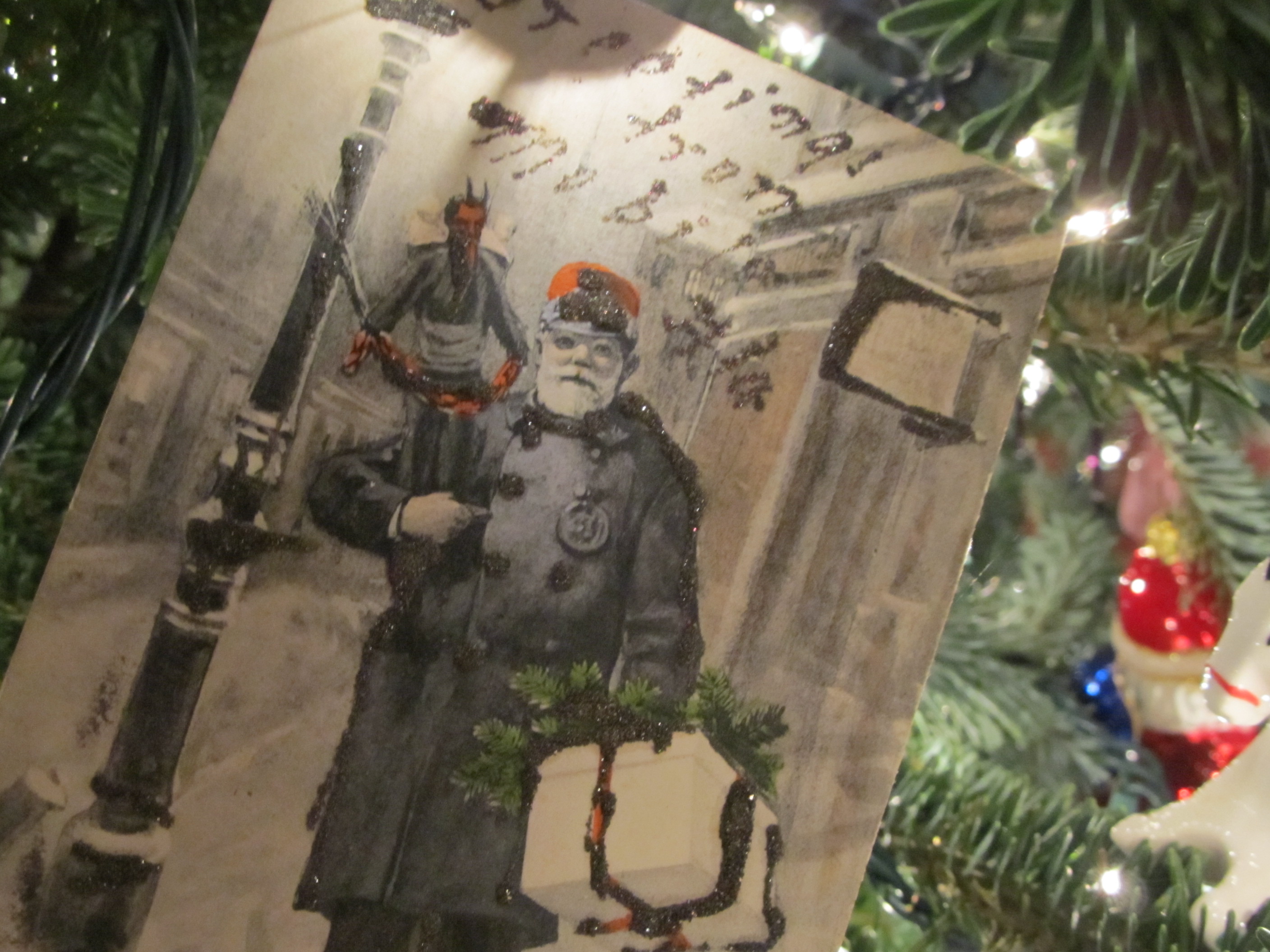
Postcard St Nick

The first of the winter Gift Bearers arrives on the 5th of December: St. Nicholas. He is a much older cousin of the American Santa Claus, but there are striking similarities. On the Eve of St. Nicholas, which is tonight, children throughout Europe would traditionally place their shoes by the chimney before going to bed for St. Nicholas to fill with gifts, as well as set out carrots and hay for his donkey. Good children might wake up the next morning to find their shoes filled with fruits and nuts and sweets.

St. Nicholas’s feast day is celebrated on the 6th of December. He is sacred to countries throughout Europe, but especially to Russia, Greece, the Netherlands, Germany, and Italy. Nicholas was a bishop of Myra, in southern Turkey, in the fourth century. He is most famous for his generosity, and this, perhaps, is the reason he is connected with the bestowing of presents. One story that has come down through the ages tells of three sisters who were without dowries, for their father was very poor. The situation became so desperate that the father decided his only option was to sell his daughters into prostitution. Nicholas heard of the problem and took action: one night as the household lay sleeping, he tossed a bag of gold through the open window, and suddenly the eldest daughter had a dowry. In time, he did the same for each of her sisters, too. He bestowed these gifts in secret, until the third time, when the father of the girls caught him in the act. He was forever grateful to the good bishop, and thus the legend of St. Nicholas as a gift bearer began.

The Eve of St. Nicholas and its related traditions are, in some places, of greater importance than the arrival of Santa Claus on Christmas Eve. Santa is a relative newcomer compared to St. Nicholas. And one thing St. Nicholas has that Santa doesn’t is a dark companion. He goes by many names throughout Europe: Knecht Ruprecht, Black Peter, Pelznickel… but this dark companion is best known as Krampus. In fact, the 5th of December is known in some parts as Krampusnacht. Krampus is most often depicted with horns on his head, a very long tongue, and cloven hooves or sometimes one human foot and one goat foot. The punishment by Krampus is pretty harsh: he carries switches and rusty chains for the express purpose of swatting naughty children, and then he’ll stuff them in a sack or a basket and carry them off to hell. Serious stuff. And while the American Santa Claus has to do it all––reward good children with gifts and punish naughty ones with coal––you might think of St. Nicholas as a wiser man, a delegator: he gets to take care of the good kids, but he gives the task of punishing the bad ones to Krampus.

So do be good. St. Nicholas would love to fill your shoes with fruits and nuts and sweets tonight. And if you’ve been bad…. Beware the Krampus!

Our image is from an old penny postcard sent to us by our good friend Linda Dailey in Maine. Is it St. Nicholas garbed in modern day clothing rather than his traditional bishop’s robes? Perhaps. And that, for sure, is a Krampus doll in his hands, just to remind us all to be as good as we can. Sweet dreams.