Category Archives: Transitions

Round the Star

ELEVENTH DAY of CHRISTMAS:
Twelfth Night, Eve of the Epiphany

Twelfth Night used to be a really big deal, a celebration rivaling that of Christmas Day. Ever the champion of the underdog, I am here today to champion Twelfth Night, too. If you are inclined to feelings of melancholy or disappointment after Christmas Day has passed, these Twelve Days––and especially Twelfth Night and Epiphany, which provide a proper send-off to the season––are just what’s needed to help get you through that. For all we talk about maintaining links to the past, perhaps it is this, more than anything, that offers the best reason behind keeping an obscure old holiday like Twelfth Night in our contemporary world. Twelfth Night helps us feel more rounded, more complete. This is the value of Twelfth Night.

My family never did celebrate Twelfth Night when I was younger, but we did mark Epiphany. My mom calls it “Little Christmas.” I do remember one year feeling kind of down after Christmas Day had passed, and she told me, “It’s ok, we still have Little Christmas ahead.” Our little tabletop tinsel Christmas tree, the one she bought decades ago at Lord & Taylor and which we set up at our house now each year, meant a lot more to me after that. Maybe because the tree is little, just like Mom’s “Little Christmas.”

Years later, after my first internship at the Shaker Press, Brother Arnold Hadd and I exchanged so many letters. In one of those letters, that winter that followed my internship, he wrote about the Shakers’ Christmas celebration. It included things like “shaking the tree” (for presents, I think) and their tradition of a Swedish smörgåsbord (this, a tradition handed them by Brother Ted, who I never did meet), and yes, Twelfth Night. There is some confusion about when Twelfth Night actually falls, but I trust the Shakers on this. They celebrate on the evening of the this day, the Eleventh Day of Christmas. I think the confusion comes out of the way we reckon our days now as opposed to the way our ancestors reckoned theirs. Traditionally, the start of a new day begins at sundown. This is why so many evenings before holidays are so important. Think of Halloween (the Eve of All Hallows) or Christmas Eve. There is a scene in The Bishop’s Wife where Cary Grant’s character convinces Mildred, the bishop’s secretary, to leave work and let him take care of typing the bishop’s sermon. “It’s almost Christmas Eve,” he tells Mildred. “You must have shopping to do.” It’s the afternoon of the 24th when he tells her this. Even then, just 70 years ago when this film was made, there was a general understanding that Christmas Eve began once the sun went down and that was the ushering in of Christmas. As for Twelfth Night, the Shakers believe (as do I) that Twelfth Night ushers in the Twelfth Day of Christmas. As such, it begins with the setting sun on the 5th of January. Twelfth Night has, as well, another name: Eve of the Epiphany.

So the traditional English Twelfth Night was a fun filled party with, no doubt, lots of ale and cider and punch, lots of food, and music, dancing, and games. When I picture a Twelfth Night party in my head, it looks a lot like the party that Old Fezziwig throws for his employees in Charles Dickens’ A Christmas Carol. It is, alas, not much celebrated here in the States. Inspired by our Shaker friends, though, we’ve hosted a few Twelfth Night dinners in the past. That, I think, is a good start.

In Italy, la Befana will make her rounds tonight, and in Latin America, los Tres Reyes, the Three Kings, will be doing the same. All of them will be delivering gifts; they are the last of the Midwinter gift bearers. Their stories are intertwined. Epiphany––a celebration older even than Christmas itself––marks the day the Magi arrived after their long journey, following that star, to see the child born in a barn. They arrived with gifts for the child, and so it is no surprise that they are amongst our Midwinter gift bearers. In Italy, though, the legends get a little more interesting, wrapped up as they are with a kindly old witch. There, it is said that the Magi stopped at la Befana’s and asked her to join them on their journey. They found her sweeping her floor. “No, no,” she told them, “I’m too busy with my housework!” And so the Magi went on their way. But as she swept, la Befana grew remorseful that she had not gone with them, and so she stopped her sweeping, hopped on her broom, and left her home in search of the Magi and the child. But she never found them. Each year on the Eve of the Epiphany, she sets out on her journey again, in search of the child, delivering small presents to good boys and girls, and coal for the not so good ones.

I have known lots of Befanas in my day. It comes with the territory when you are of Italian descent. Women and men who clean and clean and clean, and who take great pride in their clean homes. Which is a wonderful thing, of course, but you know that they would’ve said no to the Magi, too, just like la Befana herself did at that first Christmas. Where does she even come from, la Befana? Well, she is an old hag… and so is the earthly goddess at Midwinter in the circular nature of the year: Born in springtime, fair maiden in summer, mother in autumn, old woman in winter. A cycle repeating with each orbit around the sun, the story told again and again.

Closer to home, it’s not been the happiest Christmas for us, after losing my dad in February. I’d say all of us in my family are all doing well, but we are all aware, too, that Dad is missing and there have been a few days this season where I’ve been plain sad and melancholy. There is another tradition for Twelfth Night, in which the Yuletide decorations are taken down. This, too, makes me a little melancholy. In case you haven’t noticed, I am a bit in love with Christmas. There is much about our celebration these days that is grating and irksome, but Seth and I, we do a very good job of keeping these things at bay, leaving to the best of our abilities only what is pure and essential. And so Christmas is in this little home a truly extraordinary time––a time outside ordinary time––and it does make us sad to see it go. Many years, and this may very well be one of them, we follow another, even older tradition: the idea that Christmas and Yuletide run all the way to Candlemas Eve, the First of February. This is an idea that is more aligned with the planet’s natural rhythm, for with Candlemas we reach the next cross-quarter day after the Midwinter Solstice. With it, the earth shifts toward spring, for winter is then beginning to wane: astronomically, we’ll be, at that point, halfway between the solstice and the spring equinox. Our ancestors enjoyed their Yuletide greenery all the way to Candlemas but not beyond… keeping it in the house any later than the First of February was an invitation for bad luck.

If you are celebrating Twelfth Night, or if you have memories of celebrating in days past, please tell us about it by leaving a comment below. I hope you are. It is our chance to send Old Father Christmas on his way in style. He deserves as much as that, no?


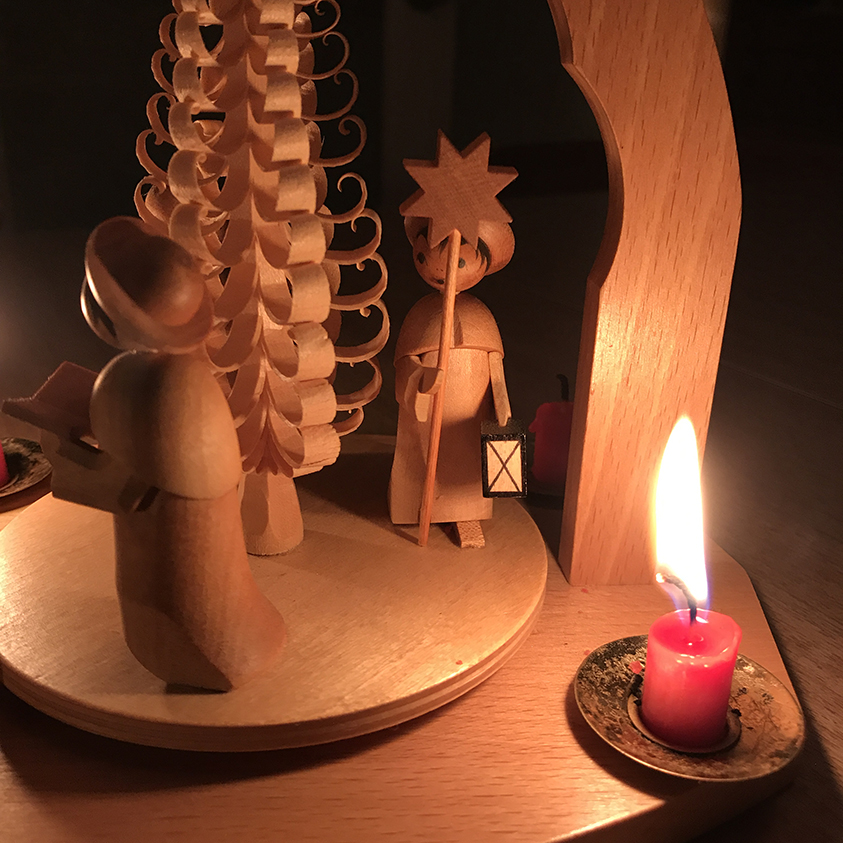
Image: Christmas pyramids from Germany’s Erzgebirge region can be quite elaborate, but ours is a simple one, featuring three carolers, one of them holding a traditional caroling star. Singing round the star was a common Twelfth Night practice though Northern Europe centuries ago. I hope it still is.
 

Almost Christmas

So much hustle and hubbub for so long––weeks, months––and then Christmas Eve comes and with it, a wash of calm. It is the calm of reality: what is not yet done is probably not going to get done, and there is a certain beauty to that. We accept our humanity and the fact that we are not perfect and we understand that all is well, no matter what is done or not done. Once again, it is Christmas.

Beyond Christmas Eve and Christmas Day are the twelve days of the year that complete Christmastide. They are days that stand traditionally outside ordinary time; six days in the old year, six days in the new. Here in this house, we know these as days filled with music and warmth, days when we can make our Christmas greetings and send them out to the world, days when we can bake once-a-year treats, days when we can read books and watch Christmas movies, days that evolve into nights when we can celebrate with mulled wine and roasted chestnuts and visit with family and friends. They are days that help me appreciate all we have, days when we count our blessings, and know that they are abundant.

The books I’ll be reading are most likely going to be old and most likely about Christmas. There is a long tradition of the Christmas ghost story––think of Charles Dickens and his Christmas Carol and all the spirits that appear in that tale. My mom and sister confided in Seth and me just tonight, in slow, hushed voices, that our great niece Joy––my sister’s little 3-year old granddaughter and my mom’s great-granddaughter––was in my old room at my family’s home with her mom just the other day and quietly announced to her mom that, “Oh, there’s Pop.” Pop, her name for my dad, her buddy. She loved him something crazy and if she can see him looking after her, well, who are we to discredit what she sees? Kids seem to be better connected to possibilities than adults. The ancient Celts thought of all these spokes in the wheel of the year––Midwinter the one we’re at now––as times when the bridge between the physical world and the spiritual world was more easily crossed.

I like to think of myself as open to these things, and so the story did not surprise me, but rather made me smile. I’ve felt Dad’s presence myself, and if he’s watching over me, certainly he’s watching over his little great-granddaughter, too. And certainly at Christmastime. It is part of the magic of this night and of this season. The nights are at their longest and darkest. The lights we illuminate, candles and electric bulbs alike, pierce the darkness, call down the light. The music and foods, carried down through the centuries, connect us to the past and the future. The stories, especially that of the child born in a barn amongst the animals on a cold winter’s night, are bridges, as well. We gather those we love and pull them close, as close as we can. We laugh, we cry, we sing, we pray. We bask in the glowing radiance of the light piercing the powerful darkness. If we allow the spirit to carry us, nothing, when we get right down to it, feels like these days feel. I’ll be with you, if I can muster the energy each day (and I think I can), through all Twelve Days of Christmas, writing about each of them. “You’ll be visited by three spirits,” Jacob Marley’s ghost tells Ebenezer Scrooge, but I guess in my version of the story, you’ll be visited by twelve. I pray you’ll make me welcome, much like Father Christmas himself, who comes each year, welcome or welcome not. But for now, to all of you: A very merry Christmas.

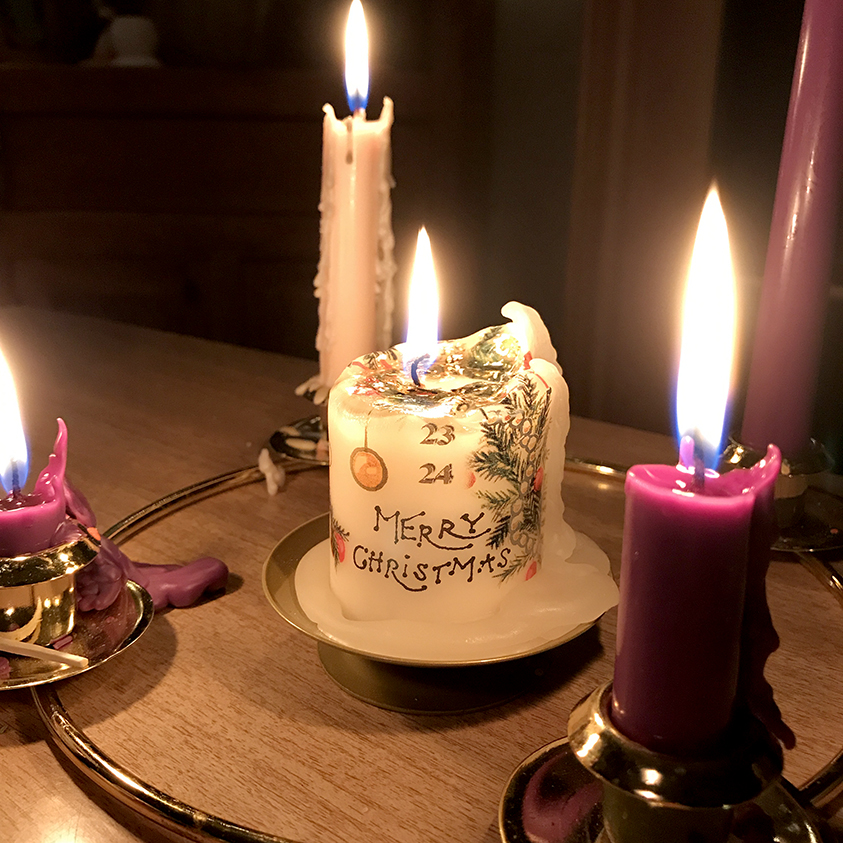
The advent candles are almost burnt down. On Sunday morning, we light three purple candles and one rose. By evening, though, it will already be Christmas Eve. And our daily advent candle, burning for a few hours each night, is ready soon to announce Christmas’ arrival.


Finding Our Way

This is for everyone who has experienced loss this past year, or ever, for that matter. I’m right there with you. I lost my dad in February. Nothing is ever the same once someone we love is gone. Things do get better eventually, but they are forever different. And this is just part of living, we know this. Knowing it, however, makes it no easier. Especially now, when we come to a juncture of the year that can be very difficult for anyone who is missing someone. And so this chapter of the Convivio Book of Days is for you, and for me, and for everyone who has felt this particular loss.

My dad is wrapped inextricably through my Christmas memories. He is part of the memories of Christmases I have from even before I was on this earth, for the stories come down through the ages. Dad was the one who, in recent years, spent hours trying to get light sets to work again once half the set had gone out, and he would re-wire some so that they had odd plugs spliced to them with electrical tape: green wires, brown plugs, black electrical tape… an “Angelo Cutrone Special.” They worked, but I’d cringe sometimes as I plugged them in, half expecting to get a shock or to have the plug explode once it made contact with the outlet. They never did. He usually knew what he was doing.

When I was little, it was Dad who decorated the house and front yard for Christmas. In the late 1960s, this involved a large electric candle, which, to the me that was 4-years old, seemed to tower twice my size, and it may very well have. It illuminated through and through and at the metal base, in script, it said Seasons Greetings and Dad would set it in place near where the driveway met the slate-covered walkway to the front door. There were illuminated choir boys, too, and multicolor lights––the kind with the big screw in ceramic bulbs, strung along the roofline attached to the stainless steel gutters that Dad would occasionally buff and polish. By 1970 or so, Dad quit the illuminated figures and the ceramic lights and from that point on it was a fresh balsam wreath wrapped in multicolor Italian fairy lights on the front door, another wrapped in red lights on the big front window of my sister’s room, and a strand or two of white lights thrown into the canopy of the crab apple tree. He’d just toss them up there. Where they landed, they landed.

Before I was born, though, there was a record player connected to outdoor speakers and Dad would play Christmas music for the neighbors, whether they wanted to hear it or not. He rotated through four or five records that we still have and still play each Christmas: Johnny Mathis’ Christmas album, an album featuring a child’s choir from England backed up by a Big Band era sounding orchestra, Christmas carols on piano by Roger Williams, and an album of all your Christmas favorites played entirely by an orchestra of bells. The Hartmans, an older couple up the road, did not care for the music, but they were friendly about it all the same. Dad would always complain that he should’ve put the lights up the week before it had gotten so cold. But he never did; he’d always be out there on the coldest day of December. Christmas was not to be rushed, after all. Sometimes there was snow. Once he pulled me up the sidewalk while I sat on my sled. I think it’s the only time I used it. For the rest of my childhood, the sled hung on the wall in the garage. We were not an outdoor people, my family.

I think of all these things––even of the Hartmans, who had moved to Vero Beach before I was born––and I think of my dad as I do my own decorating outside in the balmy Lake Worth night, just as I think of Dad every single time I go to my family’s home to mow the lawn since his passing. I sit on the rider mower as he used to and I think of Dad, as I mow with care, trying to keep straight lines like he would, and I think of him as I sweep the sidewalk, sweeping up the grass clippings just as he taught me: Corn broom along the edge, push broom down the middle.

This simple task of mowing the lawn can make me a bit emotional sometimes, and Christmas just heightens this. Earlier this month Seth and I received the new Christmas Revels recording for 2017, Tutta Bella: A Venetian Christmas Revels. For years I’ve watched the Revels create Christmas programs set in England, Ireland, Scotland, Wales, France, and Spain, and wished that someday there would be a Revels set in Italy. This year I got my wish. But when the CD arrived, I read the list of songs and was disappointed to find my favorite Italian Christmas carol, “Tu Scende Dalle Stelle,” was not part of the program. The disc arrived in early December, too soon in our book to listen to Christmas music (we’re just beginning to listen to Advent music at that point). But on Sunday morning, just yesterday, I finally added the new CD to the player. The first couple of songs played and they were good, a bit of horn fanfare… and then the third song began with a familiar haunting melody. It was my song, given a different name, “Quanno Nascette Ninno.” My heart leapt and then tears welled up in my eyes. I thought of my grandmother, who did not sing but who did sing that song. The pipers would come down from the mountains, she told me, each Christmas Eve, into her village in Italy. They would play this song. I thought of Grandma, and Grandpa, and Dad, too, and I couldn’t figure out what I was feeling. Certainly some combination of sadness and joy. And this, too, is life.

Mom has agreed to a Christmas tree this year and so we put up the tree at the family homestead a week ago. But she wants no decorations outside and a very pared down celebration of Christmas in general, out of respect for Dad’s passing. Christmas, especially, brings up so many emotions for those of us who have experienced loss, and it feels a bit inauthentic, perhaps, to celebrate. But it is right as well to celebrate and continue what those who have passed taught us, if for no other reason than to keep them present in our days. There is, of course, no right or wrong way to approach these things. What I know is I am so happy that Mom chose to keep a tree this year. That tree will be even more central and more important than ever when we gather round it, and so will the creche, the nativity scene, reminding us of the child (and the child we all once were) and the story we’ve heard a thousand times, the story that never grows old. We’ll hear it again, and again: the child come down from the stars… and in that light, we gather up our memories and we take joy, take peace, take heaven. And so if you, too, are in this same strange place this Christmastime: it’s ok. We are right where we need to be, you and me both. And we’ll all be there for each other.


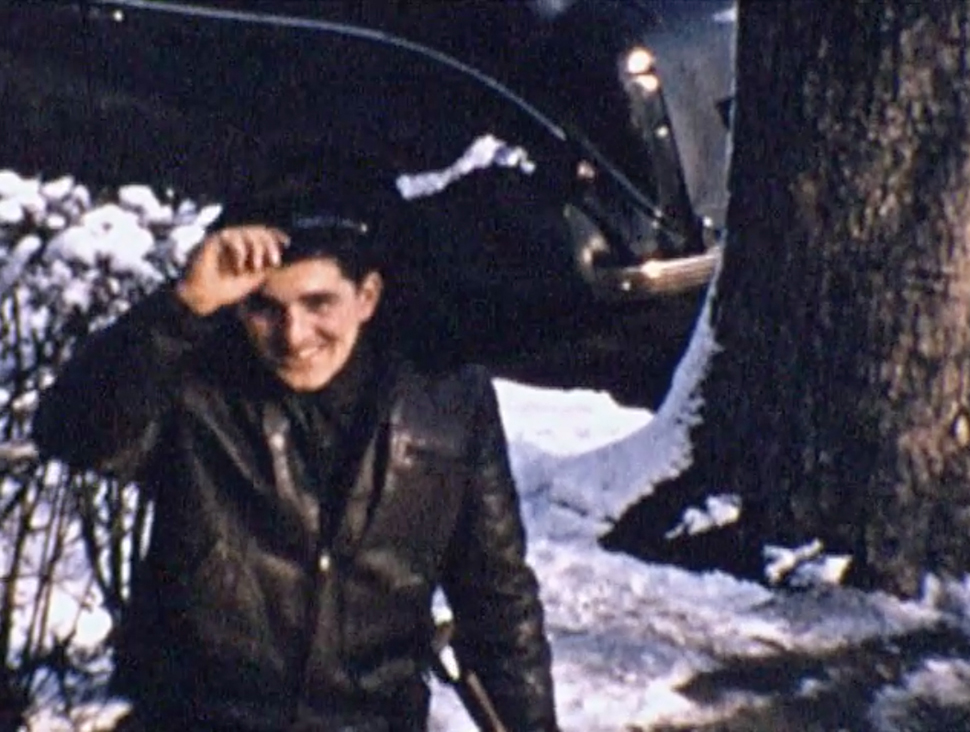
Film: Dad shoveling snow in Brooklyn, New York, 1952 or 1953.