0.918 or, I am a Citizen of the World

wesel

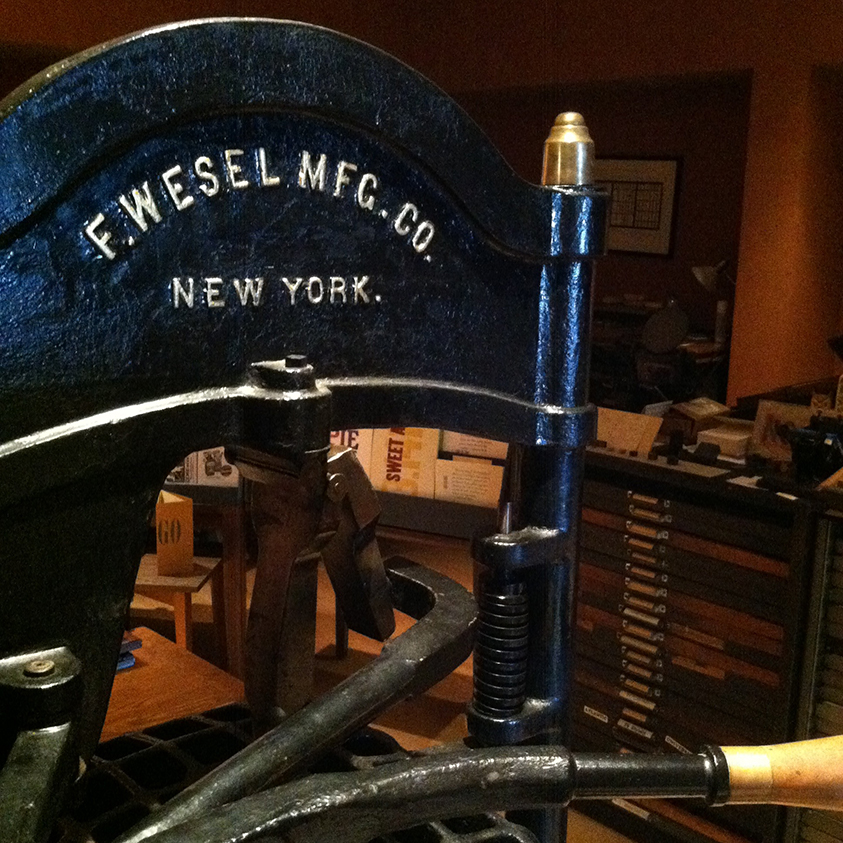
It is September 18th, 9/18, and someone somewhere at some point some seven years ago decided this was awfully similar to .918, which is an important number for letterpress printers like me: .918 is the standard height of type. Convivio Bookworks began sponsoring back then a Letterpress Appreciation Day celebration at the Jaffe Center for Book Arts at Florida Atlantic University Libraries, and we’ve done so ever since. This year, we’re supplying the Italian cookies. I also designed the print, and if you’re in the area, you can come print one on the center’s 1890 Wesel iron handpress, which is the same type of press that I first learnt to print on with Glenn House in Alabama, and then with David Wolfe in Portland, Maine.

This year’s print is a famous quote by Charlie Chaplin: I am a citizen of the world. It relates to an exhibition the center is running now about silent films and the novels in pictures by folks like Frans Masereel and Lynd Ward that came about alongside those films… and so there’s been a lot of Charlie Chaplin in my life lately, not to mention Buster Keaton and Mabel Normand and Fatty Arbuckle and Mary Pickford. Here’s something I realized the other day, as I pulled a few proofs: Charlie Chaplin was born in 1889… so when the center’s Wesel iron handpress was built, Mr. Chaplin was but a year old.

We’re printing for this Letterpress Appreciation Day Open House today until 5 PM and again tomorrow, Monday 9/19, from noon to 5 as well. I don’t have a photo of the print here to upload as I type this, but there is one on our Instagram feed! See it there, and follow us while you’re there, too.

P R I N T E R S   R O C K !


Grapes & Blueberries

DSC07997.JPG

History reveals that folks have generally been not all that interested in recording the birthdates of their children, especially a very long time ago. Heck, even in more recent times… we were never entirely sure if Grandpa’s birthday was on the 21st of November or on the 23rd, and just recently we learnt that Mom’s birthday, which we always celebrate on October the 3rd, may actually be on the 2nd. (I suspect we’ll be celebrating both days this year. Why not?)

And so it is that no one really knows when many historic figures were born, and for some of these folks, like John the Baptist and Jesus Christ and his mother Mary, these things eventually became a matter of some importance. So the Church early on assigned dates to their births, often in conjunction with astronomical almanac events. They placed the birth of Jesus at the Midwinter Solstice and the birth of John the Baptist at the Midsummer Solstice. And today, the 8th of September, in the harvest season, they placed the birth of Mary to her parents Anne and Joachim.

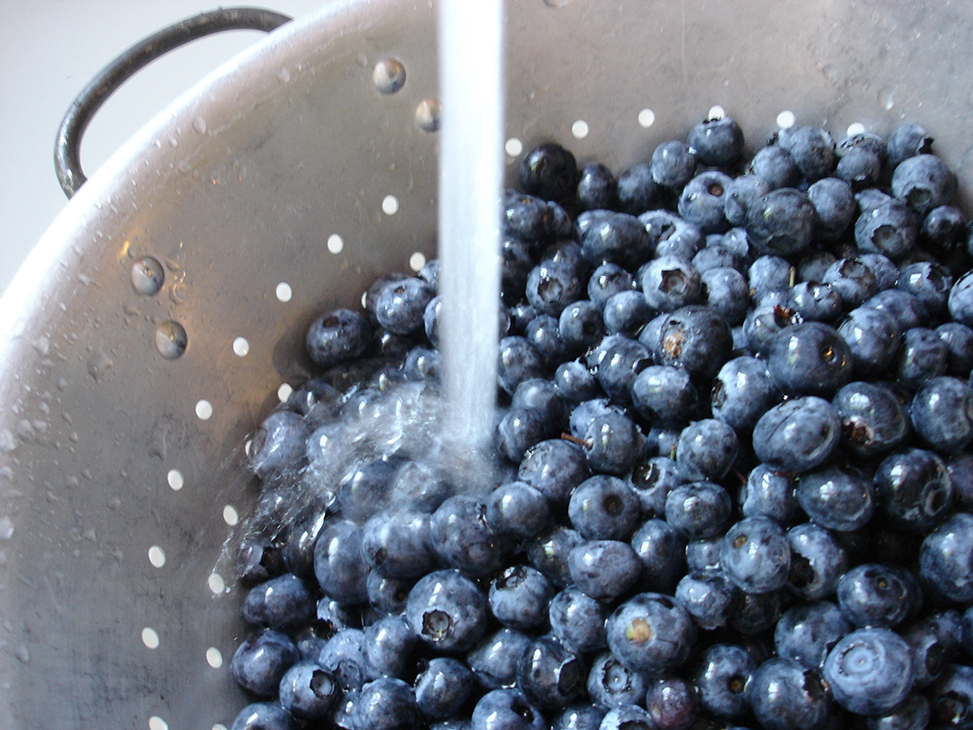
It is a time of growing abundance on the fast approach to autumn by the almanac. Summer and fall both are in our sight, and this Nativity of Mary day has elements of both, too. In Italy, it is a day of feasting on blueberries, for blue is the traditional color of Mary’s robe. Blueberries, most definitely, a summer fruit. Across the Pyrenees, though, in France, the Nativity of Mary is celebrated with grapes, an autumnal fruit. In fact, the day there is known as Our Lady of the Grape Harvest, especially amongst the wine makers, who will be bringing their best grapes to church today for a blessing. Across France today, look up at most any statue of the Blessed Mother, and you are bound to find a bunch of grapes placed in her hands. Across the Alps, in Austria and in Switzerland, it is time to bring the sheep and cattle down from the mountains and into the valleys: winter is fast approaching, and the Nativity of Mary on the 8th of September is known there as “Drive Down Day” in honor of this custom of moving the animals out of the mountains and back to the valleys, usually with some pomp and ceremony, the cows decorated with flowers and bells.

The day is, as well, a traditional weather marker: The weather today is thought to determine what the weather will be like for the next four weeks. Here in Lake Worth, where summer is king, yesterday’s weather seemed to be our first hint that summer’s heat may be breaking soon, so I’m hopeful that continues today… which may mean a cooler September? I will take that, thank you. And I’ll take some blueberries, too.


Labor Day

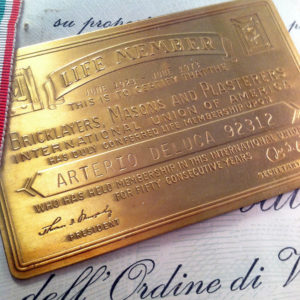
Union Card    Arturo DeLuca

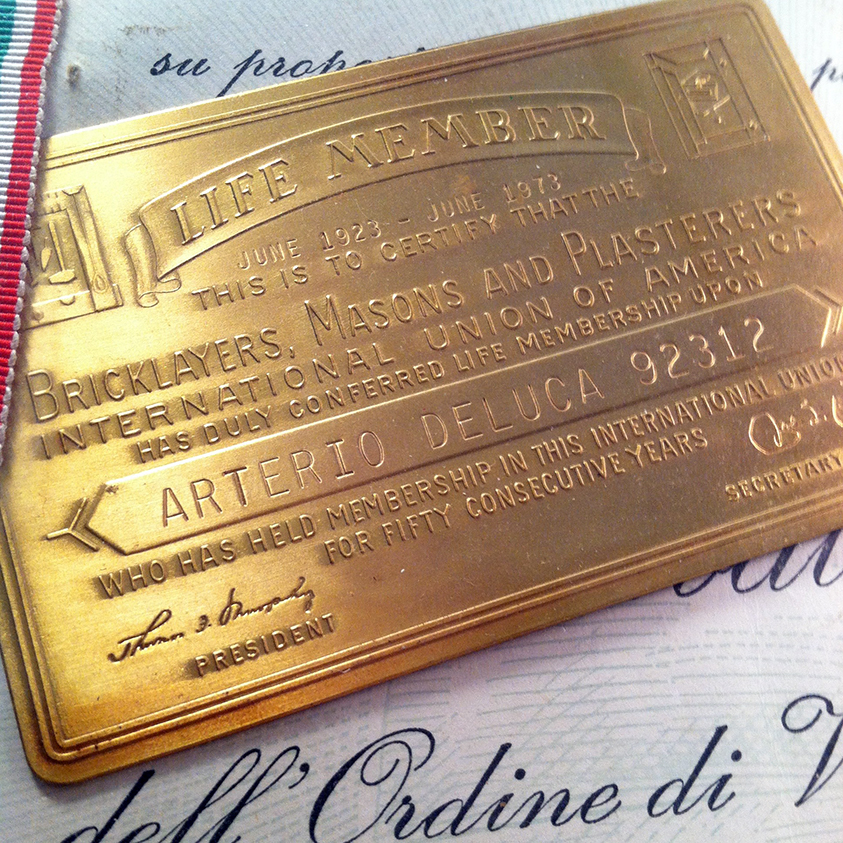
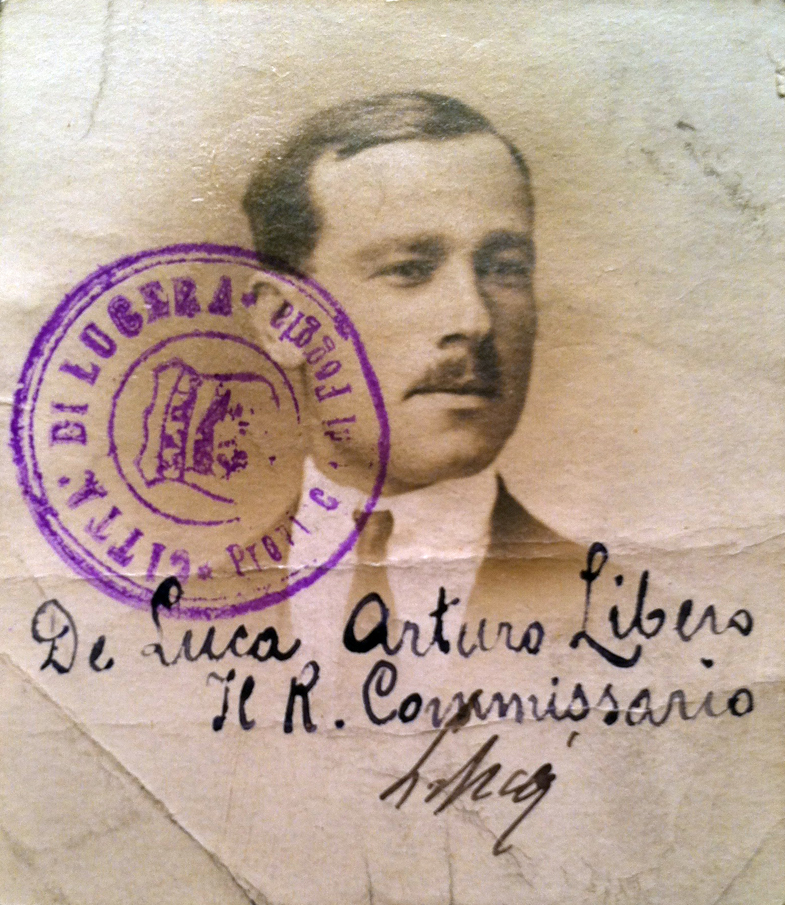
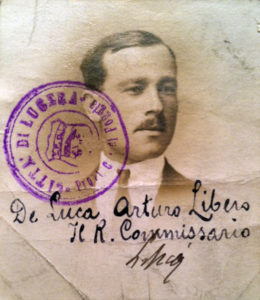
In 1973, my grandfather received his gold union card marking fifty consecutive years with the Bricklayers, Masons and Plasterers International Union of America. He was now a life member. He took that gold union card, and even though his name was misspelled, he put it inside a picture frame along with a certificate and two medals he had earned in World War I serving in the Bersagliere Corps of the Italian army, and he hung the frame on a wall, and that was that. He never talked much about either thing, not the union nor the military service. But he seemed to value both enough to keep these mementos prominently displayed.

We still have that frame: we visited my folks over the weekend and when I asked her about it, my mother pulled the frame from a shelf in a closet. I looked at everything closely, shot the photographs you see here, and returned the frame to its place on the shelf in the closet. But then I paused, picked it up again and set the frame on the bureau, next to the photographs of my grandparents and the statue of St. Rocco. That seemed a more fitting place, especially for Labor Day, a day when we celebrate the American worker. The day has become our country’s unofficial end to summer, but its history is rooted in my grandfather’s time. He was born in the late 1800s, and so was the labor movement in this country. The first Labor Day celebration was organized in 1882 in New York by the Central Labor Union. It was the Fifth of September, a Tuesday, and organizers had no idea how many workers would take part in the parade that wound through Manhattan. There turned out to be more than 10,000; perhaps even 20,000. They carried signs and banners advocating for the rights of workers; things like an 8-hour work day. Twelve years later, in 1894, Congress declared Labor Day a national holiday, falling just as it does today on the First Monday of September.

Grandpa was a union man even longer than he was an American citizen; that particular honor was bestowed upon him in 1935. (My grandmother would have to wait an additional six years for her citizenship.) When times were tough, his work as a bricklayer took him to states far from his home in Brooklyn, as far away as Iowa and North Carolina, wherever there was work; building army barracks, for instance. They worked hard, my grandparents did, and they saved and made real the dreams that first brought them to this country in the early 1920s.

I’m not sure what Labor Day meant to Grandpa, because I never asked him. So much I never thought to ask, but wisdom generally does not come to us until we are older, making us wistful. But Grandpa was a simple man and Labor Day was, I’m sure, just like any other day to him: reading Il Progresso, the Italian paper, with his coffee and toast and cream of wheat, watching Concentration and Eye Guess and Let’s Make a Deal (and shaking his fist at the TV when contestants got too greedy), playing Solitaire and Scopa and Briscola (the last two with the Italian playing cards of swords, cups, coins, and clubs), helping Grandma scour over the lentils, making sure there were no little pebbles mixed in with them. He might have puttered about the garden, bringing in a few late season beefsteak tomatoes. And certainly he passed by the frame on the wall that held the two war medals from Italy and the gold union card engraved with his misspelled name, just as he did the day before, and as he would do the day after, as well.