Meet You at the Cemetry Gates

Mary

In my family, it is common practice to think and speak of those who have gone before us as very much present. They are part of the continuum, they are not forgotten. And just as we visit friends and family amongst the living, so too do we visit those amongst the dead. And so cemetery visits were commonplace from as far back as I can remember. We would go, we would brush off the stones, plant some flowers, perhaps. It was often my job to walk over to the spigot and bring back a bucket of water for those flowers. We would spend some time, utter a few prayers, say goodbye, and move on to the next visit.

In the summertime, the cemeteries we visited were usually lush and green with big trees. I’d read the stones, wondering about the people whose lives they memorialized, wondering also about their families amongst the living who brought things to their graves: flowers, trinkets, flags, coins––the small gifts we leave for the dead. I loved the old stones best, the weathered ones, the ones with lichen and moss. Back home in Lake Worth and West Palm Beach, the old weathered ones are from the 1800s. Here in northern New England, they are from the 1700s and earlier, carved with angels and skulls, crooked in the ground after all these years.

I know people who would be content to never set foot in a cemetery, and perhaps that is you. And I understand that. But that is not me. Me, I’ve been known to visit cemeteries, even if I know not a soul in them, just to walk through on a pondering ramble. And it is not my cousin Marietta. When I suggested I drive down to New York to visit her while on this summer vacation in Maine, she got so excited. And when I suggested we make the cemetery rounds during that visit, she responded, “You are so me.” It’s a rare cousin indeed who you can invite to join you on a trip to visit cemeteries and who will agree with excitement and enthusiasm. This may be why we get along so well.

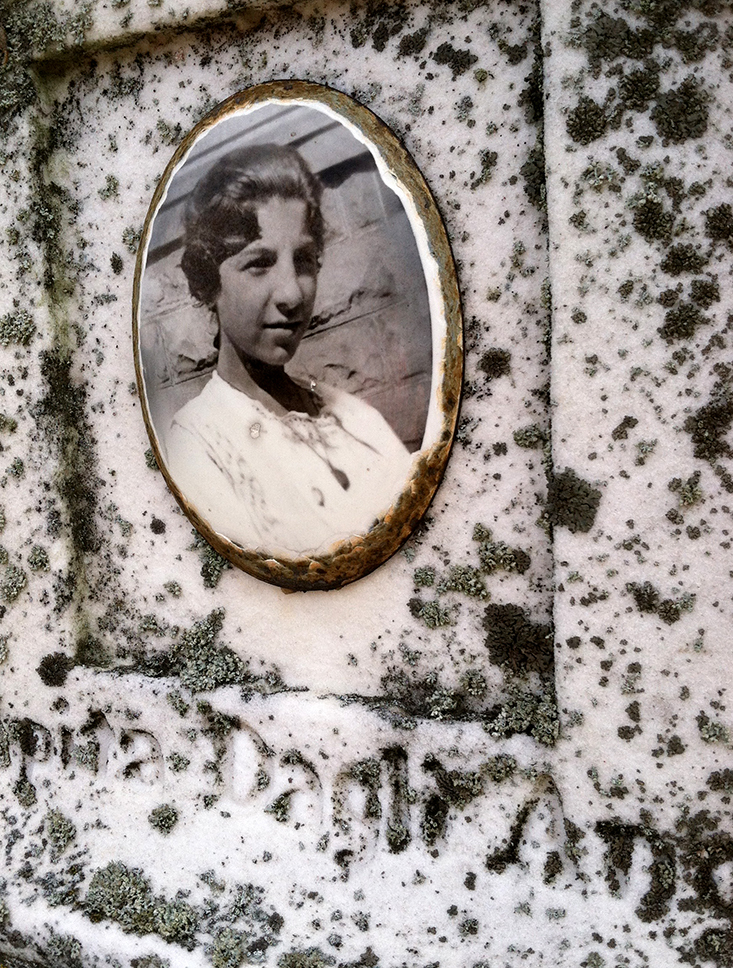
Here in Maine, while on this summer vacation, we have visited family and friends most every day. We sit, we talk, we laugh, we eat, we talk and laugh some more. But we have visited, too, the ones we visit quietly: Seth’s grandparents, the great grandparents he never met, great aunts and uncles, even his great aunt Mary, who died in the 1918 influenza epidemic, just a girl, who in a way I probably know best, only because her parents were so grief stricken at her passing that they erected a large stone that even has her photograph on it. The photo, now almost a hundred years old, is still clear as day, while lichen covers more of the stone with each passing year. Beneath her photo, the words engraved are rapita dagli angeli––stolen by angels. She was 15. No one left amongst the living has ever met her, and yet she is a presence we know well. I see her picture and I think of an old neighbor on Victor Street, where I lived as a boy. I don’t even remember her name, but I do remember her telling me once that her sister had died in 1918 in that same epidemic. I think of Mary’s sisters, the ones who lived to be old women, the ones that I did know before they left this world, the ones whose living rooms Seth and I sat in on visits past. The lines between the living and the dead get blurred at times, and this is, I think, a good thing. The dead are here in their way. We are the richer for their presence.
 

Vacationland

Tintype

For the first summer in years, Seth and I are doing what folks all over this great land do each summer: we’ve packed up and gone on vacation to escape the heat. We’re in Maine, Seth’s home state, surrounded by pines and maples, average highs in the 70s, lows in the 50s. It’s a bit of a homecoming for both of us. For Seth, this is the land where he grew up. But we’re also staying, for the first time in almost 20 years, in the home where we would spend summers back in the late 1990s. Back then, I was in grad school in Alabama. I’d come to Maine for summer internships, working at times with Brother Arnold Hadd at the Shaker Press at Chosen Land, the Sabbathday Lake Shaker Community in nearby New Gloucester, and at other times with David Wolfe, a printer and book artist on the coast in Portland. No matter where I interned each summer, our home base was The Saltbox, a home that Seth’s dad Cole had begun building from boards that were milled from trees that had been cleared from his land for a new road.

This Saltbox is a replica of an actual Colonial era saltbox in nearby York, Maine, with the distinct shape of this New England style home: two stories in the front, one story in the back, and a pitched roof that slopes down toward the back of the house, making it look like a traditional storage vessel for salt. I have always loved this connexion and its metaphor for home: this most essential act of seasoning food––a pinch of salt––connected to the building in which that act takes place.

When Seth and I were spending summers here, it was pretty rustic. The shell of the building was complete, but the exterior was wrapped in tar paper. There were windows but the interior walls were just beginning to be framed, so we could see each other from clear across the house. Our water came from a hose that Seth ran from outside up to the second floor, the water running into an old elongated cast iron sink, draining out the side of the house through a pipe into the woods below. Our lights were mostly Christmas lights, strung up along the wall studs. Each summer we added more luxuries: a reading lamp, a rice steamer, a toaster oven, an old Philco radio that got louder as the tubes inside warmed up. We heated up water on an electric burner for shaving in a basin with an old mirror that had just a bit of silver reflection left in it. It was hung from a nail in one of the wall studs on the opposite side of our little kitchen table that might fit three people at most, and there were times when we did fit three. We had Brother Arnold over once for dinner. And dinners were usually pretty damn good. We’d make things like fried squash blossoms, harvesting the vegetables from the huge garden Seth planted near his parents’ home, which was a hundred yards away through the woods. We got really good at working within limitations. Each year we took to heart the words summertime and the living is easy. We made it so with what little we had and, to be honest, the living was pretty great.

As we got busier and busier in our post-grad school days, Seth’s father finished up the saltbox project. One year the clapboards and cedar shakes went up. Another year the interior walls were finished with pine paneling and plaster. The place slowly grew up into a real home with modern conveniences like indoor plumbing (no more trudging through the woods late at night to shower). And then last year, his folks decided to rent out their old family home, and move into the smaller, more manageable saltbox.

It’s been six long years since we were last here, and now, visiting Seth’s family for summer vacation, we are back in the saltbox. It has been a wonderful homecoming, back to a place that was in many ways our first home together, and it makes me realize how the passing of time––the great turning, spiraling wheel of the year that is the subject of this very Book of Days––is equally beautiful and sad. I think back to when I was a boy and how summers went on forever, and I think back to when Seth and I were roughing it out here in an unfinished shell of a building and wonder how that could possibly be almost two decades ago. Though much has changed, much is exactly as we left it. The wind still blows through the trees towering around us, the air still is scented with pine, and the saltbox itself still is scented with wood, the wood of the trees that stood once on this land, milled into the boards that are the heart and bones and core of this home away from home.


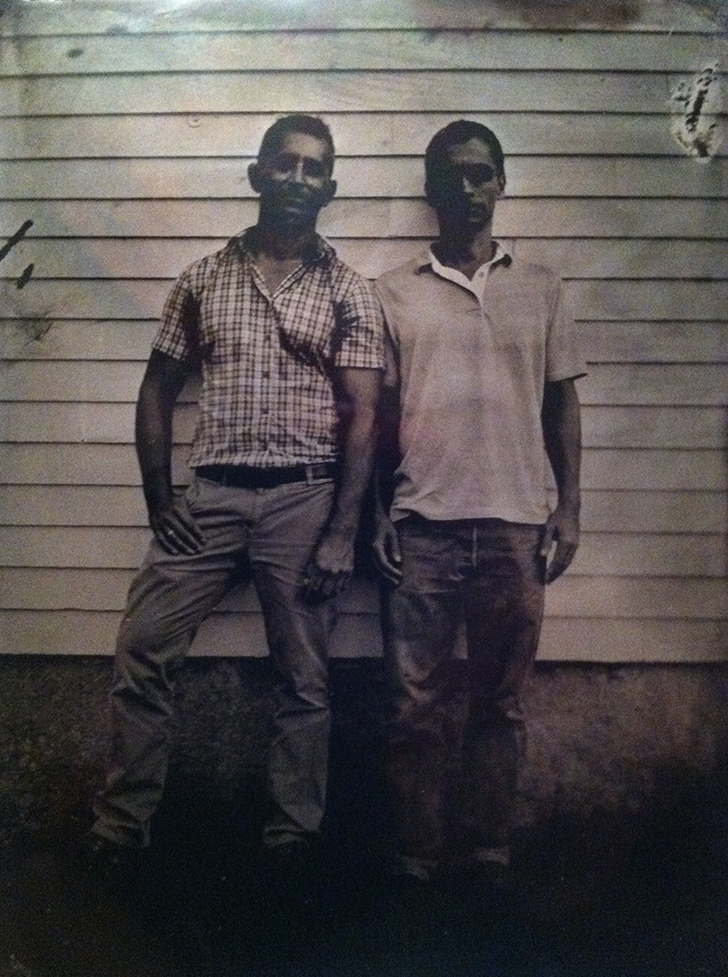
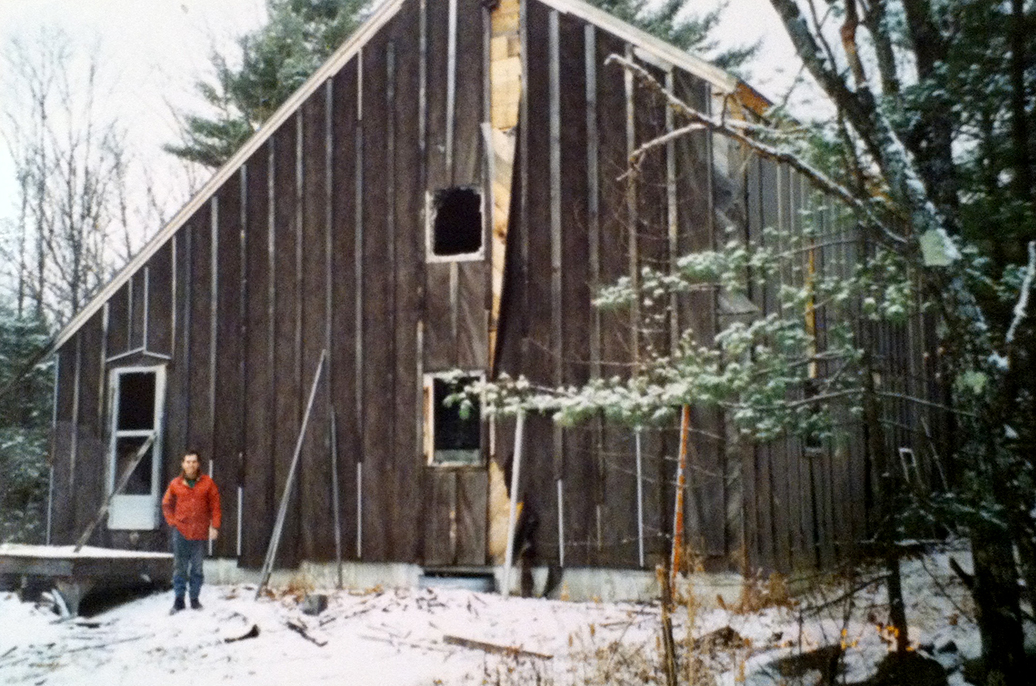
Image at top: It was Maine Open Farm Day yesterday, and the Shakers opened their farm, the place that provides the culinary herbs and herbal teas that we sell, for the occasion. That’s a tintype of me and Seth that a photographer shot there yesterday; we are standing outside the 1850 Boys’ Shop. And here’s an old photo of the saltbox as it was in 1993, three years before we began using it as our summer home:

Saltbox

The place when we lived here looked not so unlike it did when this photo was taken, though we did have windows. And that’s Seth’s dad Cole in the photo; he looks in this picture not so unlike Seth does now. When it rains, Seth even wears a red coat just like his dad’s. You can view a photo of the saltbox as it is today on the Convivio Bookworks Instagram page. Follow us there @conviviobookworks. We’d be really pleased if you did.

Vacation time has meant time off, too, from writing. My apologies for not writing you about St. Swithin’s Day this past July 15th and Our Lady of Mount Carmel on the 16th. Saturday it was the ancient Roman feast of Neptunalia & Salacia, celebration of the salty sea. Today brings St. James’ Day; oysters are traditional. Tomorrow: St. Anne’s Day––Anne, mother of Mary. St. Martha is celebrated on the 29th and it is Martha who reminds us in her own way that we need not worry so much about appearances. Come Lammas Eve at month’s end, we should be back to Lake Worth and back to our workaday world. Fittingly enough, Lammas brings the traditional beginning of transition from summer to fall.


Tanabata

Tanabata

Here is an old story from Japan: Orihime was the beautiful daughter of the Sky King, Tentei. She wove beautiful cloth on the banks of the Amanogawa, the Milky Way, and her father loved the cloth she wove, and so she worked very hard to make enough for him so that he would always have plenty of it. But Orihime worked so hard at her weaving that she never had time for anything else. As much as Tentei loved the cloth Orihime wove, he knew she needed some balance, some time away from her work, and so he arranged for her to meet Hikoboshi, the Cow Herder, who lived on the other side of the Amanogawa.

It was love at first sight if ever there was such a thing, and the two soon married, and that was wonderful, but they became so enamored with each other that all else fell by the wayside. Orihime pretty much gave up her work at the loom, and as for Hikoboshi’s cattle, well, they were soon roaming all over Heaven. Tentei grew angrier and angrier over all this, until finally he had enough. He separated the two lovers on either side of the Amanogawa and forbade them to see each other. Orihime despaired over the loss of her husband and pleaded with her father. Moved by his daughter’s tears, Tentei relented. But he allowed the two lovers to meet only once each year, on the seventh day of the seventh month. And so it goes each year, and so here we are today: the seventh day of the seventh month. It is the Japanese star festival, Tanabata.

As stars, the lovers are Vega and Altair: Vega, the Weaver Star, is Orihime, and Altair, the Cowherd Star, is Hikoboshi, separated always by the Milky Way, except, as legend has it, for this one night each year when they are reunited. Beneath the stars, here on Earth, we honor Orihime and Hikoboshi by writing wishes on strips of paper and tying them to the trees. Bamboo is traditional, but I wouldn’t think necessary. We hold our wishes, write them down, place them in the branches, open to the sky and to the stars, to Vega and Altair, to the Milky Way, to Heaven.

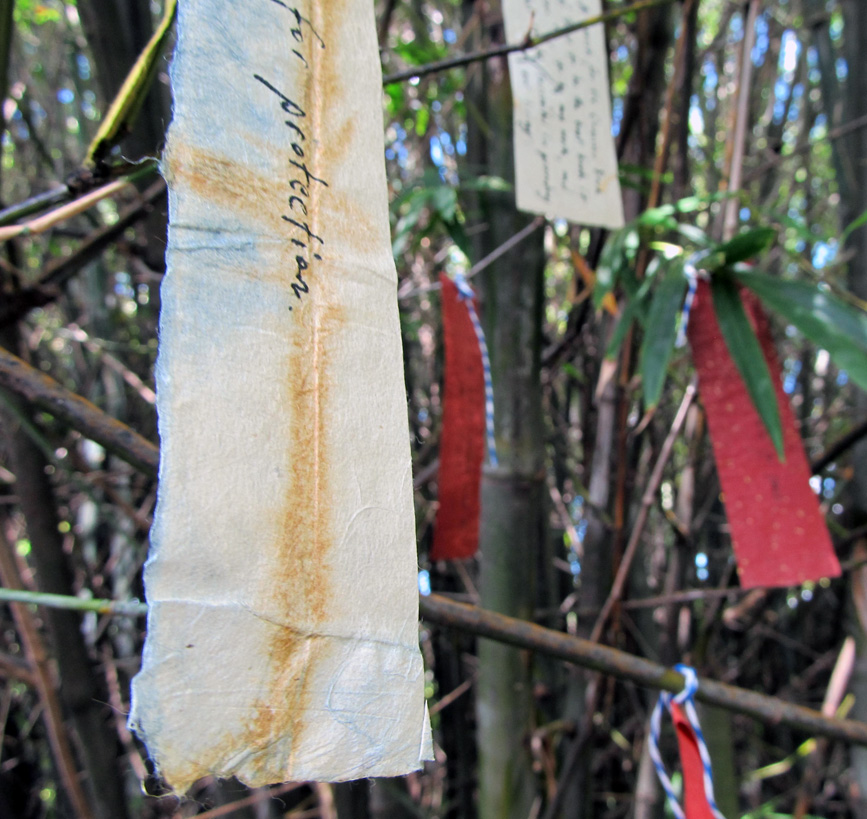
Image: Wishes of our own written on handmade paper, tied in the bamboo here at our home in Lake Worth. I made the paper from kozo years ago with Richard Flavin, who was visiting from Japan to teach a workshop in traditional Japanese papermaking and paper decoration at Paper & Book Intensive at the Penland School in North Carolina. After all these years, Tanabata wishes seemed the right thing to do with that paper.