Receiving Radiance

solstice

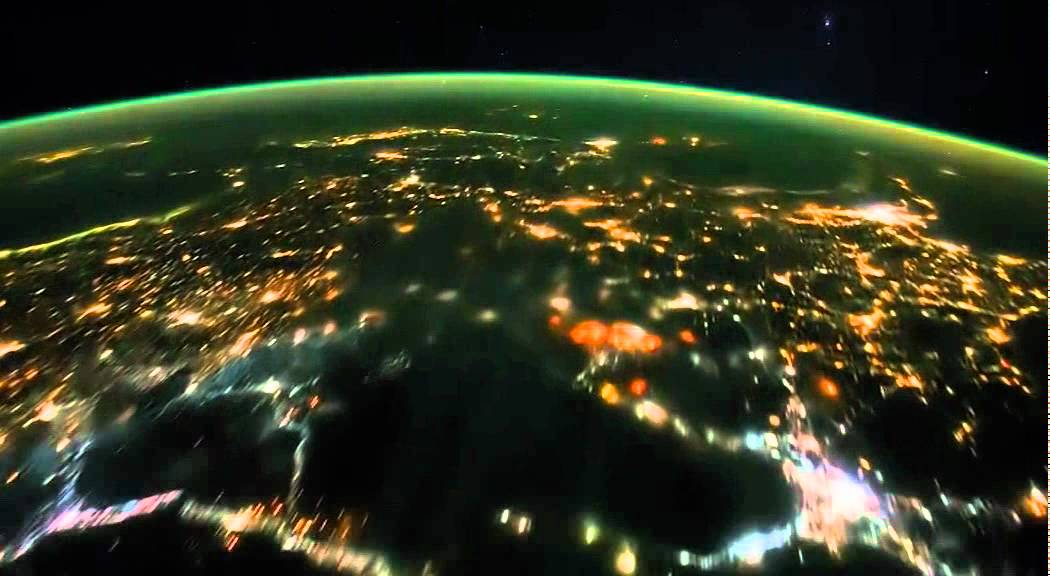
Since the midsummer solstice in June, we have been gradually losing daylight here in the planet’s Northern Hemisphere. Just a bit each day. By the autumnal equinox in September, day and night were equal. And now, here at the midwinter solstice, we reach the end of that cycle: It is the longest night of the year. Tomorrow, the pendulum begins its shift to the opposite and light will once again begin to increase. It is the clockwork of our planet, the constant rearrange, each day slightly different from the one before it and the one that follows.

For those of us who keep the traditional ways, the revels of midwinter are just now getting underway. We’ve been preparing all these weeks––last night, the Fourth Sunday of Advent, we lit the fourth candle in the advent wreath, completing the circle: four purple candles and one rose. The daily advent candle is burning down, too: just four nights from now, the candle will be gone. Our time of preparation is coming to a close and the real festivity is about to begin with Christmas Eve and Christmas Day and the Twelve Days of Christmas that follow: six of which are in the old year, six in the new––twelve days that stand outside of ordinary time.

But that is still ahead of us. For tonight, we celebrate the planet’s reaching its wintertime zenith in its constant shift, like an old man in his rocking chair on the porch. On this longest night of the year, Seth and I will head out into that midwinter darkness, and in the copper fire bowl in the back yard we will light a fire made from the wood of last year’s Christmas tree, which has been resting quietly in a corner of the yard all year long. It is our own little tradition but one that we feel honors best the spirit of the tree that brought us so much joy last yuletide. This year, the actual moment of solstice––of sun standing still (from the Latin sol stetit, “sun stands still”) is 11:49 PM here in Lake Worth, which is Eastern Daylight Time. You can count on us being out there at our fire at that moment (and for a good while before and after, as well), probably with a bottle of St. Bernardus Christmas Ale.

Will you join us in spirit? We’ve been talking about our solstice tradition for years now, so maybe there are some among you who also save last year’s tree for this night. Or maybe this is your year to begin doing so. Or maybe the best you can do is to light a candle with us tonight at 11:49. Wherever you are and however you join in, we are here as light bearers ourselves, receiving radiance from others: from sun, from flame, from the kindness we send out into the world reflected upon us. We bid you peace. Welcome yule.

Here’s a yuletide gift for you, from us: it is Björk’s song Solstice. You will most likely have to endure a brief advertisement before the video, but once that part is done, I’d suggest viewing it full screen and turning up the volume a bit. It is a simple and beautiful song, just Björk’s odd and powerful voice accompanied by the gravity harp, a musical instrument created especially for the songs on her 2011 record Biophilia. This song and its accompanying video remind me of the great immensity of things, of things much larger than my self and my concerns. Sometimes seeing the bigger picture is very comforting.
 

You are a Light Bearer

NannetteDapper1967

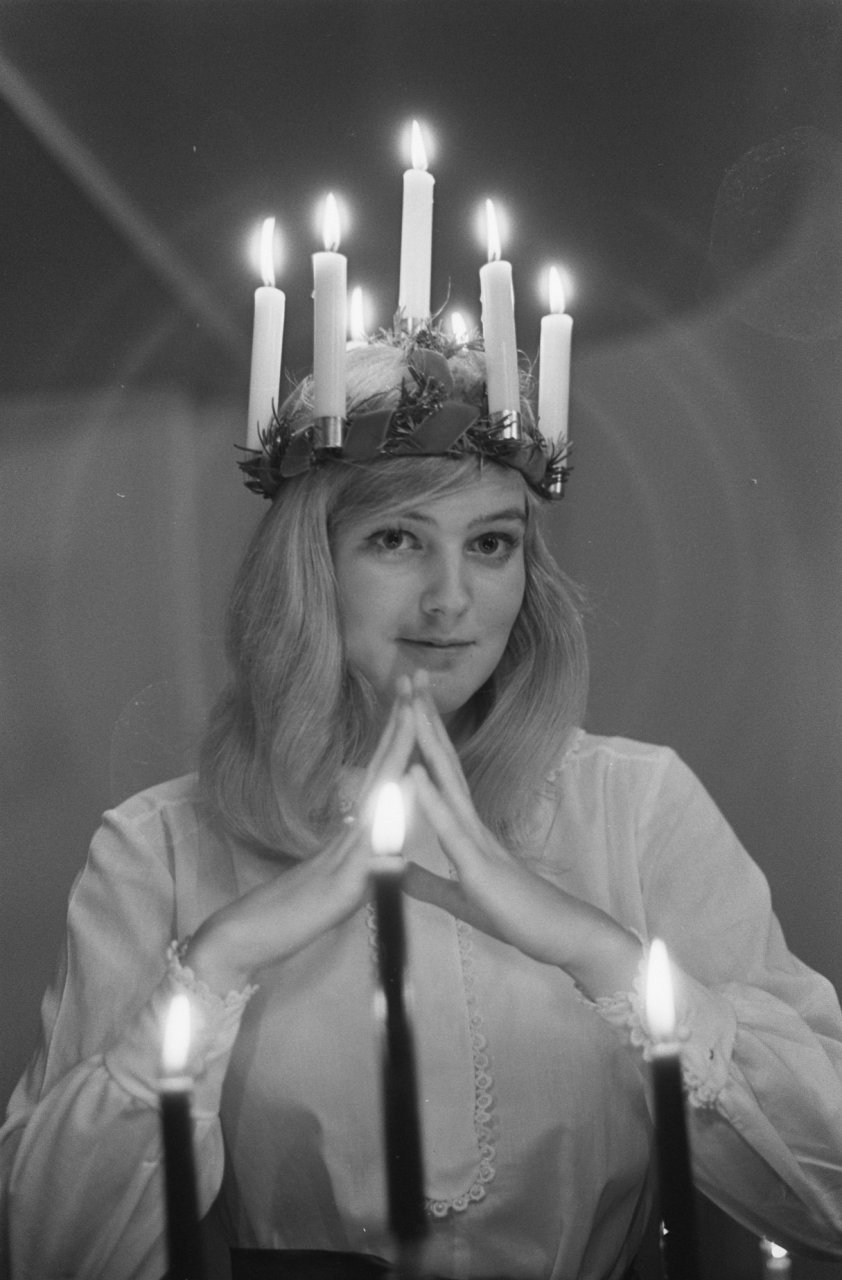
Come December 13 we are but eight days from the midwinter solstice in the Northern Hemisphere and now enters another of the light bearers, and a gift bearer, as well. It is Santa Lucia, St. Lucy, patron saint of eyesight. Lucia, a name derived from the Latin lux and lucis: light. The nights grow increasingly darker on our solstice approach. Santa Lucia breaks the night darkness with light that shines from her head, at least in the Swedish tradition.

The historical Lucia was from Sicily. She is said to have intervened in a famine in Sicily in the 16th century when a flotilla of grain mysteriously arrived in port on her feast day. Rather than take the time to mill the wheat into flour, the hungry people fed themselves on boiled wheat grains, and to this day, whole grain wheat finds its way into traditional Italian foods for Santa Lucia’s Day. But Lucia’s following is equally strong in Sweden, oddly enough. Some say that she intervened in a famine there, too, though I am not sure about that. What is obvious, though, is that life along the Arctic Circle on the approach to midwinter is dark indeed, and here is a saint who’s very name calls down light.

Here is the best song you can listen to today. It is an old Neapolitan melody about Santa Lucia, but it is in Swedish. I love this melding of cultures and celebration. In Italian, Lucia is pronounced with a “ch” (loo-chee-a) while in Swedish, the C is soft (loo-see-a). The song you’re listening to, if you’re listening to it (and I hope you are) is from a procession in Sweden of young girls dressed in white and young boys, called star boys, also dressed in white, carrying stars on tall poles. Somewhere amongst them is the Lucia, wearing a wreath of lit candles upon her head. Such a beautiful song and such a beautiful sight. In this time of still increasing darkness, we welcome the light, we welcome the beauty, we welcome the harmony and know in our hearts that this is right and this is good.

Image: “Miss Lucia,” a photograph from the National Archive of the Netherlands. Miss Lucia is Nannette van Viet-Dapper, photographed on December 9, 1967. Perhaps some Swedish traditions have emerged to the south, as well. [Public domain] via Wikimedia Commons.


Enter the Light Bearers

Candlelight

Last night, with the Eve of St. Nicholas, we celebrated the first of the gift bearers, and tonight, Hanukkah begins. It is a moveable festival in the Jewish calendar, a festival of lights, this year the first of many nights where light is celebrated. And this is no surprise in this time of darkness, for we are fast on the approach to Midwinter: the longest night of the year. Light is what we seek.

Hanukkah commemorates an historical event in ancient Jerusalem in which a small flask of oil kept the lamp of the Temple burning for eight days and nights, much longer than it ever should have, long enough for a new supply of oil to be attained at a time when the prospect of attaining that oil looked bleak. This miracle of the oil is commemorated with each Hanukkah celebration through the lighting of the menorah, a candelabra of nine candles: one central candle and eight others, one for each of those eight nights.

Just as the oil of the temple lamp is central to Hanukkah, so is oil in the traditional foods of the holiday. Much of it is fried in hot oil. The most famous (and the ones that would get me to the table faster than anyone) are potato latkes and jelly doughnuts. The latkes are pancakes made from shredded potatoes, served with apple sauce and a dollop of sour cream. And any celebration that involves homemade doughnuts of any kind, be they jelly or plain or cinnamon, is no small cause for joy.

Our neighbor Old Aunt Sarah, who has been here in Lake Worth longer than anyone, doesn’t do much cooking these days, but some years, if the mood strikes her, she does make latkes for Hanukkah. Old Aunt Sarah’s latkes were the first I ever tasted. When she makes them, she makes them in large batches, and sends some over to Seth and me. We don’t see her often, but when we do, it is always a joy and a wonder, like the time she strolled over and peered over the garden fence and her gray eyes lit up when she saw the nasturtiums we were growing. “Nasturtiums!” she said, as she gazed upon those peppery blooms. She seemed transported. “I don’t think I’ve said that word since I was a child.”

It also happens to be, tonight, the Second Sunday of Advent, when we light two purple candles on our Advent wreath. Again, light increasing, for last week we had only one candle lit on our approach to Christmas, so tonight, that light is doubled. Old Aunt Sarah’s childlike wonder is central to Advent and to Hanukkah. We bring light, ever increasing light, to a dark time.  Old Aunt Sarah and we wish you that wonder. We, collectively––Aunt Sarah, you, me––we are the light bearers. It is up to each of us.

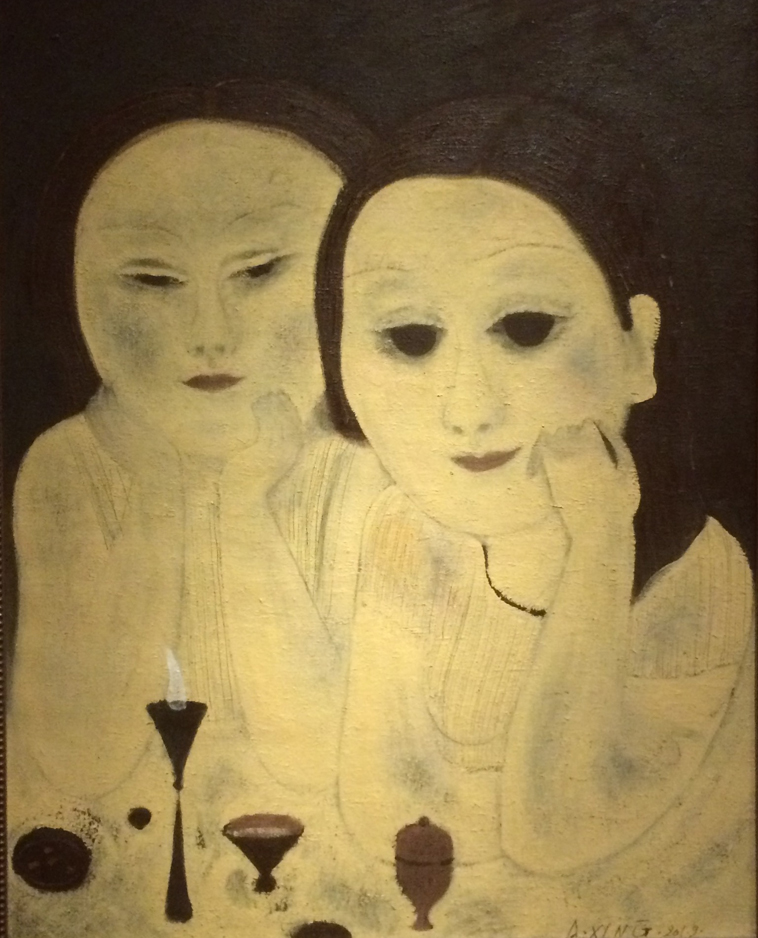
Image: “Candlelight,” a painting by Philippe Brouillard, 2015. [Public domain] via Wikimedia Commons.