Miracle of the Oil

Piechowski_Women_at_the_stove

I’ll admit it right here and now: I don’t know much about Hanukkah. I know that there are latkes, potato pancakes fried golden brown and served with apple sauce and sour cream and I like those, and I learned just today from a friend that jelly doughnuts are part of the celebration, too, and I am definitely easy to be found whenever there is a good doughnut nearby. And I know the gist of the celebration, revolving around a small flask of oil that kept the lamp of the Temple at Jerusalem burning for eight days and nights, much longer than it ever should have, long enough for a new supply of oil to be attained, and this is the miracle that is commemorated with each Hanukkah celebration, each lighting of the menorah.

Hanukkah is another festival of lights. We see these festivals in cultures across the globe, but it is fitting, I think, that so many occur now, in these darkest nights of the year on the approach to the winter solstice. This year, Hanukkah begins with the setting sun tonight, December 16, and lasts for eight days and nights. It is a movable celebration: Last year it happened to begin just before Thanksgiving, and one year not long ago, perhaps 2005, it coincided with Christmas. Old Aunt Sarah across the street made latkes that year and shared some with Seth and me. It was cold here that December, like it’s been this year, and the chill of the winter nights brought her back to her childhood and the dark nights of Hanukkah frying latkes with her mother in North Carolina, the place from whence Old Aunt Sarah hails. We enjoyed latkes that year because she had set the smoke alarm off a few times in making them, and Seth had gone over to check on her. She only makes latkes in large batches, she told him. It’s the only way she knows.

“Here, have some,” she said. She put a latke on a plate and then, next to it, a dollop of apple sauce. And then she put a whole bunch on a bigger plate. “Take some to your friend.” That’s me. That was on Christmas Eve, and that year our traditional Christmas Eve dinner of many fishes, which is our Southern Italian custom, included also many latkes. It was a pretty good combination.

This year, Hanukkah begins tonight and ends on Christmas Eve. Who knows, we may have latkes with our Christmas Eve dinner again, should Old Aunt Sarah be up to it. We’ll listen for the smoke alarm.


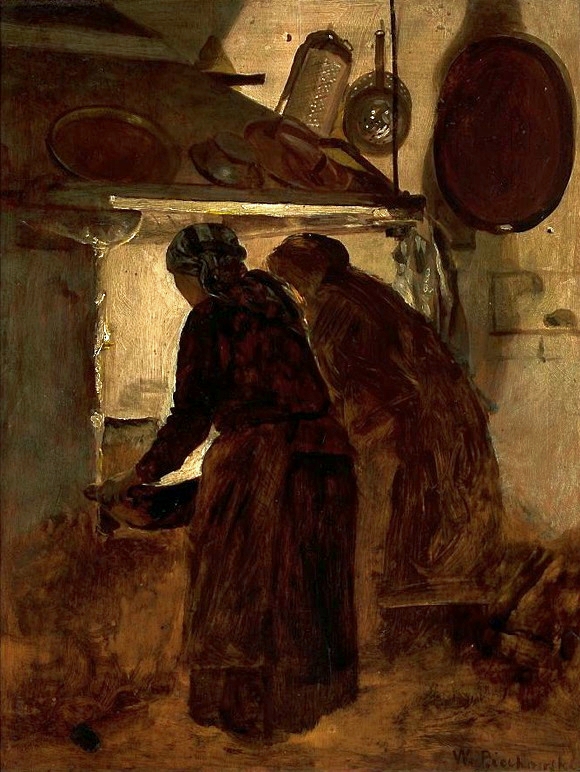
Image: Women at the Stove by Wojciech Piechowski. Oil on oak, 1888. [Public domain] via Wikimedia Commons.
 

The Night Walks with Heavy Steps

SantaLuciaCard

Have you ever spent a summer in Maine? I’ve spent many summers there, whether to be with family or, back when I was in graduate school, for a series of letterpress internships I did there in Portland and at the Shaker Community at Sabbathday Lake in New Gloucester. When it is summer in Maine, the days seem to last forever, with the sun rising early and setting late, well past the bedtime hour for many children.

Of course there must be balance to that, and now, as we approach midwinter, it’s quite a different story in Maine, and darkness falls early at this time of year and lingers long. The shift of darkness and light is even more extreme, though, in a place like Sweden, up near the Arctic Circle. The land of the midnight sun is, at this time of year, spending an awful lot of time cloaked in darkness.

Perhaps it is fitting, then, that the people of Sweden would open their arms and hearts to a saint from Sicily whose feast day comes in with the longest nights of the year. She is Santa Lucia, Saint Lucy, another of our wintertime gift bearers. The gifts she bears are simple but just what is needed about now: hot coffee and warm baked goods, heady with the scent of saffron and ginger. And light. Lucia brings light in the darkness. Of course we “see the light” and Lucia is a patron saint of those with maladies of the eyes, for she herself plucked out her own eyeballs in response to the unwelcome advances of a potential suitor. He loved her eyes, they captivated him. And so she put an end to that right then and there. This was under Roman rule in the fourth century and it wasn’t long after the eyeball incident that Lucia was martyred for her Christian faith. And while she plunged herself into darkness in her act of defiance, Lucia the saint became a light bearer.

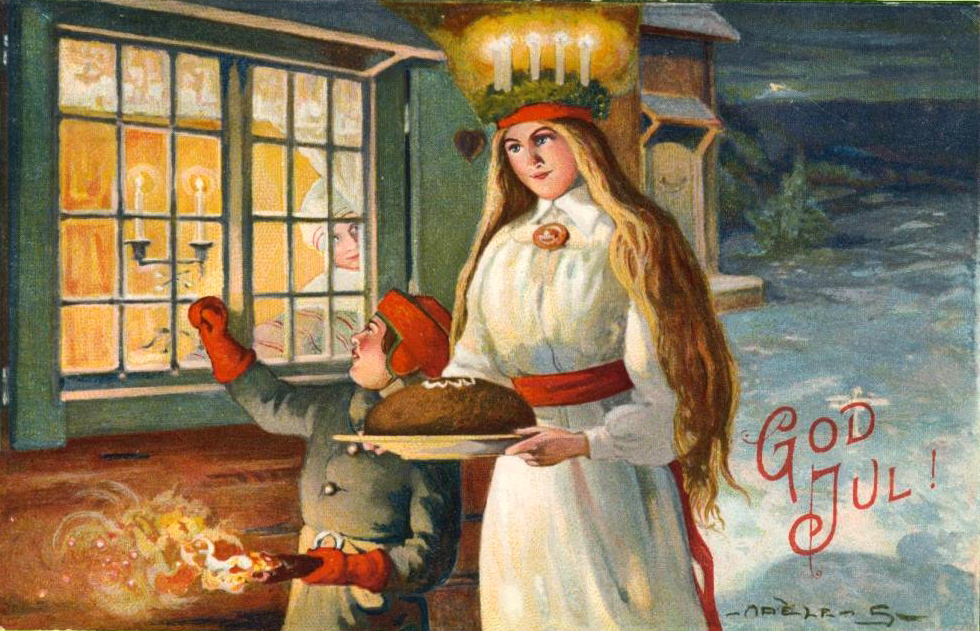
And it is the Lucia who carries light with her in the early morning darkness, entering the rooms of the household with lussekatter (saffron buns) and coffee. She is usually the oldest girl in the house, and she is usually dressed in white with a red sash, donning a wreath of illuminated candles upon her head. There are processions throughout Sweden celebrating Santa Lucia, in churches, in schools, in city streets, on national television. The processions can get quite large, with scores of attendants to the Lucia, each bearing a candle, and also a large number of “star boys” donning huge white conical caps. Everyone is dressed in white, and the procession always centers around the Neapolitan melody “Santa Lucia,” but with Swedish lyrics, my favorite part being Natten går tunga fjät, which translates to “The night walks with heavy steps.” Such a beautiful image, and such a beautiful song. You can feel it warming the air, you can feel it bearing light in the darkness.

Image: An early 20th century Swedish Christmas penny postcard designed by Adèle Söderberg (1880-1915).


Castilian Roses in December

Guadalupe

I can tell you precisely what I did on the night of December 12, 2000. It was our first December in our little home in Lake Worth, and Seth and I were at the table eating dinner when suddenly we heard the sound of fireworks above us. We both dropped our forks and ran out the back door to look into the night sky and sure enough there were fireworks exploding in the sky to the south of our house, toward Downtown Lake Worth. Since Lake Worth has a large Mexican and Mayan population, and since it was the 12th of December, we decided there was only one explanation for the fireworks: It was the Feast Day of Our Lady of Guadalupe, and there was a big festival going on downtown. We didn’t even bother to clean up or finish dinner but instead hopped into the truck and headed downtown for the festivities. We drove to Bryant Park on the lagoon, but it was silent, and so were the grounds of Sacred Heart Church as well as the plaza off the City Hall Annex and none of the downtown streets were blocked off, either, for this wonderful festival that we had concocted in our own minds.

I had left the house that night all excited to buy the traditional painted tin ornaments from Mexico that I would find at the festival celebrating Our Lady of Guadalupe… but of course there was no festival and there were no ornaments. And while the “about” page of this blog explains a lot about how the Convivio Book of Days project came to be, it doesn’t say much about the beginnings of the Convivio Book of Days Catalog, which came about as a result of me trying to find things I loved from my childhood, like traditional German advent calendars and German woodcrafts––things not easily found in stores. And that December 12 night of disappointment played a big part in that decision, too: If I couldn’t find a store or street vendor to buy painted tin ornaments from, well then, I’d go to the source and start selling them myself. And so it goes. The Convivio Book of Days Catalog does not make a lot of money for anyone, but it does go a long way toward making a lot of folks happy, and that’s what matters most to me.

So we can add Our Lady of Guadalupe to the list of influences on the Book of Days project. Not a bad influence to have. She is sacred to Latin America and especially to Mexico, and her iconic image is one we know well, especially in places like Lake Worth, where there is a strong Latin American influence. The story goes that Juan Diego, just a regular old joe, saw an apparition of a woman on a hill near Mexico City, and she asked him to build a church in her honor there on the hill. She spoke to him in his native Nahuatl language and he recognized her, by the things she told him, as the Virgin Mary.

The image we know so well miraculously appeared inside Juan Diego’s cloak in December, 1531: in one of his visits to the hill, Mary told Juan Diego to go to the barren top of the hill, but when he got there, he found it not at all barren but awash with blooming Castilian roses. He and Mary gathered the roses and she arranged them inside his cloak. And on this, her feast day, Juan Diego opened his cloak before the bishop of Mexico City. When he did, the flowers all fell to the floor, revealing the image of the Virgin of Guadalupe, and this is the very image we know so well. The church was built, and the image from Juan Diego’s cloak, or tilma, hangs to this day inside the Basilica of Our Lady of Guadalupe on Tepeyac Hill, Mexico City.


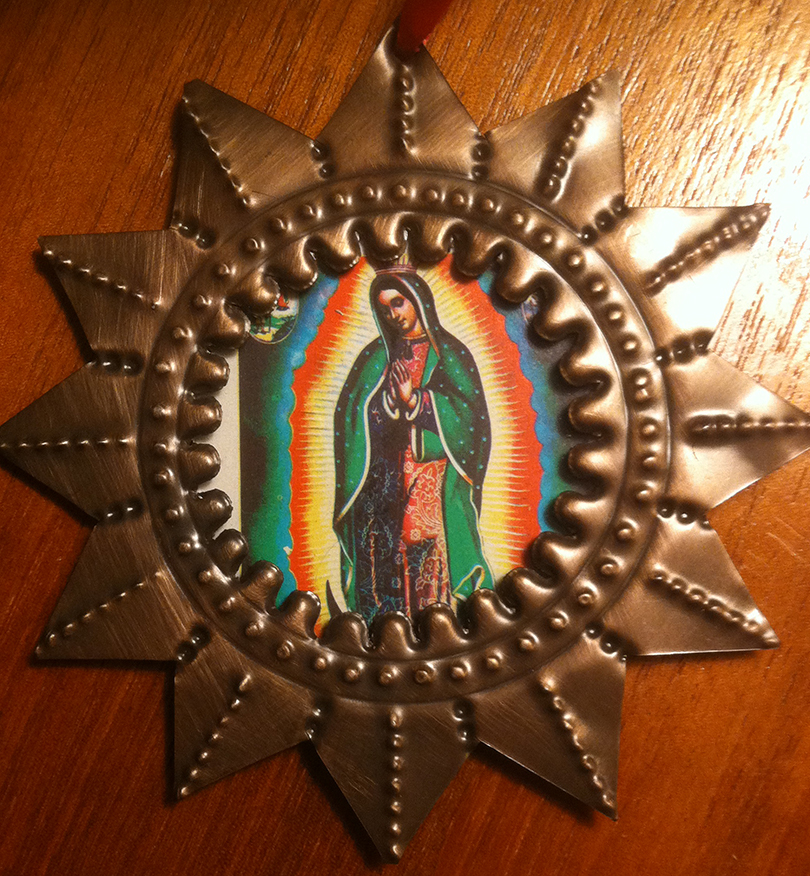
Image: One of the many tin ornaments we offer in the Convivio Book of Days Catalog.