The Eleventh of November is one of the most complex dates, I think, in terms of the seasonal round. Traditionally the day is Martinmas, or Hollantide, the feast day of St. Martin of Tours. He was a veteran of the Roman army in the fourth century who opted to take up Christian pacifism and is known best for helping a poor, drunken man on a cold winter’s day by tearing his own cloak in two so that the poor fellow could have something to keep him warm. Martin has since become a patron saint of tailors and, for better or worse, of vineyard keepers and winemakers and drunkards.
Martinmas is the day to taste the newly fermented wine. Each year’s Beaujolais wines of France, always young wines, are typically released on or around Martinmas, and the day is often accompanied by a good meal featuring goose or turkey and chestnuts––typical harvest celebration foods––and, in Italy, Biscotti di San Martino: biscotti that are so hard, the only way to eat them, really, is to first dunk them in something. That something is meant to be wine, of course.
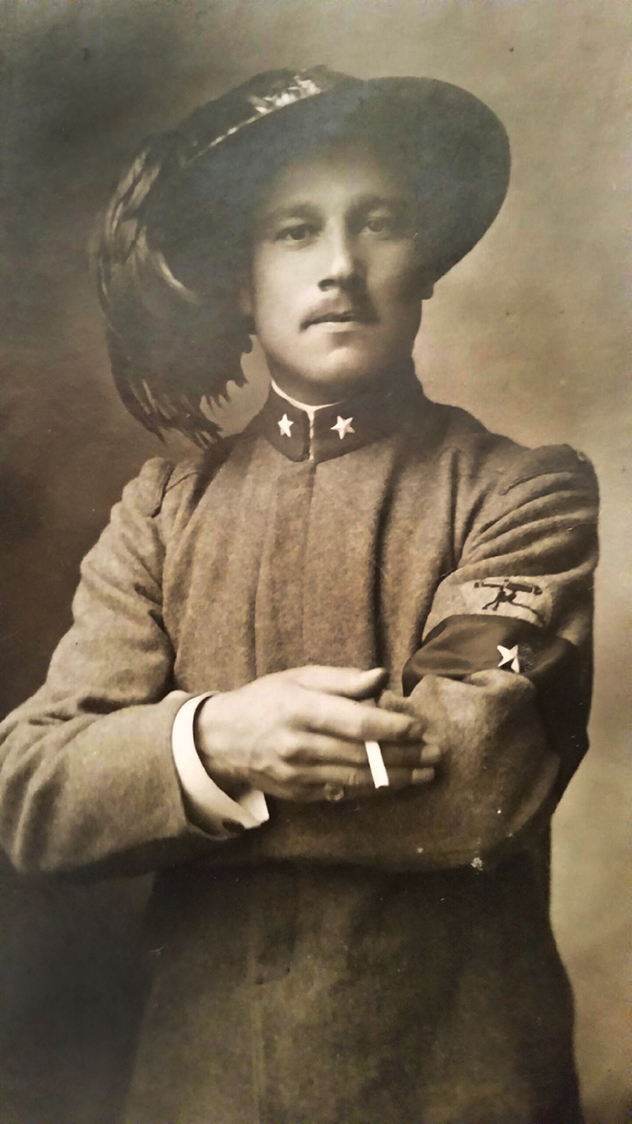
My grandparents, all of them immigrants to the US from Italy, all made wine. (My dad says he was glad to get married and leave the winemaking that went on in his family home behind… but then of course he married my mother, and her family made wine each autumn, too.) Certainly San Martino was important to them all. That’s my grandfather Arturo in the photograph above; he loved his wine, even though he was not supposed to have it because of his stomach ulcers. Back when that photograph was taken, he was a soldier in the Italian army during the First World War. He was part of the Bersaglieri corps (pronounced ber-sal-ee-erree), an elite quick moving infantry unit who wore distinctive plumed caps. I grew up seeing that photograph every day, large and framed and hanging on the wall, knowing that was my grandpa, the same guy I was playing old Italian card games with, also every day, games like Scopa and Briscola, games he probably played with other Bersaglieri when he was a young man in the war.
Grandpa was a prisoner of war in Poland. He never did understand how folks could go to a restaurant and order potato skins. “That’s all we had to eat was potato skins,” he’d tell us. The war he fought in, the Great War, which came to be known as World War I once the second one came around, ended on November 11, 1918, on Martinmas, with an armistice signed at the eleventh hour of the eleventh day of the eleventh month. And so Martinmas soon became known as Armistice Day. Today, we call it Veterans Day, and on this day, we honor all who have served in the armed forces. Many other countries have similar observances at this time of year, with a general theme of remembrance for all who have served their country.
In many ways, this day is but an extension of the Days of the Dead that began at the start of the month. The name Hollantide, in fact, is but a corruption of Hallowtide: the time of the sacred, the time of the holy. November 11 is also the old style date of Samhain, the Celtic new year. With Samhain and the Days of the Dead, from Halloween to All Souls Day, our thoughts go below the earth, just as the natural world is also shifting its energy below the earth. The leaves have flown, all growth now is below, in the roots. This makes for stronger growth above ground come spring and summer: balance. As above, so below. And while Veterans Day honors all veterans, living and dead, certainly those veterans who have passed hold a special place in our hearts. On the 11th of November, we remember them by reciting the words of Canadian poet John McCrae, written during that Great War:
In Flanders fields the poppies blow
Between the crosses, row on row,
That mark our place; and in the sky
The larks, still bravely singing, fly
Scarce heard amid the guns below.
We are the Dead. Short days ago
We lived, felt dawn, saw sunset glow,
Loved and were loved, and now we lie
in Flanders fields.
Take up our quarrel with the foe:
To you from failing hands we throw
The torch; be yours to hold it high.
If ye break faith with us who die
We shall not sleep, though poppies grow
In Flanders fields.
Our thoughts below the earth, yet above, too: poppies, for remembrance. We remember our veterans, we remember our winemakers, we remember all who have come and gone before us in these autumnal days as we continue to turn thoughts and actions inward with winter’s approach. It is natural, it is good.
Image: Arturo DeLuca in his bersaglieri plumes, cigarette in hand. In parades, the bersaglieri do not march, they trot.