Sail Across the Water

Obon

I don’t think of myself as particularly sentimental, but I do get a bit wistful about Obon, the annual Japanese festival of the dead. Any celebration that honors those who have come and gone before us finds a place in my heart. If you’ve been reading the Convivio Book of Days for a while, hopefully it is apparent by now that I am not coming from a sappy, “happy happy” viewpoint of seasonal celebration. We’ll leave that to the greeting card companies. My viewpoint is that the best seasonal celebrations are homegrown, rooted in tradition, available in the everyday… and that there is very often a dark presence involved. I read a lot of books, and someone, somewhere, in one of those books, spoke of a seat for death at all of our celebrations. By acknowledging that our time on this earth is brief, celebration and ceremony take on deeper significance. The dark guest is always with us, so why not invite him in and celebrate something that is common to us all?

This is at the heart of Obon. So how does an Italian American boy in Florida get wrapped up in and wistful about a Japanese festival of the dead? It is geography that is key: All of my Obon experiences have been at the Morikami, an inspiring local museum of Japanese culture. The Morikami is built near the site of the Yamato Colony, an early 20th century Japanese farming community in what is now Boca Raton. The Yamato farmers grew pineapples, but many misfortunes fell upon the colony, and finally, with the Second World War, the land was taken by the US Government and turned into the Boca Raton Army Air Field. George Morikami was, I believe, the only member of the colony to stay. Toward the end of the war, he purchased land west of Delray Beach, just north of the old Yamato colony, and I have older friends who remember Mr. Morikami farming his fields well into the 1970s.

George did well for himself, and before he died, he donated his farmland to the county. It is this land that is home to the Morikami, and it is the Morikami that is home to my memories of Obon. My first Obon was, I think, with my two nephews when they were little boys, and now they both have children of their own… so that first Obon was probably in the late 1980s. And I know I sometimes toss this word magic around quite a lot, but magic indeed is the great potential that comes out of our celebrations: it is the everyday alchemy that transforms the everyday into ceremony. There was no lack of magic at that first Obon.

In Japan, Obon is a summertime festival that goes on for three days, and as it began as a lunar festival, the dates of the celebration vary across the country depending on what calendar system each municipality adheres to in its Obon celebration. Some prefectures celebrate in July, while others celebrate in August. At the Morikami, it was always mid-August, around the 15th… and so for me, Obon is rooted in August. The Morikami also condensed the celebration into one afternoon and evening, rather than the three days it receives in Japan. Since this is Florida and since it was August, the threat of afternoon thunderstorms was always a part of Obon for me, too, lending a bit of excitement to the ceremony, especially since Obon is an outdoor festival. At the Morikami, as in Japan, the community gathers at an open clearing in the village. There is always a street fair (ennichi) and, at the center of the celebration, the yagura, an elevated platform on which taiko drummers and flutists perform. Lanterns are strung from the yagura and traditional folk dances (bon odori) are performed in circular patterns around it. The dances are communal and have names like “Coal Miners’ Dance.”

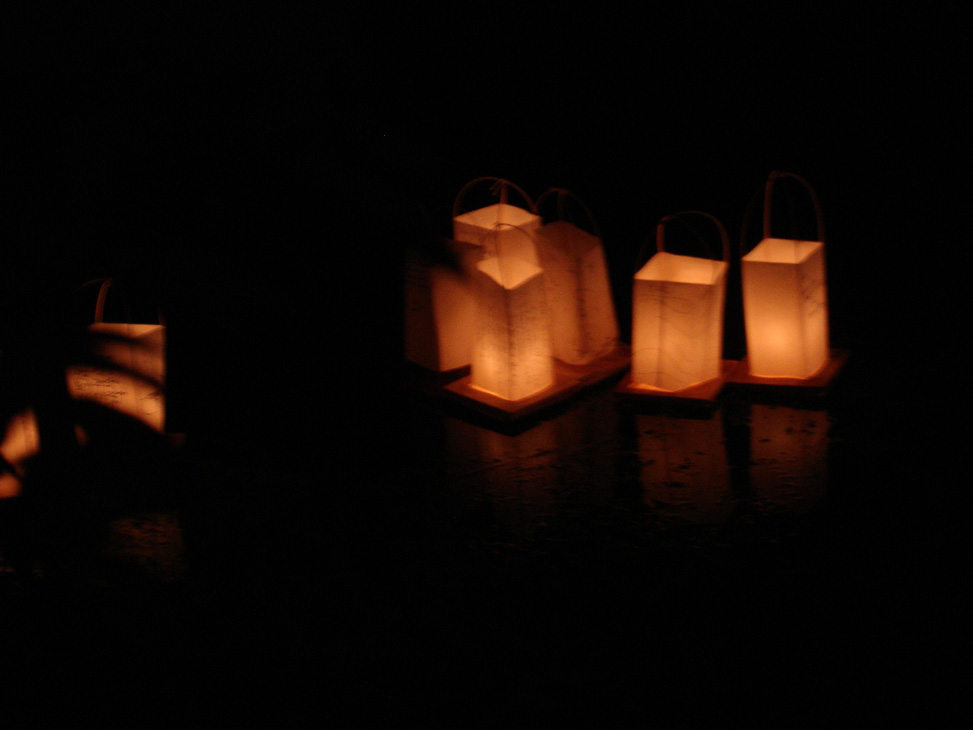
As with most ceremonies, the magic gains strength and intensity as night falls. It is the light from within that becomes most important, our own and that of the lanterns. And with nightfall at the Morikami, and with nightfall on the last night of the festival in Japan, thousands of lanterns are illuminated and set afloat upon the water. This is called Toro Nagashi. Each lantern carries the soul of an ancestor, or of many. It is a breathtaking sight as the lanterns sail across the water, off to the distant shore, to the land of the ancestors, back to their homes across the water until they return again next year.


Image: Lanterns sailing across the water on Morikami Pond. Part of my wistfulness of Obon is that it is no longer celebrated at the Morikami. The celebration has been moved to October and renamed “Lantern Festival”. Certainly in the years since my first Obon, its popularity grew to the point that the crowds were difficult to manage and staff and volunteers were often short tempered and unpleasant. I made the suggestion numerous times that it should be a three-day celebration, as it is in Japan, to spread out those crowds, but my suggestions fell on deaf ears. And now, Lantern Festival? Well. I wonder if the ancestors were consulted.


Friends Weekend

The Book of Days chapter of August 6, for the celebration of the Arrival of the Shakers in America, drew a lot of interest. I don’t share many videos, but I thought you might like this one. It’s about an organization known as the Friends of the Shakers, and the Friends host a couple of work days each year at Chosen Land, the Sabbathday Day Lake Shaker Community, to lend the Community a hand (again, “Hands to work, hearts to God”). And in mid August each year, fast on the heels of the Glorious Sixth, is Friends Weekend.

I actually did two internships with Brother Arnold at the Shaker Press, one in 1996 and the next in 1997. Both of those summers were wonderful, and once Friends Weekend came around, I knew that my summer was wrapping up, and it would soon be time to pack up my belongings and drive the long lonely road back to Alabama for the fall semester. It was always a bittersweet weekend for me.

Michael Graham, Director of the Sabbathday Lake Shaker Museum, reminded me yesterday that this weekend has been Friends Weekend. He also shared this video that I liked so much, I decided I would share it with you, too. The singing of the volunteers in the Herb Department feels a bit over the top, though to be honest, Chosen Land is a kind of place where it’s not surprising to hear someone singing in the least likely place. Shaker music is like that: it’s like water, like air. It’s just part of life when you’re there.

The video is brief and it shows much of what is good about Chosen Land. Sister Frances and Brother Arnold make many appearances in the video, and I recognize many of the other faces, too, from those Friends Weekends that I experienced. The New England accents always make me smile, especially Sister Mildred’s. Sister Mildred, who I never had the pleasure of meeting, for she left this world long before I arrived at Chosen Land. But Brother Arnold speaks of her so often, she’s like an old friend even to me, and that’s her voice you hear in song as the video closes, and perhaps you’ll recognize an old friend in her, too. Enjoy.


And in this Loving Spirit

ShakerBuildings

On the 6th of August in 1774, a slight woman from Manchester, England, arrived in America at New York Harbor with a small band of followers. Her name was Ann Lee, but her followers called her Mother Ann. They called themselves the United Society of Believers in Christ’s Second Appearing, but they became known as Shaking Quakers, a derogatory name given to them by outsiders to describe the whirling and sometimes frenetic dances that were part of their worship. They embraced the name and began referring to themselves as Shakers, and following their arrival in America, the Shaker movement gained momentum. Shaker communities sprouted up throughout New England and west into Ohio, Indiana, and Kentucky. A short lived community was founded even in Florida.

The Shakers became well known for a foundation of their belief that was handed down to them by their founder, Mother Ann: “Hands to work and hearts to God.” This concept made itself manifest in the products the Shakers created, and they became well known for the clean, simple design of their furniture, oval boxes, and poplar ware, and for the exquisite quality of all of their products: not just furniture but also garden seeds, cloaks, confections, and more. They also became known for their progressive and egalitarian ways, referring to God as Mother/Father and giving women leadership roles in each Shaker Community.

In the summer of 1996, I had the privilege of working with the sole remaining active Shaker Community in the country. In the world, actually. It’s at Sabbathday Lake, Maine, in a town called New Gloucester. The spiritual name of the Community is Chosen Land, and to be there, you sense it really is a chosen land. Seth grew up right near there, and that summer, he worked as a tour guide while I worked as an intern in the Print Shop, alongside Brother Arnold Hadd. We printed a biography of Deacon James Holmes, the first printer at Chosen Land, who, in the early 1800s, when he was in his eighties, received a gift of metal type… and then decided the only logical thing to do was to build himself a printing press and teach himself to print. My kind of guy.

Brother Arnold and I labored at this all summer long, always keeping in mind Mother Ann’s words. But on the Sixth of August, Brother Arnold asked if Seth and I would come to dinner and stay for Meeting, for it was, as he called it, “the Glorious Sixth.” We accepted, along with a few other close friends of the Community.

Dinner was wonderful, but this is nothing unusual: every Shaker meal I’ve experienced has been hearty and delicious. After dinner, as the sun began to sink low in the west, we gathered ourselves up and our own small band made its way across the street, from the Dwelling House to the 1794 Meeting House. We took our seats, the Brothers and Seth and me and other men of the world on one side of the room, the Sisters and women of the world on the other. Meeting began and progressed as it always does, with Bible readings and set Shaker songs, and especially, on this night, a song about Mother Ann’s crossing of the Atlantic that begins with “At Manchester in England, this blessed fire began…” And then, testimonies and Shaker spirituals that come from the heart of anyone who wishes to speak up or sing.

Gradually, twilight filled the Meeting House. And as it grew darker, the most amazing thing happened, for me, at least… and to this day I remember distinctly the way the fading light played tricks in my mind as I watched the Sisters sitting across from me and how I could see so many different faces in their own faces, as if the Shakers from the past were there with us, too. Considering the spirit present that night in that sacred space, they probably were.

Celebrating this evening with the Shakers was one of the great privileges of my life, and I know it may very well be the one and only time I get to do so. It was, most certainly, one of the most moving experiences of my life. And so each year this magical date appears on our Convivio Book of Days calendar. Most people read this annual entry and don’t know or care what to make of it, but I mark the day quietly, and I think of my Shaker Family at Chosen Land warmly, especially as night falls upon the land, as all those Shaker Brethren and Sisters from the ages come to visit their old Chosen Land.


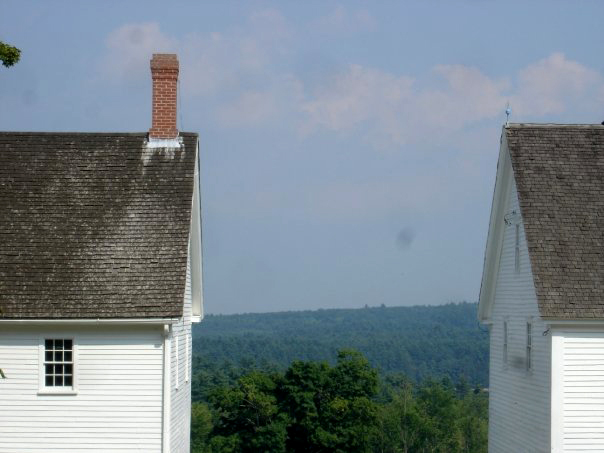
Image: Two buildings at Chosen Land (the Boy’s Shop and the Spin House), with the rolling hills of New Gloucester beyond.

We support the Sabbathday Lake Shaker Community by purchasing the herbal teas and culinary herbs that we sell at the Convivio Bookworks website from them. The Community first began selling herbs and teas in metal tins in the 1860s. To walk into the Herb Department in the Sister’s Shop is intoxicating: The very air is spiced with herbs.