To Our Home Beneath the Sea

Neptune

We are in the midst of the Dog Days of Summer, ruled by Sirius, the Dog Star. These are traditionally considered the hottest days of the year here in the Northern Hemisphere––a long stream of them that began when July was new. The Dog Days are not over until we get past August 15.

It is here, about halfway through those Dog Days, that the Romans placed the Feast of Neptunalia and Salacia, honoring Neptune, the sea god, and his wife Salacia, goddess of the salty sea. In Rome, the holiday was spent pretty much just as we today would spend a typical summer holiday: by the sea. Water and wine were important aspects of the celebration as well as general merrymaking. The goal was simple: Escape the persistent heat of summer.

If you are on holiday yourself during these Dog Days of Summer, and particularly if it is today, be sure to raise your glass (whether it contain water or wine) to Neptune and Salacia. Toast the sea, honor water and all it means to us.


Image: Triumph of Neptune Standing on a Chariot Pulled by Two Sea Horses. Mosaïque d’Hadrumète (Sousse), mosaic, mid-third century AD. Musée archéologique de Sousse.


Tagged

For Forty Days…

Shishkin Rain in an Oak Forest

St. Swithin’s Day, if thou dost rain,
For forty days it will remain;
St. Swithin’s Day, if thou be fair,
For forty days ’twill rain nae mair.

So goes a bit of British weather lore for St. Swithin’s Day, the 15th of July. Potentially forty days of rain may seem a lot to bear, but not, perhaps, to St. Swithin, who, before he died, asked to buried just outside the walls of the cathedral that was his home, so that raindrops from the eaves of the roof could fall upon his grave.

St. Swithin was a 9th century Anglo-Saxon bishop of Winchester, and he was buried, as requested, outside Winchester Cathedral. The poor fellow has not had a very restful sleep, however. His body was moved to an indoor shrine in 971––apparently accompanied by a great downpour, which some took as an expression of Swithin’s unhappiness with this change of residence. His relics have been disturbed and moved about many times since.

There is some truth, it is said, to the weather lore for St. Swithin’s Day, for the jet stream over Britain tends to follow a regular pattern at this time of year, dictating the weather patterns for the next five to six weeks. Should the jet stream lie north of Britain, the weather will typically be clear and mild. Should the jet stream lie across or south of Britain, stormy weather may be expected as rain moves in from the Atlantic. And so science seems to confirm the weather lore. Or else St. Swithin just really loves a rainy day.


Image: Rain in an Oak Forest by Ivan Shishkin. Oil on canvas, 1891, [Public domain] via WikiMedia Commons.

 

Letters to the Stars

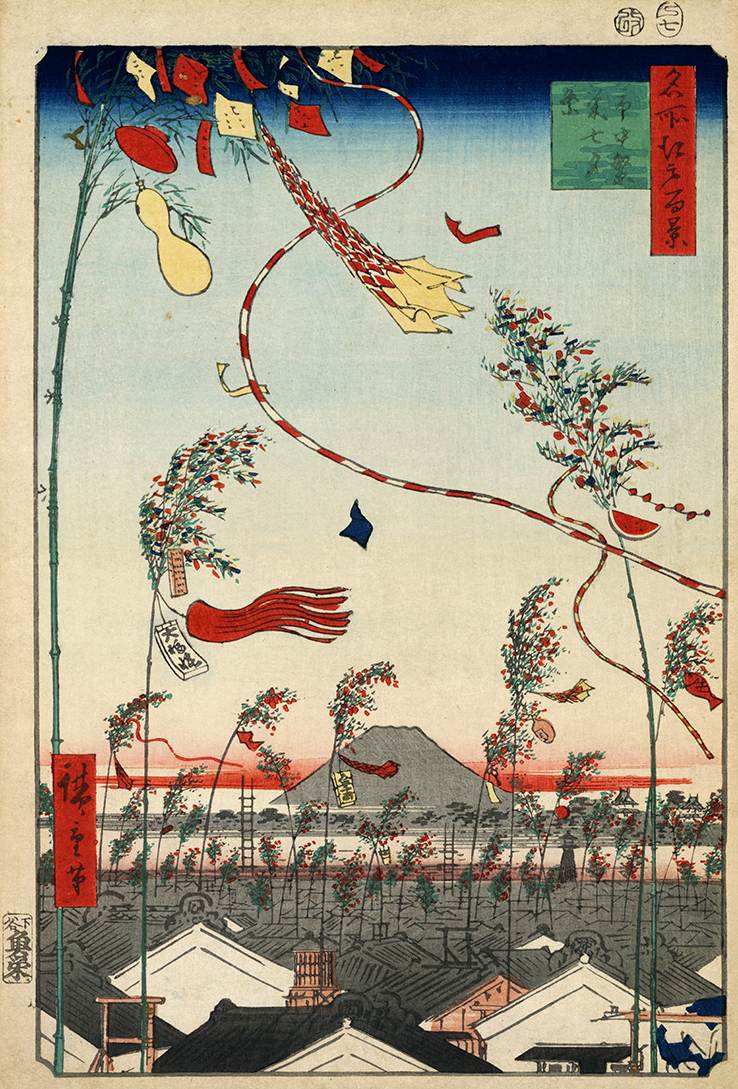
Hiroshige_The_city_flourishing, _Tanabata_festival,_1857

On the seventh day of the seventh month we’d do well to look up at the nighttime sky for the stars Vega and Altair. It is the night of Tanabata, a Japanese star festival based upon the story of Orihime (Vega, the Weaver Star) and Hikoboshi (Altair, the Cowherd Star), lovers separated by the Milky Way. They can meet only once each year on this, the seventh night of the seventh month.

Here on Earth, we celebrate by writing wishes on strips of paper and tying them to the trees. Bamboo is traditional, but any tree will do. And any wish will do. If the wish is yours, write it down, place it in the branches. Perhaps your wishes will be carried off into the heavens, or at least be made known to the elements, and perhaps your wishes will come true.

As for the lovers, here is their story: Orihime was the beautiful daughter of the Sky King, Tentei. She wove beautiful cloth on the banks of the Amanogawa, the Milky Way, and her father loved the cloth she wove, and so she worked very hard to make enough for him so that he would always have plenty of it. But Orihime worked so hard at her weaving that she never had time for anything else. As much as Tentei loved the cloth Orihime wove, he knew she needed some balance, some time away from her work, and so he arranged for her to meet Hikoboshi, the Cow Herder, who lived on the other side of the Amanogawa.

Well, it was love at first sight if there ever was such a thing. The two soon married, and that was wonderful, but Orihime pretty much gave up her work at the loom, and as for Hikoboshi’s cattle, well, they were soon roaming all over Heaven. Tentei grew angrier and angrier over this new turn of events, and finally put his foot down. He separated the two lovers on either side of the Amanogawa and forbade them to see each other. Orihime despaired over the loss of her husband. Moved by his daughter’s tears, Tentei relented. But he allowed the two lovers to meet only once each year, on the seventh day of the seventh month. And so it goes each year.

There are variations of the story, and even variations of the day of celebration. In some parts of Japan, Tanabata is celebrated in August. Obon, another Japanese summer celebration, is also celebrated at different times in different parts of the country.

The trees at Tanabata are decorated not just with wishes on paper, but also origami and other decorations made of paper. How beautiful. And if you have a wish, make it known. Put pen to paper, write a letter to the stars. Part of making wishes come true is placing them outside yourself, giving them to Tentei, to the universe.


Image: The City Flourishing, Tanabata Festival by Hiroshige. Ukiyo-e print on paper, 1857, [Public domain] via WikiMedia Commons.