I don’t think of myself as particularly sentimental, but I do get a bit wistful about Obon, the annual Japanese festival of the dead. Any celebration that honors those who have come and gone before us finds a place in my heart. If you’ve been reading the Convivio Book of Days for a while, hopefully it is apparent by now that I am not coming from a sappy, “happy happy” viewpoint of seasonal celebration. We’ll leave that to the greeting card companies. My viewpoint is that the best seasonal celebrations are homegrown, rooted in tradition, available in the everyday… and that there is very often a dark presence involved. I read a lot of books, and someone, somewhere, in one of those books, spoke of a seat for death at all of our celebrations. By acknowledging that our time on this earth is brief, celebration and ceremony take on deeper significance. The dark guest is always with us, so why not invite him in and celebrate something that is common to us all?
This is at the heart of Obon. So how does an Italian American boy in Florida get wrapped up in and wistful about a Japanese festival of the dead? It is geography that is key: All of my Obon experiences have been at the Morikami, an inspiring local museum of Japanese culture. The Morikami is built near the site of the Yamato Colony, an early 20th century Japanese farming community in what is now Boca Raton. The Yamato farmers grew pineapples, but many misfortunes fell upon the colony, and finally, with the Second World War, the land was taken by the US Government and turned into the Boca Raton Army Air Field. George Morikami was, I believe, the only member of the colony to stay. Toward the end of the war, he purchased land west of Delray Beach, just north of the old Yamato colony, and I have older friends who remember Mr. Morikami farming his fields well into the 1970s.
George did well for himself, and before he died, he donated his farmland to the county. It is this land that is home to the Morikami, and it is the Morikami that is home to my memories of Obon. My first Obon was, I think, with my two nephews when they were little boys, and now they both have children of their own… so that first Obon was probably in the late 1980s. And I know I sometimes toss this word magic around quite a lot, but magic indeed is the great potential that comes out of our celebrations: it is the everyday alchemy that transforms the everyday into ceremony. There was no lack of magic at that first Obon.
In Japan, Obon is a summertime festival that goes on for three days, and as it began as a lunar festival, the dates of the celebration vary across the country depending on what calendar system each municipality adheres to in its Obon celebration. Some prefectures celebrate in July, while others celebrate in August. At the Morikami, it was always mid-August, around the 15th… and so for me, Obon is rooted in August. The Morikami also condensed the celebration into one afternoon and evening, rather than the three days it receives in Japan. Since this is Florida and since it was August, the threat of afternoon thunderstorms was always a part of Obon for me, too, lending a bit of excitement to the ceremony, especially since Obon is an outdoor festival. At the Morikami, as in Japan, the community gathers at an open clearing in the village. There is always a street fair (ennichi) and, at the center of the celebration, the yagura, an elevated platform on which taiko drummers and flutists perform. Lanterns are strung from the yagura and traditional folk dances (bon odori) are performed in circular patterns around it. The dances are communal and have names like “Coal Miners’ Dance.”
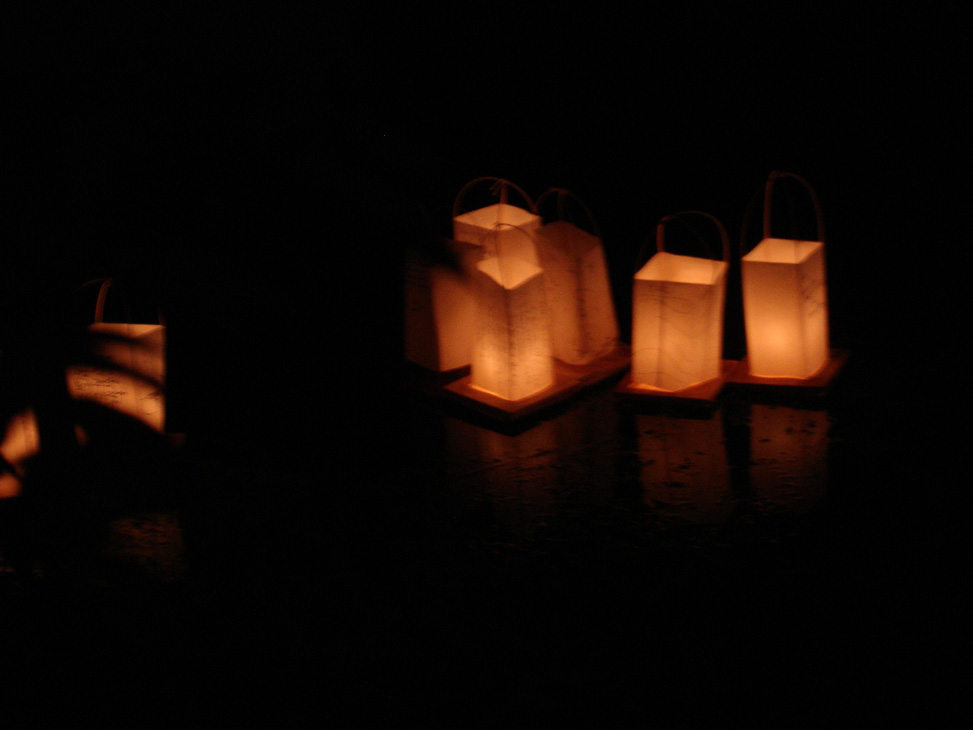
As with most ceremonies, the magic gains strength and intensity as night falls. It is the light from within that becomes most important, our own and that of the lanterns. And with nightfall at the Morikami, and with nightfall on the last night of the festival in Japan, thousands of lanterns are illuminated and set afloat upon the water. This is called Toro Nagashi. Each lantern carries the soul of an ancestor, or of many. It is a breathtaking sight as the lanterns sail across the water, off to the distant shore, to the land of the ancestors, back to their homes across the water until they return again next year.
Image: Lanterns sailing across the water on Morikami Pond. Part of my wistfulness of Obon is that it is no longer celebrated at the Morikami. The celebration has been moved to October and renamed “Lantern Festival”. Certainly in the years since my first Obon, its popularity grew to the point that the crowds were difficult to manage and staff and volunteers were often short tempered and unpleasant. I made the suggestion numerous times that it should be a three-day celebration, as it is in Japan, to spread out those crowds, but my suggestions fell on deaf ears. And now, Lantern Festival? Well. I wonder if the ancestors were consulted.