The League of Italian Grandmothers

MomGrandmaSanAntonio

With the possible exception of the three years I spent in Alabama, I have always lived in places where it is common to see religious statues in front yards. St. Francis is one you see often. But if we’re talking about a statue of the Blessed Mother or of St. Joseph or St. Anthony, and especially if it’s enclosed in a little enclave, most especially if a spotlight is trained on the statue at night, well, chances are very good that these are my people. We Italians love our saints, and it’s hard to say which is most beloved… but surely a contender for that top spot would be San Antonio, St. Anthony of Padua.

He is a populist, a saint of the people, a saint you can talk to, one who will help you with trivial matters. Finding lost car keys, for instance, or anything at all you’ve misplaced… St. Anthony is there, ready and willing to come to your aid. Case in point: one Labor Day, on a family trip to the beach, when my nephew lost the same gold bracelet off his wrist not once but twice in the surf, my mother retrieved said bracelet both times after praying to St. Anthony. We’re talking needle in a haystack here, folks. Mom swears by St. Anthony’s helpful powers to find lost articles. You may even be familiar with the old children’s rhyme: Tony, Tony come around, something’s lost and must be found. If you’ve ever said that, it’s St. Anthony you’re invoking, and he’s all too happy to assist in your trivial worries. He is an all-around good guy and today, June 13, we celebrate the feast day of San Antonio.

What I remember most about June as a boy was Grandma sitting in a folding upright lawn chair in front of our statue of St. Anthony, which was in the back yard. Grandma always sat in the upright chairs; never a lounge or God forbid a sand chair (she’d never get out of one of those), and in June, her chair was there in front of St. Anthony and in her hands were her little prayer books printed at the orphanage of San Antonio in Italy that she supported and usually a rosary, as well. She sat there for what seemed to me hours. And very often she would have a friend over doing the same thing, a friend just like her, muttering prayers in Italian into the thick summer air.

They were saying their Novena to San Antonio. Novena as in nine. It is a prayer that is said for nine consecutive days, and there are variations of the novena: it could be offered for St. Anthony’s general intercession in a problem in your life or it could be offered for no reason in particular or it could be offered even to help you find something, though one would think after nine days you might move on (the novena does even offer this option as a viable suggestion: St. Anthony, perfect imitator of Jesus, who received from God the special power of restoring lost things, grant that I may find [name the item] which has been lost. At least restore to me peace and tranquility of mind, the loss of which has afflicted me even more than my material loss.)

St. Anthony was born in Lisbon in the late 12th century but spent most of his life in Italy. He was an early Franciscan: cowled brown habit, sandals, tonsured haircut. He is known for many miracles, one of the best known being his preaching to the fishes, who gathered in great numbers to hear St. Anthony speak. He preached to the fishes after trying first preaching to people, but they weren’t much interested at the time, so he took his lesson to a nearby body of water and found a more receptive audience… which then impressed the people enough that they began listening.

The feast day of St. Anthony is a day that, for me, always calls to mind Italian grandmothers, which were the only kind of grandmothers I knew as a boy. Occasionally I would meet a grandmother who wasn’t Italian if I went to a friend’s house after school, and I would be a little taken aback sometimes if their Grandma was tall or spoke good English. And one thing all of these Italian grandmothers seemed to have in common, whether they were my grandmothers or a cousin’s, was this devotion to St. Anthony. There may have been one summer day I recall when Grandma was joined by three or four of them, all saying their novenas, all sitting on folding upright lawn chairs, all muttering in Italian, lips moving just slightly, eyes fixed lovingly upon the statue of St. Anthony in his little enclave in our little back yard.

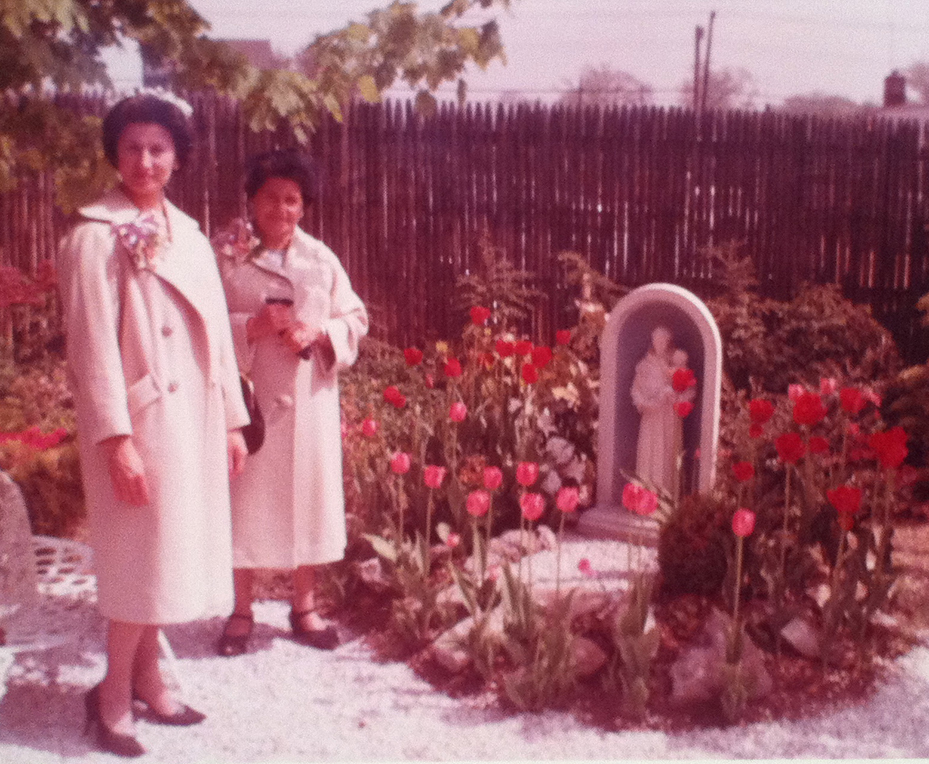
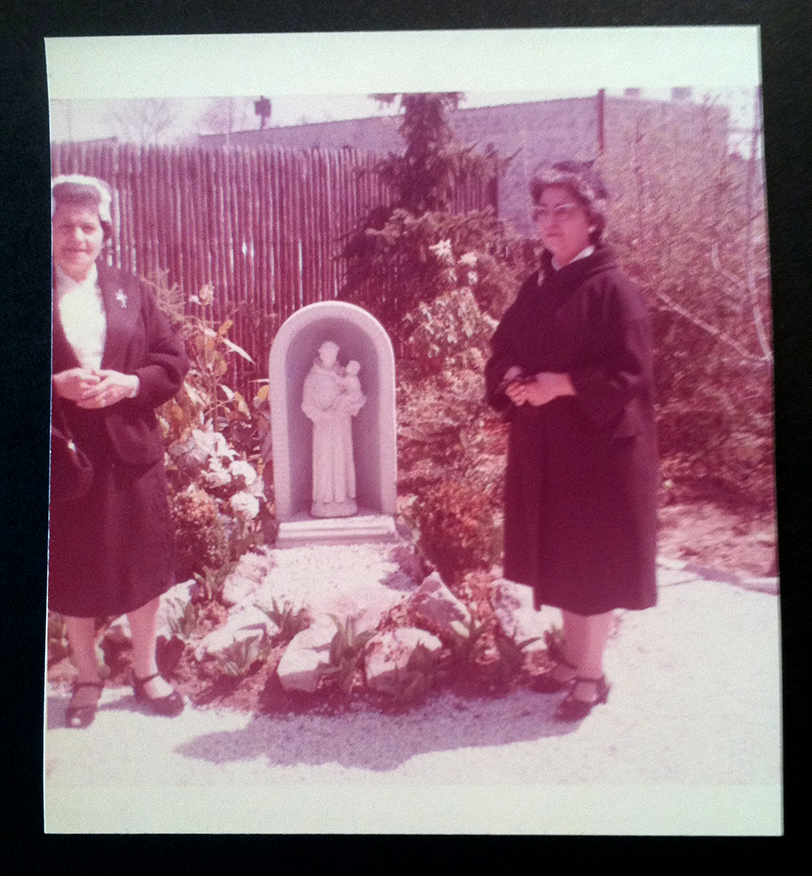
The image above is of Mom and Grandma with corsages and fancy coats, posing near San Antonio, for my sister’s first communion, and below, that’s Grandma with one of any number of her friends, all Italian, and all of whom were referred to as “Cummara”.

 

GrandmaAndCumara 


Inspiration

Inspiration

My very first Sunday Meeting at the 1794 Meeting House at Chosen Land, the Sabbathday Lake Shaker Community in Maine where I interned as a printer in the late 90s, happened to be on Pentecost Sunday. It was a blustery day, the sort of day when laundry left on the line to dry takes on a life of its own, the shirts and dresses and jeans dancing with each other as they catch the breeze and fill and empty of air and sunlight.

The Shaker Meeting House at Chosen Land is modest but beautiful in its simplicity. I entered on the left side, for this is the door through which the men enter. The women enter on the right. The room you enter into is large and uninterrupted by posts or columns; the roof is supported by boxed beams that span across the room. The walls are white plaster and the wooden beams and original benches are painted blue. The blue takes your breath away. It is the original milk paint, dyed with Maine wild blueberries, from 1794. The floor is wide plank wood. To look at it and to step upon it is to think of all the Shaker brothers and sisters who walked and danced and twirled upon it throughout its history. All these years later I still think of that wood floor and think of doing rubbings of it for a book project someday. History has seeped into every corner and crevice of this building, and this is the building I’d stepped into that First Sunday of Pentecost in 1996.

If you’ve never been to a Shaker Meeting (and chances are good, I realize, that you haven’t), here’s what happens: Sister June reads a prayer to open Meeting, then Sister Frances announces which set song will be sung from the Shaker Hymnal. There are three Bible readings. And then Brother Arnold will say a few words about their founder, Mother Ann Lee, and remind everyone to “not feel strange or a stranger.” And this is an invitation for spontaneous songs and testimonies. The songs are any of thousands of Shaker songs handed down orally through the years. And the testimonies are from the heart, inspired by the atmosphere of the Meeting.

Pentecost never meant much to me but it did after that day. Father Bob Limpert, an Episcopal minister from New York, was there, and the Shakers let him give a more formal sermon. Father Bob was inspired by that blustery day to talk about the relationships between words like gust and ghost and of course it was Pentecost, the day the Church celebrates the coming of the Holy Spirit… which, when I was a kid, was better known as the Holy Ghost. And here was this day of gusting wind ushering in holy ghosts of all kinds in this old building dripping with history: gust to ghost to spirit. And spirit brings us to inspiration.

And this always reminds me of one of my favorite professors from college, Myriam Swennen Ruthenberg, who, in an Italian Literature class, perhaps over Dante or Bocaccio or di Lampedusa, spoke one day of the connections between words, too. Her words that day were the Italian versions of respiration and inspiration and their common Latin root: spirare, breath. We breathe in and out in the act of respiration, but we also breathe in and out inspiration: we are inspired by what we take in, and what we exude or breathe out hopefully inspires others.

If you’ll follow along on my winding trail, these things all connect: the gust and ghost of Father Bob, the breathing in and out of Professoressa Ruthenberg. All are not so much of the earth as they are of the air (ghost/gust/spirit/breath/respiration/inspiration) and so they lack heaviness and instead are light and ethereal. Inspiration comes to us sometimes as fleeting as breath, a ghost seen just briefly from the corner of the eye.

Image: Taking a deep breath, crossing into the unknown. A 16th century engraving from the dust jacket of the book The Discoverers by Daniel J. Boorstin.


Your June Book of Days

June14CalendarImage

It strikes me for the first time ever (I can be a little slow, on occasion) that readers of the Convivio Book of Days Blog might be interested in the monthly calendar that I design. It’s printable so you can print it out on standard 8.5″ x 11″ paper (standard in the US, at least) and pin it to your wall. A real wall, with a real pin. We are big on “real” here at Convivio Bookworks.

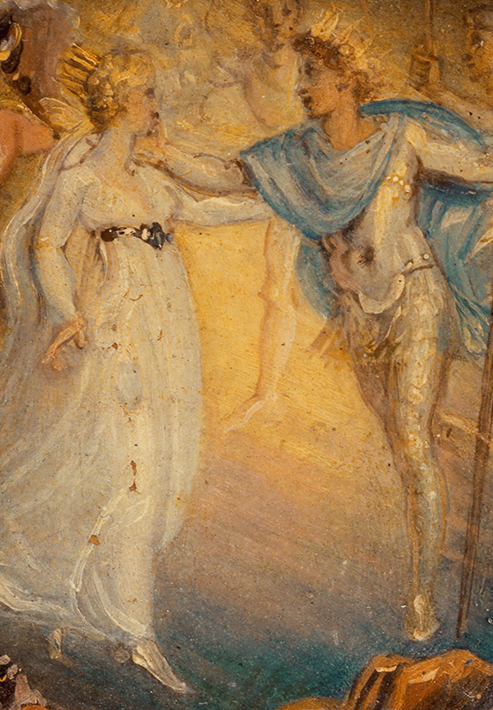
These monthly calendars are the foundation of the Book of Days project. The first one was in October 2003. You’ll find all of the old calendars at www.conviviobookworks.com in the Book of Days Archive pages. This month’s Book of Days calendar focuses on one of my favorite Shakespearean works, A Midsummer Night’s Dream, for this is the month for such dreaming. It’s a month where the traditional reckoning of time gets confusing for people: How can midsummer come at the start of summer? The calendar explains, as will the chapters that will be published this month here on the blog, especially as we get to St. John’s Day, the counterweight to midwinter and Christmas. The year is all about balance in a circular nature. It’s all about seeing things slightly differently. We become better for doing so.

Here’s that link once more:
http://www.conviviobookworks.com/Images/June2014.pdf