Enter the Gift Bearers

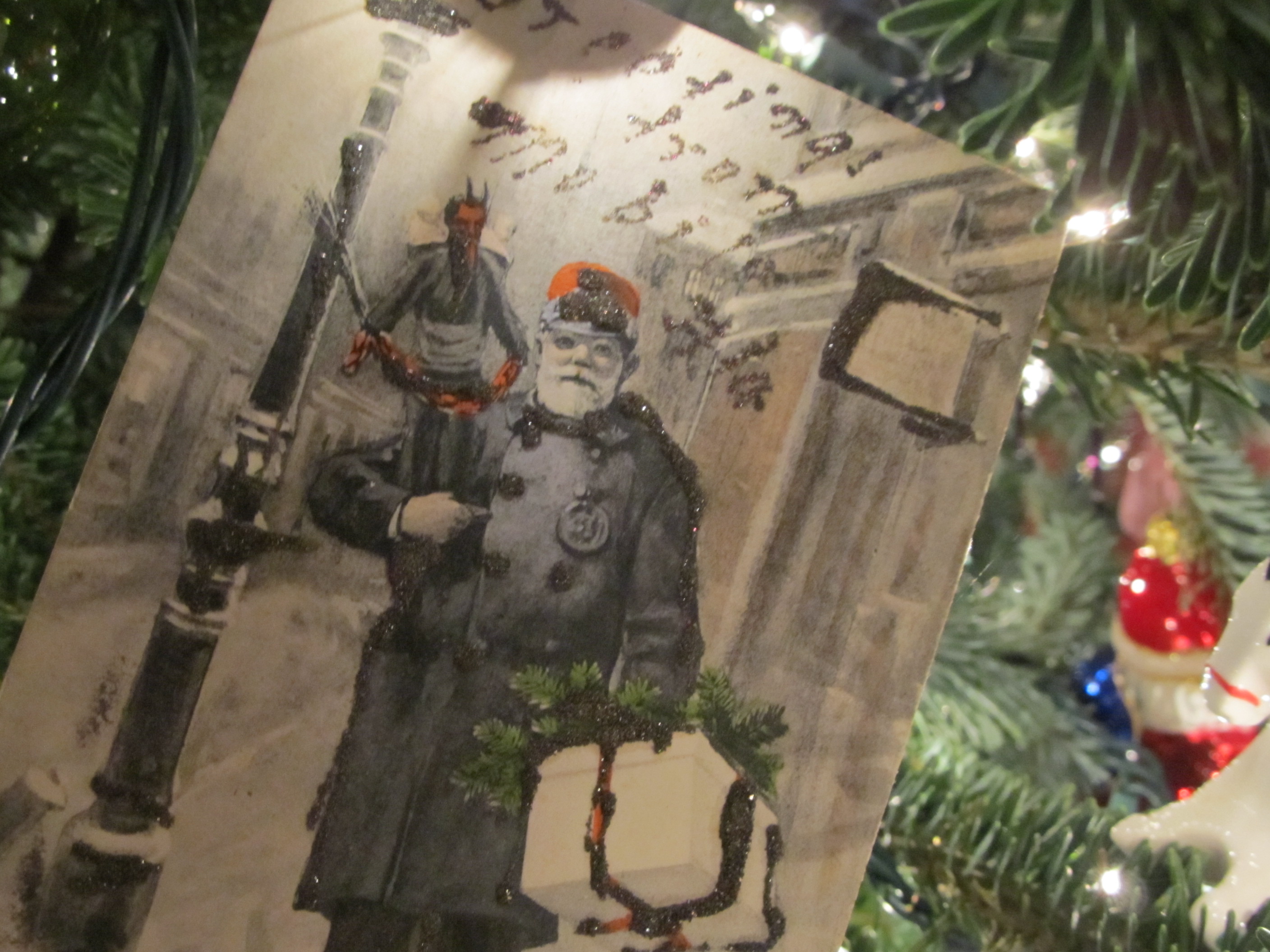
Postcard St Nick

The first of the winter Gift Bearers arrives on the 5th of December: St. Nicholas. He is a much older cousin of the American Santa Claus, but there are striking similarities. On the Eve of St. Nicholas, which is tonight, children throughout Europe would traditionally place their shoes by the chimney before going to bed for St. Nicholas to fill with gifts, as well as set out carrots and hay for his donkey. Good children might wake up the next morning to find their shoes filled with fruits and nuts and sweets.

St. Nicholas’s feast day is celebrated on the 6th of December. He is sacred to countries throughout Europe, but especially to Russia, Greece, the Netherlands, Germany, and Italy. Nicholas was a bishop of Myra, in southern Turkey, in the fourth century. He is most famous for his generosity, and this, perhaps, is the reason he is connected with the bestowing of presents. One story that has come down through the ages tells of three sisters who were without dowries, for their father was very poor. The situation became so desperate that the father decided his only option was to sell his daughters into prostitution. Nicholas heard of the problem and took action: one night as the household lay sleeping, he tossed a bag of gold through the open window, and suddenly the eldest daughter had a dowry. In time, he did the same for each of her sisters, too. He bestowed these gifts in secret, until the third time, when the father of the girls caught him in the act. He was forever grateful to the good bishop, and thus the legend of St. Nicholas as a gift bearer began.

The Eve of St. Nicholas and its related traditions are, in some places, of greater importance than the arrival of Santa Claus on Christmas Eve. Santa is a relative newcomer compared to St. Nicholas. And one thing St. Nicholas has that Santa doesn’t is a dark companion. He goes by many names throughout Europe: Knecht Ruprecht, Black Peter, Pelznickel… but this dark companion is best known as Krampus. In fact, the 5th of December is known in some parts as Krampusnacht. Krampus is most often depicted with horns on his head, a very long tongue, and cloven hooves or sometimes one human foot and one goat foot. The punishment by Krampus is pretty harsh: he carries switches and rusty chains for the express purpose of swatting naughty children, and then he’ll stuff them in a sack or a basket and carry them off to hell. Serious stuff. And while the American Santa Claus has to do it all––reward good children with gifts and punish naughty ones with coal––you might think of St. Nicholas as a wiser man, a delegator: he gets to take care of the good kids, but he gives the task of punishing the bad ones to Krampus.

So do be good. St. Nicholas would love to fill your shoes with fruits and nuts and sweets tonight. And if you’ve been bad…. Beware the Krampus!

Our image is from an old penny postcard sent to us by our good friend Linda Dailey in Maine. Is it St. Nicholas garbed in modern day clothing rather than his traditional bishop’s robes? Perhaps. And that, for sure, is a Krampus doll in his hands, just to remind us all to be as good as we can. Sweet dreams.


Preparing

Preparing

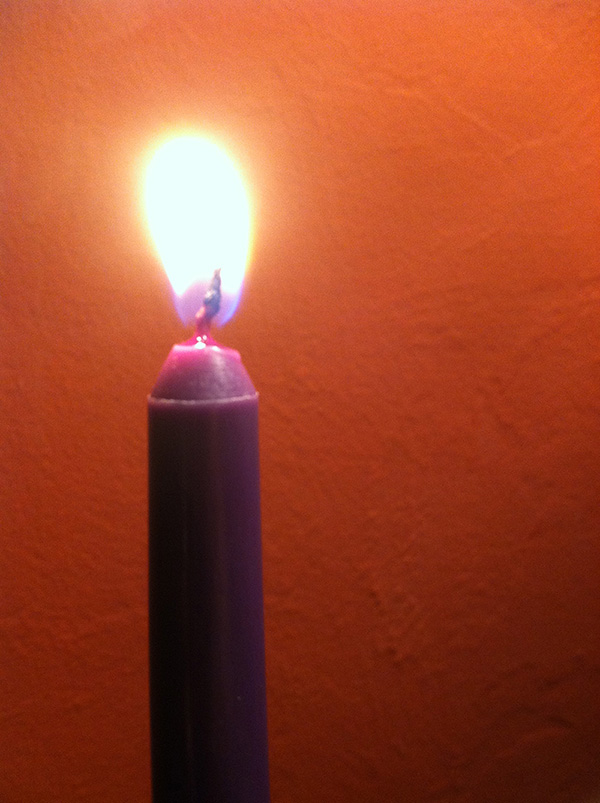
Today begins the Advent season, a time of preparation for Christmas. Here in the Northern Hemisphere, the nights grow increasingly darker on the road toward the Winter Solstice, and we counter that increasing darkness by increasing light from within. The sun may be growing weaker, sinking lower and lower in the sky, but each Sunday, beginning tonight, we light more and more candles in our homes. The tradition in most places is a ring of four candles, three of which are purple, one rose (or pink). Some cultures use three blue candles and a white one in place of the purple and rose candles, but the sentiment is the same. The first purple candle is lit tonight, on the First Sunday of Advent: one candle in the darkness. Come the Second Sunday, we light two purple candles. The Third Sunday of Advent is known as Gaudete Sunday and we light those same two purple candles plus the rose one, to symbolize a hint of joy and greater excitement as we get closer to Christmas. And on the Fourth Sunday of Advent, all four candles are lit. By then, we are deep into the darkest nights of the year, and our four candles are quite a beacon of light, and of hope.

This year, the Fourth Sunday of Advent happens to be the day after the Winter Solstice, which will occur on the 21st of December: the bleak Midwinter. In our brightly illuminated 21st century world, it can be easy to fall out of sync with the ever changing push and pull of our planet’s cycles of darkness and light, but it is this constant rearrange that is at the heart of so many of our customs and celebrations, the ceremonies of each day. Imagine a time before electricity, and it’s easy to understand the power of these cycles.

Earlier on, Advent began on the 12th of November, the day after Martinmas, and was a time of fasting in the Catholic Church in preparation for Christmas. This is no longer the case, even in the Church, but the idea of preparation, making our homes (and hearts) as fair as we are able, continues. In this house, we are firm believers in the idea that in order to fully appreciate the joy of Christmas, you need to set the stage for needing joy. This is the value of Advent. It doesn’t matter if your approach is a religious one or a secular one. Advent is a good time to do things with care. It’s a good time to make amends. If there are wrongs in your life, it’s a good time to make things right. Approach these darkening nights with this spirit of openness and thanksgiving and your joy at Christmastime, when it arrives, will be great indeed.

Giving Thanks

November

There is little need to write much about a day like Thanksgiving; we know this day well, like an old family friend who visits each November. It is universally American, non denominational, and we strive each time it comes around to make it the best we can. There is much fretting over the meal, how best to cook the bird, decisions to be made over the stuffings and whose pumpkin pie recipe to use and whether the cranberry sauce will come out of a tin or made from scratch. The fretting is as much a tradition as the meal itself. But some years we approach Thanksgiving with, for one reason or another, a greater spirit of thanks. This is our approach this year. We have much to be thankful for, and it doesn’t matter what is on the table as long as there is love and harmony amongst the people gathered round that table. From us, to you: we wish you every blessing. Happy Thanksgiving.