The Slow Christmas Movement

Advent

My neighbor Mr. Solderholm is a grumpy old Swede who can easily muster up a rant over just about anything. A good guy when you get right down to it, but you don’t want to get in his way or cross him, even accidentally. I am nothing like Mr. Solderholm and we both know this and we respect each other’s ways, but if there is one time of year where I sense a bit of Solderholm-style ire creep into my being, it’s usually about now: I find myself grumbling and shaking my fist at houses that are all decked out for Christmas in mid-November, a season for Indian corn and pumpkins, not holly and balsam. I think it’s because I am always championing the little guy, and Thanksgiving, it seems to me, is one of those little guys: an all around nice holiday that gets a bit trampled by the bigger holiday that follows it. I do not, however, want to be as disagreeable as Mr. Solderholm. What I want is to encourage folks to give Thanksgiving its due and to take the rest as it comes.

Today’s installment of the Book of Days is simply an invitation to you all: Join us in what we call “The Slow Christmas Movement.” Rather than rush headlong into Christmas the day after Thanksgiving (or even earlier), we invite you to take your time and appreciate the approach.

What comes after Thanksgiving and before Christmas is Advent: a time of preparation. We prepare our houses, we prepare ourselves––heart, mind, soul––we set the stage for joy to enter at Christmas by making it welcome and appreciating its presence. There are songs for Advent, our favorite being a carol called “People, Look East” that is set to an old French air known as Besançon. These are the lyrics for the first verse:

People, look east. The time is near
Of the crowning of the year.
Make your house fair as you are able,
Trim the hearth and set the table.
People, look east and sing today:
Love, the guest, is on the way.

It may be my instinctual desire for things domestic that makes me like that carol so much. If there was a verse about polishing the copper, I’d be right at home. What that carol speaks of, mostly, is preparing, and I think preparing is an important part of ceremony and celebration… which may be why I like Advent so much.

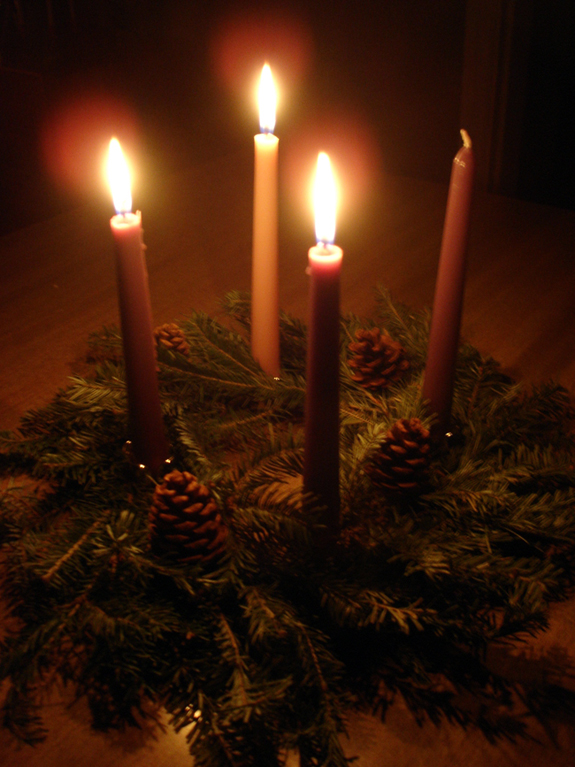
My grandparents used to get their Christmas tree on Christmas Eve. This is most traditional, and while Seth and I don’t wait quite that long, we are usually visiting our friends at the tree lot quite a bit later than most people. Here’s what you’ll see at our house before the tree arrives: candles in the windows, and an Advent calendar and Advent candles nearby. We light the traditional Advent wreath each of the four Sundays of Advent, we light a daily Advent candle each evening during dinner, and we open a window of our Advent calendar each evening, too. These are slow, simple and meaningful ways to mark the days as we approach the solemnity and the celebration of Christmas… which, of course, begins its own twelve days of celebration.

What’s odd nowadays is that the dominant culture celebrates Christmas before it actually begins, and then shuts things down well before Christmas is over. Old Mr. Solderholm once punched a man in the nose for tossing out his Christmas tree on the 26th of December. Granted, there were some other things going on between them, too, but it was the tree on the curb that instigated the argument that finally pushed Mr. Solderholm over the edge. And while I would never go as far as to punch a man in the nose over anything, there is a part of me that applauded Mr. Solderholm for that act as he stood up to defend the sanctity of old traditions. We may not see eye to eye on most things, he and I, but we do seem to agree on the importance of taking things slowly and respecting the traditions of the ceremonies we keep.

The Slow Christmas Movement means keeping Thanksgiving and keeping it well and keeping Christmas, too, but in its own time. Do so and here’s something else that happens: you almost magically have more time to enjoy everything. Thanksgiving retains its independence, Advent prepares you for “Love, the guest,” and sure, there may still be a frantic rush to the 25th of December… but once it has passed, there are twelve days of Christmas still ahead to celebrate with good food, good company, and good spirit. There is no rush.

*

At our website, www.conviviobookworks.com, you’ll find all kinds of traditional German Advent calendars (the ones with lots of glitter you remember from your childhood) as well as British ones, and some very lovely Advent candles, two of which are handmade in England.
Martinmas

Salute

Here in the United States, November 11 is Veterans Day, a national holiday honoring all who have served in the military. Older folks remember it as Armistice Day, which began as a commemoration of the formal ending of World War I, or the Great War, as it was known before World War II. It was to be the war to end all wars…. which, of course, has not been the case. Still, the armistice that ended that war, signed at the eleventh hour of the eleventh day of the eleventh month of 1918, is, in countries on both sides of the Atlantic, remembered today. In 1954, Congress replaced the word “Armistice” with “Veterans,” and this is the name we have given this national holiday ever since.

The day marks a much older celebration, though. November 11 is the feast of St. Martin of Tours, who also happened to be a veteran, but of the Roman army. He was born in 316 in the part of the vast Roman Empire that is now Hungary and became a soldier when he was a young boy. He was part of the imperial calvary (which is why he is often depicted on horseback) and was sent to serve the empire in Gaul (which is now France). At some point, though, Martin had a change of heart: he converted to Christianity and became a pacifist and refused to fight. He was imprisoned for the pacifism he preached, but eventually was released. He became a monk and founded a monastery there in France.

Many of the legends that revolve around St. Martin happen to involve wine. The best known story is of him coming across a disheveled drunken man shivering in the cold on a bitter winter’s day; Martin saw the man, took off his own woolen cape, cut it in two with his sword, then wrapped one half around the cold man to warm him. In the Middle Ages, he was one of the more popular saints and became a patron saint of all kinds of folks, from tailors to innkeepers to the French monarchy… but perhaps St. Martin is best known as patron saint of grape growers and winemakers, and even of those who delight in wine (sometimes even of drunkards).

It is no wonder, then, that St. Martin’s Day, or Martinmas, has become associated with wine. It is the day to taste the year’s new wine, which has been fermenting by now for only a few weeks. French Beaujolais wines are still, to this day, released on or around Martinmas. His day is also the last big religious feast day before Advent, which was, in earlier days, a time of fasting, and so it was also a day for a good, hearty meal, often of goose or turkey––essentially, a meal of thanksgiving for the harvest. Traditional Martinmas foods include goose and turkey, and also chestnuts and very hard biscotti, some of which are baked not just twice but three times. Hard as rocks? You bet. But there’s a reason for that: Biscotti di San Martino are meant to be dunked in that new wine that we’re drinking on his day.

In the parts of Europe that most thoroughly celebrate St. Martin’s Day, it is often a time of warmer weather, the last bit of it before the full onset of winter. Kind of like Indian Summer in America, it’s known in Italy, for instance, as l’estate di San Martino (St. Martin’s Summer). But this mild weather tends to be fleeting. Colder nights lie ahead and with Martinmas we find ourselves, by traditional reckoning of time, at the natural start of winter. It is, until Yuletide, a time of increasing darkness. The living world continues its process of shutting down and receding into itself: going underground. Trees are no longer growing above, but roots below the surface still are growing. And so the connections are strong, these darkening days, between the world of the living and the underworld of the dead.

Of course we honored these days of the dead at the start of the month with Halloween and All Saints and All Souls. But the connection of Martinmas to the days of the dead is just as strong, through memory. Before the change to the Gregorian Calendar, the 11th of November was Samhain, the Celtic New Year. Another name for Martinmas is Hollantide, and just as Halloween is a corruption of the words All Hallow’s Eve, so is Hollandtide, which comes from Hallowtide: the time of the sacred, the holy––those who have gone before. Many of our contemporary Halloween traditions come out of Hollantide traditions: the carving of turnips (replaced by pumpkins here in America) into Jack o’Lanterns and the going door to door in search of soul cakes, which has evolved into the trick-or-treating we know today. The day is also a traditional weather marker: If ducks do slide at Hollantide, At Christmas they will swim. / If ducks do swim at Hollantide, At Christmas they will slide. / Winter is on his way At St. Martin’s Day.

And so we continue turning inward at this time of year, gathering in, preparing for winter. By all means, though, warm the evening at Martinmas with wine. Light a fire while you’re at it. The Celts would have lit huge bonfires on Samhain to welcome in the new year, and in our case, a small celebration involving a fire in the hearth or in the fire pit in the back yard is just as good, and even better with a bottle of wine and some good company. Good St. Martin himself would have it no other way.

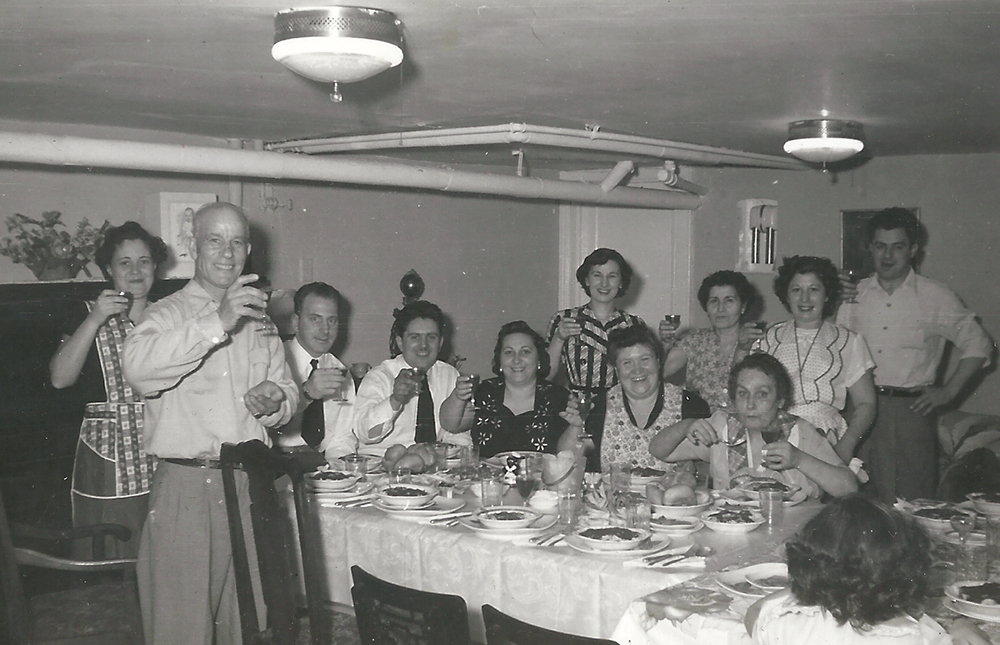
Pictured above: Parents, grandparents, aunts, uncles, godparents, raising their glasses at my sister’s christening dinner, Brooklyn 1953. “Salute!”


I Morti

I Morti

Today is All Souls Day, the companion to All Saints. It is Dia de Muertos in Mexico, I Morti in Italy, and certainly there are other names in other places for these days of the dead. I think of All Saints Day (or All Hallows, where Halloween gets its name), which was yesterday, as the more pious of the two days. Both are holidays of the Church; All Hallows is the day we remember all the countless and nameless saints who have gone before us, the ones who don’t have a feast day in their name. Ognissanti is the name Italians give to the First of November: “every saint.” But the Second of November is the day we remember everyone else, the ones who perhaps weren’t so saintly. Which is most of us, no? No matter how kind and respectful we are, there’s always something about ourselves we can improve upon. And so I think of All Souls as the more familial of the two days. These are the souls we can relate to.

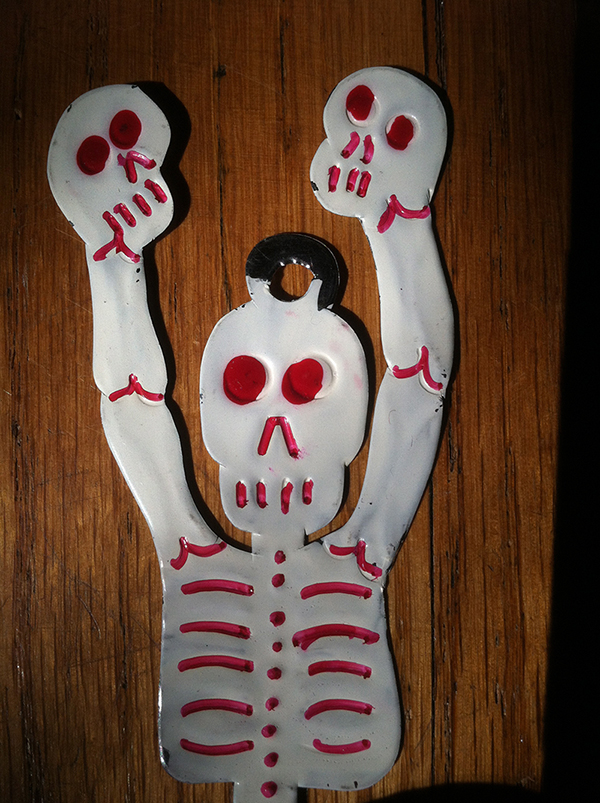
Traditional folk cultures have always had a healthy relationship with death. Death is part of life, after all. It may not be something we want to talk about, but ignoring it is, I think, to not fully engage life. Celebrations like I Morti and Dia de Muertos, and even Halloween, as it ushers in these days of the dead, give us some power to deal with reality. If death is part of the equation, we may as well have some fun with it. And so we bake Pan de Muertos (Bread of the Dead) and we drink Bone Punch and we make sugar skulls and we laugh and cry and in a way, for these few days, at least, no one is missing. We are all together, across time: the other world dwells within the world of the living.

One thing I’d like to stress right here from the start of this blog is that the Book of Days is not about fun and happiness, not all the time. Yes, if you know Seth and me and Convivio Bookworks, you know that we are pretty partial to a festive time. Good food and drink is at the heart of much of what we do. But while festivity is of great importance, I think it’s equally important to acknowledge that there is a concurrent thread of melancholy that wends its way through life. If we consider weaving fabric as an analogy, perhaps we can think of joy as the warp and sadness as the weft. You can’t weave cloth without both threads, and using both makes a pretty interesting weave. If the Book of Days was to focus only on joy, it would be one sappy book: all sugar (or worse, saccharine) and no substance. Joy and happiness are wonderful things, but it is important to set the stage for needing joy and happiness. So much about contemporary holiday celebrations focuses solely on the sweet and does not delve into the darker mysteries of the days. If you’ve ever met someone who dislikes Christmas or Halloween, for instance, this may be at the core of what they are feeling. Sugar coating reality irritates people. Don’t do it.

Here’s what’s going on in homes in Sicily today for I Morti: the children are running around the house looking for presents (usually sweets from the bakery) that their dead relatives have brought and hidden for them. This is their time to return to the world of the living, plunder bakeries, and hide treats for the kids. The dead are gift bearers, much like Father Christmas or Santa Lucia. In other parts of Italy, people are dining tonight on stews made with fava beans. These large beans have been associated with death since the days of the Roman Empire and are at the heart of meals this time of year. In some places, families will leave a spoonful or two of fava bean stew out on the windowsill for the dead to enjoy. And of course there are sweets: cookies in the shape of fava beans or of bones: fave dei morti and ossi dei morti (Fave of the Dead and Bones of the Dead).

In Mexico, of course, the celebration is fantastic, a combination of celebration and reverence. Families are enjoying picnics in cemeteries at the graves of their loved ones. There are ofrendas set up in homes, filled with cut paper (papel picado), clay calaveras, candies, candles, and marigolds, as well as photographs of the ones who have gone before. There are sugar skulls and the Pan de Muertos mentioned above. There is music and dancing (can’t you hear the marimba (rattling like bones) and the mariachi?) Talk about a healthy relationship with death!

This all derives from the Celts, for whom this time was the close of one year and the start of a new: Samhain, the ancient Celtic new year. It is the start of winter by the Celtic calendar… and by traditional reckoning of time. We are about halfway now between the Autumnal Equinox and the Winter Solstice and these gateway days were/are considered times when the bridges between the physical and spiritual worlds were more easily crossed. Or think of them as the worlds of the living and of the dead. Or of the visible and the unseen. These are the traditions that inform so much of what goes on these three days of late October and early November. The Church turned Samhain into All Hallows so many centuries ago (one of the Church’s earliest proclaimed holidays, dating to the Seventh Century), and we celebrate it still today. And if we honor these days of the dead with reverence and yes, celebration, then we’ve done well in building that healthy relationship with reality and with weaving those strands of melancholy and joy. In the process, we find ourselves more complete.