Author Archives: John Cutrone

Your February Book of Days

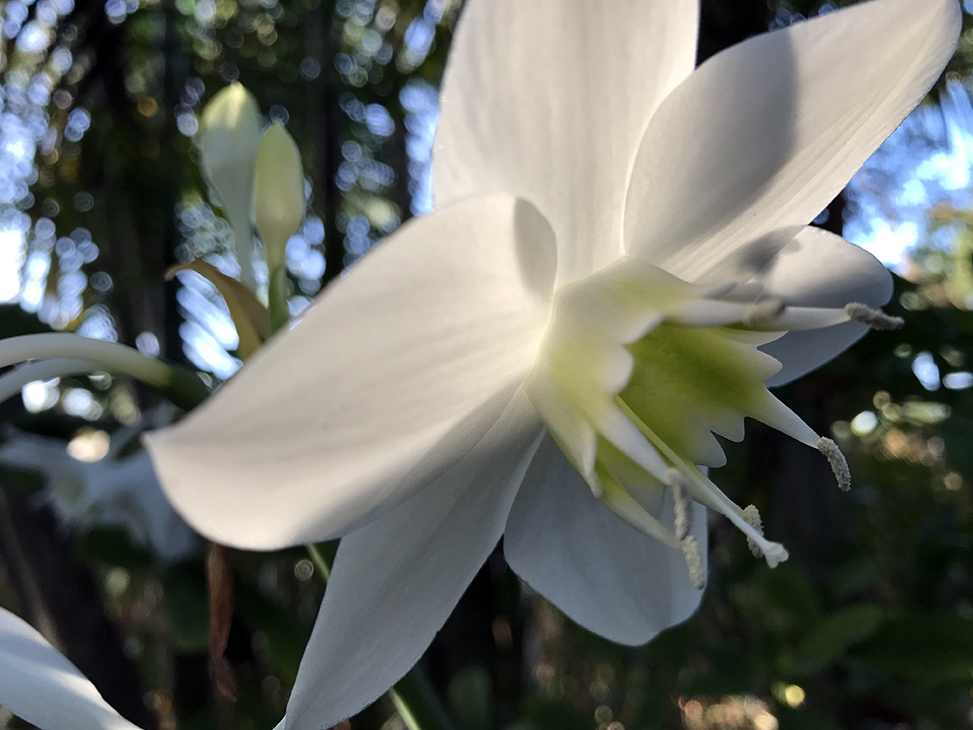
Hello Everyone. It’s February, and here in Lake Worth, where our town motto back around the turn of the last century was “Where Summer Spends Winter,” this lovely flower, the Amazon Lily, is blooming in our yard. I got its parent plant when I was a student at New College in Sarasota in 1986, and while the original is still blooming at my parents’ home, the one at our house came from a time when Seth divided the original bulbs. Our Amazon Lily is the cover star of this month’s Convivio Book of Days Calendar, chosen for the way the pure white blooms capture the sunlight as it streams through from the Southern sky. Even if February is cold and dark where you are, my hope is that this Amazon Lily brings you light.

Light is on our mind these days as we transition tonight and tomorrow toward Spring. It is a long ways off, it might seem, and yet we are now halfway between the winter solstice and the spring equinox. It is St. Brigid’s Day today, Imbolc, and Groundhog’s Day tomorrow, Candlemas. If you have vestiges of yuletide greenery still in your home, it should be taken outside by Candlemas, lest you wish to invite goblins into your home. St. Blaise’s Day on the Third, St. Agatha’s Day on the Fifth. All have their customs.

I apologize for my absence of late; I’ve been a bit preoccupied with some other matters of importance. But please consult the calendar (which is printable, by the way, on standard 8.5″ x 11″ paper), and diligent Convivio Book of Days readers may also wish to search the various days I might miss writing about in the search feature of the blog (below), where you can find posts from past Candlemasses and St. Brigid’s Days and St. Agatha’s Days. All are fascinating, and some may even make you blush (and there’s nothing wrong with that).

As for me, I promise Seth and I are honoring each day as best we can right now, and I promise, too, that I’ll write more soon. Very soon, I hope. We are conscious more than ever of our mantra to Love Each Day.


Every One to his Owne Vocation (and, Your January Book of Days)

Just when you thought you were rid of me, after all those Twelve Days of Christmas chapters… I am back again like a proverbial bad penny. Christmas may be over but the celebration in a way continues, just in a different light… for though we may indeed be back to our ordinary workaday world, our ancestors liked to make this transition with a little fun and ceremony. (One gathers that our ancestors were not as work-weary as we like to think; perhaps they would take pity on us with our hectic contemporary schedules.)

And so on this day after Epiphany, this first day back to ordinary time, comes St. Distaff’s Day. There are plenty of saints’ days through the year, but St. Distaff is a bit extraordinary, for there never was an historical St. Distaff. The day, rather, is named for a tool: the distaff is a tool that is part of the process of spinning wool or flax into thread, which is the first step to making cloth. When we think of spinning, we think of spinning wheels, but the distaff and spindle are earlier tools that preceded the spinning wheel. It is a tool traditionally associated with women and with women’s work, and to be sure, St. Distaff’s Day meant back to work for the women, always on this 7th of January. The men get their own back-to-work day soon enough, though, on the first Monday after Epiphany: Plough Monday, which this year will be on the 9th.

Spinning was so associated with women’s work that the word spinster, which is happily not much used these days, once was a recognized legal term in England to describe an unmarried woman, and the terms spear side and distaff side were also legal terms to distinguish the inheritances of male from female children. Any woman who spun thread (and that would have been most women in earlier times) would know the distaff well.

St. Distaff’s Day was a day for mischief: yes, the women were trying to get back to their spinning, but the men were still underfoot in the house. Their job on St. Distaff’s Day was a mischievous one, with the goal usually being to set fire to the flax the women were spinning. The women were wise to this custom, though, and typically kept several buckets of water nearby. Very often, it was the men who got the worst of it: to have a bucket of water dumped on you in the cold of January… for sure, St. Distaff’s Day lent a bit of excitement to the idea of returning to ordinary time.

There is an old saying for this Seventh of January that comes, actually, from the first two lines of a famous poem by Robert Herrick. It’s a poem from his 1648 book Hesperides, called “Saint Distaff’s Day, or the morrow after Twelfth Day.” The saying goes:

Partly worke and partly play
Ye must on St. Distaff’s Day.

This is good advice even for us today. We begin now the shift from Christmastide, which stood outside ordinary time, to our regular routines. Why not make the transition more interesting?

Give St. Distaff all the right,
Then bid Christmas sport good night;
And next morrow, every one
To his owne vocation.

Speaking of transitioning to ordinary time… your Convivio Book of Days Calendar for January is finally ready. The calendar is our monthly gift to you, a nice companion to the the blog… and sometimes it takes me a while to get around to it, and for that I apologize. It is a printable PDF on standard US letter size paper. Enjoy. (I should probably start working on February’s calendar now!)


Our illustrative image, both here and on January’s calendar, is an old lead printer’s cut of accord in a peaceful shake of hands. It’s a 19th century cut that we’ve used for the past three years in our annual Copperman’s Day prints. Come Monday, it’ll be time for another Copperman’s Day print, for Monday brings not just Plough Monday but also Copperman’s Day, an old Dutch printer’s holiday. These are all holidays signifying a return to ordinary time after Christmas and all take on this attitude of “partly worke and partly play.” More than likely I’ll be telling you about Copperman’s Day (and honoring it) come Monday. For now, though, “Give St. Distaff all the right.”


Faith & Hope & Sweet Release

TWELFTH DAY of CHRISTMAS:
Epiphany

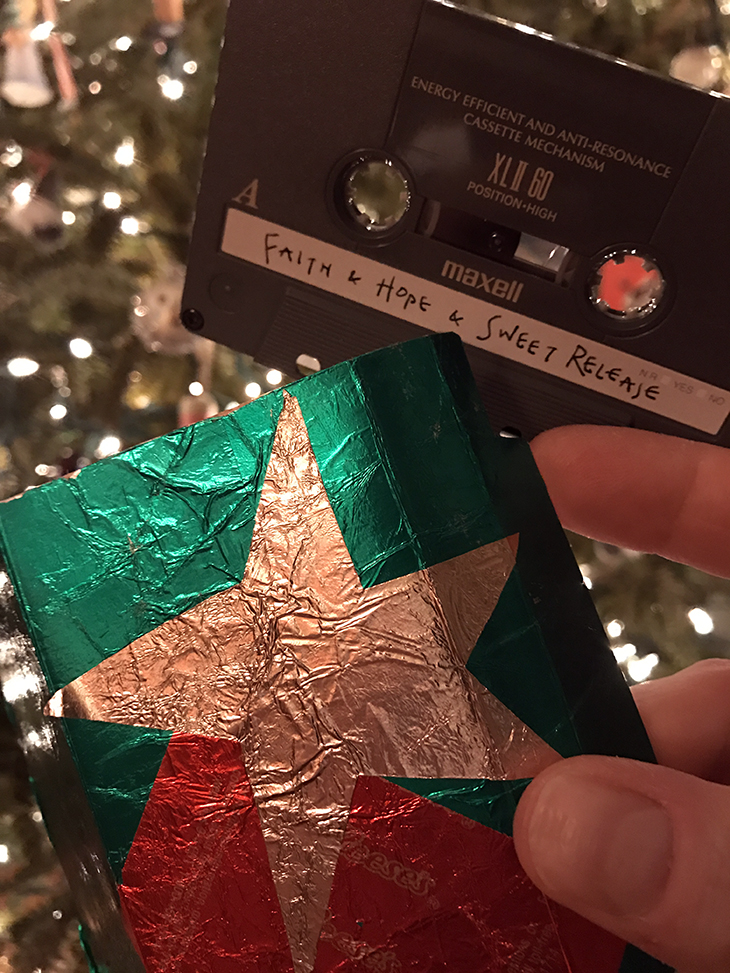
I have always, since I can remember, been fascinated with the foil that is wrapped around chocolates. The process is always the same: I unwrap the chocolate, pop it in my mouth, and while I’m eating it, I take the foil wrapping and smooth it out with my fingertips against the table or any smooth surface I happen to be near. I like watching the foil transform from crinkled to smooth. Sometimes I save the smoothed-out foils. Sometimes I use them in projects, like the cover for the Christmas mixtape I recorded for Seth after I first met him, back in December of 1995. I miss mixtapes for many reasons… not the least of which is the artwork I’d get to do on the covers. A star of foil seemed just right for this tape that went to Seth and to a few other select friends I was missing that Christmas over 20 years ago.

The star is central to Christmas and to the journey of the Magi. As such, it is central to Epiphany, the celebration of this Twelfth Day of Christmas, which is traditionally considered the day the Magi arrived at the stable in Bethlehem. And with Epiphany, our Christmas celebration comes to a close. The Magi, those three old men, have traversed the desert, following that star, and they have arrived at the stable to bring gifts to the child. La befana, the kind Italian witch, has made her rounds, too. As the story goes, at that first Christmas oh so long ago, the Magi stopped at la befana’s house and asked her to join them on their journey, but she declined the invitation. “I have so much housework to do!” she told them. And so the Magi left her home and continued on their way.

But as she swept her floors, la befana began to feel a bit remorseful, and once she finished her sweeping, she set out to find the Magi. But she never did find them, nor the child they had told her about. She searched and searched but to no avail. Still, to this day, on each Twelfth Night, la befana sets out upon her broom to seek them. As she makes her rounds, searching high and low for the child and the three kings, la befana leaves small presents for all the sleeping children. And now, on Epiphany, she resumes her sweeping, and sweeps Christmas away for another year.

Tradition would have us remove all the Christmas greenery today. But if you are not yet ready to part with your tree or other decorations, we can offer you another older tradition to follow, for some would consider Christmas to last until the First of February, which is Candlemas Eve. There is some strong basis for this in the Pagan tradition, as it is on the First of February that Yule gives way to Imbolc in the wheel of the seasonal round: it is a cross-quarter day, the midway point between the winter solstice and the spring equinox.

In our home, we close the celebration of Christmas on Epiphany night with a simple ceremony at the front door, outside on the front porch. We will gather up all who are in the home and we will each take turns writing with chalk on the lintel above the front door the numbers and letters and symbols of a traditional inscription. This year, it will read as follows: 20+C+M+B+17. These are the initials of each of the Magi (C for Caspar, M for Melchior, B for Balthasar), punctuated by crosses, blanketed on either side by the year. For me, the inscribing is always accompanied by a silent prayer that no one will be missing when we gather next to write the inscription again. All the year through, though Christmas be gone, still the inscription is there to remind us of Christmas’s presence as we pass each day through that portal. The inscription is a magic charm of sorts, protecting the house and those who pass through that doorway, harboring the goodwill and spirit of Old Father Christmas.

And so we follow that star. May it always be in our sights and in our hearts and in our dealings with our fellow companions on this old earth. And one last time this year, we say unto you: “Merry Christmas.”


I called that 1995 mixtape “Faith & Hope & Sweet Release.” There was so much new and wonderful music that year: “Now it is Christmas Eve” from Garrison Keillor, “By the Fireside” from Turtle Island String Quartet, and an original song for Christmas by Jane Siberry whose lyrics lent the mixtape its title. Our old pick up truck has a cassette player and we still listen to that mixtape each Christmas. It never grows old.