SIXTH DAY of CHRISTMAS:
New Year’s Eve, Hogmanay, First Footing
Today we come to the last day of the year and the Sixth Day of Christmas. Half of these Twelve Days fall in the old year and half in the new; in this way Christmastide, these days outside ordinary time, both close and open each year as December gives way to January, a month the Romans named for Janus, the god who looks both back on the past and forward to the future.
The New Year’s Eves I remember as a child were for the most part already emptied of the traditions of the Old World. New Year’s Eve usually was celebrated with all the aunts and uncles and cousins and grandparents at either our house or at Aunt Mary and Uncle Phil’s house, and there would usually be a very large Italian hero, perhaps six feet long, and there were potato chips and Guy Lombardo and his orchestra would be on TV playing “Auld Lange Syne” at precisely the right moment.
Guy Lombardo gave way eventually to Dick Clark and Dick Clark eventually to who knows who now. Gathering around the TV is, I’m certain, my least favorite part of New Year’s Eve, but it has always been thus in my family, and so when we gather, this is what we do.
In earlier days, Dad says, Grandma Cutrone would come round through the crowd and make sure everyone ate a spoonful of lentils and a dozen grapes at midnight on New Year’s Eve, and this, to me, is more like it. Who needs to watch a glittery dropping ball on TV when you have more interesting customs like a spoonful of lentils and a handful of grapes? The lentils are an old Italian ritual. Each little lentil symbolizes a coin, so the idea is eat lots of lentils, gather lots of riches in the new year. Capo d’anno, as the Italians call New Year’s, is all about good fortune ahead and also about clearing out the dross: All over Italy, old unwanted things are tossed out of windows at the stroke of midnight. It is not a night for midnight strolls, for all manner of items are tossed out of windows, even really big things like appliances. To have an old dishwasher fall toward you from a second floor window is something you’ll want to avoid. Best to stay indoors with the revelers in this case.
Grandma Cutrone is long gone and so are the lentils for New Year’s Eve in my family, but on my mother’s side, there the tradition was for homemade zeppole: fried dough, essentially, but the dough is enriched with eggs and this is the only night each year that we do this. The zeppole are dusted in confectioners’ sugar or drizzled with honey for a sweet year ahead. So tonight there will for sure be zeppole. And still at midnight for each person a dozen grapes, one for each month of the year, and a glass of champagne to toast the new year properly.
Scotland is perhaps the place where the new year rings in the loudest, for New Year’s is the height of the Christmas season there, bigger perhaps than even Christmas. The celebration there is known as Hogmanay, which is believed to to be derived from the French au gui menez, “lead to the mistletoe,” and this suggests a very ancient and pre-Christian derivation of most Hogmanay traditions, for it leads directly back to the Celtic druids and the mistletoe that was sacred to their ceremonies. First Footing is an aspect of Hogmanay that feels particularly like a magic spell: The first person to step across the threshold of the front doorway after midnight is this First Footer, and it is hoped that this person would be a red- or dark-haired man carrying whisky or mistletoe or, in some cases, bread, salt and coal. In this case he would kiss all the women and shake the hands of all the men before placing the coal on the fire and the bread and salt on the table and then he’d kiss all the women and shake hands with all the men once more on his way out. A ritual like this goes not without a bit of preplanning, but, as with most rituals, it’s got to be done right if the magic is to work. The goal here is prosperity and good luck, much like the lentils and grapes of Italy… but the lentils and grapes seem less complicated!
Traditions for this night vary across the globe, and we’d love to hear about yours, so please do share them. And may peace, prosperity and good luck be yours and ours in the new year. Good things to us all: good health, good spirit, creativity and wealth. Happy New Year.
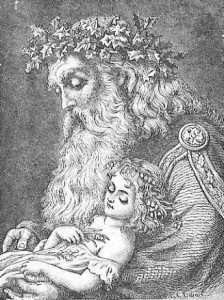
Image: Father Time and Baby New Year from Frolic & Fun, 1897. [Public domain] via Wikimedia Commons.
![Bring in the Boar's Head [Illustrated London News]](http://www.conviviobookworks.com/blog/wp-content/uploads/2014/12/Bringing_in_the_Boars_Head.jpg)