Category Archives: Epiphany

St. Distaff’s Day

Distaff

Christmas is over and it’s back to work. St. Distaff’s Day falls each January 7, the day following Epiphany, to remind us of the shift back to ordinary time. The return to work comes not without a little celebrating, though. Our oft quoted Book of Days poet Robert Herrick wrote the poem that best explains the holiday. It’s a poem from his 1648 book Hesperides, called “Saint Distaff’s Day, or the morrow after Twelfth Day.”

Partly worke and partly play
Ye must on St. Distaff’s Day:
From the Plough soone free your team;
Then come home and fother them.
If the Maides a-spinning goe,
Burne the flax, and fire the tow:
Scorch their plackets, but beware
That ye singe no maiden-haire.
Let the maides bewash the men.
Give St. Distaff all the right,
Then bid Christmas sport good night;
And next morrow, every one
To his owne vocation.

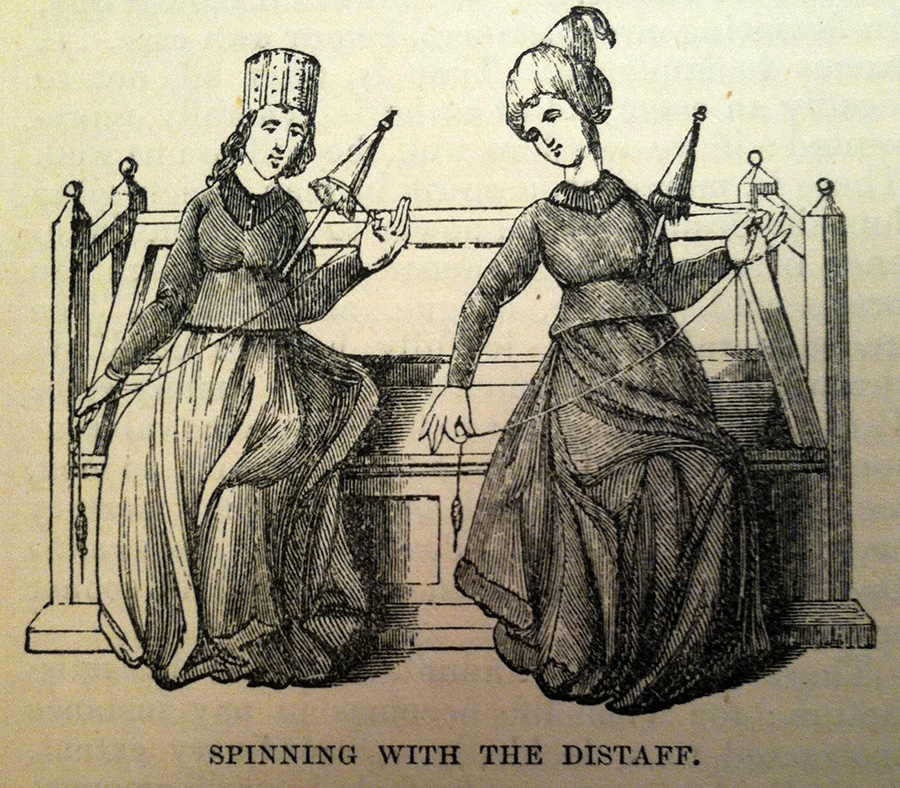
In truth, St. Distaff’s Day marked the day when women traditionally got back to work, especially at their spinning. The men still have a few days to go (quite a few this year, as Plough Monday, their traditional return-to-work day, is near a week away).

Perhaps the oddest thing about St. Distaff’s Day is the fact that there is no St. Distaff. The distaff is not a person at all but a tool that is part of the process of spinning wool or flax into thread, which is the first step to making cloth. The distaff and spindle were the tools that preceded the spinning wheel. Spinning was so associated with women’s work that the word spinster, which is happily not much used these days, once was a recognized legal term in England to describe an unmarried woman, and the terms spear side and distaff side were also legal terms to distinguish the inheritance of male from female children. Any woman who spun thread (and that would have been most women in earlier times) would know the distaff well.

St. Distaff’s Day was a day for mischief: yes, the women were trying to get back to their spinning, but the men, meanwhile, were there attempting to set fire to their flax. Of course, in the women’s attempts to put out the fires, many a bucket of water was tossed upon the mischievous men on St. Distaff’s Day.

Nowadays, perhaps it’s best to mark the day as one in which we acknowledge the shift from Christmas, a period outside of time, to the regular workaday world: ordinary time… but doing so with some measure of ceremony. Partly work and partly play and why not? Get back to work, but have a little fun, too.
 

An Epiphany

Magi

TWELFTH DAY of CHRISTMAS:
Epiphany

It’s Epiphany, the day the Magi arrived in Bethlehem to see the child. Children in Italy have awoken to presents delivered over the course of the night by la befana, and in Spain and throughout Latin America, los tres reyes, the three kings, have done the same job. Today, la befana will be back to her housework, back to her sweeping, sweeping the holidays away until the winter solstice returns again next December. An old Italian saying sums it up: E l’epifania tutte le feste porta via.

Most of what we know of the Magi comes down through tradition and not through biblical writings. The story is that there were three wise men and that their names were Caspar, Melchior, and Balthasar, but in fact we don’t know their names for sure or how many there were. We do know, however, that there were three gifts. It’s an old, old story that we know well. The Magi followed the star, finally arrived at the place where Jesus lay, paid homage to him, and brought gifts to the child, gifts fit for royalty: gold, frankincense, and myrrh.

Epiphany is a Greek word, meaning “manifestation.” The local shepherds were the first to come see the child in the manger, but with the Magi, who came from far off kingdoms, the child was made manifest to the world. Epiphany has another meaning, as well, one that James Joyce spoke of, in which characters in stories, people in general, suddenly see things differently. The two kind of go hand in hand. Nothing would ever be the same after that first Christmas night, and nothing is ever the same after a personal epiphany, either.

And so with this night, our celebration of Christmas winds down. While Twelfth Night brings us raucous revelry, Epiphany is generally quieter. The day will proceed much like any other––here in the United States, for most of us it’s just another day at work. Even the Church in this country moves the date of Epiphany to a Sunday (it was yesterday by most church calendars), but traditionalists prefer to keep its date as it always was. In this house, we will celebrate with a quiet dinner. We’ll enjoy the music and the greenery and lights for one last night. And some time in the still quiet of this night, we’ll gather up the people in our home, step out onto the front porch, bundle up if it’s cold outside, and we’ll take turns writing with chalk above the front door the numbers and letters of a traditional inscription: 20+C+M+B+14. These are the initials of each of the Magi, punctuated by crosses and surrounded by the year. The chalk is supposed to be blessed chalk, but I doubt there are many priests left who remember this old tradition and who bother to bless chalk for their congregations, so I think any chalk would be fine, blessed or not. The writing is usually accompanied by a silent prayer that we’ll all be together to do this again next year. The inscription, a magic charm of protection and a reminder of the season, remains there for all to see and it weathers the year, sometimes washing away to a ghost of itself by the following year, and sometimes remaining as vibrant as ever.

After tonight, we might light the candles in our windows, but the Christmas lights outside will no longer be lit. All the greenery and the tree are to be removed. If you have the room, perhaps you can save your tree in a quiet corner of your garden. Just tuck it away there, off to the side, and next December, do what we do: use that tree to fuel your fire on the darkest night of the year that comes when the Winter Solstice returns next December. This is, I think, an honorable way to send off the tree that has brought your family so much joy this year, and continues the spiraling circle of time and seasons that gave that tree life in the first place. The tree, you, the Magi, the child, all are part of this same spiral.

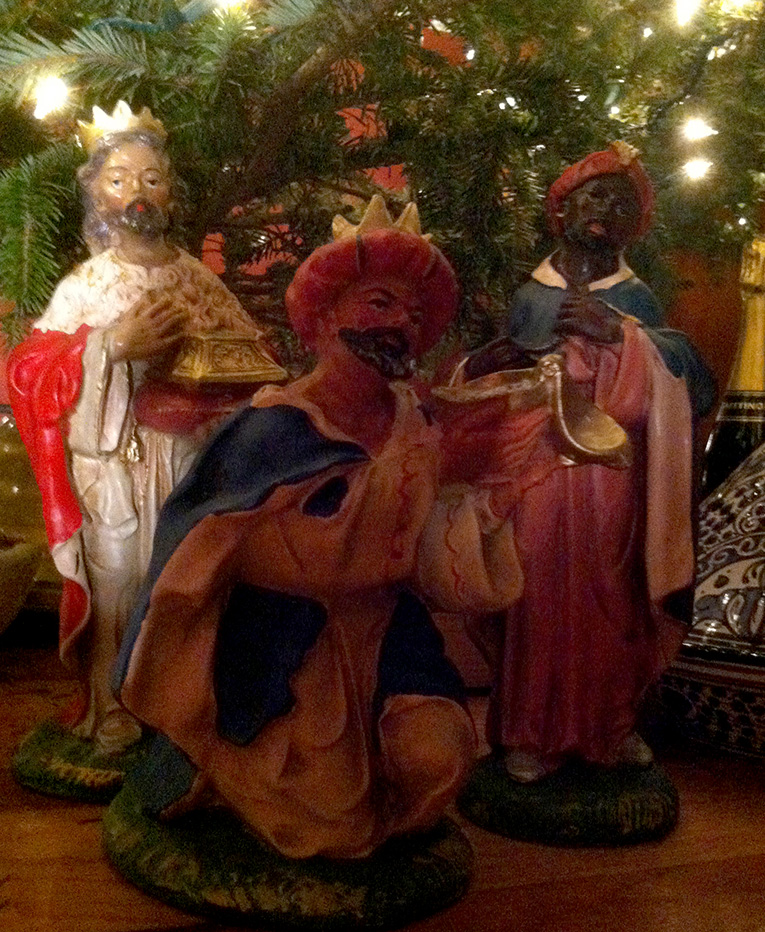
Image: Three kings brought to us as gifts by our neighbors Don and Pat Cortese, Twelfth Night 2013. 


Twelfth Night

LaBefana

ELEVENTH DAY of CHRISTMAS:
Twelfth Night, Eve of the Epiphany

The daylight hours of this Eleventh Day of Christmas offer us another day of preparation, which will be needed, for the setting sun brings us the great festivity of Twelfth Night, a night of eating, drinking, games and music to rival that with which we began at the start of the Christmas season. Christmas deserves as much, no? We rearrange our furniture for Christmas, we bring in a tree, we bake special treats… it’s such a big presence in our lives while it’s with us that it’s only proper to send Old Father Christmas on his way with the festive spirit he deserves.

Twelfth Night and Epiphany center on the Magi and their arrival at Bethlehem to see the child. Tradition tells us that their journey took them across the desert and their arrival was not until the Sixth of January. There are many traditions surrounding Twelfth Night, and as with most things Christmas, they are a mysterious blend of Christian customs and earlier pagan ones. There is, for instance, the tradition of the King of the Bean: a bean is baked into the Twelfth Night cake, and the person who finds it in his plate is crowned King of the Bean, and he becomes the Lord of the Feast for Twelfth Night, leading the company in games and song. In Italy, the bean is a fava bean. In France, there often is not just a bean but also a pea, and the person who finds the pea is the queen. These are traditions that go back directly to the ancient Roman solstice celebration of Saturnalia, where the very same thing was done. To think that people have been performing this same ritual at this dark time of year for so many centuries is, to me, fascinating.

In Italy, this Eve of the Epiphany is the night of la befana. The legend tells us that at that first Christmas oh so long ago, the Magi stopped at la befana’s house and asked her to join them on their journey, but she turned them down, for she had too much housework to do, and so they went on their way. But la befana had a change of heart as she swept the floors, and once she was done sweeping, she set out to find the Magi. But she never did find them, nor the child… and to this day, on each Twelfth Night, she sets out upon her broom to seek them.

La befana is also one of the last of the Yuletide gift bearers, for as she makes her way across the country, she delivers small presents to the children. For those that were not so good, she might leave a lump of coal, but even that is not so bad, because la befana’s coal is sweet as sugar.

Epiphany on the 6th of January is still a major day for gift-giving in Italy (as well as in Latin America, where the festival of los Tres Reyes, the Three Kings, is celebrated… and they also are gift-bearers). If la befana riding the night on her broom sounds a bit like a witch to you, that would be a fairly accurate description, and so here again we have a bit of paganness, in la befana as a personification of the pagan earth goddess as the wise old hag, giving way to the child, just as the old year passes into the new. Her name, befana, is thought to be a corruption of the Italian name for Epiphany: Epifania.

At this time of year my cousins in New York and New England gather together for a Christmastime dinner and la befana always comes to pay a visit. It’s often my cousin Cammie that plays the part. For us here in Lake Worth, Twelfth Night will be a night for a sparkling Christmas punch and a festive dinner with family. It’s usually something grand and this year it’s something we’ve never made before: a standing rib roast. Usually there are small presents to exchange in a game we call Yankee Swap, but this year, it’ll be more like a second Christmas, as my nephew and his family from the Gulf Coast come to spend Twelfth Night with us, and so the gifts given this night will be more in the spirit of the gifts the Magi brought to Bethlehem.

La befana, meanwhile, will begin the process of sweeping away the Christmas festivities for one more year. By the time she’s done with her sweeping tomorrow, Christmas will be done.

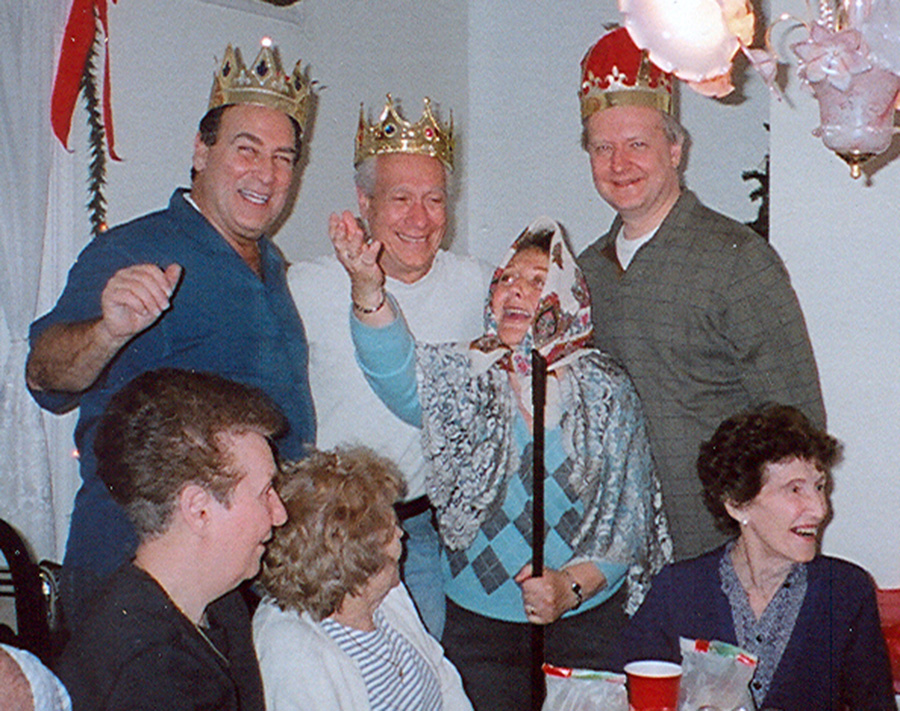
Image: My cousin Marietta was kind enough to send me this photo of a recent Cutrone cousins party, which takes place around Twelfth Night every year. That’s my cousin Cammie as la befana, backed up by our own three kings.