Category Archives: Passover

Next Year in Jerusalem

Digitized by the Gruss Lipper Digital Laboratory at the Center for Jewish History - www.cjh.org

With tonight’s setting sun comes Passover. A friend explains it best: “We are traveling through the desert with our ancestors via a table filled with metaphor and symbolism.” This moveable springtime holiday in the Jewish calendar commemorates the liberation of the Israelites from their slavery in Egypt. The celebration of Passover (or Pesach in Hebrew) is a meal, the seder. Unleavened bread is a central part of the celebration, for the Israelites had to leave Egypt so quickly there was no time to let the bread rise. Instead, it had to be baked immediately. There is traditionally a place at the table reserved for Elijah, the prophet, and the words “Next year in Jerusalem” are a common refrain.

At the table is a book, the Haggadah, which tells the Passover story. Those gathered around the table read from the book in the midst of the seder plate, filled with foods rich with symbolic meaning. They say you can’t celebrate the holiday without a haroseth, which is a mixture of chopped nuts and apples, wine, and spices. It sounds like a celebratory part of an autumnal meal, but it is here in the springtime, symbolic of the mortar used by the Israelites when they were slaves in Egypt.

Family and food, rich in meaning, celebrated since time immemorial: these are the roots of Pesach, a festival of freedom.

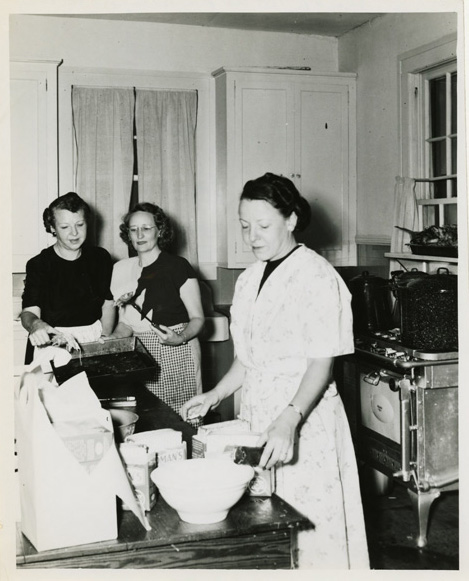
Image: Preparing for the Seder in the Kitchen of the Community House, Biloxi, Miss., April 13, 1949. Digitized by the Gruss Lipper Digital Laboratory at the Center for Jewish History.
 

Pesach

Pesach

We enter Holy Week now and always hand in hand with Easter is the Jewish celebration of Passover. This year, Passover, or in Hebrew Pesach, with the setting sun tonight, April 14. The holiday commemorates the freeing of the Israelites from their slavery in Egypt, and is celebrated with a meal, the seder. A friend explains it thusly: “We are traveling through the desert with our ancestors via a table filled with metaphor and symbolism.” Unleavened bread is a central part of the celebration, for the Israelites had to leave Egypt so quickly there was no time to let the bread rise. Instead, it had to be baked immediately.

The Italians call Passover Pasqua Ebraica, which you might translate as “Jewish Easter,” but in fact in many languages the names of both Easter and Passover are the same. Pesach informs the name given to Easter in Italian: Pasqua. The English word “Easter” does not share this etymological relation to Pesach. It is related more to the the Old English “Eostre,” which is the name of an Anglo-Saxon goddess whose feast day was celebrated around the Spring Equinox.

Among the questions asked at the seder table is this one: Why is this night different from all other nights? And I actually cannot tell you. I’ve never attended a seder. But I will join all who are in spirit tonight and wish you abundant blessings.


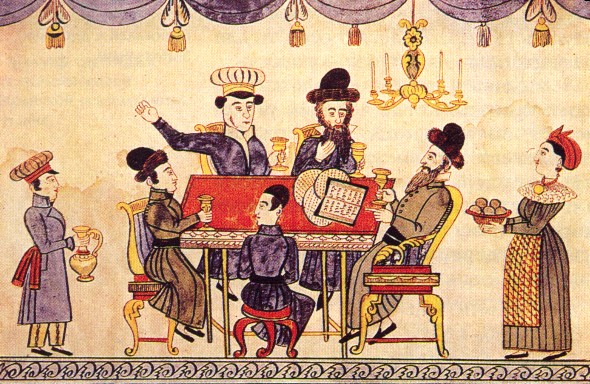
The image above is taken from a 19th century Haggadah by an anonymous Russian folk artist [Public domain], via Wikimedia Commons.