Category Archives: Summer

Olde Midsummer

A few days past the solstice, and with the setting sun tonight, we come to St. John’s Eve. You might think of it as the opposite side of the year from Christmas Eve, for indeed it is, as are the days that follow both: St. John’s Day tomorrow, Christmas Day the day after Christmas Eve. These celebrations go back to days that were already considered holy, even before Christianity. The early Church tapped into the imagery but replaced the characters. No one knows when the historical Christ was born, but the early Church decided the Midwinter solstice was perfect for emphasizing the concept of Jesus as Light of the World. They placed the birth of St. John the Baptist at the Midsummer solstice, for it is written that John was born six months prior, and also that he says of Jesus, “He must increase, but I must decrease.” And so Jesus is born at the darkest time of year, as light begins to increase, and John is born at the brightest time of year, as light begins to decrease. Here are the beautiful metaphoric connexions that the early Church loved, linking the story of Christ to the natural rhythm and wheel of the year.

Traditionally, St. John’s Eve is a night to spend out in the open air. In Italy, it’s a night for bonfires, and as Covid-19 quarantines end there, perhaps this will be the case tonight. In Rome, the traditional Midsummer meal centers around snails; local belief holds that eating snails, horned as they are like devils, will protect you from Midsummer mischief of the Midsummer Night’s Dream variety. In the towns of Northern Italy, Midsummer is a time to break out the balsamic vinegar that has for years been aging and developing complexity––sometimes a hundred years or more. Local lore says that every part of the meal must have some of this nectar of the gods in it.

St. John’s Eve has a long history in popular folklore as a portal night, a night when the pathways between worlds is most permeable. It is a night to go and gather plants for their magical properties: fern seed, for example, and St. John’s Wort. The latter will protect you from evil, the former, if gathered properly, is believed to confer the power of invisibility. But not without some peril: the seeds are fiercely guarded by the fairy folk who know more of these secrets than do we (and there is that connexion to literature and A Midsummer Night’s Dream). Closer to home, Seth and I find sometimes, while we are sitting at our Midsummer fire that burns in the copper fire bowl in the back yard, the night air suddenly is infused with spice––the fragrance drifting on the breeze, emanating from the blooms of the Guyana Chestnut tree. The tree blooms only at night, and each bloom lasts just one night, an upright pod that explodes with a crack into an orb of white fireworks. There is so much magic to be found in the darkness of night, and this will be a dark one, as the moon is still new.

And all the same, the night passes and St. John’s Eve ushers in St. John’s Day on the 24th. As for St. John himself, he is sacred to Puerto Rico, Québec, and Newfoundland. He is a patron saint of beekeepers, tailors, innkeepers, and printers like me. Tradition would have us cut and fashion divining rods on his day, for hidden treasures are thought to reveal themselves on St. John’s Day. Explore lonely places, it is said, and there these treasures shall be, awaiting any lucky finder. The magic passes with the day.

Here’s another fine way to celebrate: Join me tomorrow, 3 PM Eastern, Wednesday June 24, Old Midsummer Day, live on our Facebook page for Book Arts 101: Midsummer Night’s Dream. We’ve been broadcasting live from our studios each Wednesday at 3 during quarantine, and in this week’s episode, I’ll be showing books and prints that touch on Midsummer and magic. If you can’t be there for the live broadcast, you may still watch the video later at that same Facebook page. You know I love to see you.

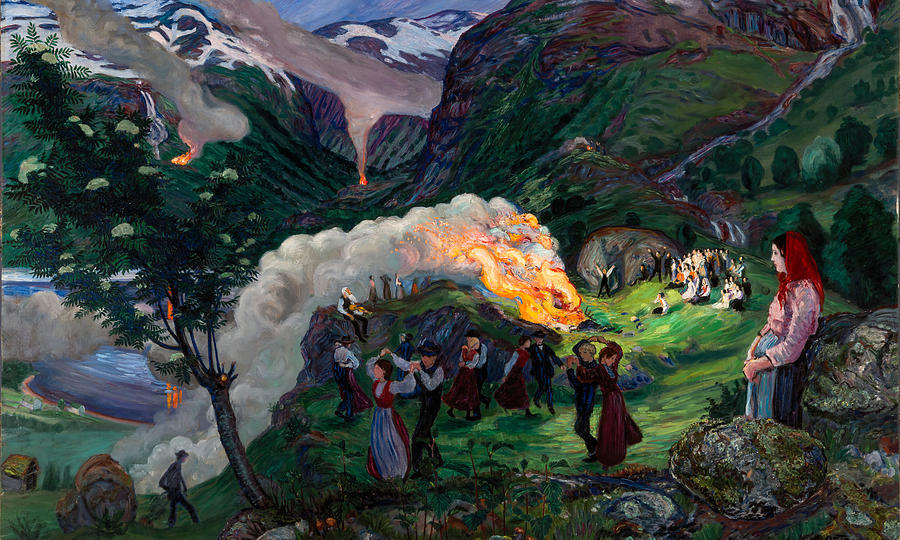
Image: “Midsummer Eve Bonfire” by Nikolai Astrup. Painting, 1915. [Public domain] via Wikimedia Commons.
 

Something’s Lost and Must Be Found

We were taught as kids that if you lose something, pray to St. Anthony and he will help you find it. Hence the old children’s rhyme:

Tony, Tony, come around,
Something’s lost and must be found.

Being an absent-minded person––a quality I inherited from my grandfather, Arturo De Luca––you’d be right in thinking St. Anthony and I are in touch quite a bit. I am forever putting things in extremely logical places, and then forgetting the logic behind it. So it seems at least once a week I am turning the house upside down looking for something I’ve misplaced.

There is, of course, a more formal way of invoking St. Anthony’s assistance in finding lost articles: St. Anthony, perfect imitator of Jesus, who received from God the special power of restoring lost things, grant that I may find [name the item] which has been lost. At least restore to me peace and tranquility of mind, the loss of which has afflicted me even more than my material loss.

These days, after months of quarantine and weeks of raising our collective voices for basic human equality, and an often mind-boggling federal response to both, that tranquility of mind can be difficult to find. My grandmother, Assunta, she certainly found a lot of it. June, for her, would begin with thirteen days of prayers to St. Anthony, who, together with San Giuseppe––St. Joseph––was one of her pals. She would sit in a folding upright beach chair in front of the statue of St. Anthony––the one that my dad painted so that it looked like he was wearing a cap, rather than sporting a Franciscan tonsure haircut––and she would mutter into the thick summer air her Tredicina to San Antonio: thirteen days of prayers that began on the First of June and continued through his feast day on June 13. And yes, the Tredicina could be offered for St. Anthony’s intercession to help you find something (though one would think after thirteen days you might move on), but it could also be offered for his general intercession with a problem in your life or it could be offered for no reason at all. Just because.

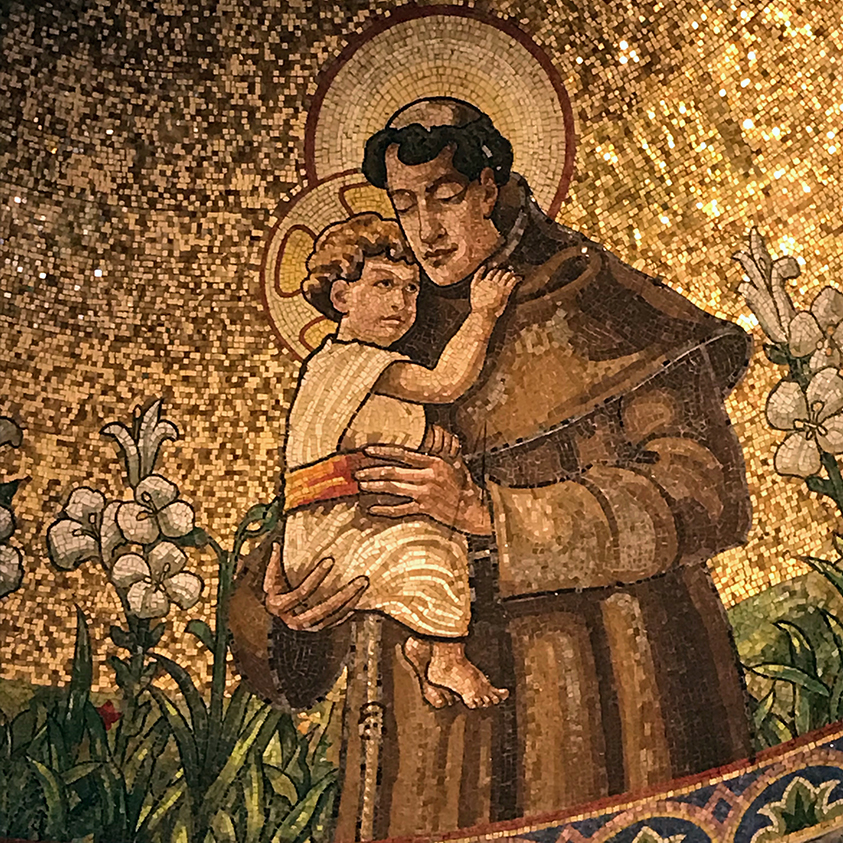
St. Anthony was born in Lisbon in the late 12th century but spent most of his life in Italy. He loved St. Francis and was an early Franciscan: cowled brown habit, sandals, that tonsured haircut. He is known for many miracles, one of the best known being his preaching to the fishes, who gathered in great numbers to hear St. Anthony speak. He preached to the fishes after trying first preaching to people, but they weren’t much interested at the time, so he took his lesson to a nearby body of water and found a more receptive audience… which then impressed the people enough that they began listening. He was also known to have donkeys kneel before him. And just before he died, in Padua in 1231, he was seen in ecstasy holding the baby Jesus in his arms. This is the image we see most often depicted in the statues outside of Italian American homes, including the one that my father painted. San Antonio is a presence we Italians like to talk to, like an old paisano. Especially now, in early June.

Anyway, these are the things that, to me, always meant that summer was here. Summer’s arrival by the almanac is still more than a week away, but the heat and humidity say otherwise, as do our traditions. Old Midsummer is soon upon us… which reminds me: don’t forget our lovely new Swedish Midsommar decoration, made by hand of painted wood and ribbon! We’ve got one sitting in our kitchen corner cupboard right now and it brings us some simple happiness each day. Plus I can tell you that with no pop up markets for us to attend and show our wares, your Convivio by Mail orders are much appreciated these days. Free shipping when you spend $50 across our catalog, so go on: order a Midsommar Maypole along with some handmade soap or some herbal tea and you’ll earn free shipping and help support Convivio Bookworks and the folks who make the things we sell. We know most of those folks by name. They appreciate your support as much as we do. (And by the way, that’s a super cool photo of my mom fishing on a lake, circa 1950, at the top of the Convivio by Mail page!)

Quarantine has thrown this aspect of my life a bit off the rails, but I promise to be better about writing. Some of my favorite days are coming, Juneteenth among them, and how can anyone not give Juneteenth the respect it deserves––this year most especially. You’ll hear from me again then, most likely, but maybe for Bloomsday, as well, on the 16th. Be safe, everyone. Much love.

Image: A shimmering mosaic of San Antonio with the infant Jesus located at the Basilica di San Giacomo in Bellagio, Italy. We were there last summer, not long after the feast day of San Antonio di Padua. Though the mosaics were certainly completed later, the church itself dates to the Twelfth Century, about the same time that St. Anthony was roaming the earth, preaching to the fishes.


Still Here

The month of May has flown, hasn’t it? And with not a word from me. I’m still here, though, quarantining at home, doing well. Each day is full, what with working from home and tackling some dormant projects and adapting to the cat’s new feeding schedule. She seems to require meals beyond her traditional breakfast, dinner, 9:30 snack, and midnight snack. Now there is also lunch, the 8:30 snack that precedes 9:30 snack, and the 2 AM snack, too, should I be up that late. Most nights I am.

Most of the projects I am working on I am not quite ready to talk about. At least one of them I’d classify as something I never thought I’d ever do, and yet here I am, doing it, and it’s been a bit all-consuming in the nighttime hours when I am not working.

Another is something I’ve been doing for work, since March, I think: it’s a live broadcast each Wednesday at 3 PM Eastern time on our Facebook page. It’s called Book Arts 101: Home Edition––a weekly ramble through the book arts, craft, design, and whatever else drifts through my head. The broadcast this Wednesday will be about that place where the book arts intersect with the culinary arts, and I’ll be talking a lot, I’m sure, about the things that influence me to write this blog. The fact is Book Arts 101 is unscripted and only loosely planned and most weeks I do it by the seat of my pants. Seth likes to show me bloopers of live news casts just before each episode. I do have a healthy dose of stage fright before each broadcast, but the fact is that 3:00 comes and there is nothing to do but click “GO LIVE.” Each week I promise I’ll be there, and so I do it.

And so tonight I have nothing to remind you of, no holidays, no holy days. I just wanted to check in, say hello, how you doing? Very well, I hope. If you can join me Wednesday at 3, I’d love it if you could. You can watch the video later, too; it’s usually posted to our Facebook page right after the live broadcast ends. You can also view the first eight broadcasts in the archive that’s kept at the Facebook page of the Jaffe Center for Book Arts. Clicking that link now makes me realize I wear an awful lot of plaid. So be it.

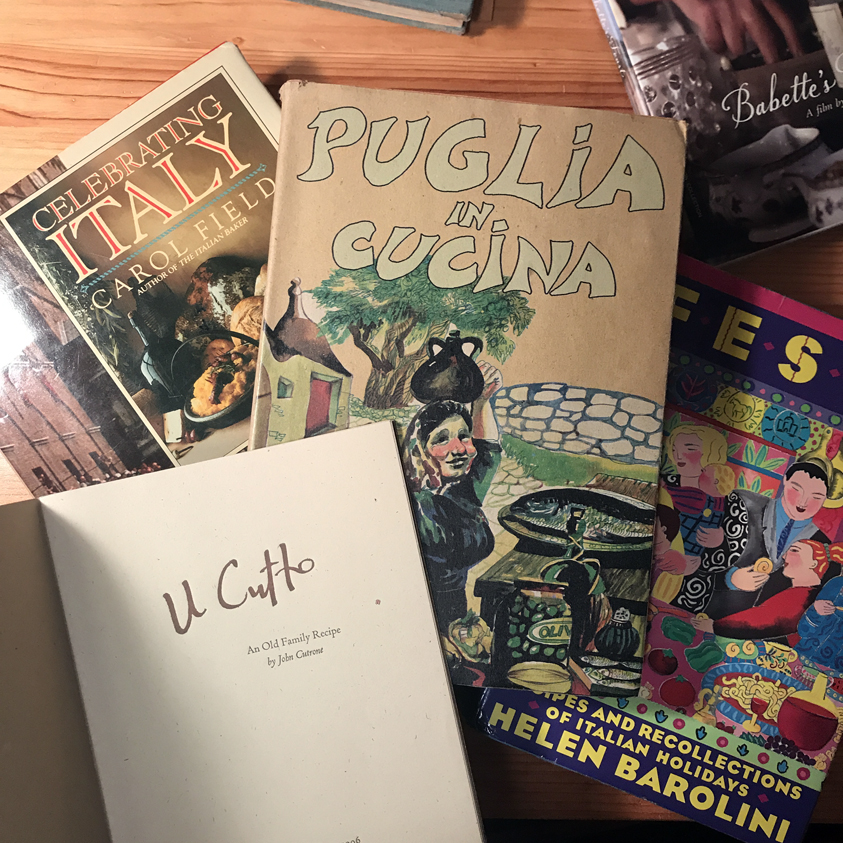
Image: Some of the books that have had a major influence on me (and this blog), as well as one of my first handmade books: U Cutto: An Old Family Recipe, which I printed and bound in an edition of 65 copies in 1996. The title reflects my grandparents’ regional dialect. They were Italian, but the language they spoke was Lucerine, an Arabic influenced dialect from their region of Puglia.