Category Archives: The Gift Bearers

Twelfth Night, Twelfth Day

The setting sun on January 5 brings Twelfth Night, the beginning of the end of the Yuletide festivities and our journey through the Twelve Days of Christmas. While nowadays it is rare to find a family that celebrates Twelfth Night, in years past, Twelfth Night celebrations in many places might rival those of Christmas Eve and Christmas Day. By the Fifth of January, though, most of us these days are back to the workaday world, and back to some semblance of ordinary time. Even I, a longtime advocate for a return to Twelfth Night celebrations, have some trouble celebrating Twelfth Night unless it happens to fall on a weekend. The fact is that the contemporary world is tough on holidays like Twelfth Night, and tough on the Twelve Days of Christmas, in general. We rarely are afforded the time and space to celebrate them fully, and so many of them––Twelfth Night, especially––fall by the wayside.

Twelfth Night ushers in Twelfth Day: the Feast of the Epiphany, on the Sixth of January. Tradition tells us that this is the day the Magi arrived in Bethlehem to visit Mary and Joseph and bring their gifts to their newborn child. Seeing the child was their great epiphany, and in turn, ours. Epiphany is a celebration even older than Christmas itself. The Church early on recognized that Epiphany holds the great symbolism that this news of the savior’s birth was for all people. The Magi are not from Judea. They are from distant lands. By journeying for twelve days and paying homage to the child, the Magi show that the message is universal.

These three kings, the Magi, they are the ones who bring gifts to children in Spain and Latin America: as they travel on Twelfth Night, los Tres Reyes Magos deliver their gifts. Their story is wrapped up also with the story of a kindly old witch in Italy. She is called la Befana. She, too, travels on Twelfth Night, delivering gifts to children. The Magi stopped by at la Befana’s cottage on their way to Bethlehem, and they very kindly invited her to join them on their journey. But la Befana, well… she had so much housework to do. She was very busy sweeping her floors, after all! So, she told the Magi, “Grazie, but no. I have far too much to do.” And so the three kings and their retinue set off again on their journey, leaving la Befana to her work. But alas, la Befana felt a tug at her heart, and decided she would join them, after all. But it was too late. She never found the Magi, and she never found the child. Even after flying on her broom in the sky. She had squandered her chance. And to this day, each Twelfth Night, la Befana searches for the newborn child, leaving presents for all the sleeping children she looks in upon.

Just as she swept and swept her cottage floor, la Befana uses her broom to sweep Christmas away for another year. And we, in our house, follow yet another ancient tradition on Epiphany: the Chalking of the Doors, most common in Austria, Germany, and Switzerland. On Epiphany night, we will gather up all who are in attendance (which very often is just Seth and me) and we will each take turns writing with chalk on the lintel above the front door the numbers and letters and symbols of a traditional inscription. This year, it will read as follows: 20+C+M+B+26. These are the initials of each of the Three Kings (C for Caspar, M for Melchior, B for Balthasar), punctuated by crosses, blanketed on either side by the year. And here’s the part I tell you each and every year: For me, chalking the door is always accompanied by a silent prayer that no one will be missing when we gather next to write the inscription again. Depending on the weather, the inscription may be there above the door for a month or it may be there all the year through. And though Christmas be gone, still the inscription reminds us of its presence as we pass each day through that portal. The inscription is a magic charm of sorts, protecting the house and those who pass through the doorway, harboring the goodwill and spirit of the Christ Child, and of the Three Kings, and of Old Father Christmas, too.

And so if this is your welcome signal, once Epiphany has passed, to put away Christmas for another year, you are welcome. But if this idea makes you melancholy, well… I bring you tidings of good news: your celebration need not necessarily end here with the close of the Twelve Days of Christmas. Though the major part of the celebration is done, our convivial poet Robert Herrick reminds us that it is fine and good, too, to keep the Christmas greenery in your home for the rest of the month of January. This practice follows the ancient customs of his day, and we, here, each year follow Herrick’s lead. While we may at this point begin to put away many of the more contemporary decorations for the season, it is perfectly fine, by this custom, to keep the greenery, to keep the candles and the stars and the lights on the tree. As long as the greenery is gone by Candlemas Eve, Herrick says, all is well. Candlemas Eve: the First of February, the Eve of St. Brigid’s Day, honoring Brigid, who bridges us from winter to spring. Robert Herrick’s approach is, we feel, a most sensible approach to Christmastide and the wheel of the year (especially if you, like we, are in love with Christmas). This approach connects the Midwinter Solstice we celebrated at Christmas with the halfway point to the Spring Equinox in March, making for, I think, a more natural progression through time and through our Book of Days at this wintry time of year. And I do love a good connexion.

Happy Twelfth Night. Epiphany blessings, and happy Twelfth Day. Peace and love onto you all.


WORKSHOPS
Come learn something new at our Lake Worth Beach shop! New offerings: Pure Bookbinding on Saturday January 31; Pasta Making: Cavatelli on Sunday February 8; Pasta Making: Mambricoli on Sunday February 22. Coming soon (not yet on the website): Pysanky Egg Making on Sunday February 1. CLICK HERE to see what’s new at our Workshops page.

THE SHOP WILL BE OPEN
this Saturday, January 10, during our next workshop. The workshop (another pasta making workshop) is sold out, but you are welcome to come shop during the workshop, between the hours of 11 AM to 2 PM. You’ll find markdowns on Christmas stollen and lebkuchen and chocolates from Germany!

Image: “Adoration of the Magi,” a folio from a French Book of Hours. Ink, tempera, and gold on vellum, circa 1415 [Public domain] via Wikimedia Commons.
Our Epiphany

The Sixth of January brings Epiphany, the Twelfth Day of Christmas by our method of counting six days in the old year and six in the new, with Yuletide in its constant role, bridging us across the years: ending our years, starting our years. No wonder, then, Christmas is such an extraordinary time.

For most, Epiphany is the close of the Christmas season. It is said the Magi, who had been following the star through the desert land for twelve days, finally reached the child in the barn on this day. Seeing the child was their great epiphany, and in turn, ours. Epiphany is a celebration even older than Christmas itself. The Church early on recognized that Epiphany holds the great symbolism that this news of the savior’s birth was for all people. The Magi are not from Judea. They are from distant lands. By journeying for twelve days and paying homage to the child, the Magi show that the message is universal.

In our home, we close the main celebration of Christmas on Epiphany night with a simple ceremony at the front door, outside on the front porch. We will gather up all who are in attendance (which very often is just Seth and me)  and we will each take turns writing with chalk on the lintel above the front door the numbers and letters and symbols of a traditional inscription. This year, it will read as follows: 20+C+M+B+25. These are the initials of each of the Three Kings (C for Caspar, M for Melchior, B for Balthasar), punctuated by crosses, blanketed on either side by the year. I tell you this each and every year: For me, the inscribing is always accompanied by a silent prayer that no one will be missing when we gather next to write the inscription again. Depending on the weather, the inscription may be there above the door for a month or it may be there all the year through. And though Christmas be gone, still the inscription reminds us of its presence as we pass each day through that portal. The inscription is a magic charm of sorts, protecting the house and those who pass through the doorway, harboring the goodwill and spirit of the Christ Child, and of the Three Kings, and of Old Father Christmas, too.

It is those Three Kings, the Magi, who bring presents to children in Spain and Latin America. This, done in the overnight hours of Twelfth Night, or Epiphany Eve, which comes upon us as the Fifth of January becomes the Sixth. The Magi are some of the last of the Midwinter gift bearers, but they are not alone, for in Italy, on this same night, la Befana, the kindly old witch, makes her rounds on her broomstick delivering her presents. La Befana is tied to the Three Kings story, for, as the legend goes, the Magi and their grand procession happened to stop by her house as they set out on their journey that first starry night. They asked her to accompany them, but she said, “No, I can’t; I have far too much housework to do.” And I have known so many Befanas in my day: Italian women who are busy, busy, with no time to do anything else but keep the house clean and keep their families fed. It’s a tough job. My family is full of women who would probably say no to the Magi, too, if they were to knock on the door.

And so Caspar, Melchior, and Balthasar went on their way, with their retinue and with their camels and with their gifts for the child of frankincense, gold, and myrrh. And as they went on their way, processing forth, la Befana picked up her broom, and began sweeping her home. She swept all the corners of all the rooms, and she swept her pathway, too, to the road. And as she swept and swept, she grew remorseful for not accepting the invitation of the Magi, and so, she decided, she would go and join them after all. But by the time she left her home, the Magi and their retinue were no where to be found. She got on her broom and flew here and flew there, and she searched and searched, but la Befana never found the Magi, and she never found the child. And each year now, on the Eve of the Epiphany, she searches again, in hopes of finding the Christ child. As she searches, la Befana brings presents for the children who have been good, and coal for the children who were not so good in the past year. But even her coal is not so bad a present, for it is usually sweet candy shaped like coal. (La Befana, is, after all, a kindly old witch.)

It is la Befana’s job, too, to sweep away Christmas for another year, and as she does, we return to ordinary time and the workaday world. But if you love Christmas as much as we do in this house, I bring you tidings of good news: your celebration need not necessarily end here with the close of the Twelve Days of Christmas. Though the major part of the celebration is done, the poet Robert Herrick reminds us that it is fine and good, too, to keep the Christmas greenery in your home for the rest of the month of January. This practice follows the ancient customs of his day, and we, here, each year follow Herrick’s lead. It is good at this point to put away many of the more contemporary decorations for the season, but it is perfectly fine, by this custom, to keep the greenery, to keep the candles and the stars and the lights on the tree. As long as the greenery is gone by Candlemas Eve, Herrick says, all is well. Candlemas Eve: the First of February, the Eve of St. Brigid’s Day, honoring Brigid, who bridges us from winter to spring. Robert Herrick’s approach is, we feel, a most sensible approach to Christmastide and the wheel of the year (especially if you, like we, are in love with Christmas).


TWELVE DAYS of CHRISTMAS SALE
At the shop, we are back to our regular hours: Saturdays from 11 AM to 4 PM, with occasional special events as well as hours by appointment. We absolutely loved seeing you at all of our Christmas Markets this past December, and we look forward to seeing you more in 2025. This Saturday at the shop (as well as online), our Twelve Days of Christmas Sale continues (a little longer than planned), with rare temporary markdowns on many of our Christmas items, as well as clearance prices on Christmas specialty foods, chocolates, and cookies. CLICK HERE to shop, or come see us this Saturday from 11 to 4 at the shop. The address is 1110 North G Street, Lake Worth Beach, FL 33460.


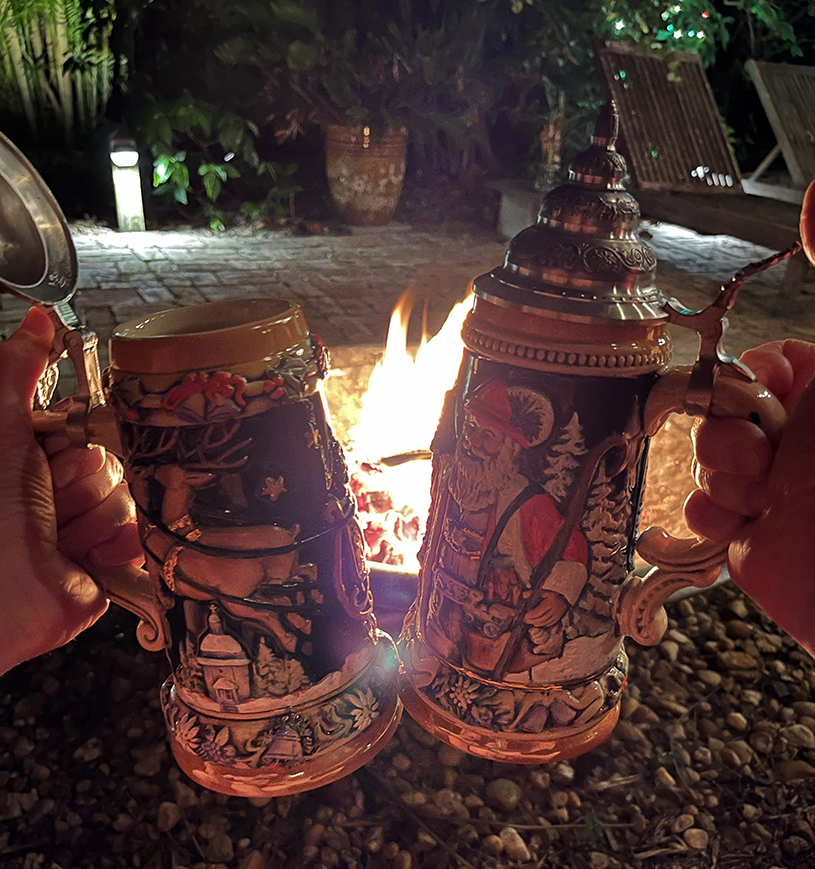
Twelfth Night fire in the chilly Lake Worth January air with roasted chestnuts and Rhineland steins of St. Bernardus Christmas Ale: It was a fine night.


Twelfth Night & Epiphany

This night of January 5, which is our Eleventh Day of Christmas, brings Twelfth Night, and the celebrations of Twelfth Night roll into Epiphany and the Twelfth Day of Christmas… and thus our Twelve Day carol ends.

ELEVENTH DAY of CHRISTMAS
January 5: Twelfth Night, Eve of the Epiphany

Twelfth Night, earlier in history, was once a really big deal. In England, it was, for a long time, a celebration rivaling that of Christmas Day. But one thing to understand about the history of Christmas, especially in Britain, is that it has always had one foot in the church and one foot in the tavern, and, truth be told, the foot in the tavern was probably heavier than the one in the church. Christmas and all its Twelve Days was a rowdy, boisterous time; it’s no wonder the Puritans despised it so. Even nearly two centuries after Puritan rule, Queen Victoria, who loved Christmas and whose husband, Prince Albert, is credited with introducing the Christmas tree to Britain, was not fond of the boisterous qualities of the holiday, and she had Twelfth Night stricken from the calendar during her reign. She disapproved of its rowdiness and thought her subjects would be better off without Twelfth Night. Her disapproval had a major impact on the celebration and it practically died out. And here we are today, the poorer for this. Especially here in the States, where we tend to just let Christmas unceremoniously fade away.

Ever the champion of the underdog, I am here in my role as a Christmas Traditionalist to champion Twelfth Night, too, for it can be a very useful holiday (no matter what Old Queen Victoria thought of it). If you are inclined toward feelings of melancholy or disappointment after Christmas Day has passed, these Twelve Days––and especially Twelfth Night and Epiphany, which provide a proper send-off to the season––are just what’s needed to help get you through that. For all we talk about maintaining links to the past, perhaps it is this, more than anything, that offers the best reason behind keeping an obscure old holiday like Twelfth Night in our contemporary world. Twelfth Night helps us feel more rounded, more complete. This is the value of Twelfth Night.

My family never did celebrate Twelfth Night when I was younger, but we did mark Epiphany. My mom calls it “Little Christmas.” I do remember one year, when I was a boy, feeling kind of down after Christmas Day had passed, and Mom told me, “It’s ok, we still have Little Christmas ahead.” Our little tabletop tinsel Christmas tree, the one she bought decades ago at Lord & Taylor and which we set up at our house now each year, meant a lot more to me after that. Maybe because the tree is little, just like Mom’s “Little Christmas.”

Years later, after my first internship at the Shaker Press, Brother Arnold Hadd and I exchanged so many letters. In one of those letters, that winter that followed my internship, he wrote about the Shakers’ Christmas celebration. It included things like “shaking the tree” (for presents) and their tradition of a Swedish smörgåsbord (this, a tradition given to them by Brother Ted, whom I never did meet), and yes, Twelfth Night. The traditional English Twelfth Night was a fun filled party with, no doubt, lots of ale and cider and punch, lots of food, and music, dancing, and games. When I picture a Twelfth Night party in my head, it looks a lot like the Christmas Eve party that Old Fezziwig throws for his employees in Charles Dickens’ A Christmas Carol. If you can manage some sort of gathering, and it needn’t be large, well, I think you’d be better for it. We are gathering with family and friends on Saturday evening this time around, for a special meal––crown roast of pork––and some games (including the old Yankee Swap gift game). No fiddler and caller, alas, but still: a proper send off to Old Father Christmas if ever there was one.

In Italy on this Eve of the Epiphany, la Befana will make her rounds, and in Spain and Latin America, los Tres Reyes, the Three Kings, will be doing the same. All of them will be delivering gifts; they are the last of our Midwinter gift bearers. Their stories are intertwined. Epiphany––a celebration older even than Christmas itself––marks the day the Magi arrived after their long journey, following that star, to see the child born in a barn. They arrived with gifts for the child, and so it is no surprise that they are amongst our Midwinter gift bearers. In Italy, though, the legends get a little more interesting, wrapped up as they are with a kindly old witch. There, it is said that the Magi stopped at la Befana’s and asked her for directions and to join them on their journey. They found her sweeping her floor. “No, no,” she told them, “I’m too busy with my housework!” And so the Magi went on their way. But as she swept, la Befana grew remorseful that she had not gone with them, and so she stopped her sweeping, hopped on her broom, and left her home in search of the Magi and the child. But she never found them. Each year on the Eve of the Epiphany, she sets out on her journey again, in search of the child, delivering small presents to good boys and girls, and coal for the not so good ones… but the coal these days is candy and sweet and so even that is not such a bad thing to find in your shoes on Epiphany morning.

I have known lots of Befanas in my day. It comes with the territory when you are of Italian descent. Women and men who clean and clean and clean, and who take great pride in their clean homes. Which is a wonderful thing, of course, but you know that they would’ve said no to the Magi, too, just like la Befana herself did at that first Christmas. Where does she even come from, la Befana? Well, she is an old hag… and so is the earthly goddess at Midwinter in the circular nature of the year: Born in springtime, fair maiden in summer, mother in autumn, old woman in winter. A cycle repeating with each orbit around the sun, another of our stories told again and again since time immemorial.

TWELFTH DAY of CHRISTMAS
January 6: Epiphany, Three Kings Day

On this final day of the Christmas season, we come to a celebration that was recognized by the Church even before Christmas itself. It is the day tradition tells us the Magi reached the stable to visit the child after their journey following the star that guided them to Bethlehem. Seeing the child was their epiphany, and that is the name of this day, too: Epiphany. Why was their day honored even before Christmas was? Probably because Epiphany holds the great symbolism that this news of the savior’s birth was for all people. The Magi are not from Judea. They are from distant lands. By journeying for twelve days and paying homage to the child, the Magi show that the message is universal.

In our home, we close the celebration of Christmas on Epiphany night with a simple ceremony at the front door, outside on the front porch. We will gather up all who are in attendance and we will each take turns writing with chalk on the lintel above the front door the numbers and letters and symbols of a traditional inscription. This year, it will read as follows: 20+C+M+B+24. These are the initials of each of the Three Kings (C for Caspar, M for Melchior, B for Balthasar), punctuated by crosses, blanketed on either side by the year. I tell you this each and every year: For me, the inscribing is always accompanied by a silent prayer that no one will be missing when we gather next to write the inscription again. Depending on the weather, the inscription may be there above the door for a month or it may be there all the year through. And though Christmas be gone, still the inscription reminds us of its presence as we pass each day through that portal. The inscription is a magic charm of sorts, protecting the house and those who pass through the doorway, harboring the goodwill and spirit of Old Father Christmas.

And with that, these Twelve Days of Christmas are done. La Befana is back to her sweeping, sweeping Christmas away, too, and we return to ordinary time, back to the workaday world. The poet Robert Herrick reminds us that it is fine and good, too, to keep the Christmas greenery in your home for the rest of the month of January, and this is something we will be doing. But the major part of the celebration is done, and with that, Old Father Christmas makes his way again to find his rest, until we conjure him back to our homes once more as the year grows old, like he himself.


TWELVE DAYS of CHRISTMAS SALE
Just a couple days left of our Twelve Days of Christmas Sale at our online shop. Through January 6, find automatic markdowns on most of our authentic German handmade nutcrackers, pyramids, and incense smokers, and chocolates and cookies, too. If there are things you wished for that Santa couldn’t fit in his sleigh, well, we’re here to help (and to offer you our best prices of the year, too). CLICK HERE to shop!


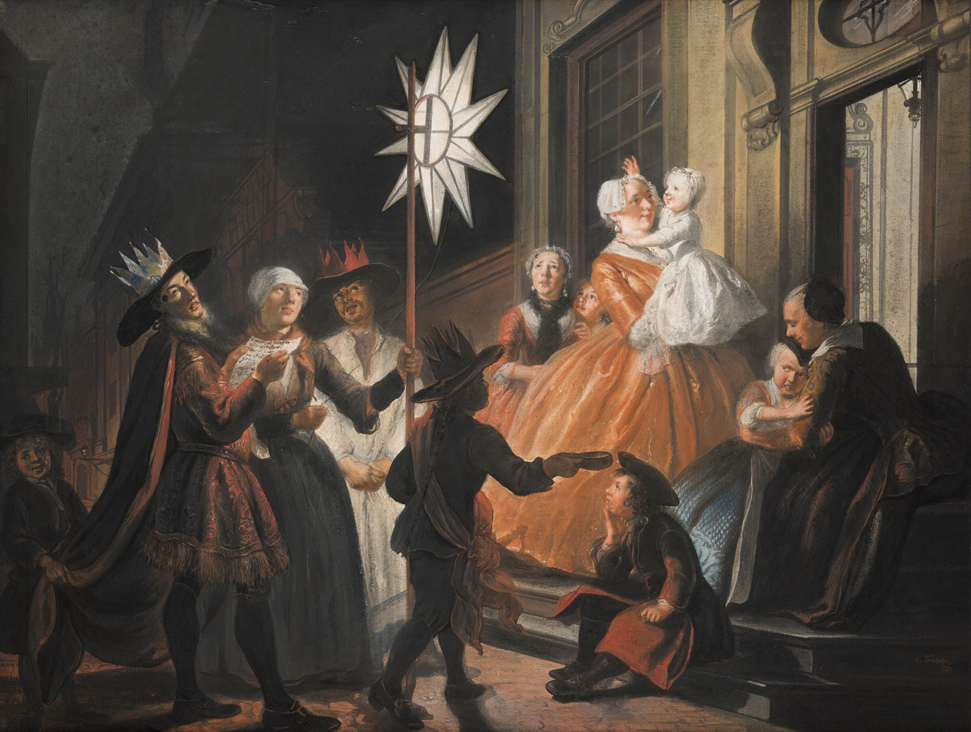
Image:  Such a fair way to send Father Christmas on his way: “Singing Round the Star on Twelfth Night” by Cornelis Troost. Pastel and brush in gouache on paper, 1740. [Public domain] via Wikimedia Commons.