Category Archives: The Gift Bearers

Santa Lucia

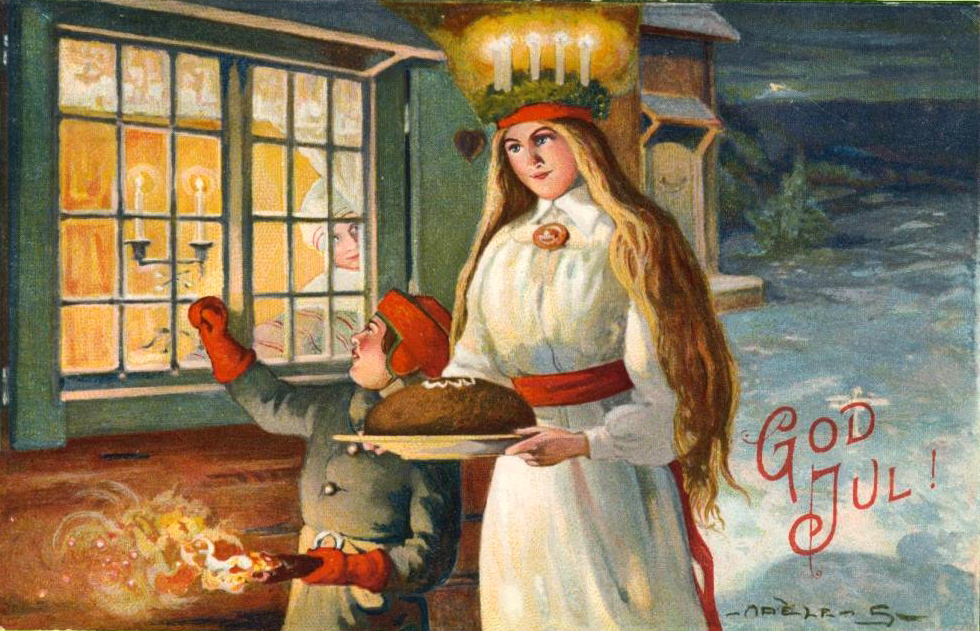
It’s late at night on the 12th (actually it is past midnight, so it is the 13th) and in these same overnight hours will arrive the next of the Midwinter gift bearers: Santa Lucia. She will come to homes mainly in Sweden and in Italy. In Italy, where children have left out their shoes and a bit of hay for her donkey, Santa Lucia will tie little presents to their shoelaces. In Sweden, where the nights this time of year are long and dark indeed, the Lucia will be one of the girls of the household, delivering saffron buns and hot coffee to the sleeping occupants, while donning a wreath of candles on her head. Or she will appear publicly in a procession, her gaggle of star boys and girls dressed in white accompanying her. Santa Lucia brings another magical night to this time of dark midwinter.

Though it be late, there is a gift I wish to bring you, as well, though I am no Santa Lucia. A star boy, maybe, at best. It’s a gift I’ve given on other Santa Lucia Days, but it is so beautiful, and subscribers Carl & Kathleen Maugeri loved it so much last year, I wanted to offer it again, for them and for all of you. It is a song called Santa Lucia, an old Neapolitan melody, but it is in Swedish, for Lucia is sacred to both Italy and to Sweden, two countries that in many ways could not be more different. I love this melding of cultures and celebration. In Italian, Lucia is pronounced with a “ch” (loo-chee-a) while in Swedish, the C is soft (loo-see-a). The song you’re listening to, if you’re listening to it (and I hope you are) is from one of those processions in Sweden: the young girls dressed in white and young boys, called star boys, also dressed in white, carrying stars on tall poles. “White,” Jane Siberry says, “the color of truth.” Somewhere amongst them is the Lucia, wearing a wreath of lit candles upon her head. Such a beautiful song and such a beautiful sight. Eight days yet to the solstice, darkness continues to build. We welcome light where we can find it. In this case, it comes with such beauty. A good night, indeed.


On Advent, St. Nicholas, and Speculaas

stclaus

Holiday confession time: When the Advent season arrives as early as it did this year, which basically stems from Christmas itself falling on a Sunday, I have a harder time than usual transitioning into the Christmas spirit. We’re already past the Second Sunday of Advent (it was yesterday) and still you’ll find dried corn hanging on our front door and orange lights strung on our bookcase. Though we’ve been opening the windows on our advent calendar, we had to catch up the first couple of days because we didn’t have a calendar chosen on the First. And life’s been so busy, Seth and I have ourselves quite a lot of catching up to do on our advent candles.

Ah, but tonight comes St. Nicholas’ Eve, and with this night, we welcome the first of the Midwinter gift bearers, wending his way through the midwinter darkness. Advent and Christmas suddenly seem more tangible, more real. On years like this, St. Nicholas serves as my reality check.

Although Santa Claus is a super big deal here in the States, and though we often call him Old St. Nick, the real St. Nicholas barely earns a blink of anyone’s eyes here. But there are other parts of the world, especially throughout Europe, where this is a very important night indeed. It is the Eve of St. Nicholas (St. Nicholas’s Day being tomorrow, the 6th of December), and children there will place their shoes by the chimney before going to bed in hopes that St. Nicholas will fill them with gifts. They’ll set out carrots and hay for his donkey.

In these overnight hours, the old bishop will make his rounds. Good children might wake up on St. Nicholas’ Day to find their shoes filled with fruits and nuts and sweets and small toys. But St. Nicholas does not wander alone; he travels tonight with a dark companion. The companion goes by many names, depending on the region––Knecht Ruprecht, Black Peter, Pelznickel… but he is best known as Krampus: half man, half goat, a bit terrifying… the punisher of children who have been naughty. These two are not as secretive as our American Santa. There are parades this time of year throughout Europe for St. Nicholas’ Day and Krampus pretty much steals the show at some of these parades, especially in parts of Germany, where tonight is known as Krampusnacht.

I love the time of the Midwinter gift bearers. Such a beautiful way to make the Midwinter darkness less… dark (despite Krampus). St. Nicholas will be followed over the next few weeks by the Christkindl, by Santa Lucia, by Father Christmas and Santa Claus, by los Tres Reyes (the Three Kings) and a kind old witch named Befana who will sweep away the remnants of the Christmas season in early January.

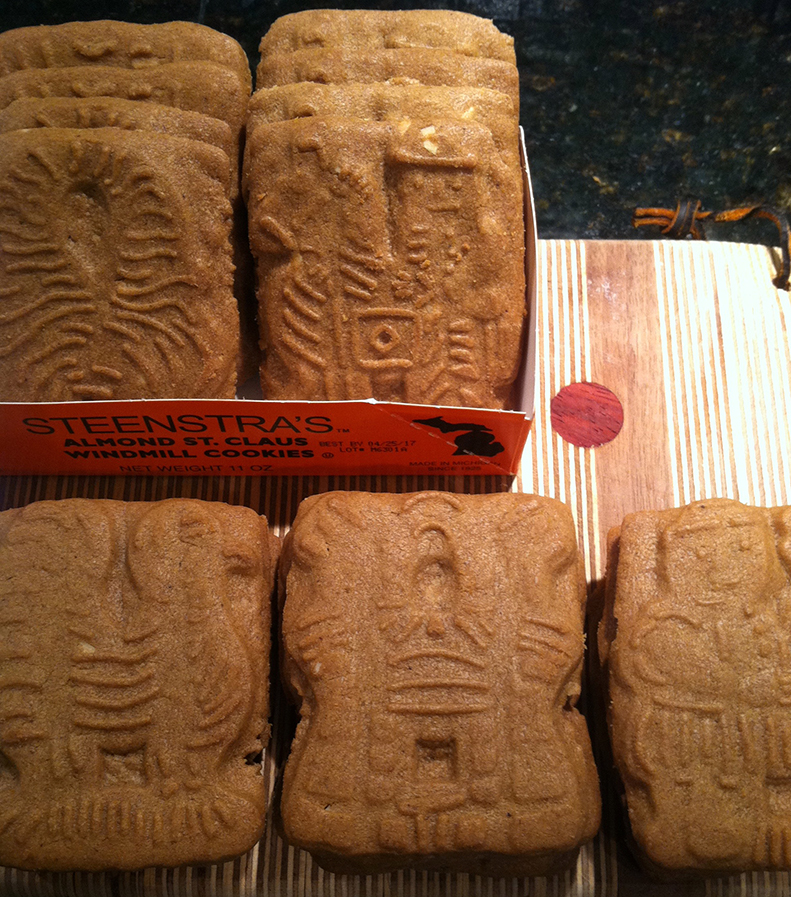
But that’s all a long ways away. For us tonight here in this little old house in Lake Worth, we will leave our shoes by the bed, which we always do. Our small old home has small old closets, and so we almost always have a couple of pairs of shoes outside the closet––there’s just no place in the closet to put them. I don’t know if St. Nicholas and Krampus will make their way this far from Europe, but chances are good that once we go to bed, Haden the Convivio shop cat will spend some time hunting down her little stuffed animal toys, carrying them about and making the odd cries that cats make once they have caught their quarry, and maybe tonight she will drop one of them into someone’s shoe, as she is wont to do so many nights. But before those magic overnight hours, we will brew ourselves some tea, or maybe some mulled wine, and we will for sure open a package of Steenstra’s St. Claus cookies. The cookies are speculaas, a type of Dutch cookie made for St. Nicholas’ Eve. They sell them all year long at the Publix bakery in a small cellophane-wrapped package. The cellophane is clear and the box inside is bright orange. The Steenstra family emigrated from the Netherlands to Michigan in 1926, and that’s where the cookies are still made, as they have been for about 90 years now. They taste of almond and warm spices like ginger and clove, and they depict five different scenes about St. Claus (more correctly about St. Nicholas of Myra, the kind fourth century bishop who gave gifts to the poor while they slept). There is St. Claus on a horse (a derivation of that donkey), a boy and a girl (because they like to receive presents from St. Claus), a rooster (because St. Claus starts his day at sunup), an owl (because St. Claus works til sundown), and a windmill (because St. Claus lives in a windmill). The first of the gift bearers gives us reason to celebrate tonight; we hope you’ll join us in that.

Image: Our Steenstra’s speculaas, ready to go. Just have to mull that wine now.


Twelfth Night

Twelfth Night

ELEVENTH DAY of CHRISTMAS:
Twelfth Night, Eve of the Epiphany

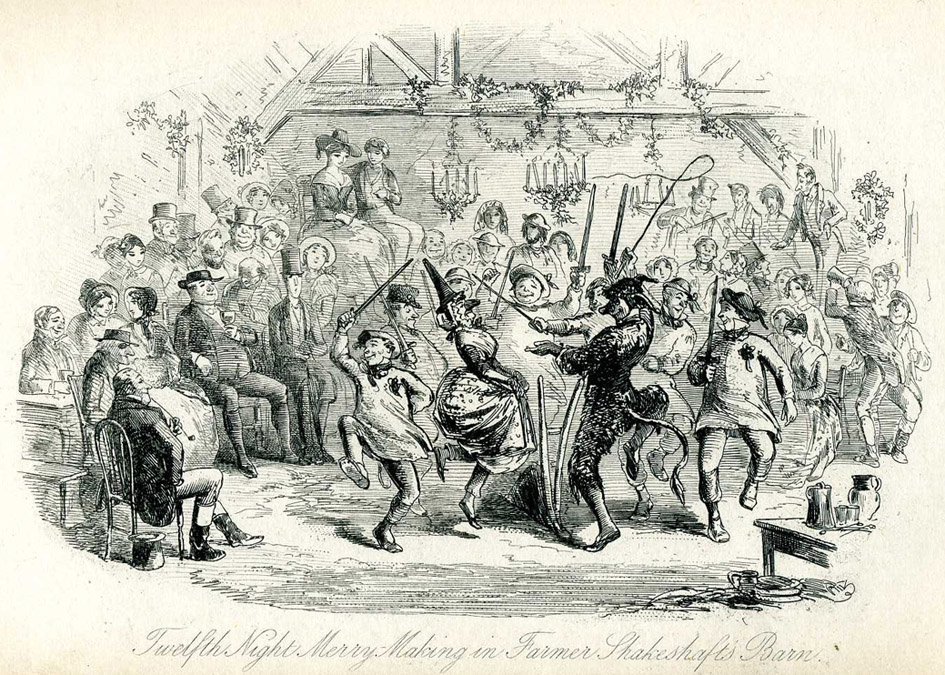
The close of the Christmas season begins here, and just as our Christmas celebration began in the nighttime hours of Christmas Eve, so the same comes Twelfth Night. If this is confusing (that Twelfth Night should come on the Eleventh Day), remember that even today, much of the way we celebrate holidays is based on traditional reckoning of time, in which a new day begins at sunset. This is why the nights before holidays are so important: Consider Christmas Eve, of course, but other nighttime events, as well, like Hallowe’en (the Eve of All Hallow’s) and at Easter, Holy Saturday, with its vigil Mass that begins only with the setting sun. And so Epiphany Eve, which is tonight, ushers in Epiphany the next day. The night is best known, though, as Twelfth Night, and it has long been a night of great festivity. When it comes to Twelfth Night, the more raucous the celebration, the better. It is a true vestige of the Roman Saturnalia festival of ancient midwinters, right down to one of the most common Twelfth Night customs: the baking of a cake that contains a hidden bean. In some places, it’s a bean and a pea. He who finds the bean is crowned King of the Bean; she who finds the pea, Queen of the Pea. These folks get places of honor at the revels. In the old engraving above, which pictures a grand old Twelfth Night gathering, you can be sure there is a King of the Bean somewhere amongst those folks, and maybe even a Queen of the Pea.

I am always fascinated by images of rousing old parties like this. I think it’s because I am the most awkward person at parties; and yet I picture the Van Tassels’ Quilting and Merrymaking Frolic in Washington Irving’s “The Legend of Sleepy Hollow” or the Fezziwiggs’ Christmas Eve party in Charles Dickens’ A Christmas Carol, and I am pretty confident I’d have a blast at either one. There would be fiddler and a caller and an abundance of food and steaming punch and, well… if you have a party like this, I hope you’ll send me an invitation. I’ll be there with bells on.

There is very little of this Twelfth Night festivity nowadays, especially here in the States where the colonial Puritans did a very good job of setting the pace for work, work, work… not to mention putting the cabbash on Christmas in general. But Christmas survived in this country despite their best efforts. Twelfth Night, however, might be considered a casualty. But I think we need Twelfth Night. Old Father Christmas comes to be with us each year for a visit that lasts but a couple of weeks. It’s only right to send him on his way again in proper fashion, and in our house, that means a celebration––even a small one if that is all we have left in us––is in order. Dinner should be a good one, and a festive Christmas punch is a nice accompaniment, as would be the same wassail we drank on New Year’s Day. Friends and family would be a great addition, as well as good music and an old game or two, like Snapdragon: Fill a shallow bowl with golden raisins and pour a bit of brandy over them. Darken the room (like the darkness of midwinter) and carefully set light to the brandy. Play the game while the brandy is aflame: Each person in the room snatches a raisin from the bowl and makes a wish upon the raisin before popping it into his or her mouth. This old game from Scotland may sound dangerous, but it’s less so than it would seem. Be careful all the same, of course. Each person’s wish should be granted before the next Twelfth Night… or so the story goes.

Christmas ends each year with Epiphany, which will come tomorrow. New things, meanwhile, are just stirring. Twelfth Night and Epiphany usher in the Carnival season. In place like Acadiana, tonight’s revels roll over into the parades and balls hosted by the local krewes that culminate with Mardi Gras, which this year falls on February 9. But again, I’m getting ahead of myself. As for Epiphany, it marks the day the Magi arrived at the stable in Bethlehem after nights of following the star that announced the birth of the Christ child. One of the most endearing figures in the story is an old Italian woman who is known as la befana. She and the Magi are the last of the midwinter gift bearers. Those three kings (los tres reyes) are the ones who bring presents tonight in Spain and Latin America, but in Italy, this is the job of la befana. As the story goes, at that first Christmas oh so long ago, the Magi stopped at la befana’s house and asked her to join them on their journey, but she declined the invitation. “I have so much housework to do!” she told them. And so the Magi left her home and continued on their way.

But as she swept her floors, la befana began to feel a bit remorseful, and once she finished her sweeping, she set out to find the Magi. But she never did find them, nor the child they had told her about. She searched and searched but to no avail. Still, to this day, on each Twelfth Night, la befana sets out upon her broom to seek them. As she makes her rounds, searching high and low for the child and the three kings, la befana leaves small presents for all the sleeping children. Even the ones who were naughty: they get coal, but la befana’s coal is sweet as candy, so even her coal is a nice present to receive.

It is la befana’s job to sweep away Christmas, and so she does this each year. She sweeps and sweeps, and by the time she’s done with her sweeping tomorrow at Epiphany, Christmas will be done. The Magi will return to their distant countries, and Old Father Christmas, whether he was welcome or welcome not, will be on his way back to the Northland. But the wheel of the seasonal round will continue to turn and new days of wonder will be upon us, even as we just begin to miss the Yuletide visitors who came to spend these dark midwinter nights in our company.


Image: “Twelfth Night Merry-Making in Farmer Shakeshaft’s Barn,” an engraving by Hablot Knight Brown (better known as “Phiz”) from the book Mervyn Clitheroe by William Harrison Ainsworth, c.1850. Today’s chapter of the Convivio Book of Days is a slightly moderated version of last year’s chapter for Twelfth Night. Like a visit from an old friend, or from old Father Christmas, slightly older, slightly wiser.