Category Archives: The Gift Bearers

The Legend of La Befana

ELEVENTH DAY of CHRISTMAS
Twelfth Night, Eve of the Epiphany

Say what you will about 2020… an awful year, to be sure, but a lot of good came of it, too. One Sunday in March a few of my cousins gathered together on Zoom for a virtual gathering, just to visit, just so we could all make each other happy. It’s continued every Sunday since, and grown to include cousins I’ve never met in person, from Atlantic to Pacific and across the ocean, too, to Italy. Zoom Fatigue? Not when you’re with this group.

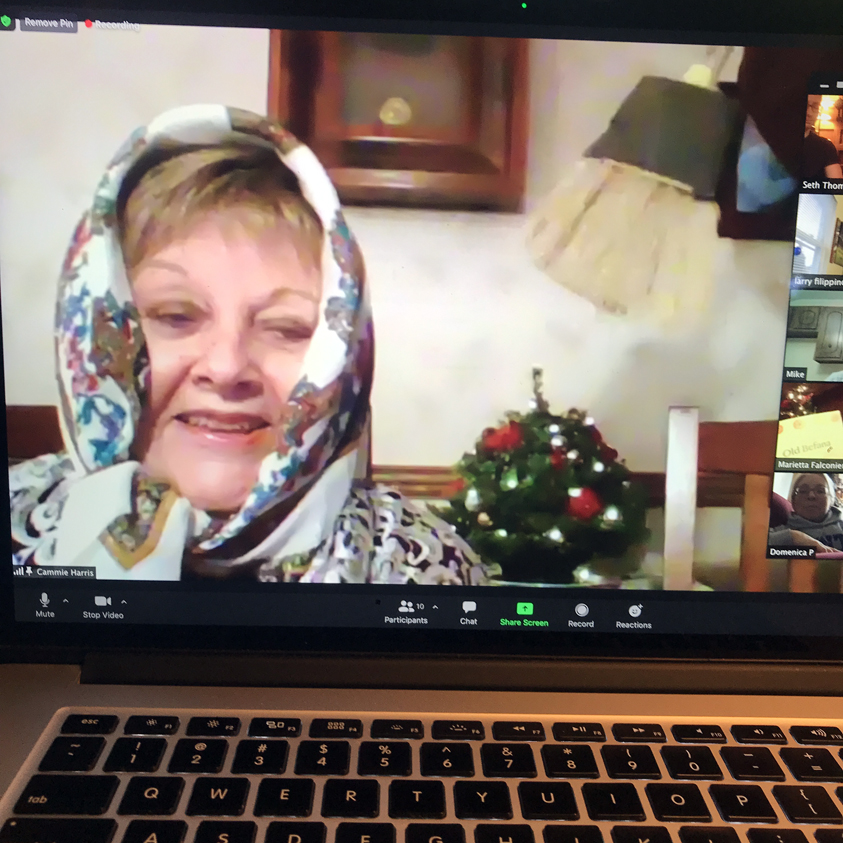
Last Sunday’s Cousins Zoom included my cousin Marietta reading a story about la Befana, the kindly old witch who brings presents to children in Italy on Twelfth Night. Her sister, my cousin Cammie, acted out the parts as Marietta read the story. And there’s Cammie in the photo above, the kerchief on her head signifying that she is la Befana, her broom for sweeping nearby. Each year my cousins in New York and New England gather for their Little Christmas party on or around Twelfth Night and Epiphany, and each year, la Befana makes her appearance, along with the three kings, all played by other cousins of mine. Alas, no Little Christmas party this year, but I finally got to see Cammie acting out her role. It was just beautiful.

La Befana is our signal that we’re coming to the close of Christmastide. With her broom tonight she will sweep away what’s left of our celebration, leaving the Twelfth Day of Christmas tomorrow open for the Magi and the Epiphany, which is a celebration even older than Christmas itself, marking the day those three old men arrived at the stable to worship the child who was born on Christmas Night. The Church celebrated Epiphany years and years before it began celebrating the birth of Christ, and somewhere along the way, in my family, at least, it picked up the nickname “Little Christmas.” Natalie Kavanagh, a Convivio Book of Days reader, wrote some years ago to tell me that where she comes from, on the Outer Banks of North Carolina, the day is known as Old Christmas.

But tonight, the Eve of the Epiphany, brings Twelfth Night. It is a cause for celebration that unfortunately doesn’t gather much attention here in the States, but what a lovely custom it is. We have been known to host a big dinner party for family and a few friends on Twelfth Night or Epiphany (an event that obviously won’t be happening this year). In some places, Twelfth Night and Epiphany are celebrations that rival Christmas itself. And why shouldn’t it be so? We spend so much time and energy preparing for Christmas. Is it not right and good to send Christmas off with a bit of ceremony? This is the value of Twelfth Night and Epiphany. This is the value of Little Christmas, and of Old Christmas. They are celebrations that provide us with a sense of completion.

But if all this sounds unbearably sad (especially after such a rough year) and if you, like us, are among those who dearly love the season, I can offer some solace, for while Twelfth Night and Epiphany may come and go, there is yet another old tradition that keeps Christmastime––the music, the stories, the festivity and lights––going all the way to the start of February. As Seth and I have grown older together, this has become the tradition that we follow, a custom that has strong ties to old Pagan traditions. The First of February brings Candlemas Eve. As celestial mechanics go, this is the night that winter begins to give way to spring, for we reach the midway point between the winter solstice and the spring equinox. Yule gives way to Imbolc in the seasonal round of the year. And by Candlemas Eve, the 17th century poet Robert Herrick tells us, all traces of Christmas greenery must be removed from the home (…how many leaves there be / Neglected, there (maids, trust to me) / So many goblins you shall see).

As people more interested in wholeness and balance, these are the ways we follow, fully realizing they are not for everyone. Mind you, a lot of our Christmas decorations will be down before Candlemas Eve. Robert Herrick did not have modern Christmas decorations to contend with; just greenery from the natural world. And by Candlemas Eve here, we are most likely down to just things from nature, too. That night, we will return to nature what is hers.

As for the legend of la Befana… I will save that story for Epiphany, tomorrow, when you will finally have enough of me and all this Yuletide stuff. If I could, I’d have my cousin Marietta tell the story, while my cousin Cammie dramatizes the part. Instead, you’ll just get me, doing the best I can.
 

Sacred Candlelight

Such a sacred act, lighting a candle. That concentrated energy in the spark of the wooden match striking the flint, a small explosion of illumination, lighting the wick that burns the tallow. Like many things of wonder, it is an act that is potentially dangerous, and yet, kept in control, a thing of extreme beauty. So many of our sacred nights here at our home are illuminated by candlelight. (Perhaps they all are sacred: for months now, since this time of isolation began, Seth has been lighting candles at the dinner table each night.)

As I write this today, it is the Feast of Our Lady of Guadalupe, and in the overnight hours as this day becomes the next, Sankta Lucia will arrive, too, with a wreath of candles upon her head, illuminating the dark cold night, this night that “walks with heavy steps.” I can picture all of the glass Guadalupe candles that are so ubiquitous in shops here in Lake Worth––from Botanica shops to the grocery store aisles––illuminated, too. Some folks are lighting Chanukah candles, and on the Advent wreath this Sunday, we illuminate two purples candles and the rose candle, too, for it is Gaudete Sunday, the Sunday of Advent where we add a measure of joy to our time of reflection. It is difficult to contain the joy that we know is coming with Christmas, and so the colors for this next week of Advent take on the joyful color of rosy pink, rather than somber purple.

And so here we are, practically midway through December already. The Feast of Our Lady of Guadalupe on the 12th of December is sacred to all the countries of Latin America, but most especially to Mexico. As the story goes, in 1531, a fellow named Juan Diego was on a hill near Mexico City and there he saw an apparition of a woman. She asked him to build a church in her honor there on the hill. She spoke to him in his native Nahuatl language and he recognized her, by the things she told him, as the Virgin Mary. And it was on 12th of December in that year that the iconic image of Our Lady of Guadalupe that we know so well miraculously appeared inside Juan Diego’s cloak: on one of his visits to the hill, Mary told Juan Diego to go to the barren top of the hill, but when he got there, he found it not at all barren but covered with roses, all in bloom. He and Mary gathered the roses and she arranged them inside his cloak. And on this, her feast day, Juan Diego opened his cloak before the bishop of Mexico City. When he did, the flowers all fell to the floor, revealing the image of the Virgin of Guadalupe. The bishop took it as a sign. The church was built, and the image from Juan Diego’s cloak, or tilma, hangs still inside the Basilica of Our Lady of Guadalupe on Tepeyac Hill, Mexico City.

The 13th, a Sunday this year, brings St. Lucy’s Day: the Feast of Santa Lucia in Italy (where Lucia is pronounced loo-chee-a) and Sankta Lucia in Sweden (where the C is soft: loo-see-a). Lucia is sacred to both countries; she was born and lived and died in Sicily, but––perhaps because the nights are so dark in Sweden in December––she was long ago taken up there and celebrated. Lucia = Light, and light is a precious commodity to come by near the Arctic Circle around this time of the approaching Midwinter Solstice.

In Italy, children will wake up in the morning to find tiny presents tied to their shoelaces, as long as they’ve left hay and carrots in their shoes before they went to bed, for Santa Lucia’s donkey. Santa Lucia follows St. Nicholas as the next of the Midwinter gift bearers. In Sweden, typically there are processions on this night in celebration of Sankta Lucia: in churches, in schools, in city streets, on national television. Each features a Lucia, donning a wreath of glowing candles upon her head, with scores of her attendants: boys and girls dressed all in white, each bearing a candle, and then the Star Boys, each carrying stars on poles and donning tall white conical caps. It is one of the most beautiful sights of these ever-darkening nights on the approach to the solstice. In homes, too, Lucia will come in the early morning darkness, wreath glowing upon her head, delivering strong coffee and saffron scented buns, lussekatter, to all in the household.

It is a time that gets jumbled up in our home (and perhaps many other places, too) with things both Italian and Swedish. Even the music for this night is jumbled, for the song that is sung throughout Sweden this night (click here to listen) is Italian in origin, an old Neapolitan melody, transformed and rewritten for a place where, at this darkest time of the year, the night is vast:

The night walks with heavy steps around farm and cottage.
Around the earth, forsaken by the sun, shadows are lowering.
Then into our dark house she treads with lighted candles,
Sankta Lucia, Sankta Lucia.

The night is vast and mute. Now here reverberate
in all silent rooms a rustle as of wings.
See, on our threshold stands––whiteclad, lights in her hair––
Sankta Lucia, Sankta Lucia.

“The darkness will soon take flight from the valleys of earth.”
Thus she a wonderful word to us speaks.
The day shall again, reborn, rise from a rosy sky,
Sankta Lucia, Sankta Lucia.

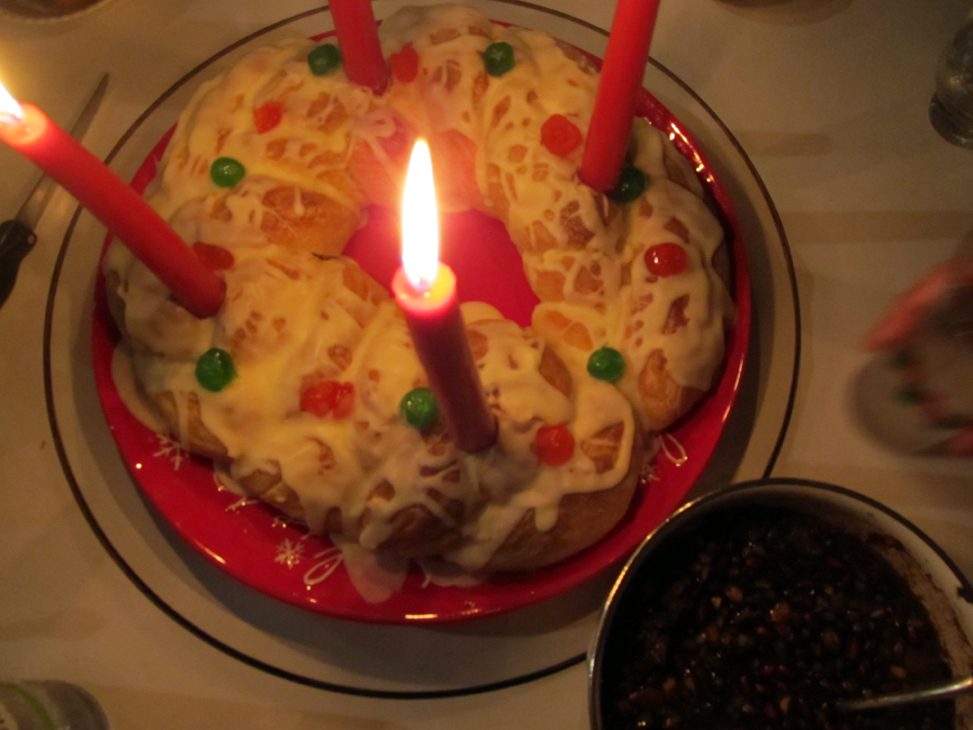
On Sunday morning, my sister will make her Santa Lucia wreath––a sweet yeast bread, braided and round, a never ending circle like the circle of days, dotted with candied cherries and illuminated with four red candles. Another simple yet delicious treat we have but once each year, and we’ll enjoy it tonight with coffee after dinner. This is our Santa Lucia way.

All of us here––my mom, my sister, Seth and me––we wish you light and peace on these sacred illuminated midwinter nights.

Image: My sister Marietta’s Santa Lucia Bread. I wish we could pour you some coffee and cut a slice for you!


Tagged , ,

Greetings from Krampus & St. Nicholas

The 6th of December brings St. Nicholas’ Day, but the 5th brings the Eve of St. Nicholas, the traditional night when St. Nick delivers presents to children in the lands where he is loved… especially Germany, Austria, Northern Italy, and the Netherlands. He is the first of the midwinter gift bearers, wending his way through these darkest nights.

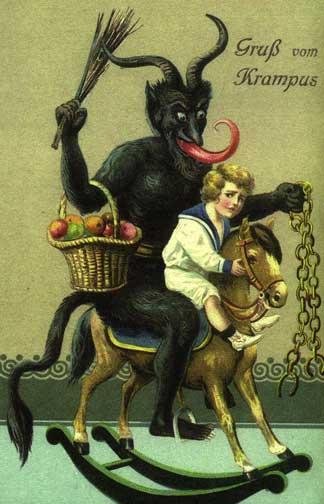
On the Eve of St. Nicholas, the old bishop will make his rounds. Wise children will place their shoes by the chimney before going to bed in hopes that St. Nicholas will fill them with gifts. They’ll set out carrots and hay for his donkey. If they’ve been good, they might wake up on St. Nicholas’ Day to find their shoes filled with fruits and nuts and sweets and small toys. But St. Nicholas does not wander alone; he travels tonight with a dark companion. The companion goes by many names, depending on the region––Knecht Ruprecht, Black Peter, Pelznickel… but he is best known as Krampus: half man, half goat, horned and furry, with an astonishingly long tongue. St. Nicholas, dressed in his bishop’s robes and hat, concerns himself with the good children. Krampus deals with the naughty ones. He carries chains or birch switches and oftentimes a sack, in which he gathers up the bad children who deserve nothing more than to be carried away. It’s a bit terrifying, but also good fun––especially in the Krampusnacht parades that feature both St. Nick and Krampus.

I love the time of the Midwinter gift bearers. Such a beautiful way to make these darkest nights somewhat less dark (despite Krampus). St. Nicholas will be followed over the next few weeks by the Christkindl, by Santa Lucia, by Father Christmas and Santa Claus, by los Tres Reyes (the Three Kings) and a kind old witch named Befana who will sweep away the remnants of the Christmas season in early January.

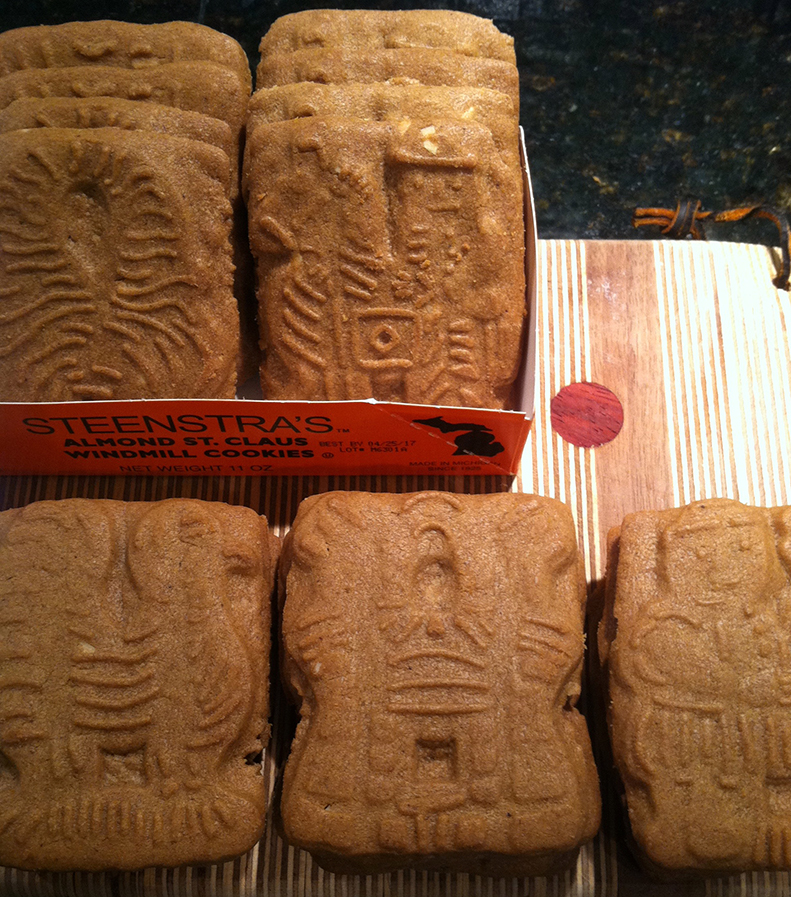
But that’s all a long ways away. For us tonight here in this little old house in Lake Worth, we will leave our shoes by the bed, which we always do. Our small old home has small old closets, and so we almost always have a couple of pairs of shoes outside the closet––there’s just no place in the closet to put them. I don’t know if St. Nicholas and Krampus will make their way this far from Europe, but chances are good that once we go to bed, Haden the Convivio shop cat will spend some time hunting down her little stuffed animal toys––in particular, Cat in the Hat––carrying them about and making the odd cries that cats make once they have caught their quarry, and maybe tonight she will drop one of them into someone’s shoe, as she is wont to do so many nights. But before those magic overnight hours, we will brew ourselves some tea, or maybe some mulled wine, and we will for sure open a package of Steenstra’s St. Claus cookies, like we do each year on this night. The cookies are speculaas, a type of Dutch cookie made for St. Nicholas’ Eve. They sell them all year long at the Publix bakery in a small cellophane-wrapped package. The cellophane is clear and the box inside is bright orange. The Steenstra family emigrated from the Netherlands to Michigan in 1926, and that’s where the cookies are still made, as they have been for about 90 years now. They taste of almond and warm spices like ginger and clove, and they depict five different scenes about St. Claus (more correctly about St. Nicholas of Myra, the kind fourth century bishop who gave gifts to the poor while they slept). There is St. Claus on a horse (a derivation of that donkey), a boy and a girl (because they like to receive presents from St. Claus), a rooster (because St. Claus starts his day at sunup), an owl (because St. Claus works til sundown), and a windmill (because St. Claus lives in a windmill).

So whether you be visited by St. Nicholas or by Krampus, or by a cat that drops presents in your shoes, tonight something special is bound to happen. Enter the gift bearers onto the midwinter stage––there is good reason to celebrate this night.

Today’s chapter is a reprint of one published on December 5, 2019. It’s been a heck of a week here and the Eve of St. Nicholas has completely snuck up on me. It’s ok; these things happen. I did, however, just check the Publix delivery option for Steenstra’s St. Claus cookies and they did not come up… and so I may have to venture into the store myself to see if they are there. We do have wine, though, and we are stocked up with mulling spices. In fact, we use mulling spices so often during these midwinter nights, you may want to be stocked up with them, too. Here’s a direct link to the Shaker Mulling Spices we sell at our catalog. If you’re local and need some, order using the discount code PICKUP at checkout, which will deduct the $8.50 shipping charge, and I will bring them by to you if you live in the 33460 zip code, or you can come by here for a front porch pick up.

Images: Steenstra’s St. Claus cookies. At the top, a late 19th century or early 20th century Krampusnacht postcard from Germany.