We Americans like to bicker about things but we do come together on occasion, and one of those occasions is today, the Fourth of July, Independence Day. Most of our celebrations across the country will at least touch upon some of the traditional iconic customs of the day: grills and pies and a good bit of drinking with music and fireworks, outdoors, accompanied by plenty of red, white, and blue.
I have always loved the Fourth of July. It was supposed to be my birthday, but I arrived early (I haven’t been very good about early arrivals since), but Independence Day tends to make my birthday a days-long celebration all the same, which is kind of nice. When I was a boy, we would usually watch the fireworks from our home, which was not all that far from the municipal fireworks display at Firemen’s Field. My mom and dad and sister and grandparents would sit on lawn chairs in the front yard, faces pressed to the sky, while I can remember at least once or twice being granted the okay to sit on the trunk of the car to get a little closer, a little more height, to get a better view.
That was in the 1970s and it was not that different then from the way it was years before and not that different from the way it is now. The first known celebration of Independence Day was at Bristol, Rhode Island, in 1777. There at Bristol were the music and the fireworks, red, white and blue bunting, and speeches, too. We have records of General George Washington, on the Fourth of July, 1778, giving his soldiers an artillery salute and a double ration of rum (yes, even the drinking has a long history).
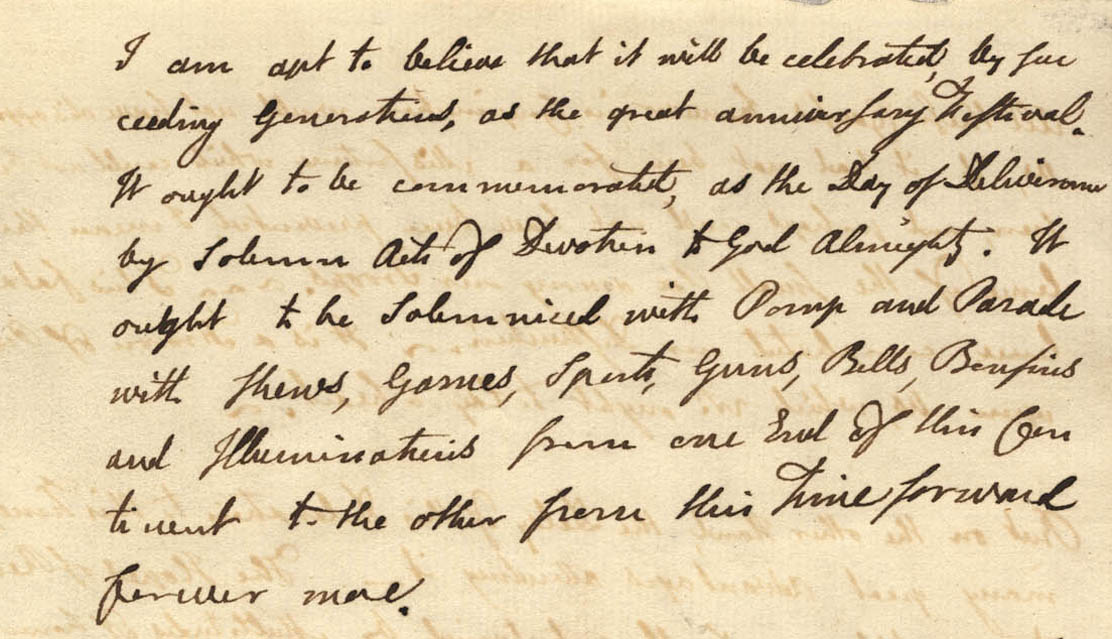
But back to the bickering, for that is what we do best (especially in an election year): There are those amongst our beloved Founding Fathers who would have wanted our celebration to be two days ago, the Second of July. John Adams was in this camp. Adams was a great leader in the fight for independence from Britain and he was our second president. It was in Philadelphia on July 2, 1776, that delegates of the thirteen colonies at the Second Continental Congress officially voted for independence, Adams amongst them. Two days later, on the Fourth, came the adoption of the Declaration of Independence that was penned by Thomas Jefferson. Adams was pretty certain July 2 would be remembered as a day of supreme importance in American history. In fact, here’s a bit of a letter he wrote back home to his wife Abigail on July 3 from Philadelphia:
The Second Day of July 1776, will be the most memorable Epocha, in the History of America. I am apt to believe it will be celebrated, by succeeding generations, as the great anniversary Festival. It ought to be commemorated, as the Day of Deliverance by solemn Acts of Devotion to God Almighty. It ought to be solemnized with Pomp and Parade, with Shews, Games, Sports, Guns, Bells, Bonfires and Illuminations from one End of this Continent to the other from this Time forward forever more.
Alas, the Fourth of July was the date written upon the document that was eventually signed by the delegates to that Second Continental Congress, and so the Fourth took on greater significance. Adams and Jefferson rarely saw eye to eye, and Adams lost his bid for a second term as president to Jefferson. But though they, too, bickered, they did share solidarity in their dream of the United States of America as a sovereign country, independent from the Crown of Great Britain. I have also loved the fact, ever since I learnt it as a little boy, that John Adams and Thomas Jefferson both left this earth on the same day, Adams in Massachusetts, Jefferson in Virginia, both on the Fourth of July, 1826: the fiftieth anniversary of the adoption of the Declaration of Independence. I like to think they both got to see some bonfires and illuminations before they went their ways… or maybe met up on the other side, where they could still bicker about the proper day to celebrate.
Image: Excerpt of a letter from John Adams in Philadelphia to his wife Abigail in Quincy, Massachusetts, July 3, 1776. With thanks to the Adams Family Archive of the Massachusetts Historical Society.