Autumn by the Almanac

SunshineHaden

Our great big Earth constantly is shifting in its seat and tonight in the Northern Hemisphere, in the overnight hours betwixt Tuesday and Wednesday, we will reach a time of balance: It is the autumnal equinox. Ever since the Midsummer solstice in June we’ve been losing a bit of daylight with each passing day, and now, halfway between Midsummer and Midwinter, things are balanced. But only briefly, for almost as soon as the balance is reached, the planet’s shifting continues and darkness now begins to overtake light.

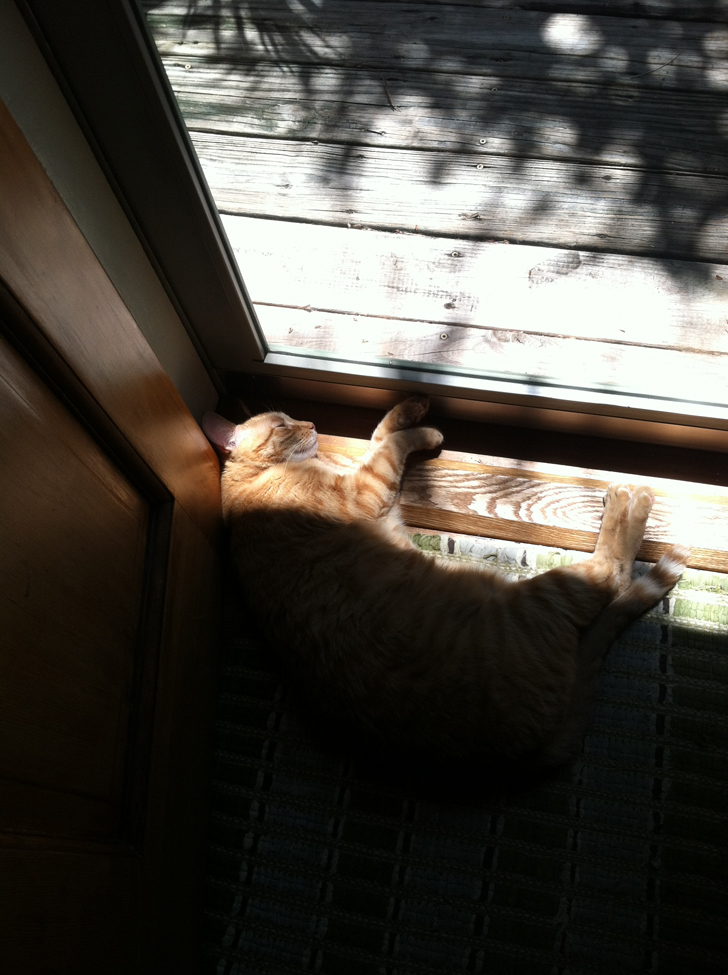
We see this constant rearrange in ways both obvious and subtle. The obvious thing we notice is that the sun rises much later and sets much earlier now than it did at Midsummer. The subtle things are more fleeting in nature: when I drive due east toward home after work the sun is setting and shining now right in my eyes through my rear view mirrors. At home, Haden the Convivio Shopcat is spending more time pressed up against the south windows as the sun dips lower in the sky; the sunlight streams again into those windows, and she is practically drunk on the stuff.

For a guy who’s spent most of his life in a subtropical place, autumn can be a pretty magical time. The season is truly an exercise of subtlety here in Lake Worth. But I’ve spent quite a few autumns in New York as a boy, where I remember making leaf books each year. In the first grade, Mrs. Cava had us gather leaves we liked and we placed them in wax paper bags and ironed them to construction paper and bound them into books. I miss falling leaves and I miss wax paper bags. Both smell so good. I also lived in Alabama for a few autumns, where stray cotton would blow from the fields to litter the roadsides. And there were a couple of blissful autumns in Maine, in Seth’s hometown, where we would load up on heirloom pumpkins and drink more cider than water and it’s a wonder I never drove off the road on my to Portland as I passed stands of swamp maples that mesmerized me with their vibrant hues. And Seth and I met in autumn in North Carolina, at the Penland School of Crafts, where he was a potter and I, naturally, printed a book called Autumn. I may live in a decidedly unautumnal place, but autumn is the season I love most.

The moment of equinox is different each year and this one arrives at 4:21 AM on the 23rd of September here in Lake Worth, which is Eastern Daylight Time. If precision is important to you, calculate from here to your location. This is a very black and white view, though, and I tend to see the world in shades of grey. I’m rarely interested in precision in matters such as these, but more interested in the general theme of balance that arrives with this time. The equinox will also bring the arrival of autumn by the almanac in the Northern Hemisphere (and of course spring in the Southern). But the almanac provides just one way of looking at things. More traditional reckoning of time places the equinox as the middle of autumn, and I like to picture the season, and the year, in this way: balanced right now, like a scale. Tomorrow it begins tipping more toward darkness as the Earth shifts back even further in its seat: winter is fast approaching as we enter now the darker half of the year.


Image: Haden getting as much sunlight as she can, pressed up against the glass of our front door. Come November, she’ll have more sunlight than she’ll know what do with streaming in through the same glass. Each day different than the one that came before and the one that follows.


We Went to the Feast

Feast_of_San_Gennaro_NYC_2014

There is a famous Norman Rockwell painting that first appeared on the August 30, 1947 cover of The Saturday Evening Post. It’s titled “Going and Coming,” and in the top half of the painting, a family is on their way to a grand day out. In the bottom half of the image we see the same family on their way back home. Everyone is all chipper and excited on their way out; on the way back they’re all beat and exhausted.

My family has an Italian saying that reminds me of this. We say it in the Lucerine dialect that my grandparents spoke, so keep in mind it’s not at all proper Italian but more an Italian Arabian mix, and I’m only taking a guess at the spelling. Like Norman Rockwell’s painting, it too has two parts. The first part goes, “Amai a festa!” This means “We’re going to the feast!” and we say the words with great excitement. And that’s quickly followed by the second part: “Amaiutt’a festa.” This means “We went to the feast” and we say those words with great exhaustion, quietly and slowly. It seems Norman Rockwell, as all-American as he was, may have known a few people from my grandparents’ small village in Italy, because this saying could very well have been the inspiration for his painting. Going to the feast may seem fun and exciting as you’re setting out to go, but once you’ve been there on your feet all day and night, battling the crowds, a shower and bed may be more in line with what you really want.

There were many saint’s feasts to choose from in my parents’ days growing up in Italian neighborhoods in Brooklyn, but the one they are mostly referring to in this old saying is the Feast of San Gennaro. He is St. Januarius but even in America he is mostly known by his Italian name of Gennaro. He is the patron saint of Naples, Italy, and when so many Napoletani migrated to New York at the turn of the last century, San Gennaro became big there, too. The first celebration of the Feast of San Gennaro on the streets of New York City was on his feast day, September 19, in 1926. Since then, it’s become Little Italy’s biggest and longest running feast. It’s been going on for quite a few days now, since the 10th of September, but tonight is the biggest night of the feast, and it all concludes tomorrow on the 20th.

My mother would go to the feast when she was a girl. She went for the music and the food and the cute boys, but she remembers also the procession with the statue of San Gennaro hoisted up on the shoulders of men. People would pin dollar bills to the saint’s cloak as he was paraded through the city streets, on his way to the church.

I was at one or two San Gennaro feasts when I was a little boy. What I remember most are lights strung up in the night sky, decorations that spanned from pole to pole above the street, sausages and peppers on crusty Italian bread, music and people all around me, and big balloons filled with sand that a kid like me could punch up and down into the air. The balloon was attached to my wrist with a rubber band and it was the best thing ever, at least to the me that was probably 7 years old at the time.

Is the Feast of San Gennaro still like this? I don’t know. Even though I feel like a kid most of the time, it’s a long time since I was seven. If you are at the feast this year, I’m counting on you to let me know. Tell me all about it. And if there are sand balloons, please tell me you bought one and punched the sky with it.

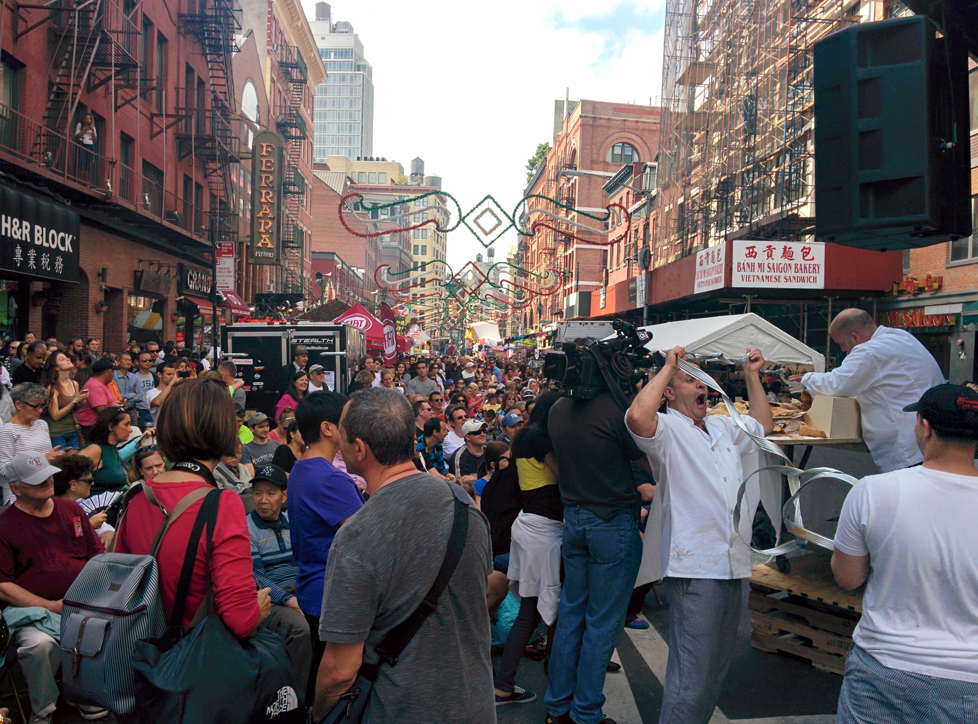
Image: Looking north down Mulberry Street in Little Italy during the San Gennaro Festival in 2014. To the right the Little Italy Bakery can be seen constructing what became the world’s largest cannoli. Photo by MusikAnimal, 20 September 2014, Creative Commons.


0.918 or, Live a Good Story

photo

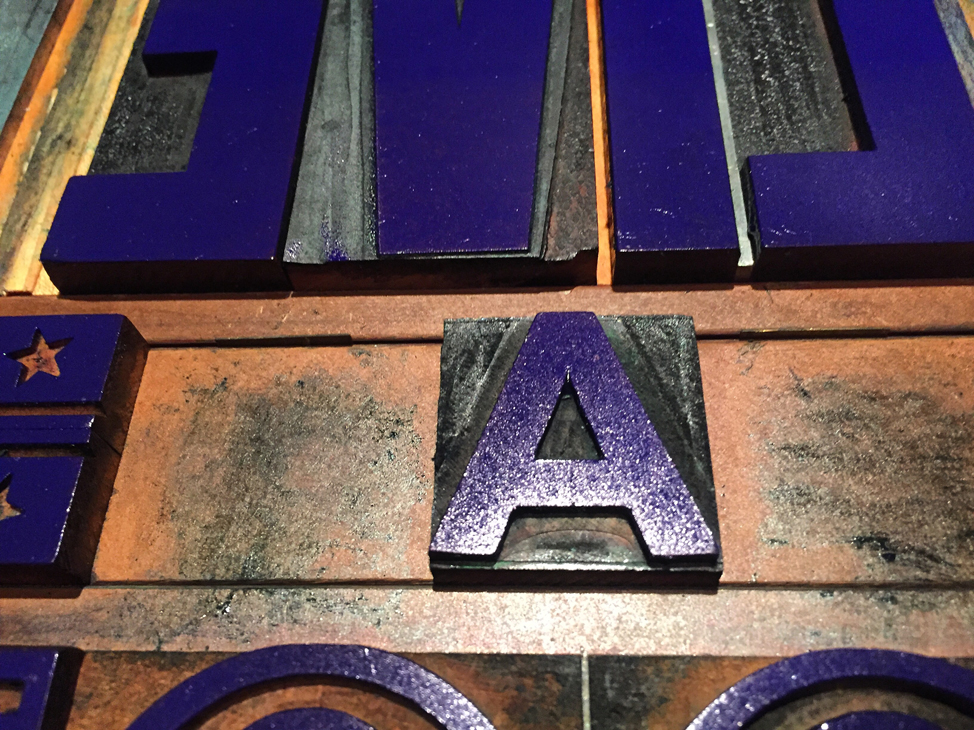
Ask any letterpress printer about the number 0.918 and if that printer is worth his or her salt, they should give you a hearty smile and a twinkle of the eye. It is an important number in their craft: 0.918 inches is the standard height of type. From the base of the type to the printable surface, no matter if it’s metal type so small you need to set it with tweezers or a piece of wood type so large you can fit only one character at a time into the press, all of it measures the same 0.918 inches in height.

I’m a printer and a lot of the folks who read this blog are printers and book artists. This is because we know each other (sometimes only by name) and we support each other (sometimes without ever meeting). We are a tight knit bunch, book artists and printers. And today is a big day for the printers. It is September 18, 9/18, the closest iteration of 0.918 we get on the calendar. It is Letterpress Appreciation Day.

Printshops around the globe will be celebrating, and if they’re not, they should be. Convivio Bookworks is sponsoring Letterpress Appreciation Day at the Jaffe Center for Book Arts, as we do each year. We bought the center 50 pounds of popcorn kernels for the event and for a film festival that ran all this week on the run up to Letterpress Appreciation Day. So today, I plan on eating popcorn, printing if I’m lucky, and remembering all the great printers I have known and the ones I have never met but whose work has influenced and informed my own through example and the power of good timeless design. The ones I have known have all been real characters, which, when you think about it, is the essence of any good printshop and of any good story. Make the story you live a good one.


Image: This year’s Letterpress Appreciation Day message of positivity reads “Live a Good Story.” It was set in historic wood and metal types by JCBA student Charles Pratt and we’ll teach folks to print it themselves on the center’s 1890 Wesel Iron Handpress, just as my friends David Wolfe and Glenn House taught me so many years ago. Thanks Charles. Thanks David. Thanks Glenn.