If you, like me, are of Italian heritage (I have mentioned once or twice in this blog that if you’ve seen the film Moonstruck, you’ve met my family), then chances are good you’ll associate June with San Antonio, St. Anthony of Padua. My grandmother would say novenas to St. Anthony every June, and so would every other Italian grandmother I remember from my childhood. Nine days of prayers to St. Anthony, seated before a statue of the saint in the backyard, prayer books and rosaries in their hands. It was as much a part of summertime as peaches in wine and dinner outside at the picnic table.
My mother did not know her grandparents for she was the first in her family born in the States. Her grandparents never came to America and even her older sister was born in the Old Country. But she remembers her mother saying the novena to St. Anthony together with Mamam, who lived next door and who was like a second mother to her. Mom recalls walking up to them, just to ask her mother a question perhaps, and then Mamam motioning to her to first of all be quiet, and then to sit and join them… which, as you might imagine, was not something a little girl wanted to do. And so she’d be stuck there while Grandma read the intercessions to St. Anthony and while Mamam, who couldn’t read, replied “Pray for us” to each one.
There probably are not many Italian grandmothers around nowadays who do this. If there are, I don’t know them. If you do, though, today is an important day for them, for it is the feast day of St. Anthony of Padua. Anthony was from Portugal but Italians have claimed him as their own for centuries. It was in Padua that he preached, deeply moved by his contemporary, St. Francis of Assisi. He died in Padua in 1231 and was canonized soon after. He is invoked for the finding of lost articles, mostly. An old children’s rhyme comes out of this tradition: Tony, Tony, come around, something’s lost and must be found.
Aside from her novenas in June and her statue of St. Anthony, which is still in the backyard at my family home, Grandma also kept, in a little gift box with a removable lid, a small loaf of bread, about the size of a dinner roll. The box, with the bread in it, is still in a drawer in her room. Who knows when it was baked, but it was certainly decades ago, at least the 1950s, maybe earlier. It was blessed when it came out of the oven by a priest and she called it St. Anthony’s Bread and she kept it in that box in her drawer in her room and took it out only in times of heavy storms, when she would open up the box and place it on a windowsill. Now it is Mom who takes out the St. Anthony’s Bread when it storms. It’s gotten us through every hurricane and tornado warning we’ve been through, and quite a few big thunderstorms, too.
This is the St. Anthony I know. A presence in the family, guardian of the backyard, protector of the home, retriever of goods lost, companion to grandmothers who sit and talk to him day after day, especially now, especially in June, as summer’s heat settles in and the days grow long, long enough to fool us into thinking they may never grow short again.
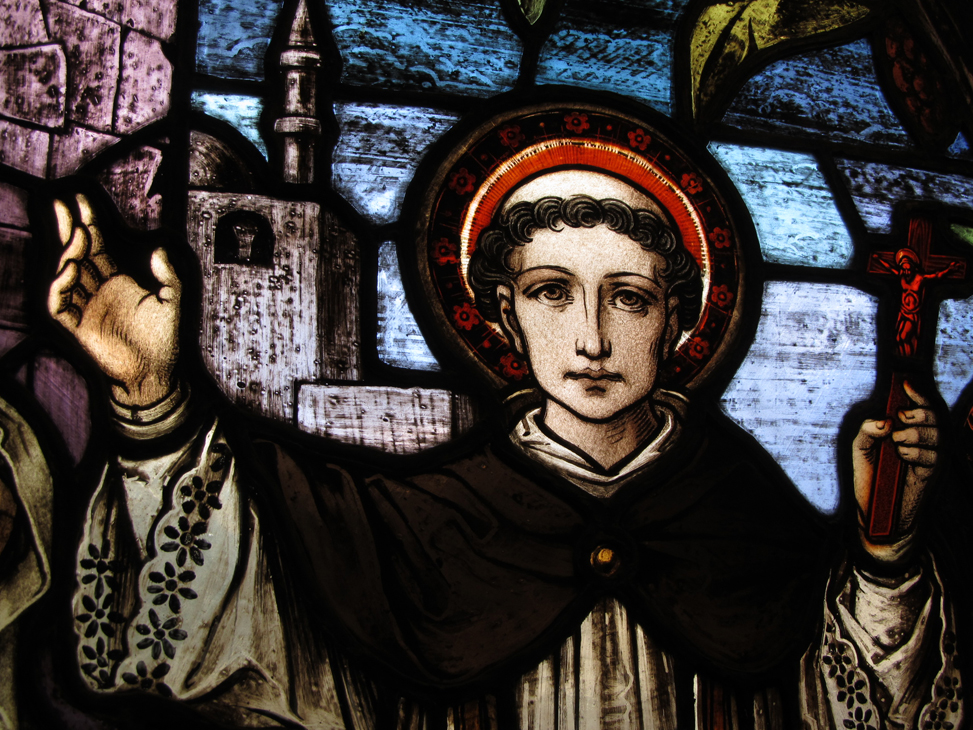
Image: St. Anthony of Padua as depicted in one of the stained glass windows at the 1913 St. Anthony Chapel at St. Ann Church in Downtown West Palm Beach.