Leeks & Daffodils

St David

The First of March brings St. David’s Day, sacred to Wales, where the day is marked by an abundance of daffodils and leeks. Most folks there will be wearing leeks and daffodils on their lapels today in honor of St. David. They both are national symbols: the daffodil being a basic symbol of Wales, much like the thistle is a symbol of Scotland, and as for the leek, that’s a more interesting story, as it goes back to an ancient battle in which the Welsh troops wore leeks in their caps in order to distinguish themselves from the Saxon troops they were fighting. It’s also interesting, I think, that the Welsh for leek (cenhinen) is so close to the Welsh for daffodil (cenhinen pedr). It is said that over the centuries there was so much confusion about the two that both were adopted as symbols. The green and white colors of those leeks and daffodils also recall the royal green and white of Ancient Britain.

The daffodil may be prettier, but the leek is delicious, which cannot be said for daffodils. I love buying leeks at the market and I love cooking with leeks. And though I am generally not a person who is easily embarrassed, I think it’s safe to say that leeks played a distinct role in my Most Embarrassing Moment, which are moments we all have, of course.

That moment came for me many years ago at dinner with my family. We were at a swanky restaurant, and swanky is not something my family typically does, so I think we were, from the start, on high alert. This, of course, only makes embarrassing moments easier to conjure, as you sit there, buttons buttoned, ties knotted, out of your element. It was Mom and Dad and my sister and my two nephews, who were probably in middle school and high school at the time. We were waiting for the other folks to arrive, the folks who had invited us, but in the meantime we were seated and looking over the fancy menu. Something on the menu was made with leeks, and my youngest nephew leaned over to ask his mom what are leeks and would he like them? I overheard this question and explained that leeks were of the genus Allium, related to garlic and onions and that they were in fact kind of like onions. And then I proclaimed, rather boldly, that “I would take a leek over an onion any day,” which of course sounds different than it reads, and the words left my mouth just a split second before my brain could stop them from doing so and the sentence hung there in the swanky restaurant air for just a second or two, right there over the table, above the crystal and the fine silver and crisp white linens, until an audible snort gushed from my nephew’s nose and there may have been sprayed water that ushered from the other’s mouth and it became pretty clear right then and there that we are not a swanky dining people, my family. And so that is my leek story. I wanted to crawl under the table at the time, but the good news is I’ve overcome that and I don’t think I’ve been embarrassed since. We all have these moments, and I’m pretty sure no one in the swanky restaurant that night remembers the guy who would so gladly “take a leak over an onion.” Life is too short to let embarrassment control it.

And despite our petty worries, spring proceeds and burgeons and in Wales, the daffodils and leeks are vigorously growing now. And there is something about Wales that is hard to pin down, but the place seems to drip with magic. St. David is said to have been the son of a prince of Cardiganshire of the ancient regal line of Cunedda Wledig. Some also state that he was the son of Xanthus, son of Ceredig, lord of Ceredigion, and Non, daughter of Gynyr of Caergawh, Pembrokeshire. The names alone sound magical. Early biographers claimed that St. David was able to work miracles, not just after his birth, but even before he was born.

St. David’s Day brings in March and March comes with traditional weather markers: March is known to begin and end in opposites: If the month comes in as a lion, it will go out as a lamb, and of course the opposite is thought to be true then: in like a lamb, out like a lion. The first three days of March are ancient saints’ days: St. David is followed by St. Chad on the Second and St. Winnal on the Third. The three days taken together are often part of old weather lore. St. Winnal’s Day especially is generally expected to be particularly stormy.

First comes David,
Next comes Chad,
Then comes Winnal,
Roaring mad.

Also, So many mists in March you see, So many frosts in May will be. Here in Lake Worth, March is always one of our most beautiful months. Garrison Keillor has called March “the month God created to show people who do not drink what a hangover feels like,” but that’s not the case here in Lake Worth. Check back with us in August, though.

It’s the First of the month, so head over to our website for the newest Book of Days printable monthly calendar!


Image: St. David, as he is often depicted, riding a goat, from the Chambers Bros. Book of Days, 1869. One of the traditions of St. David’s Day is the baking of gingerbread “taffies” by English bakers… not so much a celebration as a mockery of the day. The taffies were baked in the shape of a Welshman riding a goat. The English are more directly descended from the Saxons who were defeated by the leek-donning Welsh at that ancient battle, so they weren’t the biggest fans of St. David. Do you see the leek in the engraving?


Ephemeral

Man in the Moon

Here in Lake Worth it’s our 20th Annual Street Painting Festival this weekend, and it is raining as I write this. Just a bit, a little shower with some lightning in the distance, just enough to keep us on our toes. But it always rains during the Street Painting Festival. God’s way, perhaps, of saying, Yep, that’s a pretty nifty trick you Lake Worthers have come up with: closing down the main streets downtown and creating exquisite artworks on the pavement, paintings made of chalk on asphalt… but I’m still in charge.

There is an old joke my grandfather used to tell about two guys at an outdoor concert. They’ve gone to hear the local orchestra, no doubt playing something by Puccini or Rossini, but suddenly there is a rumble of thunder and a burst of lightning and the sky opens up and the rain scatters everyone, orchestra and audience alike. The two friends are drenched. Under cover of a rooftop in the square, one friend says to the other, “Eh, se Dio non capisce di musica ….” That is, “If God doesn’t understand about music….” well then, what can you do?

So maybe God doesn’t understand about art. There are, nonetheless, great masterpieces created each year on the streets of Downtown Lake Worth, and it is a great lesson in letting go, for these artworks are as ephemeral as they get. They last only until the next rain, and even if is should stay dry for a few days, as soon as the traffic returns to town the artwork is under foot and under wheels and dust quickly returns to dust.

Last year’s Saturday night rain at the Street Painting Festival was a real gully-washer. This year, so far, it is just a light rain, a few passing showers. Nothing more than an annoyance, but still, a reminder. Meanwhile, the air tonight smells of rain, the smell of ozone carried on the wind. The smell is clean, fresh, and it is carried over the streets of Lake Worth, over the rooftops, through the palms and orange trees, across the lagoon, over the dunes and out onto the deep dark Atlantic.

Image by Convivio neighbor Guy Icangelo, who photographed this street painting on Lake Avenue. This year’s Street Painting Festival has an old movie theme, and this iconic image is from an early silent film. Do you recognize it?


Concordia

Pompeii_family_feast_painting_Naples

A simple post today, a reminder that tomorrow, the 22nd of February, is the Roman festival of the goddess Concordia. It is a feast of goodwill that was known also as Charistia. This is a day for folks to reconcile their differences, to make amends, and it was traditionally celebrated as a meal amongst family and friends, with one purpose: the settling of all disputes that cause discord. Harmony is the goal.

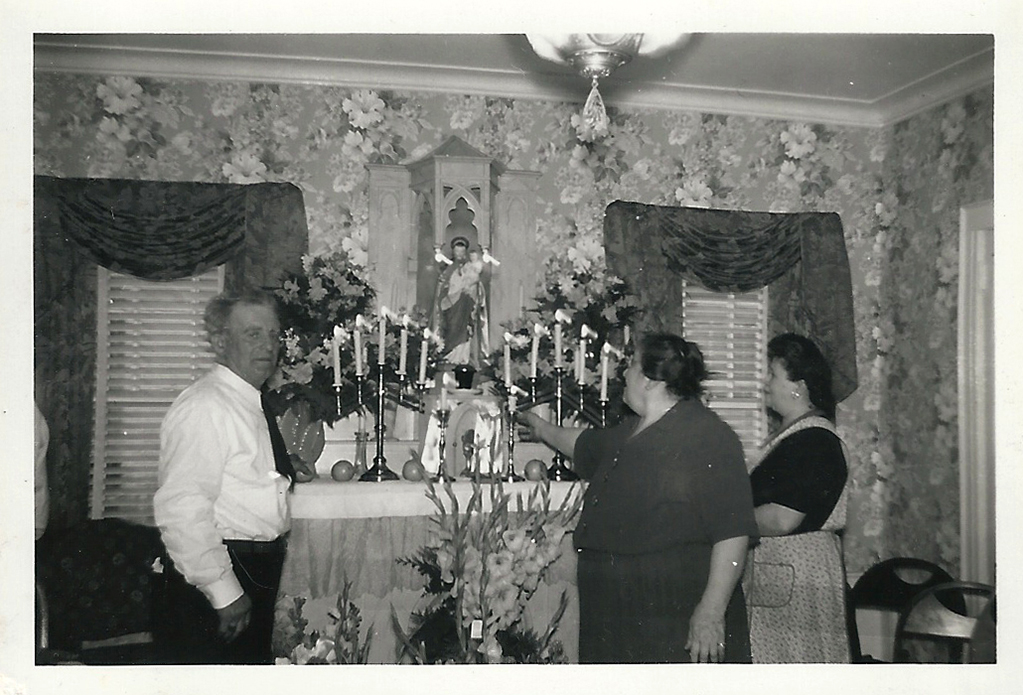
When I ponder all the people in my family lore, all the ancestors, all the folks in old sepia and black and white photographs, and when I think of all the stories that accompany the faces, I think about Concordia and this very special day set aside for the resolution of differences. I think about the people we remember who never had a pleasant or positive thing to say, and I think about the people we remember with kindness, and I know exactly into which camp I hope the people who come afterwards place me.

Image: “Convito,” a fresco painting from Pompeii, now in the Museo Archeologico Nazionale (Naples, Italy), before 79 AD, [Public domain], via Wikimedia Commons.