The Fourth Sunday of Lent marks the midpoint of the Lenten journey each year. It is known as Laetare Sunday, which is from the Latin for “rejoice.” Purple, the color of the Lenten season, is switched out for rose for this one day; a signal that the day is not meant to be somber, but rather celebratory. In the United Kingdom, the day takes on special significance, for it is, as well as being Midlent, a day known as Mothering Sunday. It is a day to visit your mother, gather the family together. And when you visit her, you should bring her a simnel cake.
Simnel cakes are, apparently, found often at the Easter table in England nowadays, but traditionally they were made for Midlent or Mothering Sunday. They are a kind of light fruit cake made with layers of marzipan. Recipes for simnel cakes are readily available online and you can buy a simnel cake at the baker’s if you happen to live in the UK. But I find the history of these cakes, especially on this, their proper day, most fascinating. And so for today’s chapter, I’m taking you directly to the Chambers Bros. Book of Days for their chapter on Mothering Sunday and simnel cakes, for I can’t tell the story any better than they did back in 1869. And when you can’t improve upon something, it is best, I think, to leave it be. I suspect the 1869 recipe (or receipt, as the proper word would have been back then) is not quite the same as the modern version (especially when you read of a “crust that is as hard as if made of wood”) but in the annals of stories about the celebratory foods we eat, the history of the simnel cake is particularly fascinating. So turn your clock back about a century and a half, and enjoy. Here we go:
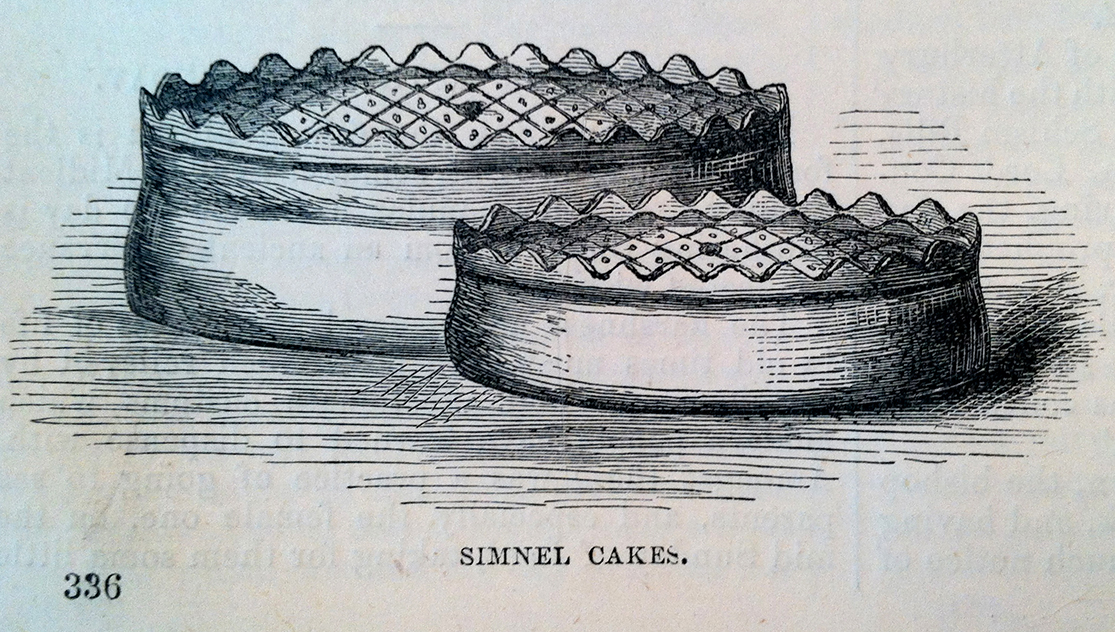
IT IS AN OLD CUSTOM in Shropshire and Herefordshire, and especially at Shrewsbury, to make during Lent and Easter, and also at Christmas, a sort of rich and expensive cakes, which are called Simnel Cakes. They are raised cakes, the crust of which is made of fine flour and water, with sufficient saffron to give it a deep yellow colour, and the interior is filled with the materials of a very rich plum-cake, with plenty of candied lemon peel, and other good things. They are made up very stiff; tied up in a cloth, and boiled for several hours, after which they are brushed over with egg, and then baked. When ready for sale the crust is as hard as if made of wood, a circumstance which has given rise to various stories of the manner in which they have at times been treated by persons to whom they were sent as presents, and who had never seen one before, one ordering his simnel to be boiled to soften it, and a lady taking hers for a footstool. They are made of different sizes, and, as may be supposed from the ingredients, are rather expensive, some large ones selling for as much as half-a-guinea, or even, we believe, a guinea, while smaller ones may be had for half-a-crown. Their form, which as well as the ornamentation is nearly uniform, will be best understood by the accompanying engraving, representing large and small cakes as now on sale in Shrewsbury.
The usage of these cakes is evidently one of great antiquity. It appears from one of the epigrams of the poet Herrick, that at the beginning of the seventeenth century it was the custom at Gloucester for young people to carry simnels as presents to their mothers on Midlent Sunday (or Mothering Sunday).
It appears also from some other writers of this age, that these simnels, like the modern ones, were boiled as well as baked. The name is found in early English and also in very old French, and it appears in mediæval Latin under the form simanellus or siminellus. It is considered to be derived from the Latin simila, fine flour, and is usually interpreted as meaning the finest quality of white bread made in the middle ages. It is evidently used, however, by the mediæval writers in the sense of a cake, which they called in Latin of that time artocopus, which is constantly explained by simnel in the Latin-English vocabularies. In three of these, printed in Mr. Wright’s Volume of Vocabularies, all belonging to the fifteenth century, we have ‘Hic artocopus, anglice symnelle,’ ‘Hic artocopus, a symnylle,’ and ‘artocopus, anglice a symnella;’ and in the latter place it is further explained by a contemporary pen-and-ink drawing in the margin, representing the simnel as seen from above and sideways, of which we give below a fac-simile. (N.B.: For Convivio Book of Days readers, that image is presented above.)
It is quite evident that it is a rude representation of a cake exactly like those still made in Shropshire…. It is curious that the use of these cakes should have been preserved so long in this locality, and still more curious are the tales which have arisen to explain the meaning of the name, which had been long forgotten. Some pretend that the father of Lambert Simnel, the well-known pretender in the reign of Henry VII, was a baker, and the first maker of simnels, and that in consequence of the celebrity he gained by the acts of his son, his cakes have retained his name. There is another story current in Shropshire, which is much more picturesque, and which we tell as nearly as possible in the words in which it was related to us. Long ago there lived an honest old couple, boasting the names of Simon and Nelly, but their surnames are not known. It was their custom at Easter to gather their children about them, and thus meet together once a year under the old homestead.
The fasting season of Lent was just ending, but they had still left some of the unleavened dough which had been from time to time converted into bread during the forty days. Nelly was a careful woman, and it grieved her to waste anything, so she suggested that they should use the remains of the Lenten dough for the basis of a cake to regale the assembled family. Simon readily agreed to the proposal, and further reminded his partner that there were still some remains of their Christmas plum pudding hoarded up in the cupboard, and that this might form the interior, and be an agreeable surprise to the young people when they had made their way through the less tasty crust. So far, all things went on harmoniously; but when the cake was made, a subject of violent discord arose, Sim insisting that it should be boiled, while Nell no less obstinately contended that it should be baked.
The dispute ran from words to blows, for Nell, not choosing to let her province in the household be thus interfered with, jumped up, and threw the stool she was sitting on at Sim, who on his part seized a besom, and applied it with right good will to the head and shoulders of his spouse. She now seized the broom, and the battle became so warm, that it might have had a very serious result, had not Nell proposed as a compromise that the cake should be boiled first, and afterwards baked. This Sim acceded to, for he had no wish for further acquaintance with the heavy end of the broom. Accordingly, the big pot was set on the fire, and the stool broken up and thrown on to boil it, whilst the besom and broom furnished fuel for the oven. Some eggs, which had been broken in the scuffle, were used to coat the outside of the pudding when boiled, which gave it the shining gloss it possesses as a cake. This new and remarkable production in the art of confectionery became known by the name of the cake of Simon and Nelly, but soon only the first half of each name was alone pre-served and joined together, and it has ever since been known as the cake of Sim-Nel, or Simnel!
Image: Simnel cakes, an engraving from the Chambers Bros. Book of Days, Edinburgh, 1869.