Author Archives: John Cutrone

And so We Begin, Again

FIRST DAY of CHRISTMAS:
St. Stephen’s Day, Boxing Day, Day of the Wren

Christmas Eve and Christmas Day have passed, and now we enter into the Twelve Days of Christmas. And I know I will hear from some of you that Christmas Day is one of those Twelve Days, and this is true in some traditions: in those that are more churchly. But since Christmas is an old pagan holiday that was reinvented by the Church, I feel more comfortable following the older traditions in this case. Those traditions would place six of our Twelve Days at the end of the old year and six at the start of the new year, and there is an unspoken magic in this balance, as well as in the fact that there is one day of Christmas for each month of the year that has passed.

If you are feeling a bit deflated now that Christmas Day has passed, you’re not alone. It is a very common feeling in a world that rushes headlong into Christmas in early autumn and then unplugs the holiday on the 26th of December. But as the crowning of the year, with the old year dying and the new year on its way, these Twelve Days stand outside ordinary time: It is Yuletide, Christmastide… and I will do my best to offer you suggestions, based in tradition but updated where necessary, to bring the most to this Christmas season. We begin with St. Stephen’s Day on this First Day of Christmas.

Stephen was the first Christian martyr, and so the Church assigned this first day of Christmas to him. In Italy, this is a day for roasted chestnuts and mulled wine (as is tomorrow, St. John’s Day: the Second Day of Christmas). My Aunt Anne and my mom say that my grandmother, Assunta, typically made soup for supper on this First Day of Christmas, when we remember Santo Stefano. The soup was a nice break from the rich fare of Christmas Eve and Christmas Day. Over in Ireland, it is the Day of the Wren. It is the wren that is traditionally thought to have brought bad luck upon the imprisoned Stephen, who was making his escape when a wren alerted the sleeping guards to the situation. His capture lead to his execution and martyrdom. Wrens were traditionally hunted on this First Day of Christmas, then paraded around town.

And in England and the Commonwealth countries, it is Boxing Day. Servants typically had to work on Christmas Day, but the First Day of Christmas was their day to spend with their families. Their employers would send them home with boxes of gifts for themselves and for the families they were heading home to.

Tonight, join us in raising a glass of mulled wine and cracking open some roasted chestnuts for this First Day of Christmas. The mad rush is over, and now we can enjoy Christmas in our own time.

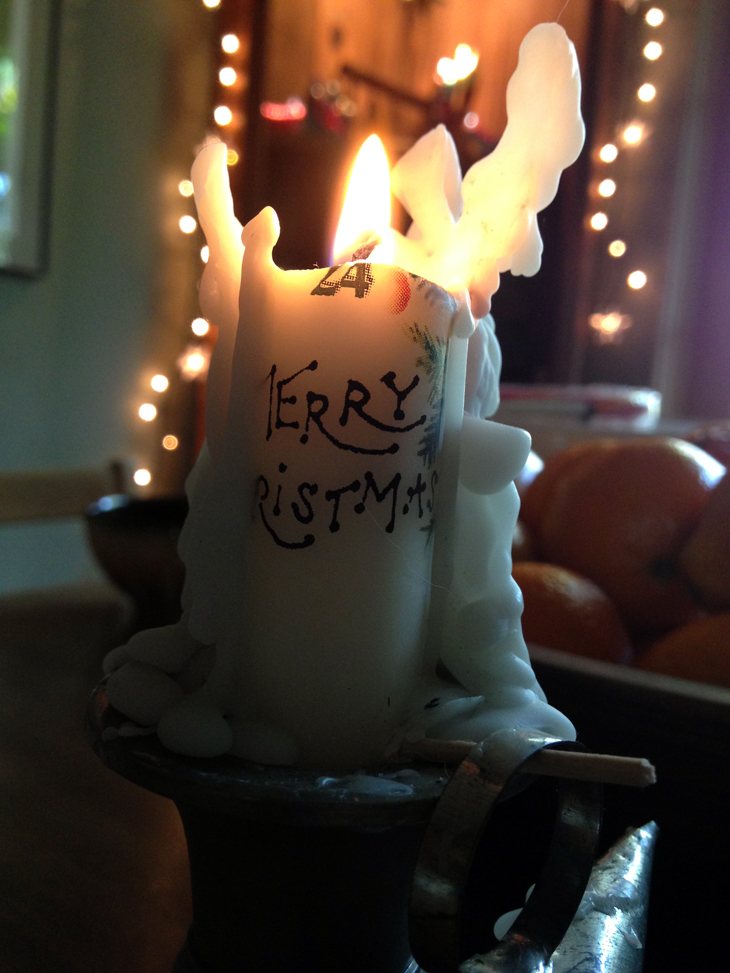
Image: Our daily advent candle, illuminated for breakfast on Christmas Day. All through December we burned the candle an hour at a time day by day, counting down the days to Christmas. Now that Christmas is here, why would we rush it away?
 

Brightest and Best

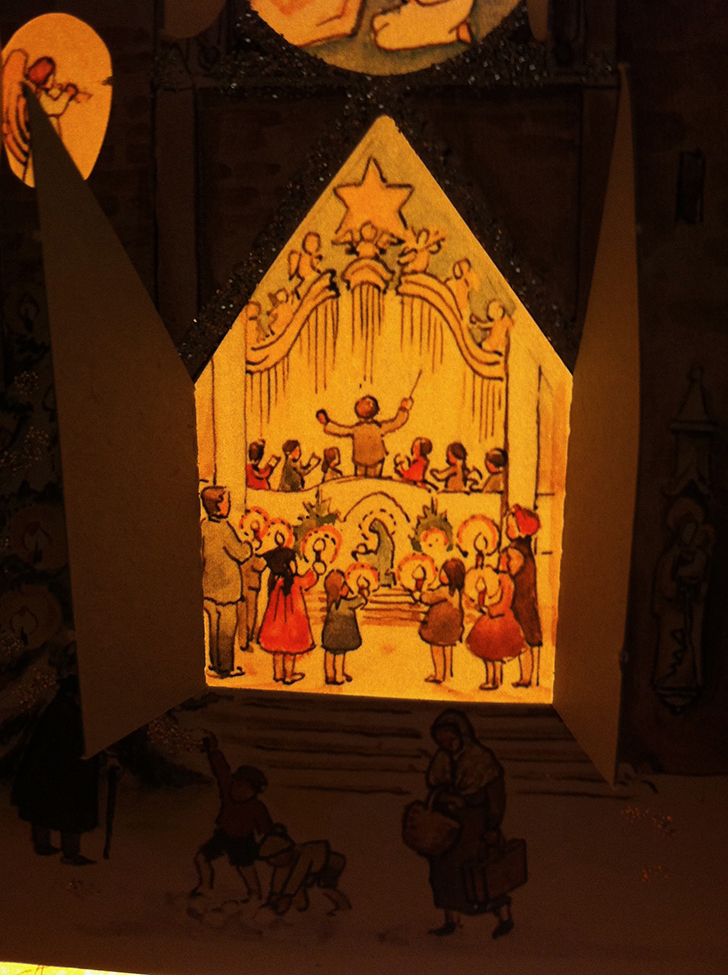
Some folks open their advent calendar windows in the morning, but we are more of a nighttime household; we like to hold the open window up to a light source in the darkness in order to illuminate the scene within. And tonight, in these wee small hours of Christmas Eve becoming Christmas Day, now that all the company has left, my mom and dad, my sister, my nephews, their wives and their kids… it is again just Seth and me and Haden the cat, here next to me atop a basket beside the Christmas tree. We opened tonight’s advent calendar window––the last of them, now that Christmas is here. The scene is lovely, as is the night.

This time each Christmas Eve, these moments when most of the folks around me are tucked into bed, are each year some of my favorite. Wishes abound this time of year for peace and for joy… and these are the moments when they seem most tangible. It is quiet and the darkness is, as Dylan Thomas wrote, close and holy. The lights we use to illuminate the midwinter night pierce the darkness with warmth. It may have been a month or more of madness leading up to this moment, but now that Christmas is here, there is not much left to do but enjoy its presence.

The nights now are their darkest but our hearts are open and our celebrations all focus on bringing light to that darkness. Christmas, Hanukkah, Yule, Kwanzaa, all involve candles, all call down the light, all invite us to be a light ourselves, a light in the darkness. And this I wish for you: that you be a light, that you encourage that light in others. Pure and simple.

If I have it in me, and I think I do, I’ll be writing again this year about each of the Twelve Days of Christmas. Just as there is more than one way of reckoning time, there is, as well, more than one way of reckoning these Twelve Days. We subscribe to the notion that Christmas is a season outside ordinary time beginning with Christmas Eve, blossoming into Christmas Day, which then moves into the Twelve Days of Christmas, half of which are in the old year, half in the new. Christmas is just beginning. Sit a spell with us, here in this close and holy darkness, and enjoy it. Merry Christmas.


Darkest Night

And once again the solstice is upon us: winter solstice in the Northern Hemisphere, summer solstice in the Southern Hemisphere. We here in Lake Worth are in the Northern, where the nights have been growing longer and longer since our summer solstice in June. Each day a bit more daylight has been shaved off our allotment, and sent to the opposite hemisphere. The great mechanical balance of this, all its immensity: so beautiful, so constant. I am reassured always by this. No matter what is going on in our lives––all our triumphs and our hardships, too––no matter what we do to each other, or how we disrespect this planet we live upon, still it rocks back and forth, still this motion continues. This shifting of the Earth in its cosmic rocking chair is what creates our seasons. It goes on with or without us, as it has since it began and will until it ends.

Here in the North it is the start of winter by the almanac. By traditional reckoning of time, though, winter began with Halloween and with the Days of the Dead and we find ourselves now at the height of winter, it’s midpoint: This is old Midwinter. This is why, in so many churches and in so many homes this time of year, we sing a beautiful old song called “In the Bleak Midwinter.”

The moment of solstice, for those of you who like precision, is 5:44 AM on December 21 here in Lake Worth, which is Eastern Standard Time. The Eastern Time Zone is pretty large, though, and there are ways of determining the solstice moment––of “sun standing still”––with even greater precision should you wish it. In this house, we take a more roundabout approach. Plus 5:44 in the morning is an admittedly odd time of day to celebrate anything. So we will save our celebration for the night of the 21st, with a ceremony small and simple. We’ve been saving last year’s Christmas tree in a corner of the yard all year. It’s been there since we brought it out after Twelfth Night last year, after the Christmastide festivities came to a close. It’s been drying since then, as the days grew longer through spring and summer, and still as the days grew shorter again through fall and the start of winter. Every now and again throughout this past year, we would be blessed with a whiff of pine, a reminder of Christmas, as we passed by or worked near the old tree. That scent an instant portal to memory. On solstice night, we will use wood from that tree to fuel our midwinter fire. For us, it will be in the copper fire bowl outside in the back yard.

Perhaps you, too, have been following our ways and saving your old Christmas tree each year for this purpose. I like to sit there by the fire and imagine our sparks and woodsmoke rising into the air to meet yours, carrying all our wishes and blessings. But maybe you don’t have your old tree, or perhaps you live in a place where a fire is just not possible. Or maybe you simply don’t have it in you to build a fire. It’s okay. My suggestion always is to simply light a candle to mark the night and to take in its blessings. Light it for just a few minutes and then put it out, if you wish. And if you can’t do that, even if you illuminate a lightbulb somewhere and do it in a spirit of connexion with the mechanical clockwork of our immense planet, that, too, is a wonderful thing. Part of the Convivio approach is to not fret over things but to find ceremony where we can. This is what we mean by “the ceremony of a day,” and what better time to put that into practice than this, the shortest day, the longest, darkest night?


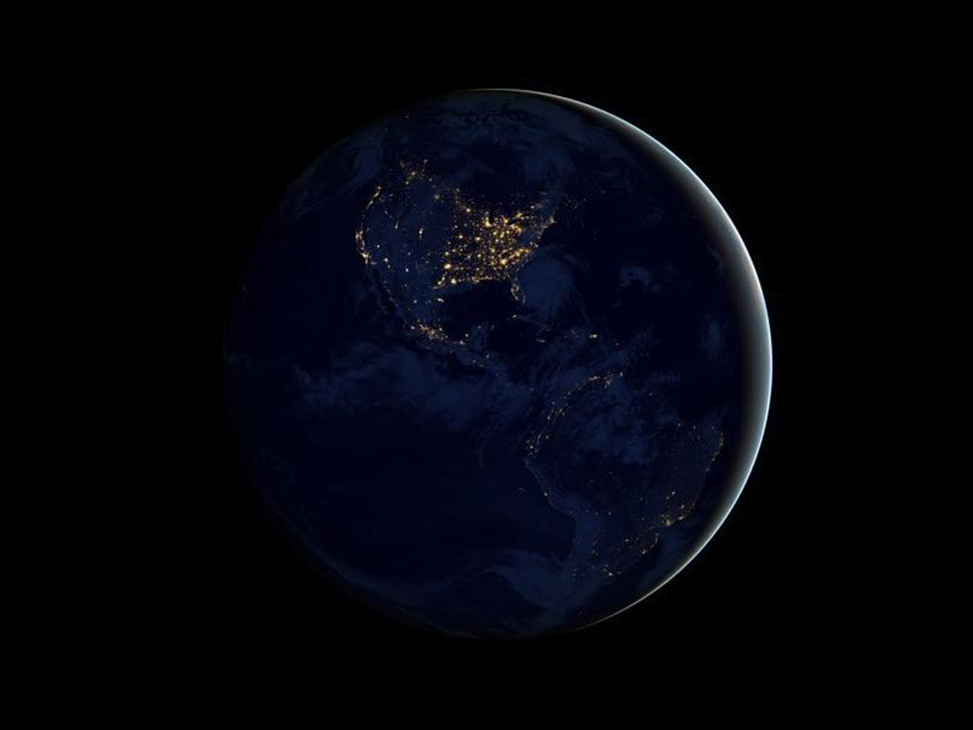
Image: “Earth at Night.” Released by NASA December 5, 2012, this photo was assembled from multiple shots taken by the Suomi NPP satellite during April and October 2012. [Public domain] via Wikimedia Commons.