Author Archives: John Cutrone

Your July Book of Days

Liberty

My birthday is on the First of July and so that makes me, according to some of my Canadian friends, an honorary Canuck, for my birthday falls on Canada Day. I find this all very interesting, because I was supposed to be born on the Fourth of July, a “real live nephew of my Uncle Sam,” as the song goes, but I was early for something for once in my life, arriving three days early and on the national holiday not of my native country but of Canada. What is odder is when I speak in public, which turns out to be pretty often (and even this is odd as I’m a pretty shy guy, generally), people often ask me afterward where in Canada I’m from. Toronto? Alberta?

I chalk this up to a couple of things: First, as a shy guy, I am a quiet guy. My voice doesn’t carry well and I mumble a bit… so when I speak in public, I try to focus on projection and diction. Second, I listen to a lot of Canadian music. For no particular reason; it just so happens that a lot of my favorite artists are from there. You try listening to Jane Siberry for 28 years and see if her speech and diction patterns don’t infiltrate your head, too. (Not to mention all those prior years of fascination with The Smiths, UB40, and, when I was a kid, ABBA––not an American in the bunch.)

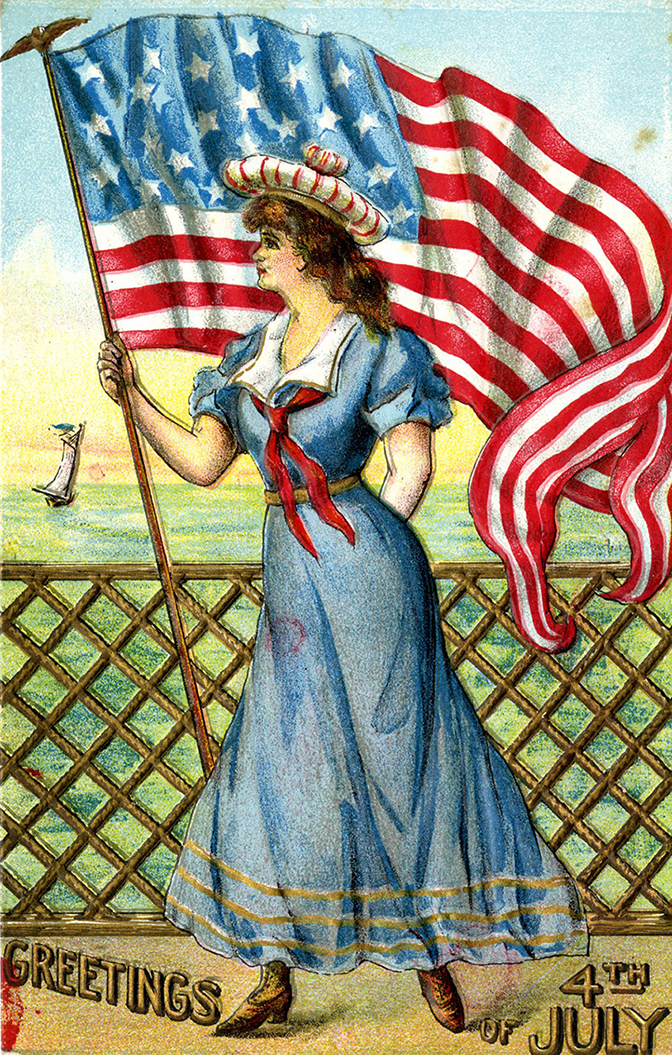
Put these things together (28 years of singing along to a quirky Canadian and attempting to focus on diction) and I am pretty sure this is the source of my apparently not-quite-American speech patterns. Or maybe it’s just that I was born on Canada Day. Nonetheless, I am pretty big on the Fourth of July, and the family will be coming to our house for the traditional cookout and for toasted marshmallows as the day closes, and come sunset, we will head to the lagoon to watch the municipal fireworks. And in pondering what or who should be the cover star of the Convivio Book of Days Calendar for July, it was a no-brainer: I went with something patriotic in honor of our nation’s 239th birthday. Click either of those two links above and you’ll have this month’s calendar, ready to print as a PDF document on standard US Letter size paper.

The image is from an old penny postcard from our collection. As the postcard says, 4th of July Greetings to you, and to yours. I wish you a month of wonderfully summery things.
 

On What Makes Magic

Viola Tricolor

St. John’s Eve, tonight, brings Midsummer. In the seasonal round of the year, we now sit directly opposite Midwinter and Christmas. The celebrations for both Midwinter and Midsummer are old celebrations, older than you or I or anyone can recall, older even than the events assigned to them by the early Church, for the Church early on recognized that honey draws more flies than vinegar, and in that spirit, old pagan celebrations continued but with new names and new focus. Hence the birth of Christ was set at the winter solstice and the birth of John the Baptist, the voice crying in the wilderness, setting the path straight for the savior, was set at the summer solstice.

St. John is unusual in that he is remembered not just on the day of his death (which is the case with all the other saints) but also on the day of his birth. And as is often the case with traditional holidays, it is the eve the night before when the real celebration occurs. My take on this is that there is a certain magic to nighttime events: perceived magic if not real, though our ancestors thought nights like Midsummer and Midwinter full of real magic and open to the realm of fairies and sprites and other folks of parallel universes. You need only look to Shakespeare’s A Midsummer Night’s Dream, set on this very night, to grasp the beliefs.

But no matter whether you give credence to these other realms or not, there is no denying the air of mystery that accompanies a celebration at night. We hang fairy lights in the trees, we light candles and beseeching fires, we walk amongst flowers that bloom only at night and spice the air we breathe. We take our celebration outdoors and the stars and moon are above us and this is infinitely more mysterious than the ceilings in our homes. This, too, is magic, as powerful as any other.

Midsummer and St. John’s Day are not much celebrated in the States, much to our loss. But in other places, this is a night to spend out in the open air. In Scandinavia, with the sun at its northernmost point in the sky, this is the time of the Midnight Sun (how magical is that?). It is a night there for bonfires and meals of pickled herring and new potatoes with sour cream. Further south in Italy bonfires are also part of the night, but the meals vary by region. In Rome, the Midsummer meal centers around snails; local belief holds that eating snails, horned as they are like devils, will protect you from Midsummer mischief. In the towns of Northern Italy, Midsummer is a time to break out balsamic vinegar, aged as long as a hundred years. Every part of the meal has some of this nectar of the gods in it, for the lore of the land says that this is the time of year when the must enters the grape on the vine, and it is the must that will eventually become both the wine and the balsamic vinegar (again, magic). The must is the juice, crucial to both, for good balsamic vinegar is made from must just as is wine. It is then aged all those years in casks of various types of woods: at least a dozen years, but, as mentioned above, sometimes a hundred years or more.

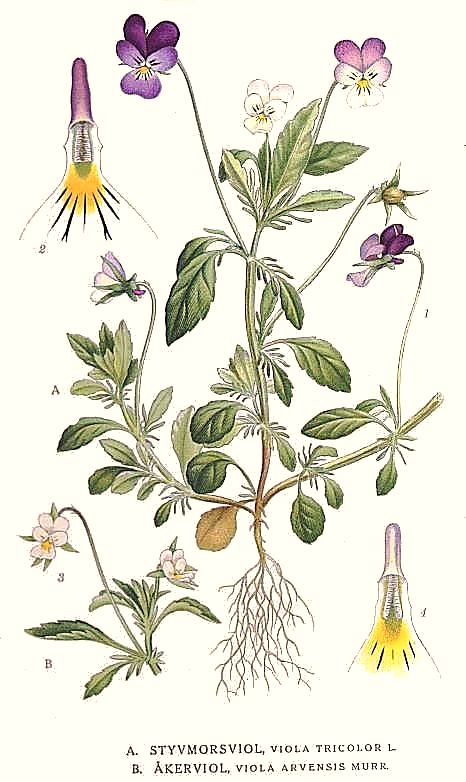
It is a night to go and gather plants for their magical properties: fern seed and St. John’s Wort. The latter will protect you from evil, the former, if gathered properly, is believed to confer the power of invisibility. But not without some peril: the seeds are fiercely guarded by the fairy folk who know more of these secrets than do we. The magical properties of plants also play into Shakespeare’s comedy. Have you ever wondered what is the “herb” (a little western flower, Before milk-white, now purple with love’s wound) that Oberon instructs Puck to fetch and squeeze the juice of onto the eyelids of Titania and then of the lovers? Well, these are the things I wonder about. Oberon goes on to tell us that maidens call it “love-in-idleness,” but in modern terms it turns out the herb is a flower known as Viola Tricolor, also known as Heartsease or Wild Pansy. You may have some blooming now in your summer garden. So much magic, so close to home. Make the most of it. Happy Midsummer.

Image: Viola Tricolor, Plate No. 227 in Bilder ur Nordens Flora by C.A.M. Lindman, published in 1905. [Public domain] via Wikimedia Commons.


Father Sun

Summer

Events today both celestial and closer to home: It is Father’s Day and it is solstice day. Here on the surface of the planet we honor our fathers, those we were given and those that we chose or who chose us. I know of two friends who are probably having the most amazing Father’s Day right now: they adopted a family of three brothers and sisters just last week. And so we salute all the fathers on this day… as well as all the men out there who have been like fathers to others. You know who you are. Happy Father’s Day.

And as we celebrate and honor our fathers, grand workings are taking place above our heads in the celestial realm. Here in the Northern Hemisphere at 12:39 PM Eastern Daylight Time today, the 21st of June, comes summer by the almanac. It is the summer solstice, marking the furthest north the sun will appear in the sky before the Earth begins once again to shift in the opposite direction. The sun will appear to stand still there at its northern zenith, and that’s the origin of the word solstice, from the Latin sol stetit, “sun stands still.” The days have been lengthening since the winter solstice in December, but now once again daylight begins to wane. Tomorrow there will be a few seconds less sunlight than today, and the next day a few seconds less, and so it continues until the winter solstice comes once more next December. Each day slightly different than the one before and the one to follow: the constant rearrange.

It is the start of summer by the almanac, but by traditional reckoning of time, summer began at the start of May with the arrival of May Day. This older approach to time places the solstices and the equinoxes at the middle of each season, which, when you think about it, is a considerably more logical approach. Looking at things as our ancestors did, it begins to seem odd to mark the start of summer, for instance, with the last of the lengthening days, and the start of winter with the last of the lengthening nights. These are, more naturally, midpoints of the seasons.

And so our ancestors thought of this time as Midsummer, with Midwinter at the winter solstice. Pagan festivals grew up around these celestial events and eventually, with the spread of Christianity, so did Church festivals. To Midwinter the Church attached the birth of Christ; to Midsummer, the birth of John the Baptist. And while we don’t celebrate these holidays precisely on the solstice, they are both solidly connected to the celestial events and the times of sol stetit with both Christmas and St. John’s Day just a few days after their respective solstice, the sun appearing to stand still at both.

Across cultures, these transitional times were long considered magical. Witches and fairies and sprites were more active, animals gained powers of speech. Our friend William Shakespeare was well attuned to this lore: his comedy A Midsummer Night’s Dream, which I have long loved, is set on St. John’s Eve. In the play, the realm of the fairies and the realm of the mortals blend as one, at least for a night or two. This is the magic that can be conjured at such times, as the balance of light and dark on our planet begins to shift again. Summer is here, but it’s been here a while already. Magic is here, too, revealed to us if we are open. These are interesting days. Read more here at the blog come St. John’s Eve on the 23rd.

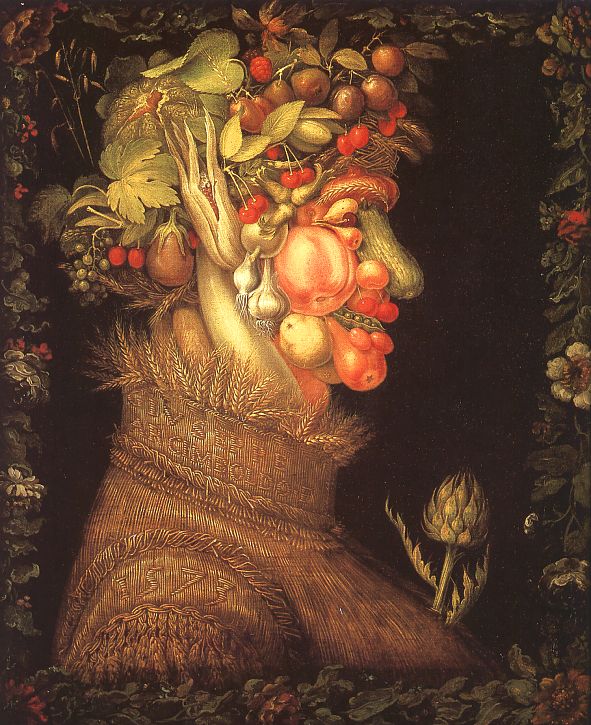
Image: Summer by Giuseppe Arcimboldo. Oil on canvas, 1573, [Public domain] via Wikimedia Commons.