As a printer and a book artist who writes about the quirkier side of seasonal traditions, I can get a bit giddy about a day like today. It’s St. Bartholomew’s Day, also known as Bartlemas, or Bartlemy’s Day. It is a lesser known feast day of a lesser known saint, to be sure… but this saint is a patron saint of bookbinders and book artists, and his day has long held great significance to printers and papermakers, too. It is the day of the great printers’ celebration known as the Wayzgoose. If you’re a book person, this is it: THIS is your day.
Very few professions get to claim a saint just for themselves, and this is the case with St. Bart, too. Aside from looking after all these bookish artisans, he is also a patron saint of butchers and tanners and cheesemakers. Usually in these matters there is some bizarre connection to a gruesome story and that is the case here: St. Bartholomew was one of the original Twelve Apostles and his martyrdom is said to have been delivered upon him in Armenia in the First Century, where he was flayed alive for his Christian beliefs and crucified upside down. (I told you it was gruesome.) The flaying is our connection to butchers and tanners and by extension to bookbinders, for one of their traditional materials for binding books is leather. (How the cheesemakers hopped on board the St. Bart train, I do not know.)
The Bartlemas connection for the rest of the bookish professions seems to come in more as a matter of practical timing and here we come to a common Book of Days theme: summer is waning, winter is approaching, let’s prepare and let’s celebrate. Since the Midsummer solstice in June, we’ve been losing a little bit of daylight each day. Very soon, with the autumnal equinox in just four weeks, day and night will be balanced. This progression toward darkness in the Northern Hemisphere will continue, day by day, until we get to the Midwinter solstice in December. In the days before electrical light, by this time each summer in print shops across England it would become apparent that there was not enough daylight to set type by hand. Usually by St. Bartholomew’s Day, daylight had to be supplemented by lamplight and candlelight in order to get the job done of minding all those Ps and Qs.
As for the papermakers, their Bartlemas connection comes from the dual nature of their profession early on: Paper was used not just for books and printing, but also for windows. Glass windows were not very common back then, especially in homes. What folks could afford was paper. Around Bartlemas Day, papermakers traditionally made this waxed window paper, which would be needed now that winter was on its way. After they had made all they could, they emptied their vats and began making paper again for the printers using rags that had been retting all summer. For the papermakers, St. Bartholomew’s Day was marked in this “Out with the old, in with the new” fashion.
It is the printers, however, who really made the day a celebration. We can be a rowdy and celebratory bunch, to be sure. A good printshop proprietor (I like to think of someone along the lines of a Mr. Fezziwig from Dickens’ A Christmas Carol) would close up shop for the day, give his printers the day off and line their pockets with a little extra pay. The extra pay was meant to help them procure a goose for their dinner table (which is one idea as to the origin of the name Wayzgoose). Where there is good food there is generally good drink, and healthy amounts of ale were poured out at a typical Wayzgoose, too. If you were in Cornwall, it might be mead instead of ale. Even to this day there is a Blessing of the Mead ceremony in Cornwall on St. Bartholomew’s Day. Oh and guess who is a patron saint of beekeepers, too? Yes, St. Bartholomew. As we continue to gather our stores for the coming winter, it is traditional, too, to bring in the honey crop on his feast day.
Hopefully this past weekend you read the previous chapter of the Convivio Book of Days blog, which supplied a recipe, first published in 1664, for a rare Bartlemas Beef. It is Sunday night as I write this, and our Bartlemas Beef is in the fridge, covered over in white wine and vinegar, as it has been all day and night. In the morning it will be dried, rubbed with nutmeg, ginger, mace, cinnamon and cloves. It is a recipe that requires some time. Since I have to go to work in the morning, I’m putting it in the slow cooker with potatoes and parsnips and carrots, and come evening, we shall see what we shall see. It will be served hot, not cold, which is not what Hannah Wolley dictates in her recipe, but I think Hannah would be okay with that. There will be ale and we will raise our glasses and the roof a bit in honor of all the printers, all the papermakers, all the bookbinders. It is a noble craft. Huzzah and cheers to us all.
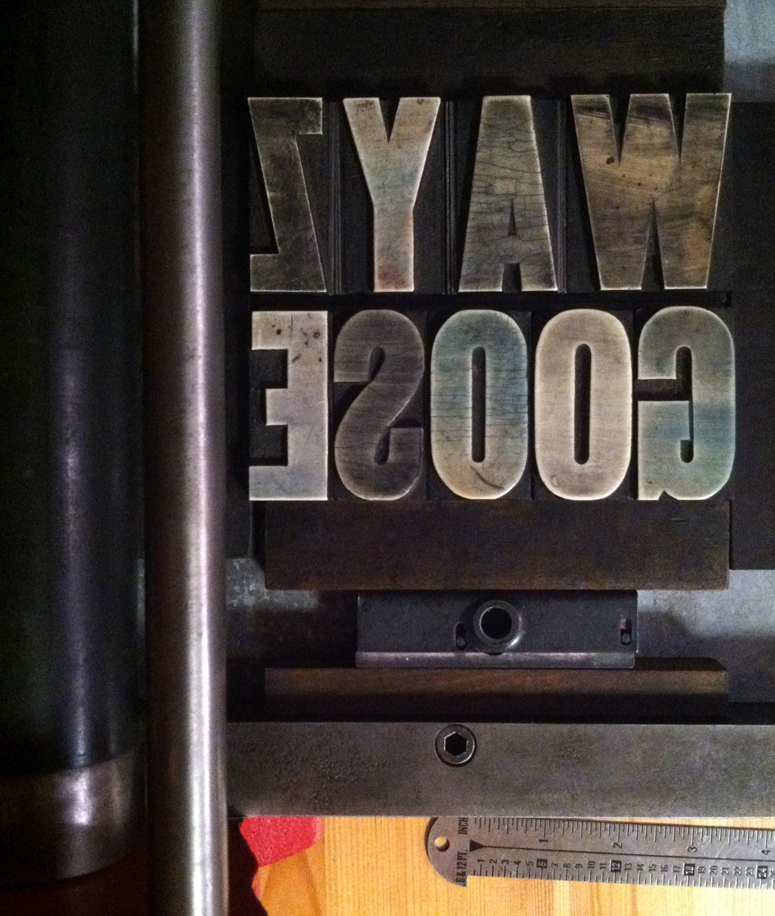
Image: The wonderful word WAYZGOOSE set in historic wood type from our collection, ready for printing in the bed of the newly refurbished Nolan tabletop press that our pal Terrence Chouinard recently delivered to us from Chattanooga. He painted it Fire Engine Red for us. The goal for the Nolan is to help make our printing more portable, allowing Seth & me to print at workshops and events… like at the Maker Meet coming up at Social House in Downtown Lake Worth on Wednesday evening, September 2, 2015, from 6 to 9 PM. You should come see us there.
Did you miss our 1664 recipe for Bartlemas Beef? Subscribers to the Convivio Book of Days blog did not. Click on a SUBSCRIBE or FOLLOW link and you’ll never miss another chapter.