Category Archives: Beltane

The Garden, or Your May Book of Days

One winter or early spring when I was a boy my mom saved up several Kellogg’s Corn Flakes boxtops and sent them in to the Kellogg’s Company and in exchange, an envelope full of flower seeds arrived in the mail. There were packets of zinnia seeds, and morning glories, and cosmos, four o’clocks and snapdragons and marigolds and who knows what else. We planted all the seeds that spring in one little plot in the front yard along the neighbor’s hedge. It was quite a lovely little flower garden, and one day I even saw a photographer out there, shooting pictures. I told Mom about that, and she was certain it was a photographer from the newspaper, and that our flowers would be in the paper. I’m not sure if she really believed that or if she was just telling me a story, but I felt that she was right. Our little flower garden, in my view, was worthy of news coverage.

Gardening was nothing new. Each year Grandpa would plant tomatoes and basil and eggplant and peppers and rocket and other staples of an Italian vegetable garden. But flowers were new to me. And the seed packets! They were so beautiful. A colorful illustration with the name of the flower printed in sharp black letters at the top. That was the first time I really noticed seed packet illustrations, and it made quite an impression on me. By the following winter, I was scouring the W. Atlee Burpee Catalog, and the George W. Park Seed Company Catalog, ordering seeds for next spring’s garden. I was thoroughly disappointed when the seeds from the mail order catalogs arrived in plain packets, rather than illustrated ones. Lesson learned.

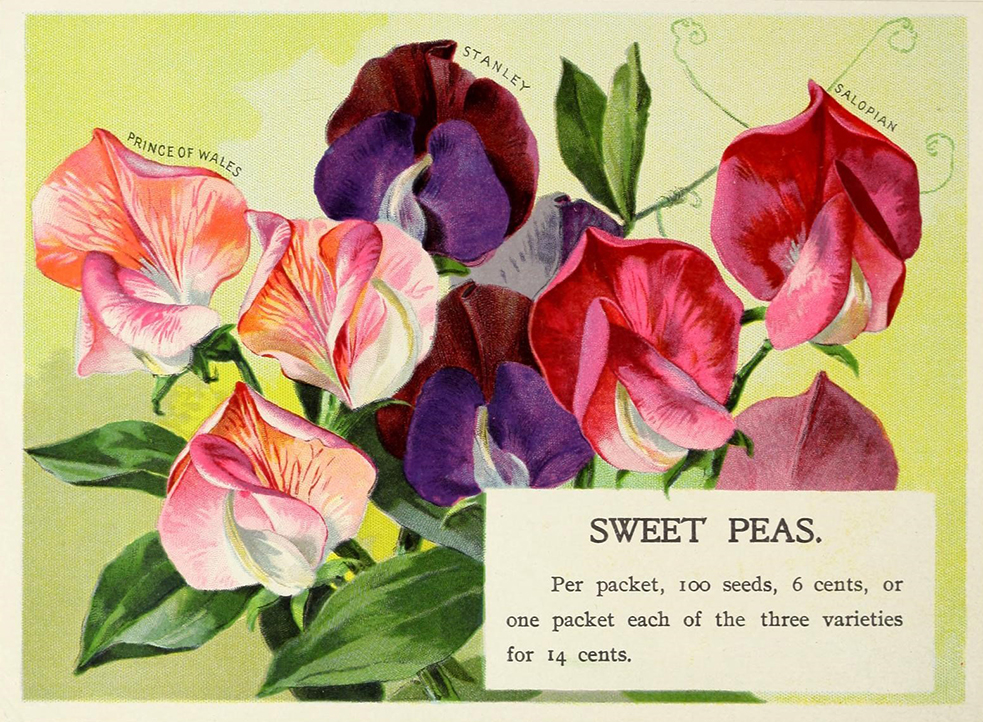
At any rate, it is May, and here is our monthly gift to you: the printable Convivio Book of Days Calendar for the month. Our cover star this month is a seed packet from an even earlier time than Mom’s 1970s mail order stash from Kellogg’s Corn Flakes. The packet gracing our calendar was first printed in 1900. Long before that, as far back as the late 1700s, the Shakers began selling garden seeds in packets for home gardeners. I came to love their seed packet designs once I began seeing them in my research at the Shaker Library at the Sabbathday Lake Shaker Community when I first went there for a book arts internship in 1996. The Shaker seed packets I saw there did not have beautiful illustrations but their typography was beautiful (which was indeed not the case with the plain packets I received from Burpee and Park when I ordered through the mail that winter in the late 70s).

Being the First of May, it is May Day, which is also known traditionally as Beltane, the day’s Celtic name. It is a cross quarter day: halfway between equinox and solstice. It is a time of increase. The days lengthen (as they’ve been doing since the Midwinter solstice in December) and we are fast approaching the longest day, which, for us in the Northern Hemisphere, will come with the Midsummer solstice in June. In traditional reckoning of time, today would be the very start of summer… which is why the approaching solstice takes the name Midsummer (even though the solstice is, by the almanac, the first day of summer). This approach has always felt more balanced to me. To have summer begin just as the days start to get shorter feels, to me, like the choreography of the sun and planet is a bit off. I like the old names Midsummer and Midwinter, and so I use them for this reason.

If there are maypoles in your neighborhood, this is very likely the day you’ll see them decorated with ribbons and flowers. You might also find a paper basket or cone full of flowers hung on your door, a rather sweet old tradition practiced by children. Most likely, if you live in the United States, the day will pass without notice. May Day and Beltane are celebrations not widely celebrated here. There are many such celebrations, thanks most likely to our Puritan roots and our tendency to work, work, work. But alas, as the saying goes, All work, no joy, makes Jack a dull boy.

OPEN STUDIOS DAYS: THIS WEEKEND!
Come see us at the shop this Saturday & Sunday, May 2 & 3, from 11 AM to 5 PM, as we (and other artists throughout Palm Beach County) open our doors for Palm Beach Cultural Council’s Open Studio Days. We’ll teach you how to make a small accordion book, perhaps with a bit of hot foil stamped text, and we’ll be serving cookies and our new Horn & Hardart Automat Coffee. Those things are free and on the house! Also free: help us continue writing the Exquisite Corpse story we began last weekend during Independent Bookstore Days. The story is coming along nicely and is, indeed, quite surreal (as the Surrealists, who invented this literary game, would have wanted it to be). We’ll also be open for great eclectic shopping, too, of course. We’re at 1110 North G Street, Lake Worth Beach, Florida 33460. CLICK HERE for the details, and also to browse our online catalog, and do come by this Saturday and Sunday, please!


Image: A seed packet from the Miss C.H. Lippincott Seed Company. From the Henry G. Gilbert Nursery and Seed Trade Catalog Collection. Print on paper, 1900 [Public Domain via Wikimedia Commons].

 

Sumer is Icumen In

We were in Maine one month ago, Seth and me and our niece, and during our visit we had not one but two big snowstorms. There’s a very high likelihood that we were the only three people in the State of Maine at the time who were excited about the snowfall. We went sledding, snowmen were built, there were snowball fights, and there was a great deal of cheerfulness and laughter coming from the three visitors from Florida, whilst everyone we ran into there was thoroughly sick of winter. Spring, however, comes slowly to the Pine Tree State. Surely it has arrived there by now. Let’s hope so, anyway, for here we are now at April’s ending and with its close, the start of May. Tonight manifests another of the old stories –– the stories we tell each other year after year, and which never grow old, for the wheel of the year turns and each spoke is new and yet is the old familiar, too. And so here is tonight’s story: it is Walpurgis Night, the Eve of May. And with it, we reach the first step toward proper summer: tonight, we spring into summer.

The night is named for St. Walpurga, a saint who, in medieval times, had not one but two (like our Maine snowfalls in March) feast days each year: February 25, which is the day she left this earthly life, and the First of May, which was the date of her canonization in the 9th century. Her May feast day has actually not been celebrated in the Church for centuries now; nonetheless, St. Walpurga is forever tied to the transition from spring to summer, and we are the richer for it, for still we get to wish each other a Happy Walpurgis Night as we welcome May, and why would we deprive ourselves of saying words filled with such wonder? This night is particularly loved in Sweden, Finland, and Bavaria. In Sweden, this is a night for bonfires, for gravlax and sparkling wine outdoors under the stars. In many places, historically, this was a night, especially for the young and hearty, to stay out til dawn as winter becomes but a memory and as we enter into the gentler time of year.

In the Celtic tradition, it is Beltane. It is the cross quarter day that helps us spring to summer here in the Northern Hemisphere. In the wheel of the year, Beltane is the direct opposite spoke of the cross quarter day that comes as we fall into winter, which is Samhain, or Halloween. The fall into winter brings descent, life burrowing down beneath the earth, while the spring into summer brings ascent, life springing forth from the earth. It is an aspect of the everlasting mysteries of the planet and its place in the universe: we know these things so well, for we witness them each year with the planet’s revolution around the sun, and yet how these things have all come to pass still has the power to leave us breathless. (Again, the old stories.) The very names given to these days are shrouded in mystery, too, for their pronunciations are, for most of us, not of our tongue, and what seems apparent is not: Beltane is pronounced bowl-tan-a; Samhain is pronounced sah-win. Like the names of angels in ancient tongues, to speak the names connects us to a long forgotten past whose embers smolder still in the bonfires we light in the countryside, in the fire bowls we light in our yards, and even in the candles we illuminate in our homes.

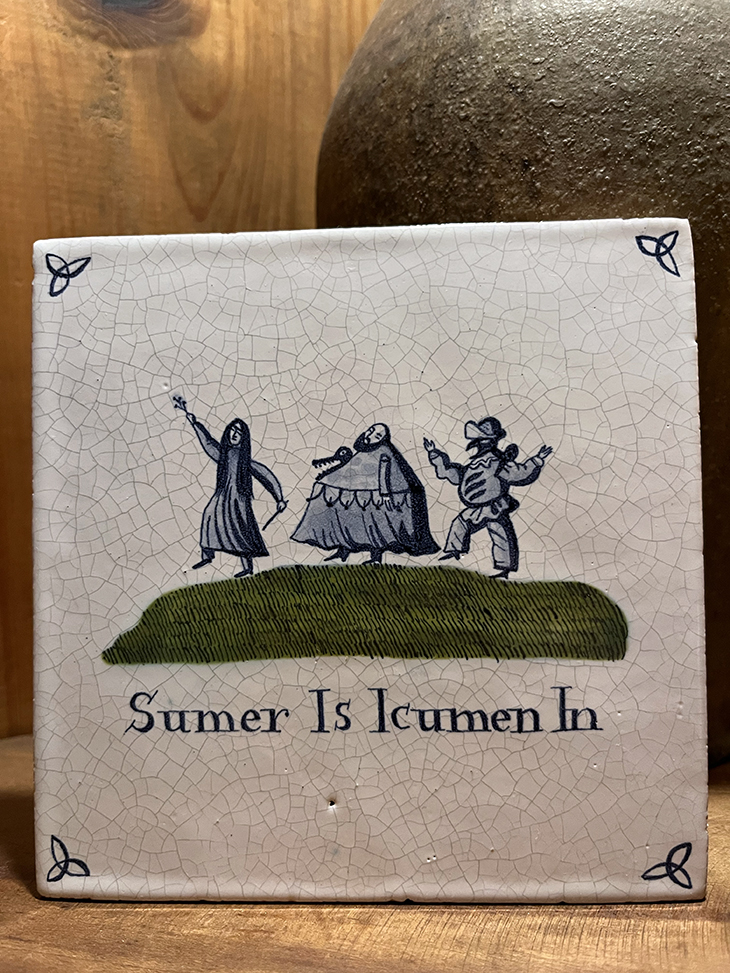
I’ll be back tomorrow with your Convivio Book of Days calendar for May. For tonight, though, we wish you a good and warm Walpurgis Night. Welcome May! “Sumer is Icumen In,” as the medieval English carol goes. The days are getting longer and longer and lighter and lighter. There is no snow in the forecast.


Image: Seth recently purchased a couple of handmade ceramic tiles from artist Paul Bommer in the United Kingdom, whose work we’ve admired for a very long time. This tile is sitting in the corner cupboard in the kitchen tonight for Walpurgis Night and the Eve of May. You can find Paul’s more recent work (which is a bit more irreverent than his work in the 2012 link above) at Paul’s Instagram page: @paulbommer. (Seth also bought the tile of the bearded swimming man.)


COME SEE US AT THE SHOP!
We’re open for Mother’s Day Shopping (not to mention gifts for dads and grads, too) on Saturday May 3 from 11 to 4, and on Sunday May 4 from 11 to 3, and again on Saturday May 10 from 11 to 4. We’ve got two creative workshops coming up, too (which require registration in advance): I’ll be teaching Pure Bookbinding on Sunday May 4 (only two seats remain), and Kim Spivey will be teaching a new session of Collagraph Printmaking on Sunday July 27.


Spring into Summer

End of April, start of May: it’s another of the old stories manifesting again tonight –– the stories we tell each other year after year, and which never grow tired, for the wheel of the year turns and each spoke is new and yet is the old familiar, too. And so here is the old story for tonight: it is Walpurgis Night, the Eve of May. With it, we spring into summer.

The night is named for St. Walpurga, a saint who, in medieval times, had not one but two feast days each year: February 25, which is the day she left this earthly life, and the First of May, which which was the date of her canonization in the 9th century. Her May feast day has actually not been celebrated in the Church for centuries now; nonetheless, St. Walpurga is forever tied to the transition from spring to summer, and we are the richer for it, for still we get to wish each other a Happy Walpurgis Night as we welcome May, and why deprive ourselves of saying words filled with such wonder? This night is particularly loved in Sweden, Finland, and Bavaria. In Sweden, this is a night for bonfires, for gravlax and sparkling wine outdoors under the stars. In many places, historically, this was a night, especially for the young and hearty, to stay out til dawn as winter becomes but a memory and as we enter into the gentler time of year.

In the Celtic tradition, it is Beltane. It is the cross quarter day that helps us spring to summer here in the Northern Hemisphere. In the wheel of the year, Beltane is the direct opposite spoke of the cross quarter day that comes as we fall into winter, which is Samhain, or Halloween. The fall into winter brings descent, life burrowing down beneath the earth, while the spring into summer brings ascent, life springing forth from the earth. It is an aspect of the everlasting mysteries of the planet and its place in the universe: we know these things so well, for we witness them each year with the planet’s revolution around the sun, and yet how these things have all come to pass still has the power to leave us breathless. (Again, the old stories.) The very names given to these days are shrouded in mystery, too, for their pronunciations are, for most of us, not of our tongue, and what seems apparent is not: Beltane is pronounced bowl-tan-a; Samhain is pronounced sah-win. Like the names of angels in ancient tongues, to speak the names connects us to a long forgotten past whose embers smolder still in the bonfires we light, in the fire bowls in our yards, or even in the candle you illuminate in your home. We certainly don’t need candles, do we? And yet we light them, especially on nights like this, nights that mark a shift.

Here’s another part of the old story I’ve offered you in the past: It was a few years ago on Walpurgis Night that Convivio Book of Days reader (and fellow letterpress printer) Leonard Seastone gave us a pointer in the blog comments about a good song for this night, and I always remember this kindness. It is a traditional Swedish song called “Maj vare välkommen” (May Be Welcome), and that song will be part of our quiet celebration tonight, too, even if it’s just playing in my head. Leonard signed off on that Walpurgis Night using his proper Swedish name –– Lennart Einar Sjösten –– so he seems to me a good authority on these matters. I hope he’ll be celebrating tonight as Seth and I will be, and I hope you will, too, in some way, grand or small.

I’ll be back tomorrow with your Convivio Book of Days calendar for May. For tonight, though, we wish you a good and warm Walpurgis Night. Welcome May!

SAVE ONLINE! At our online catalog, save $10 off your purchase of $85 or more, plus get free domestic shipping, too, when you use discount code BUNNY at checkout. It’s our Zippin’ Into Springtime Sale, good on everything in the shop, now until we decide it’s done. CLICK HERE to shop! And don’t forget to use discount code BUNNY at checkout if your order is $85 or more.

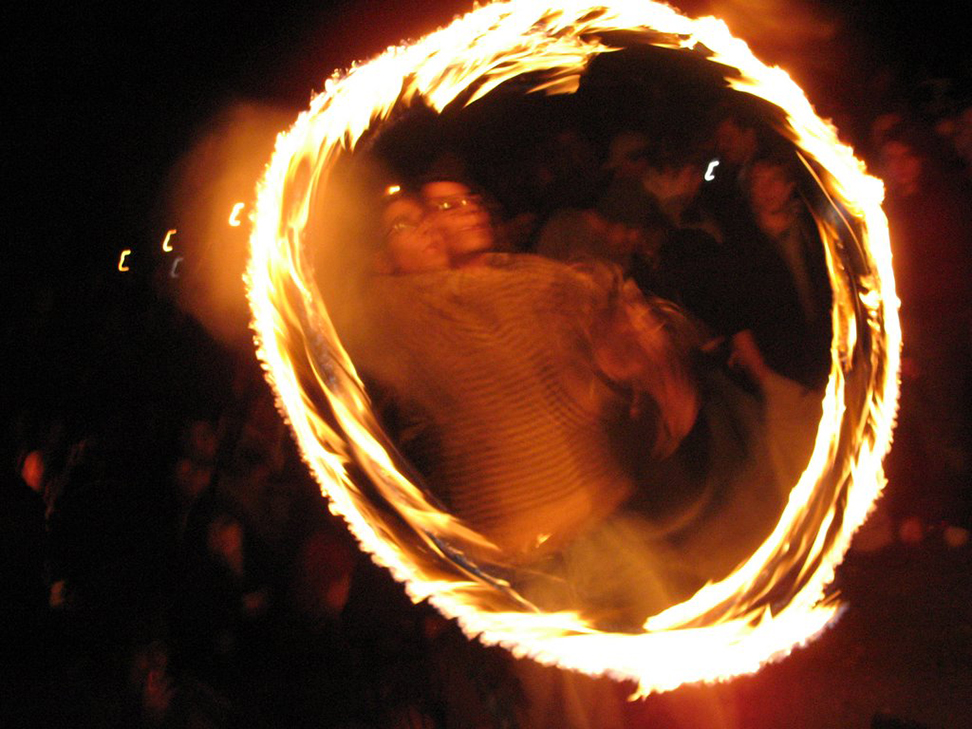
Image: “Walpurgia Night Fest on Heiligenberg in Heidelberg (Germany)” by Przemyslaw Grudnik. Photograph, 30 April 2006. [Public domain] via Wikimedia Commons.