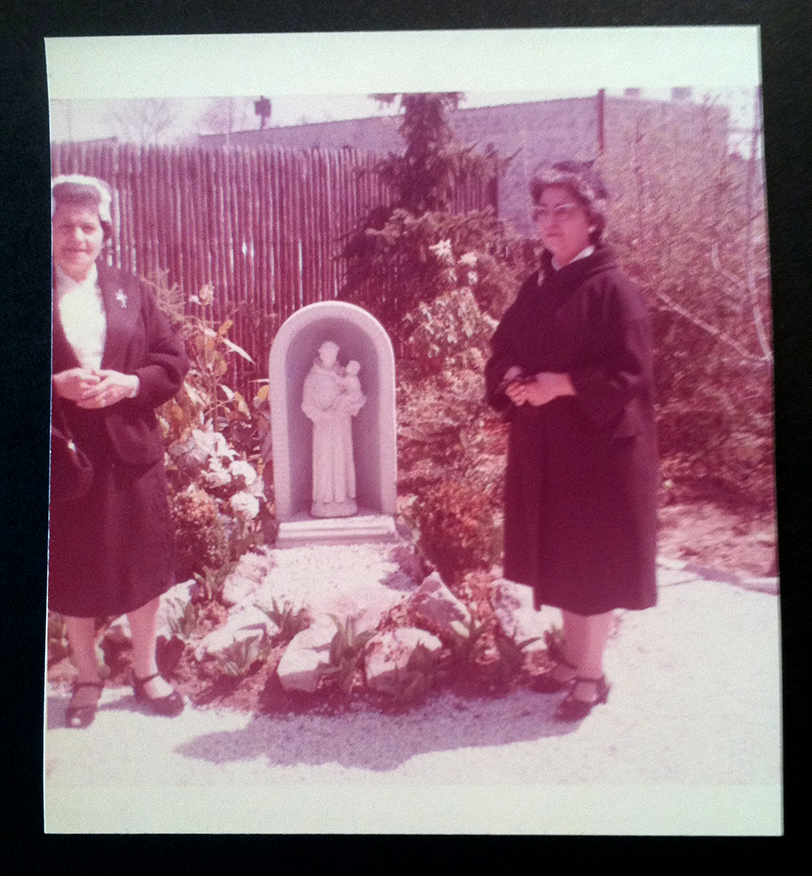
Welcome to the gentle time of year. It is Memorial Day Weekend, our unofficial start to summer. It was the Sunday of Memorial Day Weekend, 1949, that my mom and dad got married––two good looking kids from Brooklyn, tying the knot in the company of their family and friends at St. Blaise Church, with a football reception afterward at the Livingston in Downtown Brooklyn: piles and piles of sandwiches, “football” referring to the idea that folks would toss the waxed paper-wrapped sandwiches across the room. “Hey,” someone would shout, “send me a capocolla!” and indeed, someone would toss a capocolla sandwich his or her way. How great is that? Sandwiches flying across the room, mountains of homemade cream puffs, and trays and trays of Italian cookies, mounded in pyramids, wrapped in cellophane. The Roy Rogers Orchestra was playing live and certainly there were at least one or two tarantella dances. No wedding planners, no destinations, no fondant on their cake. There was a big fight between Mom and Dad the night before over mustard, but all was smoothed out by morning and the rest, as they say, is history. Now that’s a wedding.
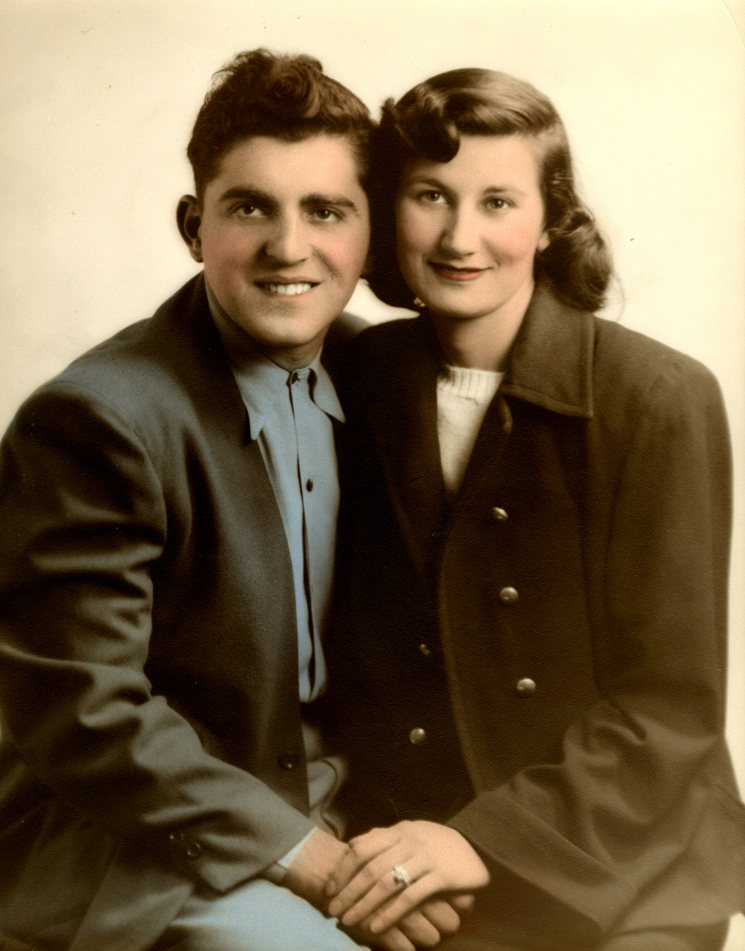
They chose Memorial Day rather roundaboutly… and so here comes one of my family’s legendary stories. Mom and Dad were engaged in February, 1948, and Mom wanted to get married at her birthday that next October. But at some point that spring, Grandma and Grandpa Cutrone sat them down and asked them to hold off for a year. “If you do, we’ll give you a nice present,” they said. Mom and Dad gave it some thought, and said ok, they would. And so the date was set for Memorial Day Weekend, 1949. Just before the wedding––like, that morning––Grandma pulled my dad aside. “Johnny,” she said, “I only have $100 for your present.” At this point, it is helpful to understand how Italian weddings work. We don’t give toasters and towels at weddings. We give cash. At some point during the reception, the groom and the bride, holding a white satin bag, have a seat at a table. A line of guests forms from there, the guests holding envelopes––the busta. The cash. Each guest approaches, kisses the bride and groom, bestowing their congratulations on the couple and into the white satin bag, their busta. Next morning, the bride and groom will gather with the family and someone will have a pen and paper and while the happy couple open the envelopes, the person with the pen and paper records, for posterity, what each guest gave. It’s a very matter of fact process, something you might associate more with accounting departments than with newly-married lovebirds.
Now my dad, he knew already what my mom’s parents were giving for their wedding present. Grandma and Grandpa DeLuca were giving them $1,000. Not too shabby a present back then (nor now, for that matter). So there was going to be quite a disparity between the gifts of the two sets of parents. So Dad, in that thirteenth hour, pulled out his wallet, took three $100 bills out of it, and shoved them into his mother’s hands so she could add them to her busta. The next morning, Mom and Dad opened Grandma and Grandpa Cutrone’s envelope, and their gift was recorded at $400––which was also not so shabby in those days. All was well and face was saved and my dad––who also somehow paid for the wedding reception––got his own 300 bucks back. Which could be the end of the story, but it’s not.
The secret remained a secret for years and years until one of many spirited and exuberant dinner table disagreements amongst my extended family. Things became more and more heated and eventually the matter of Millie and Johnny’s wedding gift came up. It seems all of my other aunts and uncles had received $100 from my grandparents, and the $400 gift that my parents got was a sore point. The shouting built and the accusations built and finally my dad stood up and above all this cackling, yelled, “OK, enough!” I like to think he slammed his hand on the table, too, and maybe he did. He turned to his mother. “Ma, how much did you give for my wedding?” Grandma looked at him blankly and wasn’t sure exactly what to say. “Eh, $400,” she finally uttered. Dad looked at her again, raising his eyebrows. At that, she sighed and she came clean. Dad and Grandma explained to everyone at the table that day what had transpired in the hour before his wedding years before. My mother’s mouth fell. All these years, and she had no idea.
And so these are the stories we tell and the things we think about at Memorial Day. And it is another day to miss Dad more since he’s left us. Dad hits us with lots of memory days this time of year: His birthday on the 18th of May, their anniversary on the 29th… oh and then soon after comes Father’s Day, the day he called Jack Ass Day. Last year, on their first anniversary apart, Memorial Day Weekend found Mom in the hospital with shortness of breath. What they told us would be an overnight stay turned into a week or more. Cardiologists couldn’t quite figure out what was what, even after she was sent home. Finally, she went to Dr. Molly, the doctor Mom and Dad had gone to for years and years. Dr. Molly put Mom on a water pill and also observed what none of the hospital doctors seemed to care about, even though we had told them about Dad’s recent passing: “You’re heartbroken.” Perhaps that needed to be acknowledged. Mom has been in good health since.
The day is special to my family, but it is special to many. As a nation, it is the day we remember our fallen heroes, those who gave their lives in service to their country. But it is one more day where we just remember, plain and simple. Memorial Day (or some version of it) is celebrated not just here in the United States, but in other countries, as well, and usually at this particular time of year. It is a tradition that harkens back to Ancient Rome. The day was earlier on known as Decoration Day, and the Memorial/Decoration Day traditions in this country go back to the Civil War era. The original date, May 30, was chosen for it was believed that flowers for decorating graves would be in bloom in every state of the Union on that date. It’s since been moved to the last Monday of May. This year it falls on the 28th. It is our unofficial start of summer here in the US, but a somber one if we honor the day in its proper tradition. And so we decorate, and we remember. And we tell stories. Flowers and stories for remembrance, flowers and stories beckoning summer and the gentle time of year.
Image: Johnny & Millie. This their engagement photo, not all that long before that sit down with Grandma and Grandpa Cutrone that led to the decision to be married on Memorial Day Weekend, 1949.