To Make a Rare Bartlemas Beef

MrsBeetonsMeatCuts

Monday next will bring St. Bartholomew’s Day, the day of the traditional printer’s wayzgoose, this is a big day for book artists like me: St. Bartholomew is a patron saint of bookbinders and book artists and his day has been of significance to printers and papermakers, as well, for centuries. Goose is one traditional meal for the day, as is cheese, for St. Bart is also a patron saint of cheesemakers. But so is Bartlemas Beef, which takes some time to prepare… hence today’s post, designed to give you the time necessary to prepare a proper meal for your Wayzgoose Monday.

This recipe for a Rare Bartlemas Beef is taken from The Cook’s Guide by Hannah Wolley, printed in London in 1664. (The book’s full title is quite long: The Cook’s Guide: or, Rare receipts for cookery Published and set forth particularly for ladies and gentlewomen; being very beneficial for all those that desire the true way of dressing all sorts of flesh, fowles, and fish; the best directions for all manner of kickshaws, and the most ho-good sawces: whereby noble persons and others in their hospitalities may be gratified in their gusto’s. Phew. Perhaps the first celebratory printer’s wayzgoose came about once the typesetter triumphantly finished setting the type for this long-winded title.)

Lady Wolley calls this beef “rare” meaning fine or good. It does not refer to the cooking temperature. Judging by the three days soaking, she means for us to use salted beef, but that was 1664 and this is not and I think we can begin with fresh beef at the second step of her recipe, where the vinegar and wine is introduced. Be that as it may, here is her full 1664 recipe for a Rare Bartlemas Beef:

Take a fat Brisket piece of beef and bone it, put it into so much water as will cover it, shifting it three times a day for three dayes together, then put it into as much white wine and vinegar as will cover it, and when it hath lyen twenty-four hours take it out and drye it in a cloth, then take nutmeg, ginger, cinnamon, cloves and mace, of each a like quantity, beaten small and mingled with a good handful of salt, strew both sides of the Beef with this, and roul it up as you do Brawn, tye it as close as you can; then put it into an earthen pot, and cover it with some paste; set it in the Oven with household bread, and when it is cold, eat it with mustard and sugar.

There you have it: an old old recipe for celebrating an old old holiday. The St. Bart’s Wayzgoose is not widely celebrated today, but, considering the current boom of interest in letterpress printing and book arts, perhaps it should be. Pass the mustard, please.

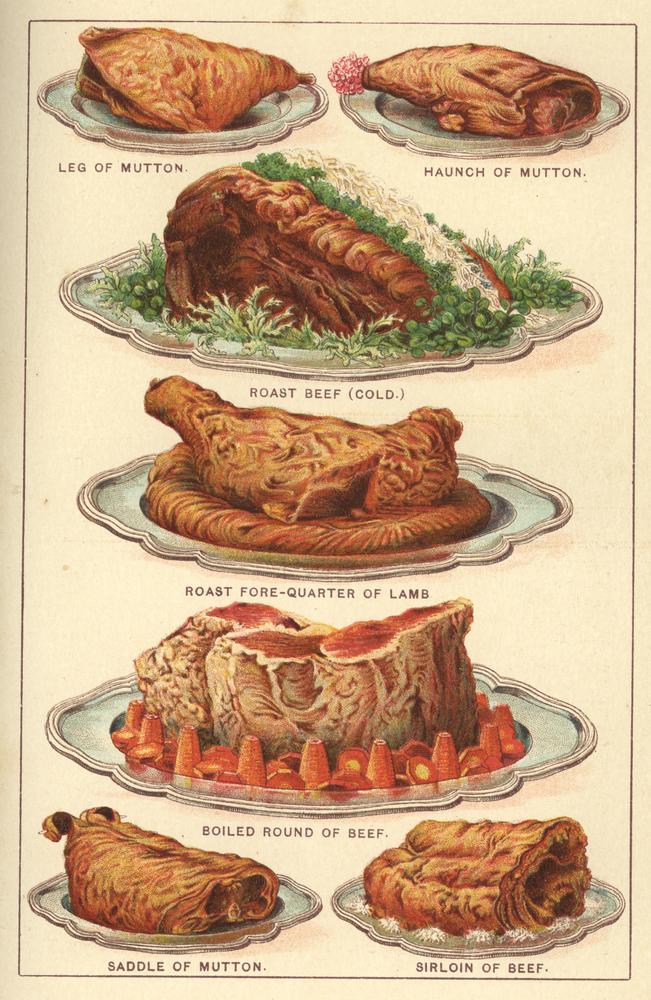
The image of several fancy cuts of meat is from another old cookbook (though not nearly as old as Hannah Wolley’s): Mrs. Beeton’s Cookery Book, 1901. Thank you to the University of Michigan Digital Library for the online version of The Cook’s Guide.

 

Tagged

Ferragosto or, Dog Days are Over

While in Japan it is the time of Obon, in Italy it is the time of Ferragosto. Woe to American tourists who travel to Italian cities at this time of year, for chances are good they will find the majority of shops and restaurants closed. Most Italians have headed to the sea for the Ferragosto holiday, a practice that dates back to ancient Rome where this time was known as Feriae Augusti, or “Holidays of the Emperor Augustus.”

The sea is the logical destination as these sultry Dog Days of summer, the hottest part of the year, ruled by Sirius, the dog star, come to a close. There are many schools of thought as to the meaning and the timing of the Dog Days, but if we have to choose one, I’ll subscribe to the version that has them begin each year in early July and end about now, around the 15th of August. For all these Dog Days, Sirius and our sun have been rising together in the morning sky. It was thought in times past that the combined heat of the two made for our hottest days. But in the constant rearrange of the stars and planets, now Sirius begins to emerge from the sun’s bright light and heat to rise independently. The two forces separate.

In the Catholic Church, today is the Feast of the Assumption, marking the day of Mary’s ascent, body and soul, to heaven. Mary, human like us. It is also my grandmother’s birthday. Because she was born on the Assumption, her parents named her Assunta, in honor of the day. Ferragosto and the Feast of the Assumption go hand in hand.

In Lavagna, Italy, yesterday brought a festival that features a cake that stands 21 feet tall! It is the Torta dei Fieschi, a wedding anniversary celebration that dates all the way back to 1230. Tomorrow, on the 16th, it is Il Palio in Siena, the famous horse race that runs through the entire city. This Ferragosto tradition is accompanied by celebrations throughout Siena and, of course, great quantities of food and wine.

In short, if you are in Italy, Ferragosto is not a time to stay home. But this seems not unusual. Some years ago, my mom’s cousin Tina visited from Italy. We had never met her before. She arrived in Miami for a one week stay with three very heavy suitcases, and while she was with us, she changed outfits more than once a day. One of her morning robes had feathers on it. We had never seen such a thing except maybe in glamorous old Hollywood films. Feathers floated into the air in her wake as she floated down the hallway. On Sunday during her visit, we did what we always do: Mom made a big dinner while Dad puttered around the house. Tina asked in Italian, “But what do you do on Sundays here?” Mom answered in the best Italian she could muster. “We cook, we read the paper, we relax.” Tina was not impressed. “In Italy,” she said, “we go out. We go dancing.”

This is what I imagine Italy to be like during Ferragosto, at least if you are in the right place at the right time. If you are in a touristy part of Florence or Rome during Ferragosto, you’re probably in the wrong place at the wrong time. But if you are in Siena, or in Lavagna, or in Napoli (where Tina is from)… well, there’s probably a lot of celebrating and dancing to be done. Get you to the sea or get you to a festa. Summer is coming to a close and it is time to send it out with a bang. Florence + the Machine have got that down pat. The dog days are over, the dog days are done.

DogDays


Tagged , ,

Honoring the Dead & Honoring Obon

DSC09719.JPG

In Japan, it is the time of Obon. At least in some parts of Japan… for this festival honoring the dead is one of shifting dates depending on region and calendar. Some places, like Tokyo, celebrate in July (this is called Shichigatsu Bon); others in August (Hachigatsu Bon). And then there is Kyu Bon (Old Bon) and this is based on the lunar calendar. Hachigatsu Bon and Kyu Bon are typically celebrated around the 15th of August. But the celebration lasts for three days; most likely things are getting started about now for a celebration that will probably peak on Saturday.

Obon is an outdoor festival that rings with the sounds of street vendors, taiko drums, and the music of set dances. The drummers and their accompanying flutists may be set up atop a yagura, an elevated platform decorated with red and white streamers. Lanterns are strung from the yagura to illuminate the scene once night falls. Around the yagura go the dancers, their motions slow and graceful and very methodical, the dances communal, old and traditional. They are called bon odori: familiar steps, familiar sights each year.

Thanks to the presence of the Morikami Museum in Delray Beach, Obon used to be a big part of the summer cycle here in South Florida. The beach, the heat, the humidity, thunderstorms most afternoons, and Obon: these were the things we could count on as part of what is constant about this land where summer lingers long. Since it is an outdoor festival, the heat and humidity assured you that it would be a sweaty time and the afternoon thunderstorms lent an air of excitement to Obon each year: Would there be a downpour? Wise Obon goers at the Morikami kept an eye open for the nearest shelter should the weather turn.

Eventually the Morikami built a shelter to contain the yagura and dancing, and while that protected everyone from the good chance of rain, it also protected us from the expansive night sky: the stars and the clouds and the evening breeze. It was the beginning of a downward spiral of protection. Nowadays the Morikami doesn’t even let us sweat: they’ve moved the festival to October, when it is cooler, and they call it Lantern Festival. In their good intentions, they’ve made Obon safe and also devoid of meaning, for it has lost its connection to the wheel of the year. Summer here is no longer the same: our local Obon celebration has become one of the dead we honor at this time of year.

The most beautiful part of Obon is something we can almost all celebrate in some way, whether as a community or on our own. It is what the Japanese call Toro Nagashi: the lighting of lanterns that are set afloat on the water. It is believed at Obon that the spirits of the dead return to the land of the living for a brief visit. But of course they must return home again. As night falls on the third night of the festival, lanterns––hundreds, or thousands, depending on the community––are illuminated and floated out to sea. At the Morikami, which is far from the ocean, the lanterns float across Morikami Pond. You, too, can make simple lanterns for Obon. A small piece of wood, a bag on top, some sand inside nestling a little tea light: these are all that is necessary. You might write a message on the paper bag or decorate it somehow. Sumi ink is traditional, but not required. Your lantern can be set on a pond, on a lake, on the ocean’s shore. The lanterns carry the souls of the ancestors, back to their homes on the distant shore across the water. We set them on their way, wish them well, look forward to their return.

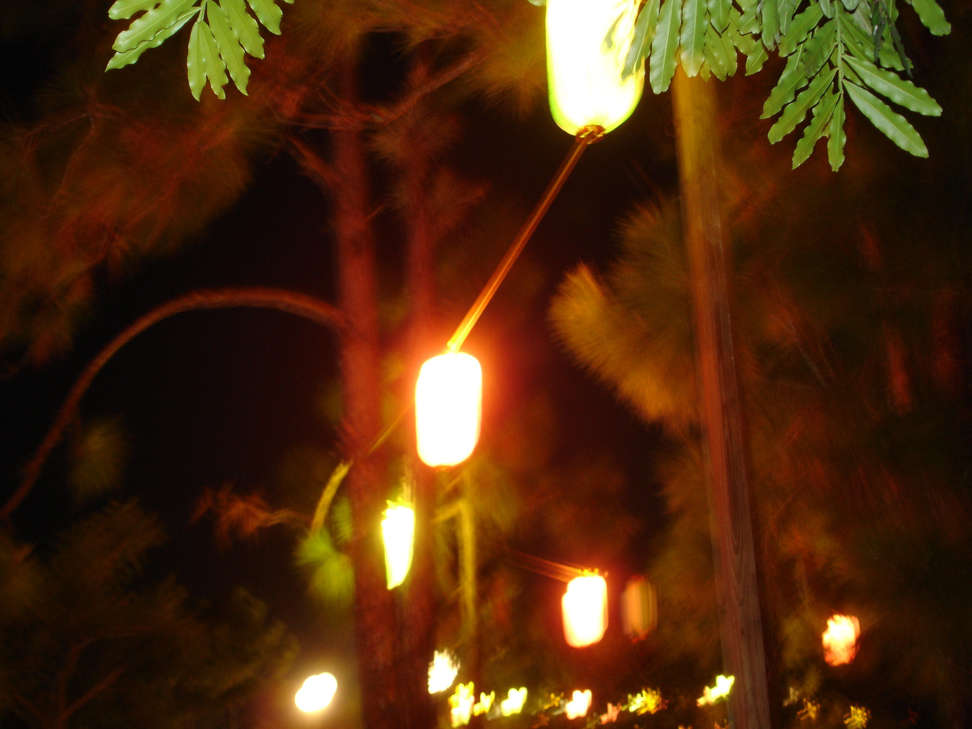
Image: Electric lanterns at the Morikami’s Obon festival, many years ago, strung in the trees from the yagura and through the ennichi street fair, above the vendors, above the dancers, above the spirits.