Balance Returns

Autumn

Tonight, by the almanac, autumn begins in the Northern Hemisphere. The precise moment, for those of you who like precision, is 10:29 PM here in Lake Worth. That’s Eastern Daylight Time, so you can do the math accordingly to where you live. Precision is great, but I am more of a roundabout kind of guy, and I am more of a traditionalist, anyway, of the mindset that autumn began with Lammas, the celebration of the first harvest, at the start of August. By this traditional reckoning of time, we are now midway through autumn, and we are also now midway between the year’s longest day (Summer Solstice, or Midsummer) and its longest night (Winter Solstice, or Midwinter). Tomorrow we inch closer to darkness, crossing a border that begins to make nights longer than days in our hemisphere. But for now, we are balanced, and this, hopefully, is reflected in us.

The time of gathering in intensifies now, for as darkness overtakes light, cold increases, as does our sense of urgency, and even in these times of plenty, when we can have almost anything we want at any time of year (should we wish it), still we instinctually gather in and take more joy in home and in hearth. And so now we balance what was the opening aperture of spring at the opposite side of the seasonal round with gathering, storing, closing. Winter is coming; naturally, we want to make it as warm and comfortable as we can.

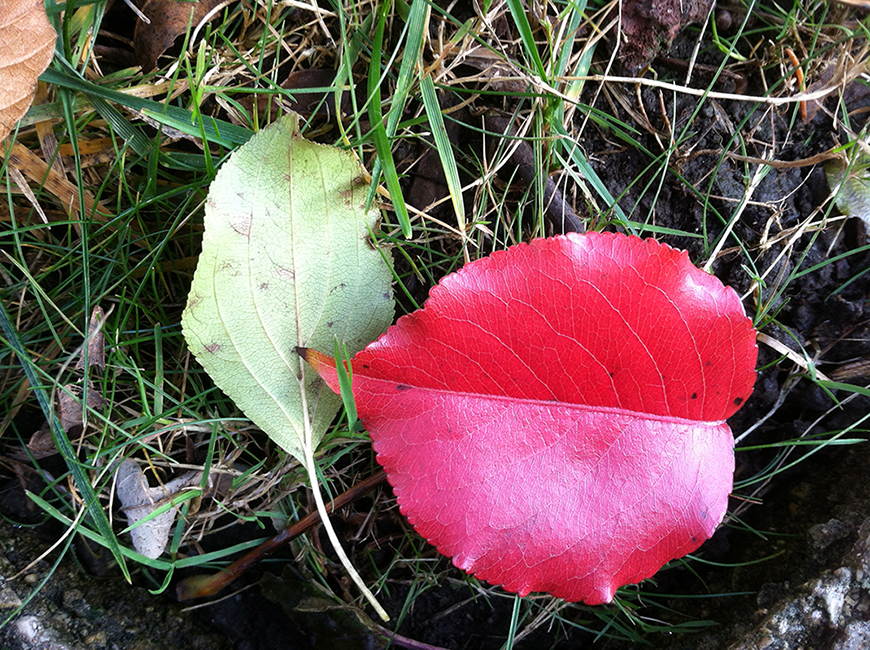
Here in South Florida, whereas spring comes early, so autumn comes late. It’s still quite summery out there for us. But Orion is there lording over the early morning darkness before the sun rises to the east, and occasionally we wake up to a slightly less humid day. The air is growing lighter, less still. We begin to play with the idea of shutting off the air conditioning and throwing open the windows. But that’s Florida for you: often a little contrary to the rest of the country. Nonetheless, soon the big green leaves of the Florida Almond trees will begin turning red. They are not widely planted, and they are wall flowers for most of the year, but each autumn for a couple of weeks they make their presence known. There’s one across the street in Old Aunt Sarah’s lot. Sometimes I walk on over and stand under that blazing red tree and even though it may be 80 degrees all around me, I look up into those red leaves and pretend that I am in a place where autumn makes itself well known.

If you are in one of those places, go, gather some apples, visit a farmer who grows pumpkins (like Intervale Farm in New Gloucester, Maine… that’s all Jan Wilcox grows there), find someone who makes cinnamon doughnuts and tells good stories. Pour yourself some cider, hard or fresh, either is fine, raise your glass to Seth and me, and we will do the same from here. It just won’t be as chilly here, and the colors won’t be nearly as beautiful.


Image: Autumn by Giuseppe Arcimboldo. Oil on canvas, 1573, [Public domain] via WikiMedia Commons.


0.918 or, The Superhero of Today Works Quietly Away

Letterpress Superhero

A lot of the folks who read The Book of Days are book artists, because I am a book artist, and we book artists are a tight knit bunch. We look out for each other and we take care of each other and we support each other’s projects. And for those of us in the book arts who happen to be letterpress printers, today we have another red letter day. It’s not one you’ll find in any calendar, and it was only recently dreamt up by someone involved in the craft. But each 18th of September we printers celebrate Letterpress Appreciation Day, and this is based on one very important measurement: the height of type in the US and the UK, which is always 0.918 inches. That measurement is from the base of the type to the printable surface at the top of it, and it is the same no matter what point size the type: the smallest 4 point type cast in metal to the largest wood type you can think of for printing large posters––all of it measures the same height: 0.918 inches.

Someone a few years back thought it would be a good idea to honor printers and printing on September 18 (9/18) and some of us (ahem, me) have been celebrating this date ever since. If you know a printer, this is a good day to shake his or her hand and to admire what they do. If you are a printer, this is a good day to share what you know.

On this particular Letterpress Appreciation Day, I remember the man who first taught me how to print on an iron handpress: Glenn House. He taught me, and now I teach others. One of the great things about humanity is we take what we know and we pass it on. Glenn House left this world on Sunday. He was a good guy. He liked to say “yes” where others said “no,” and this is something I try to emulate, too. The day we printed at the iron handpress at the University of Alabama, we printed an old poem, an old song, and it went like this:

William Matrimmatoe
He’s a good fisherman.
He catches hens,
Puts them in pens.
Some lay eggs.
Some lay none.
William Matrimmatoe
He’s a good fisherman.
Wire, briar, limber, lock.
Three geese in a flock.
One flew east.
One flew west.
One flew over the cuckoo’s nest.
Wire, briar, limber, lock.
Out goes you, old dirty dish rag, you.

Glenn was one of the quiet superheroes I have known in my life, and so this year, the printing I am doing, with others, is a small way to honor his memory and his legacy. To spend this day printing: well, Glenn would like it like that.


Image: This year’s Letterpress Appreciation Day message of positivity. Printed on the 1890 Wesel Iron Handpress from historic wood types.


Our Lady of the Grapes

Böttcher_Christian_Eduard_-_Setting_out_for_the_grape_harvest, _Oberwesel-on-Rhine_-_1867

Now we are well into September and in places where there are vineyards, the grapes are ripening on the vines, speaking of great alchemical potential: crushed and barreled and left to ferment, activating natural yeasts and sugars, the next wines are about to be made.

The timing of today’s feast––at the start of the grape harvest––is, to me at least, interesting. Nine months ago we celebrated the solemnity of the Immaculate Conception, and today, we celebrate the Nativity of Mary. The Church celebrates the deaths of saints (don’t you love when I tell you all those gruesome tales of how saints met their ends?) but in the case of Mary and John the Baptist, also their births. And tradition tells us that Mary was born on this day in Jerusalem to St. Ann and St. Joachim.

Italians like to eat blueberries for this day, a day important to all Marias and Mariettas… and there are many in my family. The blue of the berry is a reference to the traditional color of Mary’s cloak. Lights are illuminated in windows, especially in the rural areas, and bonfires are not uncommon on this night. Across the Alps, in Austria, it is time to bring the sheep and cattle down from the mountains and into the valleys: winter is fast approaching, and the Nativity of Mary on the 8th of September is known there as “Drive Down Day” in honor of this custom of moving the animals, often with some pomp and ceremony.

In France, though, there is this nice connection between the Nativity of Mary and wine: winemakers refer to the day as “Our Lady of the Grape Harvest,” bringing their best grapes to church for blessing. Across France you will find bunches of grapes placed in the hands of statues of Mary on this day. I like this connection between Mary, a goddess of sorts, and wine, especially as we ponder the bread and wine that is central to each church Mass, but central also to any good meal in places throughout Europe. These two elements can easily be a meal unto themselves (“a jug of wine, a loaf of bread, and thou”), should that be all you have, and you’d walk away sated and probably quite happy.


Image: Setting Out for the Grape Harvest by Christian Eduard Böttcher. Oil on canvas, 1867, [Public domain] via WikiMedia Commons.