Good morning! It’s May Day, Beltane, start of summer by the Celtic calendar and in the traditional reckoning of time. This is a Convivio Dispatch from April 30, 2013. It’s one of my favorites, and chances are good you’ve not seen it. So please do. Welcome Summer! ––jlc
Hello My Friends:
John Cutrone here, from Convivio Bookworks in Lake Worth, Florida. It’s a rainy afternoon as I write this on this last day of April. It’s my one day off from work this week, and while I have a list of errands to run, the rain has been nice and the truth is I don’t really care to leave the house. It’s just me and the cat is curled up nearby and we’ve agreed that the sound of rain on the roof is pretty much all we need right now to be content. It’s a very good time, it seems, to write to you.
It doesn’t rain very much here this time of year typically. The height of summer is the big rainy time, with thunderstorms most afternoons, and today has been somewhat of a harbinger of summer, which is fitting as we move forward from spring to summer in these overnight hours. It’s a transitional night tonight: Walpurgis Night, a night for gravlax (a cured salmon with dill) and sparkling wine and bonfires… and in the morning, we bring in the May and welcome summer. It’s a tradition that’s not as often celebrated as it was back when Robert Herrick wrote about it in his poem “Corinna’s Going a-Maying,” which is a bit of a shame, I think. Most of us will be going to work on the first morning of May. These folks in Herrick’s day, though, they were going a-maying. They were throwing off the covers, they were being brief in praying, they were heading out to the fields and meadows and who knows what they were doing, but they were coming back rather grass-stained, apparently. This is much better than heading in to the office on the First of May. I guess we’re not as modern as we think.
Our neighbor Margaret is a big Robert Herrick fan. When she recites his work aloud, she conjures up her best British accent, which is but a variation of her actual accent, which she swears she does not have but she is from Maine and if she’s had a glass or two of something then she begins losing certain consonants, like R, which is always the first letter to drift away into the humid Lake Worth air. If you get Margaret angry her accent will creep in, too, as it does when she is deprived of sleep. But this is all neither here nor there; the point is she can tune in easily to a British accent without being “too” British. It is, perhaps, the natural restraint and humility that comes along with being from Maine. Online, where you can do practically anything, you can listen to a recording of Dame Peggy Ashcroft reading Herrick’s “Corinna” poem, but there’s no point in that once you’ve heard Margaret offer up the same poem. She’ll do this sometimes at a cookout in the yard, or if she’s sitting on your couch in the living room, visiting. Margaret will begin, out of the blue sometimes, and she carries you off with her voice to the very core of Robert Herrick’s writing; she brings you to Corinna’s room and to that grassy field and to the porch trimmed with hawthorne and when you open your eyes at the end of the poem, it takes a moment to grasp your actual geographic location. She is that good.
Father Seamus, too, is another one who recites poetry, and to have two great reciters of poetry in one not very large town is pretty unusual. There is a good possibility, in fact, that this town isn’t big enough for two great reciters of poetry. Seamus and Margaret have, once or twice, bumped into each other at a place like Minnie’s Diner or the Golden Glow Grocery. I’ve never witnessed it myself, but it’s said that the tension becomes something thick and heavy in the air, something you can slice and serve on a plate. There was, as well, the legendary Breakfast Counter Encounter one early morning at Minnie’s, in which there was only one seat open at the counter when Seamus walked in, and it was there beside Margaret, and he took it, and Margaret, it is said, did not even say good morning but instead launched straight away into “Gather ye rosebuds while ye may / Old time is still a-flying / And this same flower that smiles to-day / To-morrow will be dying,” all whilst looking straight down at her scrambled eggs and buttered toast, and Seamus knodded at Minnie, which was his signal for a coffee, and cleared his throat and proceeded with “Let’s go then, you and I / When the evening is spread out against the sky / Like a patient etherized upon a table….” and by the time they were done, the breakfast counter was clear and the room was loud and folks were divided into two camps: the Margaret Camp and the Seamus Camp. But it was Herrick’s “Corinna” that finally did Father Seamus in, because it always makes him blush. Seamus, they say, got a little jittery at that point, announced he had had enough coffee, set a five dollar bill on the counter to pay for his breakfast, and left.
Me, I missed the whole thing. It is the stuff of legend in this town, but I am not an early riser, never have been, and I was still asleep in my bed while this epic poetic event went down. No one told me, “Get up, get up for shame, the blooming morn upon her wings presents the god unshorn!” Or that the blooming morn upon her wings would be presenting Margaret v. Seamus at Minnie’s Diner. I slept through the whole thing, which would have been quite a thing to see, and I have regretted this ever since.
And so this morning, I hope you did not sleep late. Few beads are best. Get up, get up for shame. Bring in the may. And here: Margaret asked me to share this with you. She says you should read it aloud.
Corinna’s Going a-Maying
by Robert Herrick
Get up, get up for shame, the blooming morn
Upon her wings presents the god unshorn.
See how Aurora throws her fair
Fresh-quilted colours through the air :
Get up, sweet slug-a-bed, and see
The dew bespangling herb and tree.
Each flower has wept and bow’d toward the east
Above an hour since : yet you not dress’d ;
Nay ! not so much as out of bed?
When all the birds have matins said
And sung their thankful hymns, ’tis sin,
Nay, profanation to keep in,
Whereas a thousand virgins on this day
Spring, sooner than the lark, to fetch in May.
Rise and put on your foliage, and be seen
To come forth, like the spring-time, fresh and green,
And sweet as Flora. Take no care
For jewels for your gown or hair :
Fear not ; the leaves will strew
Gems in abundance upon you :
Besides, the childhood of the day has kept,
Against you come, some orient pearls unwept ;
Come and receive them while the light
Hangs on the dew-locks of the night :
And Titan on the eastern hill
Retires himself, or else stands still
Till you come forth. Wash, dress, be brief in praying :
Few beads are best when once we go a-Maying.
Come, my Corinna, come ; and, coming, mark
How each field turns a street, each street a park
Made green and trimm’d with trees : see how
Devotion gives each house a bough
Or branch : each porch, each door ere this
An ark, a tabernacle is,
Made up of white-thorn neatly interwove ;
As if here were those cooler shades of love.
Can such delights be in the street
And open fields and we not see’t ?
Come, we’ll abroad ; and let’s obey
The proclamation made for May :
And sin no more, as we have done, by staying ;
But, my Corinna, come, let’s go a-Maying.
There’s not a budding boy or girl this day
But is got up, and gone to bring in May.
A deal of youth, ere this, is come
Back, and with white-thorn laden home.
Some have despatch’d their cakes and cream
Before that we have left to dream :
And some have wept, and woo’d, and plighted troth,
And chose their priest, ere we can cast off sloth :
Many a green-gown has been given ;
Many a kiss, both odd and even :
Many a glance too has been sent
From out the eye, love’s firmament ;
Many a jest told of the keys betraying
This night, and locks pick’d, yet we’re not a-Maying.
Come, let us go while we are in our prime ;
And take the harmless folly of the time.
We shall grow old apace, and die
Before we know our liberty.
Our life is short, and our days run
As fast away as does the sun ;
And, as a vapour or a drop of rain
Once lost, can ne’er be found again,
So when or you or I are made
A fable, song, or fleeting shade,
All love, all liking, all delight
Lies drowned with us in endless night.
Then while time serves, and we are but decaying,
Come, my Corinna, come, let’s go a-Maying.
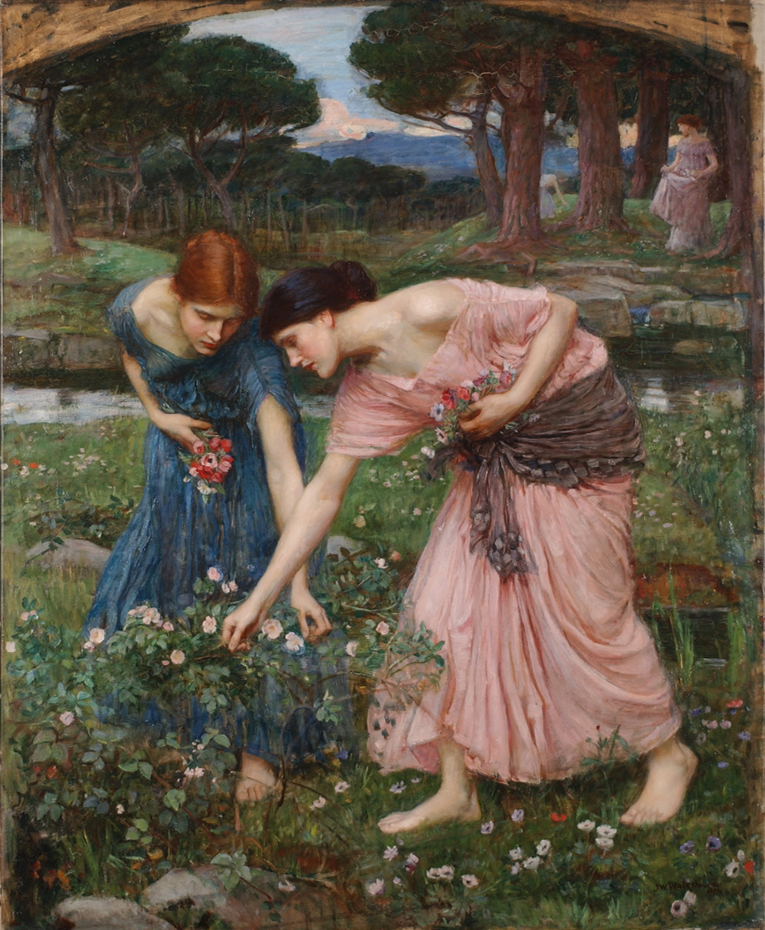
Image: Gather Ye Rosebuds While Ye May by John William Waterhouse, oil on canvas, 1909, [Public domain] via WikiPaintings.