Following that Star

Starlight

TENTH DAY of CHRISTMAS:
St. Titus’s and St. Gregory’s Day

On this Tenth Day of Christmas, we celebrate the feast days of St. Titus, disciple of St. Paul (first century), and St. Gregory, bishop (541)… not to mention St. Rigobert and St. Ramon. But to be honest, even with so many good saints to celebrate on the Fourth of January, there’s not much in terms of ceremony to attach to these guys. And maybe that’s just as well, for the Tenth Day of Christmas is perhaps best marked as a day of preparation for what lies ahead: Twelfth Night and Epiphany, which, in some places, mark the biggest celebrations of the season. For those who keep Christmas well, it is only fitting to close the Yuletide festivities with a bang, and it will take some doing to prepare for that proper close.

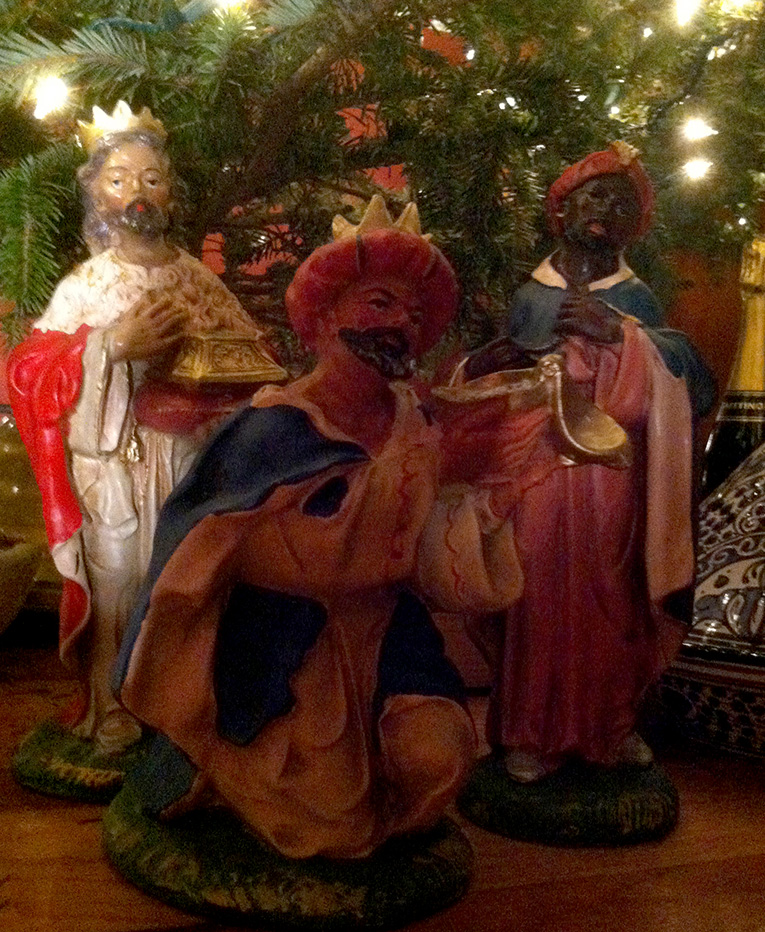
Here’s a recipe for one of the Epiphany traditions in our house: Three Kings Cakes. You will need three loaf pans because the recipe yields three cakes, one for each of the Magi: Caspar, Melchior, and Balthasar. The Magi will arrive on the Sixth of January, just in time for these delightful cakes that are flavored with honey and rose water, flavors of the ancient Mediterranean world, flavors they certainly knew well in their day. Perhaps the aroma, like the star, will help them along as they wend their way across the land.

*

THREE KINGS CAKES
makes three cakes

For the Batter
1 cup butter
generous 3/4 cup sugar
2 eggs
2 teaspoons vanilla
2 1/2 cups currants
3 cups applesauce
1/2 teaspoon salt
1 tablespoon baking soda
1 teaspoon cinnamon
1/2 teaspoon ground cloves
4 cups flour

Preheat oven to 300 degrees. Cream together the butter and the sugar, then add the eggs and vanilla. Beat smooth before adding the remaining ingredients. Grease 3 loaf pans (about 8″ x 4″ x 3″ or so) and divide the batter amongst the pans. Bake for one hour, or until a toothpick poked into the center of each cake comes out dry. Let the cakes cool in their pans on a rack.

For the Syrup
1/2 cup honey
1/2 cup sugar
1/2 cup water
1 cinnamon stick
6 whole cloves
2 tablespoons rose water

Once the cakes are baked, combine the syrup ingredients, except for the rose water, in a saucepan over medium heat. Once the sugar dissolves, add the rose water. Remove the cinnamon stick and the cloves and then pour the hot syrup over the cakes in their pans, divided equally amongst the three cakes. The syrup will soak into the cakes. Allow to cool completely before unmolding from the pans. Serving the three cakes on three platters makes for a nice presentation on Epiphany Day.

If you have trouble finding good rose water, we happen to sell the stuff at our website. Our rose water is made by the Sabbathday Lake Shaker Community in Maine, from their line of culinary herbs and herbal teas that we’ve been selling at conviviobookworks.com for years now. It’s one of the most delightful flavorings you’ll bake with, adding a mysterious and delicate flavor not just to these cakes, but also to apple pie, cookies, and even French toast. It’s pretty wonderful.

Come tomorrow, we’ll be hanging paper star lanterns in our house, filling up the Christmas punch bowl once again, and cooking up a hearty meal. Twelfth Night and Epiphany mark feasts that almost rival Christmas Eve and Christmas Day, where our journey first began. Somewhere on the horizon there are three old men following that star, nearing their destination, and la befana is at her cleaning; she has her broom in hand, and she’s ready to sweep away the festivities. But that’s another story for another day. Perhaps tomorrow.


Tagged

Joyeux Noël

NINTH DAY of CHRISTMAS:
St. Genevieve’s Day

Beginning with yesterday’s feast day of St. Macarius, we’ve entered into a more contemplative period of our Yuletide Twelve Days, a trend that will continue through tomorrow. Today on this Ninth Day of Christmas we celebrate St. Genevieve, patron saint of Paris. She was born in the fifth century in the French countryside and eventually settled in Paris, where she became a nun. She is attributed with saving the city from an attack by Attila and his Huns in 451 through fasting and prayer, and she was the founder, around 475, of the Basilica of St. Denis.

St. Genevieve is often depicted with a candle, and here again at the deep darkness of solsticetide we have an image of light, much like Santa Lucia on the 13th of December. It is said that although the devil continually blew out her candle when she would pray at night, St. Genevieve was able to relight it without use of flint or fire… and again the bleak midwinter’s darkness is overcome.


Tagged

St. Macaroon

EIGHTH DAY of CHRISTMAS:
St. Macarius’s Day

Today we celebrate St. Macarius of Alexandria, known for his extreme asceticism (a word dangerously close to aestheticism, no?). But before he became so hardened against the things of this world, Macarius was a confectioner, and so he is known as a patron saint of cooks, confectioners and pastry chefs. This, as you might guess, is the St. Macarius we are most interested in on this Eighth Day of Christmas. Some people have a hard time saying St. Macarius, and so he has also been known over the ages as St. Macaroon––fitting enough for a confectioner, I’d say.

Macarius was born in Alexandria in the early fourth century and it is in that fabled city where he made his living selling candies and pastries. In about 335, he left the bustle of the city to become a monk, and eventually made his way to a monastery in the desert (a word dangerously close to dessert, no?) and lived the life of a hermit from there on out. He ate very little: raw vegetables most days, and on special days, a bit of bread dipped in oil.

There is a rather nice story attributed to St. Macarius, a story he is said to have told his fellow monks in the monastery, who were interested in perhaps moving out of the desert and into the city in an attempt to reach more souls. Macarius spoke of a barber in a small town who eked out a decent living by charging three coins for a shave. He earned enough this way to sustain himself and his family and to even save a little extra for his old age. But he heard a rumor that barbers in the nearby city were charging a lot more than three coins for the same service. He thought long and hard about this, and finally, he made the decision to sell all he had in the small town and move to the city and set up shop there, where he could earn a larger profit for his services. And so he did.

Sure enough, at the end of his first day in the city, he had earned more than he had ever earned in the small town, and the barber was quite elated. And after closing up shop, he headed for the market to buy food and provisions for his family, but he found that everything  in the big city market was much more expensive than it had been in the small town. Indeed, he ended up with no money at all in his pocket that day––a trend that continued each day after. Finally, the barber decided it would be best to return to his native town, where at least he made a small amount of progress each day in his savings.

With this story, St. Macarius swayed his fellow monks to stay in the quiet solitude of the desert. And of course there is a lesson in this story for all of us: a lesson of quiet patience, the understanding that sometimes what is best for us is right where we are.

St. Macarius became so devoted to his asceticism that he began to take things to some extreme ends. He once spent twenty days out in the open air without sleep, a self-inflicted punishment for accidentally killing a mosquito that had bit him. I’ve always been wary of extremists, and so for me, the best celebration of St. Macarius’s Day for this Eighth Day of Christmas is a celebration that calls to mind his place as a patron saint of confectioners and cooks. It’s a great day, I think, for enjoying something sweet. Think of all the joy that confectioners bring us, even today. Certainly Macarius brought much joy to the people of Alexandria when he was selling candies and confections there. And so on this Eighth Day of Christmas, remember St. Macarius, and take joy.


Tagged