Author Archives: John Cutrone

Don’t Blush: Here’s your February Book of Days

Type the Italian word minne into Google Translator and ask it to translate to English and you may get what I got: minne––the same word, repeated. Google did not see fit to translate such a word. But we’re all adults here, so I will translate for you: Minne is the Italian equivalent of, well… any number of English slang words for breasts: boobs, tatas, you can take your pick from a very long list. This all brings us to one of the oddest days in the seasonal round: St. Agatha’s Day, when Sicilian bakeries prepare a once-a-year sweet delicacy known as minne de virgine––Virgin’s Breasts––pastries that were invented by the nuns of Catania for us to savor with our espresso.

Saint Agatha, or Sant’Agata in Italian, lived in Catania in Sicily in the third century; she is sacred to those places, especially to Catania. The pastries are made from sponge cake with a mound of sweet ricotta cream on top, covered in marzipan and dotted, in the proper place, with a cherry. You may blush as you eat them, but the pastries come from the story of Agatha’s martyrdom for her faith: The Roman governor of Catania became enthralled with Agata’s beauty. Agata, however, one of the secret upstart Christians in town, had taken a vow of chastity to protect her virginity. The Roman governor would have none of it, though, and continued his advances. Agata continued to reject him to protect her faith… and for this she was sentenced to death by the governor. He had her killed in a gruesome manner that it pains me to describe for you. Yet I fear I must… for it’s the only reason these delicious minne de virgine make any sense: he had Agata’s breasts severed before roasting her above a bed of live coals. I told you it was gruesome.

Sant’Agata is now patroness of Catania. She is invoked for protection from breast disease as well as from volcanic eruptions. It was the nuns of Catania who began baking the confections that we enjoy each Fifth of February, something they’ve been doing for centuries. It’s part of what makes Catholicism so incredibly fascinating, especially in Italy. Marzipan pastries in the shape of breasts made by Catanese nuns? This is probably a big part of what makes Protestants so nervous around us Catholics, even to this day. We are a somewhat dramatic people.
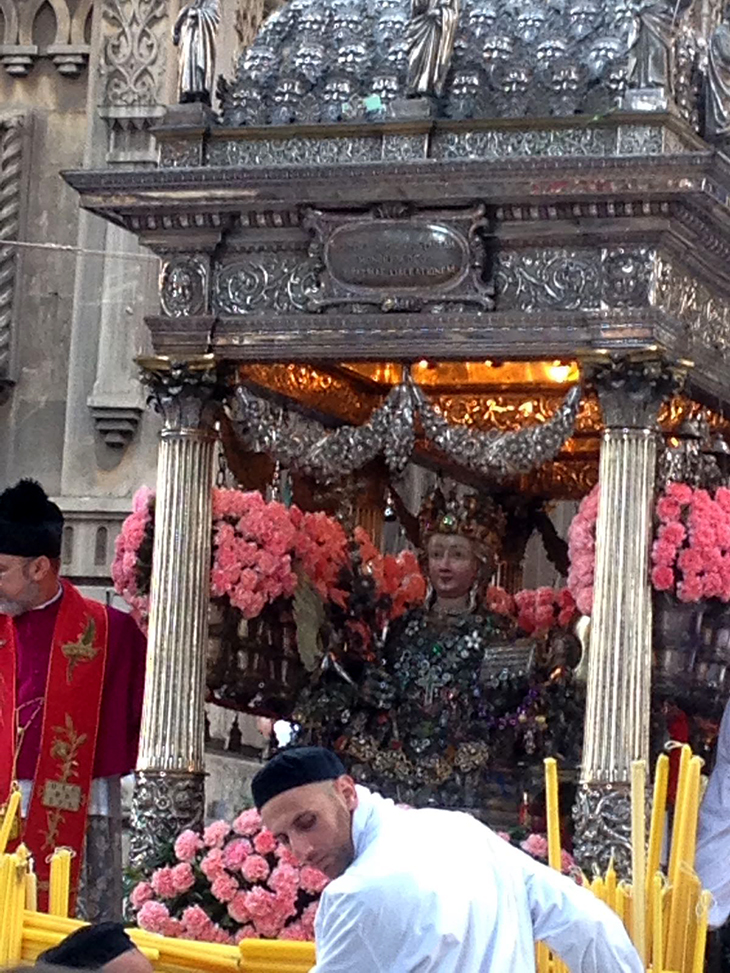
The celebration in Catania has been going on for a few days now, but it all culminates tonight with processions through the city of large carriages and spectacular candelore––enormous towers with lit candles depicting scenes from St. Agatha’s life. The candelore are paraded and danced through the streets of Catania to shouts of “Evviva Sant’Agata!” by men in full costume, the towers hoisted upon their shoulders. (Again, not for the faint of heart.)

I love when there are literary connexions to the foods we eat, and my Italian professoressa, Myriam Swennen Ruthenberg, should she be reading this, might be thinking now of a famous scene in Giuseppe di Lampedusa’s novel Il Gatopardo (The Leopard, in its English translation) in which Don Fabrizio looks over a vast table of Sicilian desserts that include these minne de vergine, the breasts of St. Agatha. He asks for some and receives them and he beholds them on his plate. He thinks of the famous paintings of St. Agatha presenting her own severed breasts on a plate. He asks, “Why ever didn’t the Holy Office forbid these puddings when it had the chance?”

And so today I hope you can find at an Italian bakery some minne de virgine. You don’t need to blush when you order them; just point, perhaps whisper the word “minne,” pay and go. And if you can’t find them, I have at least one something special for you today. It’s our monthly gift to you, somewhat belated this time around: The Convivio Book of Days Calendar, this time for February. It’s a fine companion to the blog, a PDF that you can print on standard US Letter size paper. You’ll find also a bevy of new items in our Book of Days Catalog for Valentine’s Day that we can ship to you pronto. We ship via US Priority Mail so most orders arrive in two or three days, and we offer free shipping if your order totals $50 or more (it’s a flat domestic shipping rate of $8.50 if your order is less, which is also not so bad).


The title photograph of minne de vergine in Catania is by Stefano Mortellaro, 2005 [Creative Commons] via Wikimedia Commons. The photograph of the statue of Sant’Agata comes to us thanks to Luisa Mangano-Johnson, a new friend of mine. She, too, is from Catania. We met last Saturday at the “Italy in Transit” symposium at Florida Atlantic University, where I got to speak about my family, the film “Moonstruck,” and the connexions between the two and my creative work (including the Convivio Book of Days). Grazie mille, Luisa!
 

Light Every Lamp

Throughout Mexico tonight, the dinner table will, for many, include tamales and hot chocolate, while in many parts of Europe, crepes will be on the menu. And at sunset, we’ll light every lamp in the house. It’s Candlemas. We are emerging from the darkness of Yuletide as the seasonal round of the year shifts from winter toward spring.

Candlemas is the day of blessing of candles in the Church, forty days past Christmas, with great processions of candles lit and born aloft, a light for the world. It is known as well as Purification Day, which comes out of an old Jewish tradition: forty days after the birth of a son, mothers would go to the temple to be purified. You might think of it as renewal, fitting for this time of year, the approach to spring. Not without coincidence, it was just yesterday, as Imbolc began, that the earth goddess was renewed as well, as our planet is now halfway on its yearly journey between the solstice of midwinter and the equinox of spring. And so the story goes that Mary went to the temple to be purified, carrying her newborn son, and it was there that she met the elders Anna and Simeon. Simeon recognized the child immediately as the light of the world, and this is the basis for the blessing of candles on this day, and the day’s lovely name.

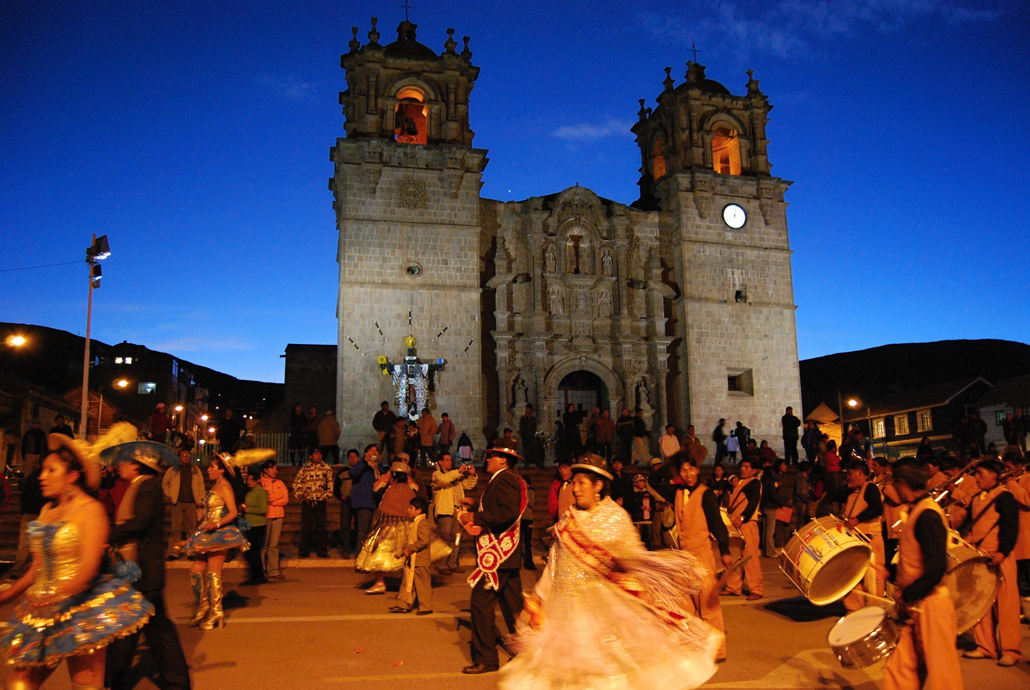
One of the most beautiful and elaborate Candlemas celebrations is in the city of Puno in Peru. The photo above is of the Candlemas celebration there two years ago. The celebration in Puno and many other places in Peru, Bolivia, and other parts of South America will continue on for the better part of two weeks.

Candlemas is perhaps the most well known weather marker of the year: Here in the US, Candlemas isn’t much on our radar, but we do know the day as Groundhog Day. If Punxsutawney Phil sees his shadow as he crawls up out of his burrow, it’ll mean 40 days more of winter; if he sees no shadow, then it will be an early spring. This weather lore comes out of much older weather marking traditions related to the Second of February, but which all seem to offer the same wisdom––that a bright and sunny Candlemas Day means a longer winter, while a dark and cloudy one means welcome warmth will soon be on its way:

If the sun shines bright on Candlemas Day,
The half of the winter’s not yet away.

Tomorrow, the 3rd of February, brings St. Blaise’s Day. St. Blaise protects against maladies of the throat. On his feast day, priests will bless each member of their congregation by invoking a prayer to St. Blaise while holding two unlit candles in one hand about the neck of each person receiving the blessing… surely related to Candlemas, too. My mom and dad got married at St. Blaise Church in Brooklyn in 1949. It was my grandparents’ neighborhood parish, a small church. And so we have some fondness for St. Blaise. Ah, but that is tomorrow. Today, though, when we awake, we’ll see what that old groundhog says about winter this year. We shall see what we shall see, and it will be what it will be. The weather is beyond our control. But we can, at sunset, run about the house and light every lamp, for a few minutes at least, and illuminate our world.


Image: Candlemas at Puno, Peru by Pavel Špindler, 2016 [Creative Commons], via Wikimedia Commons.


The Bridge

No matter what happens in our lives––times of sadness, times of joy––our planet continues to do what it does: spin on its axis and orbit the sun. These are the celestial mechanics of a universe ruled by gravity. The spinning causes our passing days and nights and the orbiting, our seasons, and today, thanks to that constant progression around the sun, we find ourselves just about midway between the midwinter solstice of December and the spring equinox of March.

As a halfway point in the seasonal round it is known as a cross-quarter day, one that in Celtic tradition is called Imbolc: the start, in traditional reckoning of time, of spring in the Northern Hemisphere. The Church gave the day to St. Brigid, or St. Brigit, but me, I like the Brigid version because it looks more like “bridge,” which is what Brigid does: she bridges us from one perspective to the next, from winter to spring’s first stirrings. It will, for sure, be a long while before winter loses its grip, but Brigid gives us the assurance that it will happen, for nothing stays the same in the Earth’s daily migration along its path. Winter will give way to spring, spring to summer, summer to autumn, autumn to winter, winter to spring again. “The only thing that stays the same is change,” say the Waterboys in an old song of theirs, and they are right.

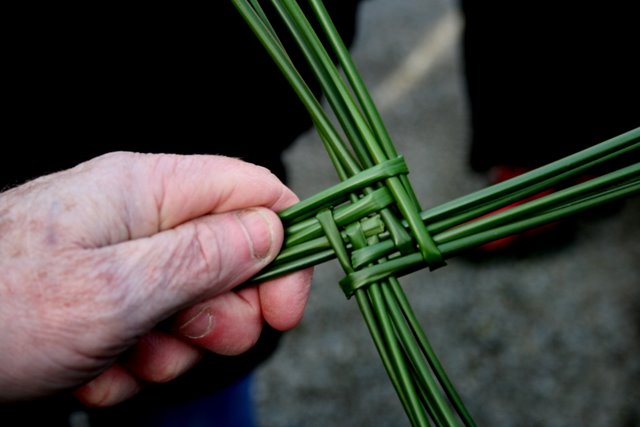
It is traditional for St. Brigid’s Day to fashion a St. Brigid’s Cross out of rushes or reeds (this is what you see in today’s photograph, above), as well as to leave an oat cake and butter on a windowsill in your home. This, to encourage Brigid to visit your home and bless all who live there. Brigid bridges us also to Candlemas, which comes tomorrow, and tonight, being Candlemas Eve, marks the true and official end of the Christmas season. If there still remain vestiges of yuletide greenery in your home, this is the night to remove them. And so tonight return to nature what is hers––the rosemary, bays, mistletoe, holly, ivy, all––if for no other reason than that soon enough, the earth itself will once again be erupting in green.

Image: St. Brigid’s Cross by Liscannorman [Creative Commons], via Wikimedia Commons.