Here in late summer comes another celebration honoring those who have gone before us: in Japan, it is the time of Obon. It is a celebration familiar to us here in South Florida thanks to the presence of the Morikami Museum in Delray Beach. Although I do have a bone to pick with the Morikami these days, now that they’ve moved their Obon celebration to October and renamed it “Lantern Festival”. (What the… ? You can’t just move traditional celebrations around like that!) In this strange green land where things can change so rapidly and so immensely (someone once attributed Florida’s malleability to its sandy soil, which can be so easily bulldozed and sculpted… an idea that seems to hold some truth), I get a bit wistful about Obon.
Back when the Morikami first started its Obon Festival, it was a pretty quiet affair, and it was so beautiful. The beauty seemed to be dripping from the pine trees, which most often at Obon were dripping with rain, too. The celebration was outdoors, of course, because Obon is an outdoor event. The festival began in the late afternoon, for it is at heart a festival of the night, and here, in late summer, it rains most afternoons: it is the daily respiration of the land. I would have the scent of pennyroyal on me: pennyroyal to keep the mosquitoes at bay. In a clearing amongst the dripping pines would be the yagura, an elevated platform, painted with red and white stripes, on which taiko drummers and flutists perform. Illuminated lanterns were strung from the yagura and lines of dancers performed bon odori––traditional folk dances––moving in circular patterns around it. The dancers danced to the rhythm of the drums, but sometimes they danced to recorded music: traditional Japanese folk songs with strange cadences that filled the thick Florida air, and there were traditional motions that were part of the dances––dances like “Coal Miners’ Dance,” in which the dancers journeyed around the yagura with a shoveling motion, taking a few steps forward and almost just as many back. Their progress around the yagura was always very slow and languid… the rhythm of late summer.
Nearby, also in the pines, the street fair: the ennichi, where you could buy food and fresh lemonade and toys and all manner of things. So much to buy! One Obon I bought a set of small woodcut prints tied up in string. Electric lanterns were strung up throughout the pine trees at the ennichi and near the yagura, and that, too, was a beautiful sight. But anticipation grew as the sun grew heavy at the western horizon, for we all knew that once darkness fell, there would be the other lanterns––candlelit paper lanterns, set upon the water. Hundreds of them, certainly; thousands perhaps, illuminated and cast out upon Morikami Pond. In Japan, Obon always concludes this way, for Obon is a celebration of the dead returning to the land of the living for a brief spell, to have some fun again with the living, and when it is over, the spirits return to the other shore aboard these lanterns. It is a breathtaking and spellbinding sight, as they drift silently away. We would stand there, at the water’s edge or as close to it as we could get, watching and thinking, “See you next year.” Any method we have to keep open the channels of communication is all right by me.
My wistfulness about Obon goes back to those early days when the Morikami was small and so was the celebration. And I suppose this is how wistfulness generally works: holidays seemed better when we were younger. But the Morikami grew up into a major museum and the Morikami’s Obon festival grew and grew in popularity to the point where it was hardly fun anymore. Lots of people, yes, but in Japan, Obon is a celebration that goes on for two or three days, and maybe the Morikami could have followed those ways as a device to spread out the crowds. Eventually they began taking very good care of us, too: they built a shelter to protect us all from the summer rains, but in the process of protecting us, they took away the sky and the stars and separated us from the majestic pines. And now they are protecting us from the heat and humidity by moving the celebration from August to October. I’m sure Lantern Festival at the Morikami is lovely… but it’s not Obon.
In Japan, Obon is coming to a close about now, probably tonight. Some regions may have celebrated Obon as early as July. Much with local Obon ways depend on regional customs and with the use of varied calendars, lunar and solar. The Florida celebration was based on the Morikami celebration, and so Obon for me is the August one. Eventually, I suppose, folks here will get accustomed to the Lantern Festival of October and think of Obon as October, as well. And I will be a crotchety old man shaking my fist, yelling, “No, no, damnit! It’s in August!”
One Obon, when it was not possible to go to the celebration, a friend and I made our own lanterns: he made one and so did I. We each cut a block of wood and set it inside a paper bag, upon which we wrote messages in deepest dark black sumi ink. I wrote to my grandparents. We had no yagura, no dances, and no ennichi street fair. But when the sun sank low and night fell upon the land, we went outside to the pond behind my family’s home and we lit our lanterns and set them out to sail. We watched for a while as they drifted further away, two lights illuminated on the water, making their way toward the distant shore.
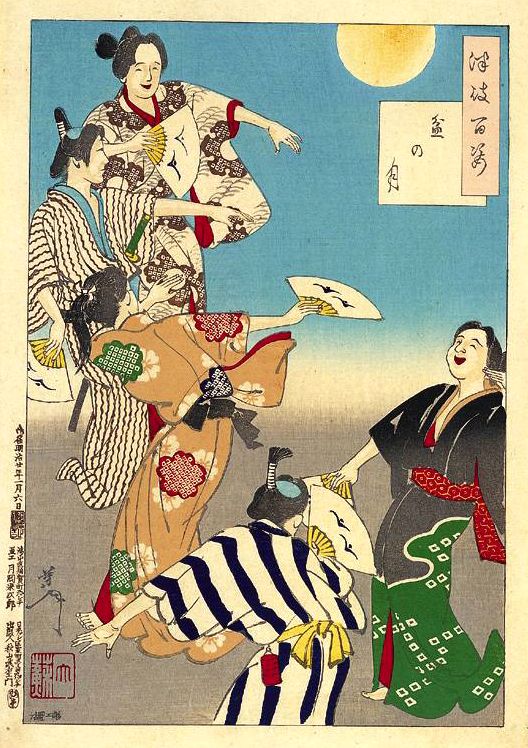
Image: “Bon no tsuki” (Bon Festival Moon) by Tsukioka Yoshitoshi. Woodcut print, late 1800s [Public domain] via Wikimedia Commons.