The wheel of the year turns another notch, July gives way to August, and the shift brings us to the next cross-quarter day: Lammas, or, in the Celtic tradition, Lughnasadh. It feels most definitely still like summer, but Lammas brings the first suggestion that summer is ripening into autumn. Indeed, in the traditional reckoning of time, Lammas brings the first day of autumn, as we are now well past summer’s zenith, which came with the June solstice: we are about halfway between that solstice of midsummer and the upcoming autumnal equinox.
And I know this is bittersweet, this idea that summer is passing, but with Lammas, we enter into my favorite time of year. Don’t worry, I see the irony; this blog I write about the wheel of the year constantly reminds us to live in the present and to enjoy the ceremony of each day, but here’s my confession: This is the time of year I look forward to, always. I like the ripening bounty of summer, the increasing darkness on the way toward the midwinter solstice, the gathering in, the harvest. So while Lammas these days gets short shrift in most places, it is a signal to me that we are coming into the months I love best, and so I have a soft spot in my heart for this old, practically forgotten holiday.
Lammas is the celebration of the first harvest. It is truly a holiday of our agrarian past, when most folks earned their livings off the land. While most of our celebrations and holidays are rooted in this past, Lammas hasn’t translated very well to contemporary life. Most folks are not interested in celebrating the waning of summer. We look around at all that is thriving now in summer’s gentle days, but we understand that it won’t be here long. Shakespeare understood this well. His Juliet was born at Lammastide; his play Romeo and Juliet takes place in the heat of the last week of July, and Juliet never reaches her birthday; she is, in a way, a sacrificial first harvest.
So is John Barleycorn. Tradition would have us bake a loaf of bread for Lammas. It was considered bad luck to harvest grain before Lammastide, and so this Lammas loaf was baked always with the newly harvested grain. It is traditional also to break out a bit of the other stuff that is made from grain: whisky and ale are typical candidates. John Barleycorn is the personification of the grain that makes both. Barley, corn, wheat: he represents them all, and in the old song about him, John Barleycorn must die before he can be resurrected as bread and as warming, inspiring drink. (To be honest, the old song doesn’t care much about his appearance as bread; it is an old drinking song, after all.)
Out of Lammas come the county fairs we know so well, celebrations as they are, at heart, of the first harvest. Ours, here in Palm Beach County, Florida, is in January… which may seem to most like an odd time of the year for a county fair. But here in this topsy-turvy land, we begin planting our fields in September and October; January is our first harvest. It is, in a way, our local Lammastide.
Topsy-turvy though we are, we still keep time with the rest of the country, and even if our transition to fall is a subtle one, Lammastide keeps me going through these waning days of a long Florida summer. If you, like me, are looking forward to all the bounty of autumn and the quaint celebrations of winter that call down the light even in darkest night, then Lammastide may be days you, too, should consider marking. Lammastide begins with Lammas Eve on the 31st of July, continues through to Lammas on the First of August. The baking of a loaf of bread would be perfect, but fetching a good crusty loaf at the bakery would be just as fine. You might accompany this with a bit of whisky or ale, raising your glass to Old John Barleycorn and to Old Man Summer, drinking down the warmth of summer, seeing where the inspiration leads you.
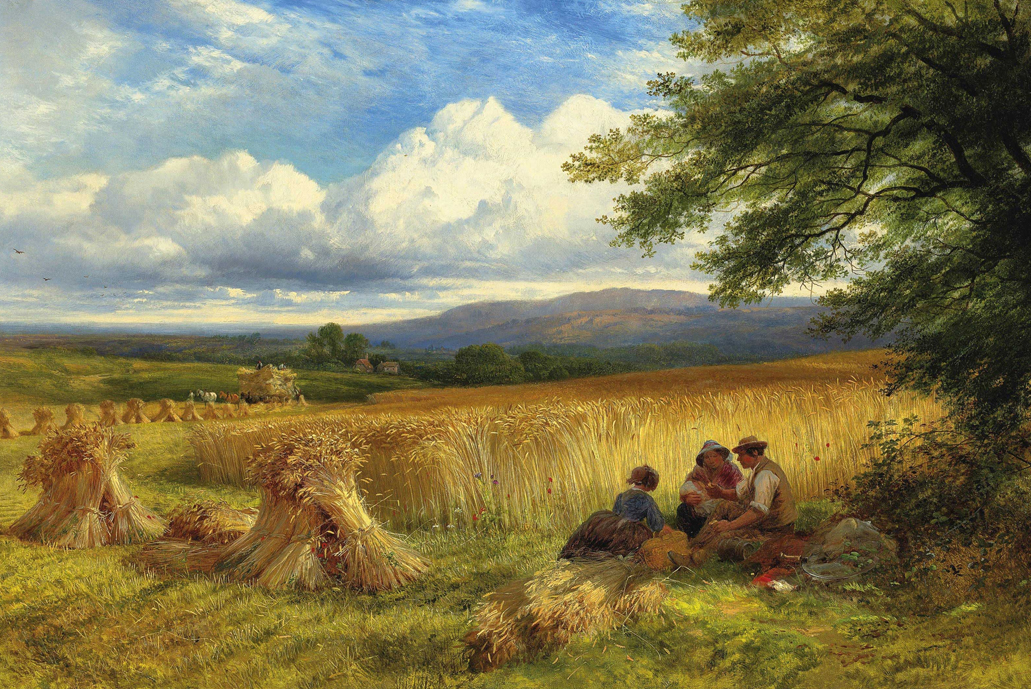
Image: “Harvest Rest” by George Cole. Oil on canvas, 1865 [Public domain] via Wikimedia Commons. Our summer vacation, by the way, has passed. We are back home again in Lake Worth, which also is bittersweet; missing the place and the people we left behind, but also happy to be home in the other place we love, with other folks we love. If we could gather them all up around us whenever we wanted, that would be a wonderful thing.