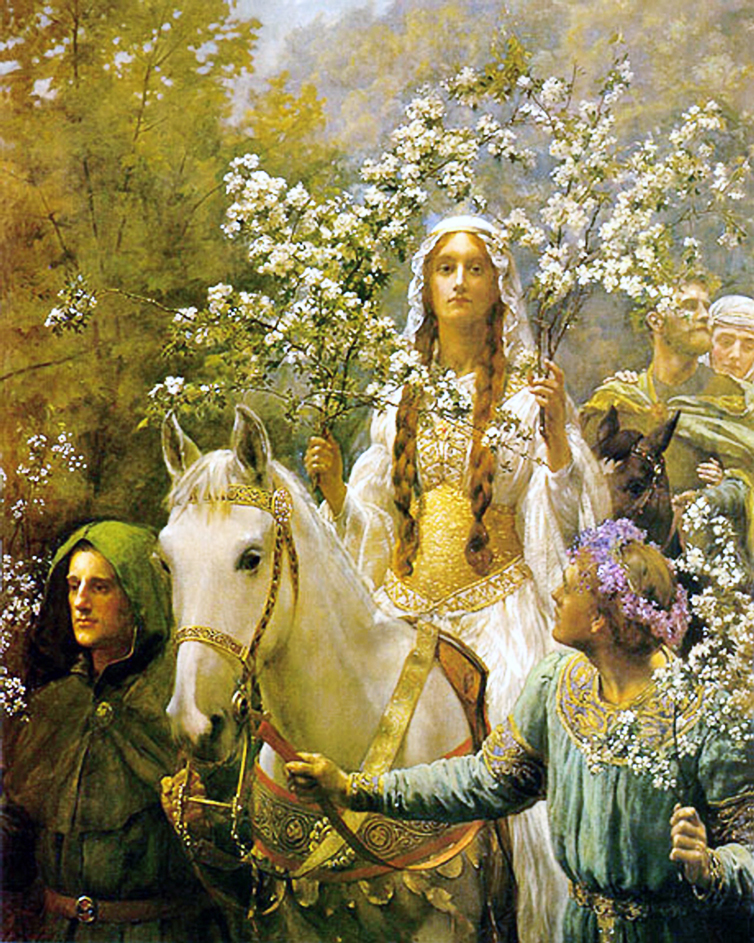
Image: “Queen Guinevere’s Maying” by John Collier. 1900. [Public domain] via Wikimedia Commons.
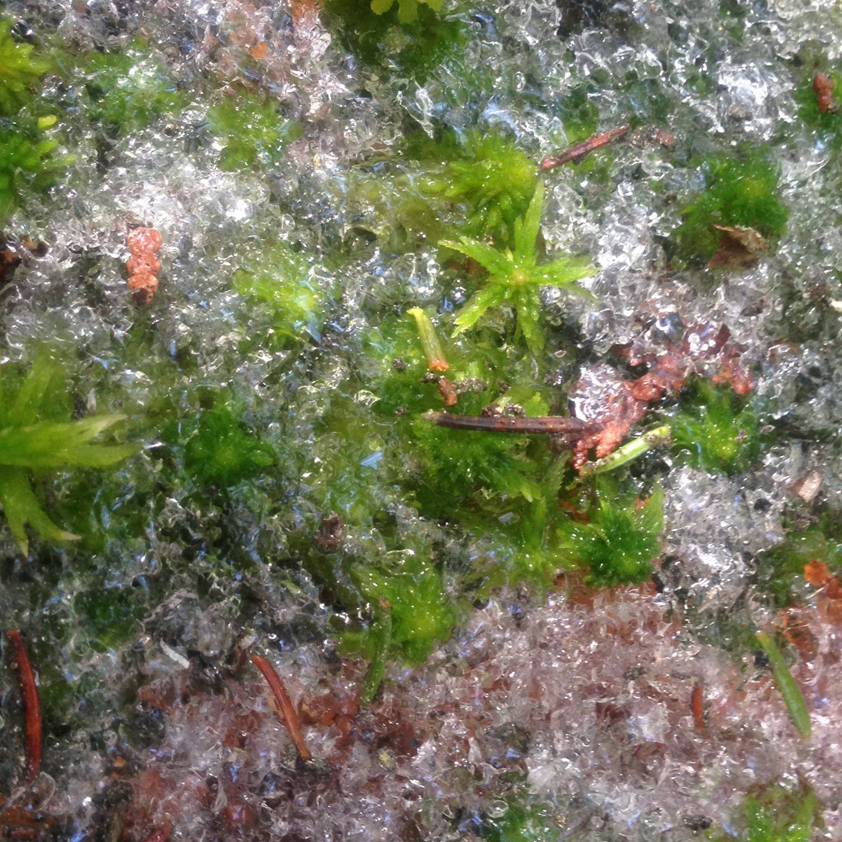
Just a few days ago I saw the most beautiful photographs from a friend in Maine of the Sabbathday Lake Shaker Community covered in snow, a snow that had just fallen. The Community is in New Gloucester, not far from Portland. Another friend is in Northern Ontario, up near the Arctic Circle, and that’s where the photograph above comes from. She calls it “Slow Quaffeth the Moss.” There, winter is becoming spring, and in many other places it is clear that winter is holding on with all its might.
Be that as it may, we come tonight to a transition time that actually beckons summer. It is May Eve, Walpurgis Night, which sounds so lovely in its Dutch and German version, condensed to one word, Walpurgisnacht, named not for May but for St. Walpurga, whose feast day happens to come tomorrow, as well. This is a holiday respected mostly in Northern Europe, especially in Scandinavia and in Germany, though it is celebrated as well in England and in Italy and to be sure many other places, though in the States, not so much. But for Walpurgis Night, which comes with the setting sun each April 30, it is customary to light a bonfire and to eat gravlax, a thinly sliced cured salmon, served with dill and mustard and a good hearty Nordic dark rye bread, washed down with quantities of sparkling wine. With this simple act, hopefully in communion with those we love, we bid a warm welcome to the gentler time of year, for tomorrow brings May, and summer. Despite the icy moss in Northern Ontario, despite the snow on the barn at Sabbathday Lake, our ancestors viewed the wheel of the year as one based on the solstices and equinoxes and their quarterly divisions, and as this 30th of April becomes the First of May, the spokes of that wheel shift to the next quarter: We are now halfway between Spring Equinox and Summer Solstice, which, to them, it being the longest day of the year, was the height of summer: Midsummer. And so we sing old songs like the Padstow May Morning song with refrains like For summer is a’comin’ in today, for it is. Even if there is still some snow on the ground. That snow is not long for this world.
Beltane is another name for May Day. It comes from the Celtic calendar, the opposite spoke of the wheel from Samhain, which celebrates the coming of Winter on the eve of November. Again, bonfires. In England, meanwhile, it’s not so much the eve as the morning that’s important for May Day, and the custom is to rise before dawn and head out to the fields to “bring in the may,” returning home with bundles of flowers that are then used to decorate the doorways, the hearth, the windows, everything. Though heartier revelers would head out from Walpurgis Night, out to the woods, for a celebration, often quite amorous, that lasted through to morning.
It is a lovely night, Walpurgis Night, and we encourage you to go be in it. You may not have a place to light a big bonfire, but if you have a fire pit outside in your yard, why not go ahead and light a little fire, or at least a lantern or candle? And while you’re sitting around the fire, you may as well break open a bottle of sparkling wine. I’ve already stopped by to visit my friends at Neptune Fish Market on Dixie Highway in Lake Worth. The smoked salmon was just out of the smoker when I asked for it. It smells incredible: smokey and mysterious, mysterious like the wheel of the year that forever is turning.
The photograph above, “Slow Quaffeth the Moss,” is by Jane Siberry. Jane’s new record is titled “Ulysses’ Purse.” On it is a song you should all hear at least twice; once to hear it, once more to listen to it, at which point you may wish to listen again and again. The song is called Morag and it begins, “Arise from your mossy bed, leave your lichen dreams aside, the deer have left clear trails for you to find.” I can’t get enough of it. Click on the link; let me know what you think.
If you’ve been reading the Convivio Book of Days for some time, you’ve probably figured out by now that it’s the odder days and celebrations that capture my attention most, and tonight’s setting sun brings one of them: St. Mark’s Eve, a night for divination, mostly of the romantic sort, but of other types, too.
With St. Mark’s Day, tomorrow, the 25th of April, we reach a day that sets us firmly on the path toward summer, with blessings uttered upon the newly sown crops. It is a day associated traditionally with the return of migratory birds to northern climes; the cuckoo especially in Europe. In traditional reckoning of time, summer is near indeed: we’ll be celebrating it fully come May Day on the First of May, which is next Sunday, with May poles and songs like “Sumer is Icumen In.” You might think of St. Mark’s Day as summer’s harbinger.
Just as the seasons are viewed differently in traditional reckoning of time, so are the days. Days were traditionally reckoned to end with the setting sun, and still to this day it is the eves of holidays––the night before––that often receive the greater stature. Think of Halloween, the Eve of All Hallows. Or Christmas Eve, with its Midnight Mass, and Holy Saturday, with its Vigil Mass for Easter, celebrated only once the sun has set. These are all remnants of this traditional reckoning of time that so often gets mention here in this book of days.
And so it goes as well with St. Mark’s Day, and tonight, the 24th of April, brings St. Mark’s Eve, a night long set aside as one for divining the future. Romantic futures, especially, and here is perhaps the most common of divination spells for St. Mark’s Eve: Fast from sunset and during the night, bake a cake that contains an eggshellfull of salt, wheat meal, and barley meal. Once the cake is baked, set it to cool on the table and leave the door to your home open. Sometime over the course of the night your future love will come in and turn the cake. As you might imagine, this goes back to a time when we were not apt to lock our doors; I imagine this spell has been thwarted in modern times by locks and security systems and perchance by pepper spray, too.
But perhaps your curiosities run more macabre? Very well; we have a St. Mark’s Eve spell for you, too. The only problem is you will need to begin now for a divination event that will occur three years from tonight. For this and for the next two St. Mark’s Eves you’ll need to fast and then spend the hours between 11 PM and 1 AM sitting on the porch of a church. Come the third year, in that witching hour, you should see a procession pass before you of the shadows of all who will die in the coming year, as this excerpt from a poem by James Montgomery suggests:
‘Tis now, replied the village belle,
St. Mark’s mysterious eve,
And all that old traditions tell
I tremblingly believe;
How, when the midnight signal tolls,
Along the churchyard green,
A mournful train of sentenced souls
In winding-sheets are seen.
The ghosts of all whom death shall doom
Within the coming year,
In pale procession walk the gloom,
Amid the silence drear.
The poem is titled “The Vigil of St. Mark.” But back to matters of the heart: Just as at Halloween, there is as well a long standing tradition of divination by nuts on St. Mark’s Eve. Young women would set a row of nuts on the hot embers of the hearth, one for each girl. Each would breathe the name of her intended into the hearth and if the love was to be true, the nut would jump away as it got hotter. But if the nut sat there and was consumed by the fire, the love was not meant to be:
If you love me, pop and fly,
If not, lie there silently.
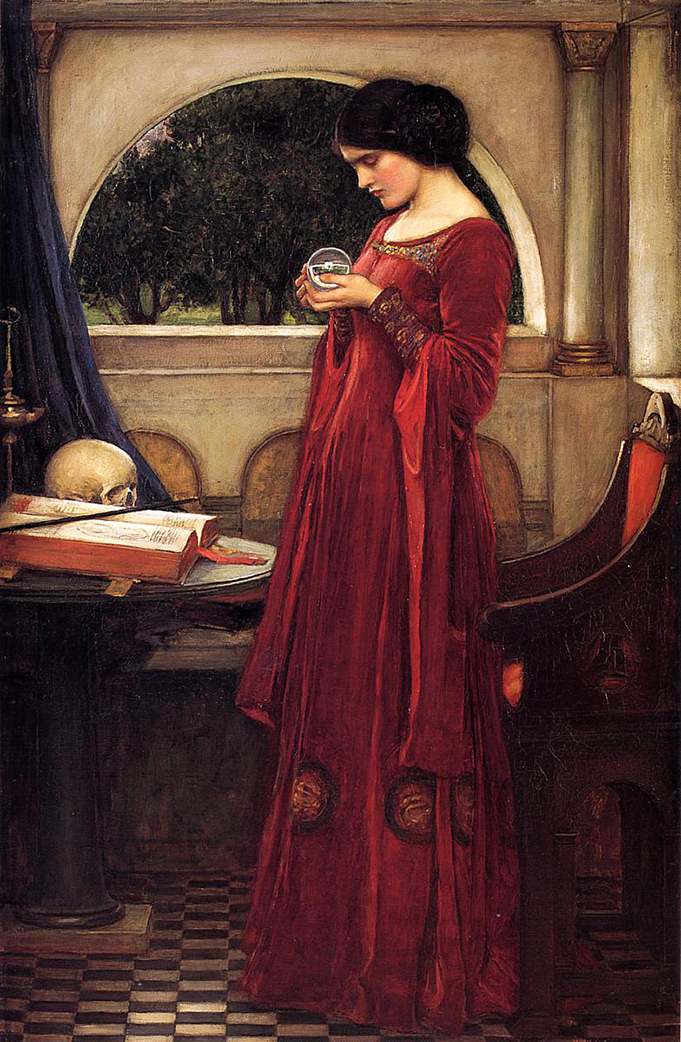
What will the future bring? If you must know, then perhaps St. Mark’s Eve is the night you’ve been waiting for. Peering into my crystal ball, though, I can already tell you: Summer is a’comin’ in. It won’t be long now. The birds have been calling to us to let us know.
Image: “The Crystal Ball” by John William Waterhouse. Oil on canvas, 1902 [Public domain] via Wikimedia Commons. Oddly enough, while we do have a photograph, the actual location of this painting appears to be not known. If only we had a crystal ball.