Category Archives: Lent

San Giuseppe

SanGiuseppe

It’s St. Joseph’s Day today, the 19th of March. When the Lenten season begins early, which this year it did not, St. Joseph’s Day arrives bringing a welcome respite from Lent’s bare-bones penitence in the form of decadent desserts. This year, we’re only two weeks into Lent at this point… but still, we’ll take the decadent desserts.

St. Joseph is sacred to Italy. He is a patron saint of children and of pastry chefs, both of whom typically have a fondness for sweets, and any Italian bakery worth its salt today will be selling at least a couple of pastries made especially for San Giuseppe. It’s a good sign if you walk into one such bakery today and see trays and trays of zeppole and sfinci. Both are pastries of fried dough, generous in size, each typically something you could fit into two open hands. Zeppole are filled with custard and often include a few cherries on top. Sfinci are filled with sweetened ricotta cream, perhaps with a few small chocolate chips, very much like a cannoli filling. Many Italian bakeries sell these pastries for a few weeks before and after St. Joseph’s Day, but today is their traditional day, and we take that first bite into a delectable zeppole, with the aroma of strong espresso in the air, and we thank San Giuseppe for bringing a bit of sweetness to Lent’s otherwise stark and penitent nature.

Variations of these sweets, in name and in shape and ingredients, exist throughout Italy for the feast of San Giuseppe, but it is in the South, from where my family hails, that they are best known. Both sfinci and zeppole are pastries with histories that go back many centuries, with names that come out of the Arabic influence on the region. How far back do they go? The ancient Romans made fried pastries each year on the 17th of March in honor of Bacchus, and it is thought that the zeppole and sfinci we make today are direct descendants of those springtime sweets.

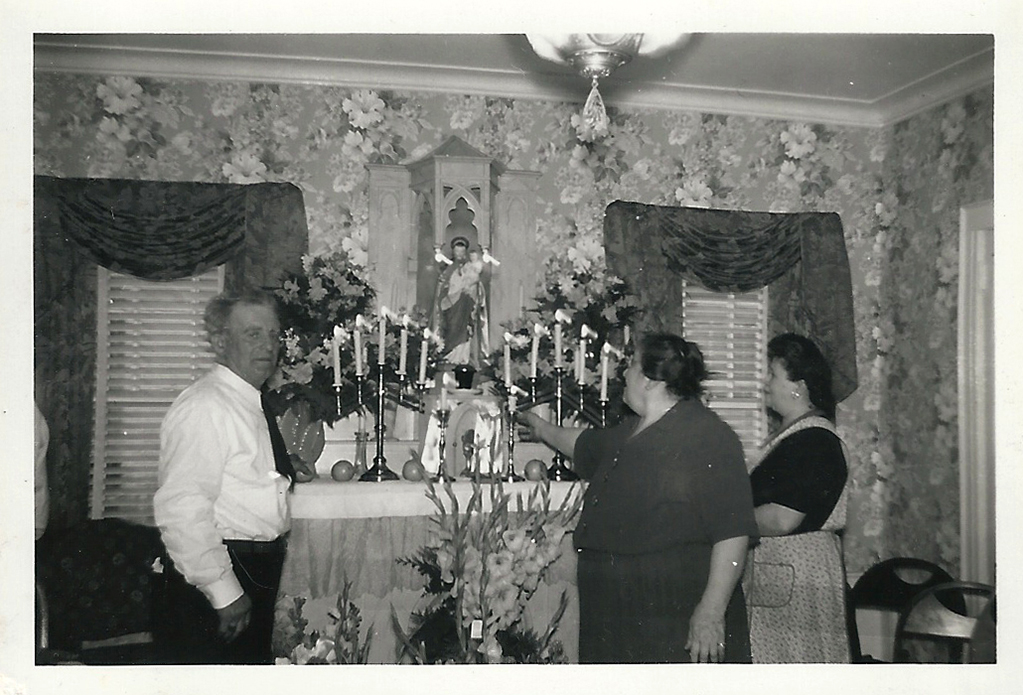
Both of my grandmothers were devotees of San Giuseppe. Many years before I was born, Grandma Cutrone used to prepare an altar to St. Joseph each year for his feast day. My dad would help her set up the altar in their home, and on it Grandma would place breads and ceci beans and oranges and animal crackers for the children. There are old 8 mm black and white home movies of friends and neighbors coming in to see the altar and pay their respects. The priest would come to bless it, and Grandma Cutrone would give each person who visited an orange to take home with them.

My Grandma Assunta did not have such an altar in her home, but she would often pray to San Giuseppe, and we couldn’t leave church each Sunday before she lit the big candle at St. Joseph’s statue in the chapel. We would visit him each week there. To this day, every time I go to a church, I light a candle for her, because that’s what she would do, and it’s one of many ways I have of keeping in touch with those who came before us.

I’m glad they both loved St. Joseph so much. A good friend of ours, Father Philip Joly, recently helped me see St. Joseph in a new light. St. Joseph, who is also a patron saint of families, is almost always depicted as an old man. The truth is, though, Mary was probably just a teenager when the angel came to tell her she would be giving birth to a son, the son of God. Joseph, who was engaged to her, was probably not much older himself, and he, too, received a visit from the angel saying, “Don’t be afraid.” There he was, a young man, with a pregnant teenage wife, pregnant not by him, asked to become a father to a son that was not his. That’s a lot to swallow, no? But he supported his betrothed, and he went through with it. He had compassion, and he had faith. Joseph’s family was no ordinary family. And so when we think of San Giuseppe as the patron saint of families, we know that that extends to all families, no matter how traditional or non-traditional they may be. What a guy.


Image: That’s Grandma Cutrone on the right, Grandpa Cutrone on the left, my dad’s Aunt Carmela between them, and the altar to San Giuseppe in their home for St. Joseph’s Day, circa 1940s, Brooklyn, New York.



Quaresima

Jan_van_Bijlert_-_Pulling_of_the_Pretzel_-_Google_Art_Project

By now, we are one week into Lent, into our journey of forty days. In Italy, the season of Lent is known as Quaresima, which sounds not at all as spare as its English counterpart. It sounds almost celebratory, doesn’t it? But don’t let the name fool you: The traditional image for Quaresima is an old hag, gaunt and thin, which is in stark contrast to the traditional image for Carnevale, a rather robust and rotund man with a necklace of sausages dangling from his head. But there is wisdom in these depictions: the Carnival season is certainly about excess. By the Lenten season, it was time to make do with what was left in the larder, which, by now, was very often not much… even well into the 20th century.

Even now, I am not one to buy fruits and vegetables that are out of season, shipped in from another hemisphere. Yes, we can buy peaches and cherries even in February… but I just can’t. I love peaches and cherries, but there is something about eating them in their proper time that makes them special. Having them at any old time of year reduces these seasonal delights into commonplace everyday commodities, rendering them not as special.

But I digress. We were talking about Lent. The forty days of Lent are meant to mirror Jesus’s forty days of fasting in the desert. It was Pope Gregory I who began the rule on abstaining from meat and things of the flesh (milk, cheese, eggs) in the late 6th century. This is why we dye eggs at Easter––it was traditionally done in celebration of being able to eat them again. Things were pretty strict early on, but over the centuries, have loosened to the point that now, most Catholics just abstain from meat on Fridays during Lent.

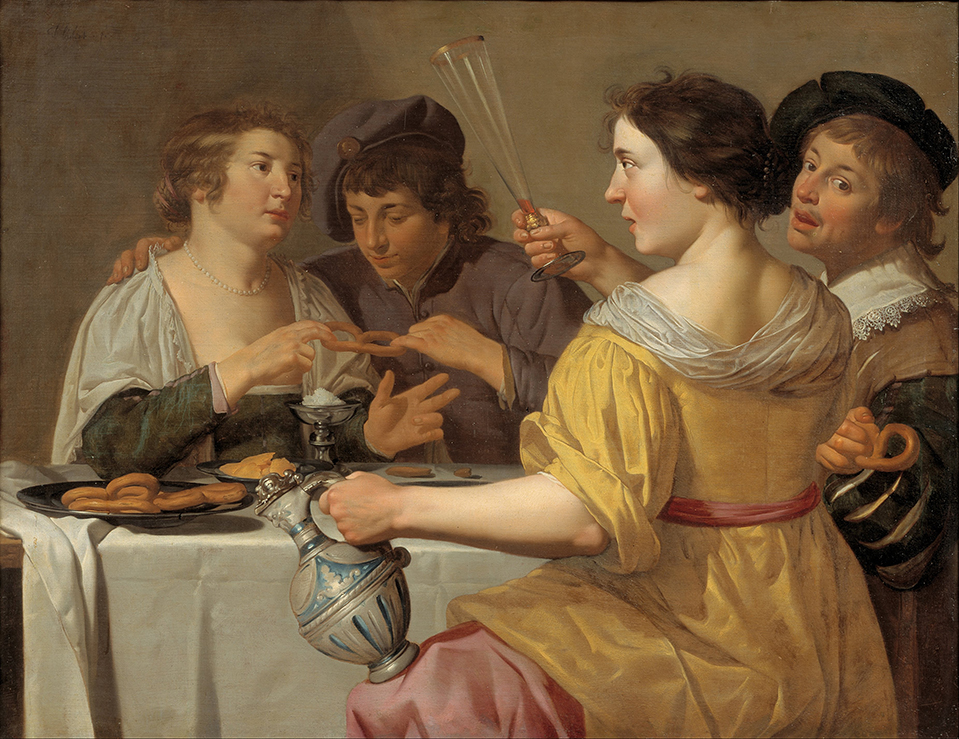
Being a time of spare solemness, it is not surprising that there are not many celebratory foods that accompany Lent. There is one, however: The humble pretzel. At their most basic, pretzels are made with just three ingredients, all Lenten-friendly: flour, salt, and water. It is thought that the name “pretzel” is derived from the Latin bracellae: “little arms,” essentially, evoking the prayer posture of early Christians, who prayed with their arms crossed over the chest. Go ahead, try it right now, then look down at your chest: class pretzel shape. This penitential bread––again, so common nowadays so as to be nothing special––has a history that goes back many many centuries. The first pretzels were thought to be made in the 6th century. Some historians think they go back three centuries more.

Connections like these are, I think, so fascinating. That a common pretzel can have such interesting roots (and deep ones, at that) and can have a connection to celebratory days (or penitential ones, in this case) is such a wonderful thing.


Image: Het trekken aan de krakeling (Pulling of the Pretzel) by Jan van Biljert, oil on canvas, c. 1630, [Public domain], via Wikimedia Commons.


Tagged ,

Homo? Humus. Fama? Fumus. Finis? Cinis.

Love Each Day

A simple post for a simple day with a simple reminder: Life is short. The title of today’s chapter is actually an old medieval meditation, recorded by author Giovanni Papini. The brevity of human life, condensed into six words. Translated: Man is dust. Fame is smoke. Ashes in the end. We are made of stuff of this earth and we are destined to return to it.

Being reminded of this is the value of Ash Wednesday. We go to the altar, ashes are smeared on our foreheads in the sign of the cross, and the gift we are given is the reminder that the time we have here on this earth is very brief indeed. So be kind, be gentle, be engaged. Turn off the TV, especially if it is the TV news. (When is the last time you watched the TV news and thought, I’m so glad I watched that?)

We are now in the season of Lent, forty days that ultimately remind us to love each day. Find some ceremony in every one of them.


Image: Love Each Day broadside, designed in handset wood type by William J. Landis, printed letterpress on the 1890 Wesel Iron Handpress at the Jaffe Center for Book Arts, Boca Raton, Florida, 2013.