Category Archives: Lent

Forty Days, & Your March Book of Days

Tonight we eat pancakes for our supper. It is Shrove Tuesday, and with this dinner we clear out the pantry, for tomorrow, we enter a new month and the lenten season, too: our annual forty days of solemn reflection that set the stage for rebirth and the miracle of spring. Forty days, or Quadragesima in Latin, fortieth, which is why the Italians call this season Quaresima. It sounds lovely, no? Not nearly as spare as the English word lent, pared down to four letters, bare-bones. But whether we say lent or quaresima, it is, traditionally, a period in stark contrast to the excess of carnival, which has been going on for weeks now in festive towns like Venice and New Orleans and ends tonight with Mardi Gras. And once Mardi Gras passes, so lent, quaresima, begins.

It is no secret that here at home, it’s been a rough time for us. We lost my dad earlier this month. But life is all of this, the joy and the sorrow, embracing it all, not turning from the hardest parts. And so we do not turn away and we love, even if it brings hardship. Family was the most important thing to my dad. And my dad, it seems, took care of us to the very end. While the past few months brought many challenges his way, and worry on the part of the rest of us, Dad took care of that worry for us. He checked out on his own terms, at peace, it seems, with all he had to make peace with, and he took those worries we had about him and dispelled them, sent them out to the world, diluting them to nothing. One last great act of love and caring.

Ceremony, celebration, is a curious thing. It appears at times like frivolity, and it certainly can be. But there are deeper roots to these ceremonies we hold, year after year, as our parents and grandparents did, through time immemorial. Roots that grow through the ground, the ground that holds my father and all our ancestors, all who came before us. It is the one commonality we all share. Were it not for death, we would have no pressing reason to celebrate, no reason to make the most of each day. And this is why we say there is a seat for death at the table at all our celebrations. Death is the guest who must be present at every celebration, every ceremony. Without death, the “ceremony of a day” is nothing.

And so we approach these forty days, forty days that begin with ashes and an invitation to be well, to put all our efforts into making a good life for ourselves and for all around us: “Remember man that thou are dust and to dust you shall return.”

And yet there is more than this, too. The dust is what remains and there is something more that is larger than all of us. Here, I know, we run into belief systems and philosophies, but I think we can all agree that something more remains once we are gone: spirit, soul, memories… call it what you will. What you call it does not matter.

Last Friday, after work, I stopped at the rehab center where I would go see Dad most every day for the last few weeks of his life. More than two weeks had passed since I was last there, and it felt important that day to stop and to say thank you to the nurses and assistants who took such good care of him in his last days on this earth. It was, perhaps, another aspect of closure I was seeking. And so I drove up, with a heavy heart, and I entered the building. At the reception desk, where earlier in the month I had been checking in multiple times each day, I explained, as tears welled up in my eyes, what I wished to do. The volunteer there expressed her condolences and she issued me a visitor’s badge. I went up to the second floor, stepped off the elevator, and walked the corridors, past Dad’s first room, past the nurse’s station, past the room Dad moved to halfway through his stay, past the second nurse’s station, and then another loop around again. There were RNs and nursing assistants everywhere, but I didn’t recognize a single soul. Not one of them. Even Dad’s old roommate and his wife: they were gone. “Why do you seek the living amongst the dead?” echoed through my mind, and I began chuckling a bit. There was nothing for me there. I stepped again into the elevator. I descended, and I left the building. Outside, the sun was bright and the air was warm. There was a gardener working in a bed nearby. I looked at him twice, but definitely did not recognize him, either.


Here is a link to where you’ll find your Convivio Book of Days Calendar for March. It may not be updated to March’s calendar when I first publish this blog chapter, but if not, check back again in an hour or two, for it will be. This month’s cover star is a type of shaving brush tree that we see round Lake Worth and neighboring towns. The tree loses its leaves each winter, one of our few deciduous trees here in South Florida. Come spring, it blossoms in advance of the year’s new green leaves. The blossoms are amazing bursts of pink energy––the pink shaving brushes that give the tree its common name. Death and rebirth: the story never grows old.
 

Ye Olde Simnel Cake

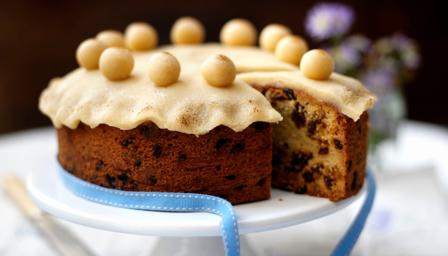
SimnelCake

The Simnel Cake is a tradition in England for Easter, but simnel cakes actually have their origin in traditions for Laetare Sunday, or Midlent… which also happens to be Mothering Sunday there. As Lent is a moveable time, so is Laetare Sunday and Mothering Sunday, but this year it is tomorrow, Sunday March 6. The day marks the midpoint in the Lenten journey, and it brings a change in attitude: We switch for this one day from solemn purple to joyful rose. And much like Mother’s Day here in the States, Mothering Sunday is a day to honor our mothers. Tradition would have you visit your mother and bring her a simnel cake.

And so here is a recipe for simnel cake from the BBC. For sure you will find many recipes to choose from online, but the idea is generally this: a light fruit cake made with layers of marzipan. And for those of you who like a little culinary history with your culinary creations, here’s the history of the simnel cake as recorded in 1869 in the Chambers Bros. Book of Days. Enjoy, and get baking:


Simnel

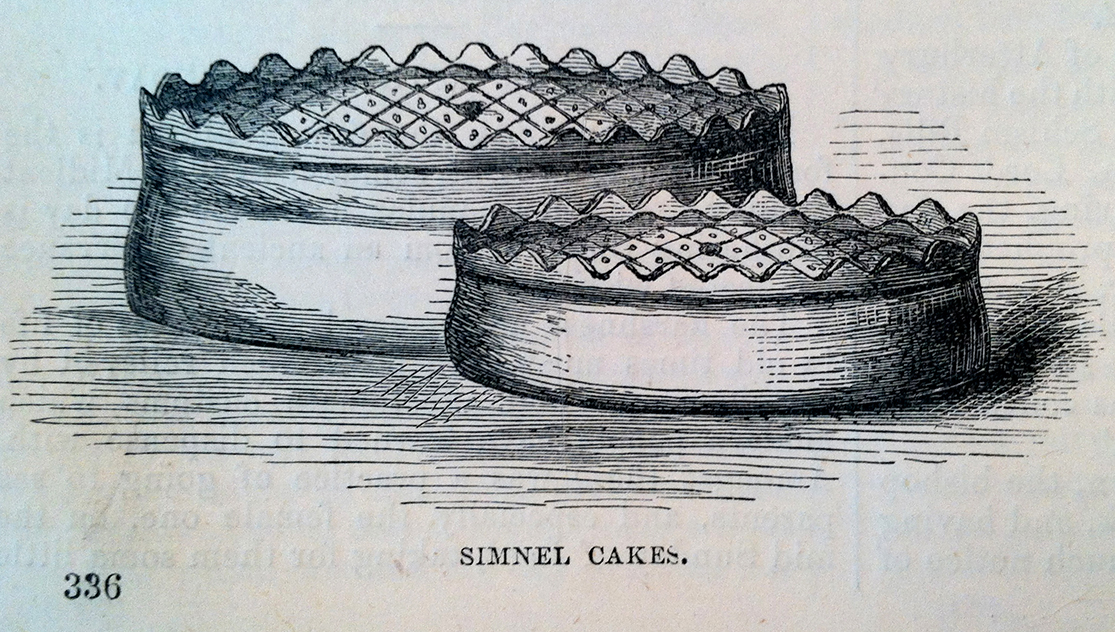
IT IS AN OLD CUSTOM in Shropshire and Herefordshire, and especially at Shrewsbury, to make during Lent and Easter, and also at Christmas, a sort of rich and expensive cakes, which are called Simnel Cakes. They are raised cakes, the crust of which is made of fine flour and water, with sufficient saffron to give it a deep yellow colour, and the interior is filled with the materials of a very rich plum-cake, with plenty of candied lemon peel, and other good things. They are made up very stiff; tied up in a cloth, and boiled for several hours, after which they are brushed over with egg, and then baked. When ready for sale the crust is as hard as if made of wood, a circumstance which has given rise to various stories of the manner in which they have at times been treated by persons to whom they were sent as presents, and who had never seen one before, one ordering his simnel to be boiled to soften it, and a lady taking hers for a footstool. They are made of different sizes, and, as may be supposed from the ingredients, are rather expensive, some large ones selling for as much as half-a-guinea, or even, we believe, a guinea, while smaller ones may be had for half-a-crown. Their form, which as well as the ornamentation is nearly uniform, will be best understood by the accompanying engraving, representing large and small cakes as now on sale in Shrewsbury.

The usage of these cakes is evidently one of great antiquity. It appears from one of the epigrams of the poet Herrick, that at the beginning of the seventeenth century it was the custom at Gloucester for young people to carry simnels as presents to their mothers on Midlent Sunday (or Mothering Sunday).

It appears also from some other writers of this age, that these simnels, like the modern ones, were boiled as well as baked. The name is found in early English and also in very old French, and it appears in mediæval Latin under the form simanellus or siminellus. It is considered to be derived from the Latin simila, fine flour, and is usually interpreted as meaning the finest quality of white bread made in the middle ages. It is evidently used, however, by the mediæval writers in the sense of a cake, which they called in Latin of that time artocopus, which is constantly explained by simnel in the Latin-English vocabularies. In three of these, printed in Mr. Wright’s Volume of Vocabularies, all belonging to the fifteenth century, we have ‘Hic artocopus, anglice symnelle,’ ‘Hic artocopus, a symnylle,’ and ‘artocopus, anglice a symnella;’ and in the latter place it is further explained by a contemporary pen-and-ink drawing in the margin, representing the simnel as seen from above and sideways, of which we give below a fac-simile. (N.B.: For Convivio Book of Days readers, that image is presented above.)

It is quite evident that it is a rude representation of a cake exactly like those still made in Shropshire…. It is curious that the use of these cakes should have been preserved so long in this locality, and still more curious are the tales which have arisen to explain the meaning of the name, which had been long forgotten. Some pretend that the father of Lambert Simnel, the well-known pretender in the reign of Henry VII, was a baker, and the first maker of simnels, and that in consequence of the celebrity he gained by the acts of his son, his cakes have retained his name. There is another story current in Shropshire, which is much more picturesque, and which we tell as nearly as possible in the words in which it was related to us. Long ago there lived an honest old couple, boasting the names of Simon and Nelly, but their surnames are not known. It was their custom at Easter to gather their children about them, and thus meet together once a year under the old homestead.

The fasting season of Lent was just ending, but they had still left some of the unleavened dough which had been from time to time converted into bread during the forty days. Nelly was a careful woman, and it grieved her to waste anything, so she suggested that they should use the remains of the Lenten dough for the basis of a cake to regale the assembled family. Simon readily agreed to the proposal, and further reminded his partner that there were still some remains of their Christmas plum pudding hoarded up in the cupboard, and that this might form the interior, and be an agreeable surprise to the young people when they had made their way through the less tasty crust. So far, all things went on harmoniously; but when the cake was made, a subject of violent discord arose, Sim insisting that it should be boiled, while Nell no less obstinately contended that it should be baked.

The dispute ran from words to blows, for Nell, not choosing to let her province in the household be thus interfered with, jumped up, and threw the stool she was sitting on at Sim, who on his part seized a besom, and applied it with right good will to the head and shoulders of his spouse. She now seized the broom, and the battle became so warm, that it might have had a very serious result, had not Nell proposed as a compromise that the cake should be boiled first, and afterwards baked. This Sim acceded to, for he had no wish for further acquaintance with the heavy end of the broom. Accordingly, the big pot was set on the fire, and the stool broken up and thrown on to boil it, whilst the besom and broom furnished fuel for the oven. Some eggs, which had been broken in the scuffle, were used to coat the outside of the pudding when boiled, which gave it the shining gloss it possesses as a cake. This new and remarkable production in the art of confectionery became known by the name of the cake of Simon and Nelly, but soon only the first half of each name was alone pre-served and joined together, and it has ever since been known as the cake of Sim-Nel, or Simnel!

Images: Photo from the BBC; Simnel cakes engraving from the Chambers Bros. Book of Days, Edinburgh, 1869.


Tagged ,

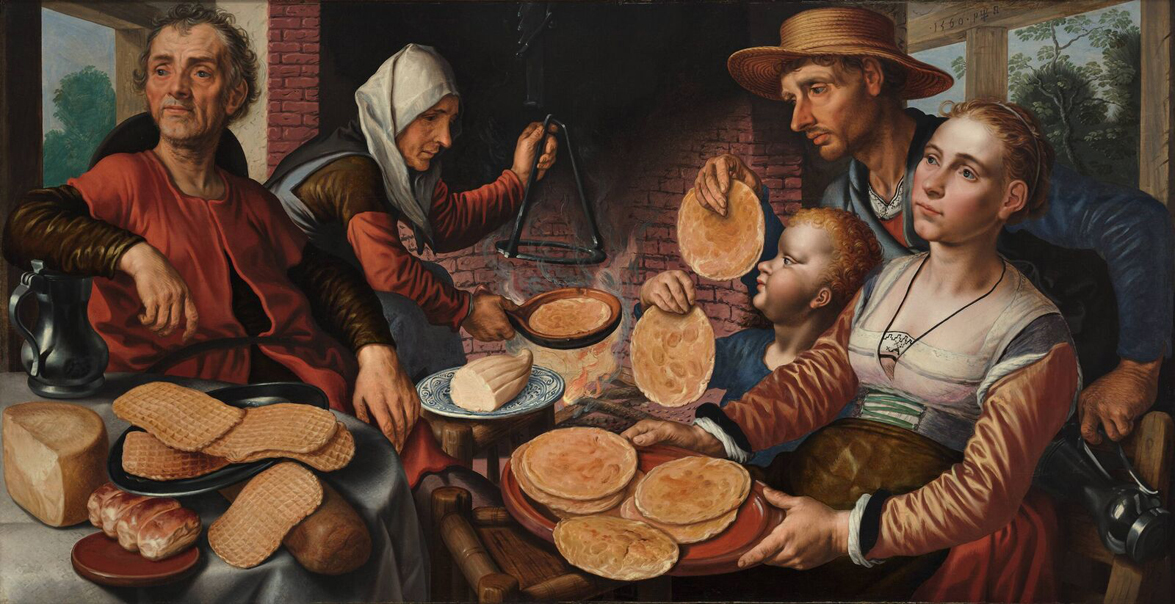
Pancakes for Our Supper

The Pancake Bakery

Pancakes for supper? Yes, please. Carnevale is concluding and today it is Mardi Gras. The day is better known in some places as Shrove Tuesday, and tradition would have us eat pancakes for our supper tonight. That alone is cause for celebration. It is a supper designed to use up the last of the eggs, the last of the butter, the last of all that was restricted in earlier days as we enter the somber season of Lent, which begins tomorrow with Ash Wednesday. Lent back then was much more restrained than it is now, where we pass on meat on Fridays. In earlier times, the restraint was a matter of necessity as much as of observance, for by this time of year, the stocks of food from the harvest were usually quite depleted. If folks were to make it through to the first harvests of spring and summer, a little restraint now was an important thing.

But that is tomorrow. Tonight we eat pancakes for supper and we remember the importance of appreciating each and every day.

Image: “The Pancake Bakery” by Peter Aertsen. Oil on Panel, 1560. Museum Boijmans Van Beuningen, Rotterdam. [Public domain] via Wikimedia Commons.