Category Archives: Passover

April Showers, or Your Convivio Book of Days for April

For your printable Convivio Book of Days calendar for April, we are tuning into the old adage: April showers bring May flowers. Here in Lake Worth, the flowers are blooming already (Amaryllis on the ground, and when we look up, the sky right now is crazy yellow with the blooms of Tabebuia argentea). Spring is most definitely with us. We realize, though, this welcome season takes longer to reach other places. If you’ve seen little evidence of it yet, worry not, it will soon arrive.

If you’re reading this in the morning, beware, for it is All Fools’ Day, when tricks and practical jokes abound until noon. You may, of course, be one of the tricksters, in which case we wish you good luck and healthy fooling. I’ve initiated some good April Fools’ tricks in my day, but this year I am feeling rather dim-witted and so I am sticking to the defensive role, remaining on lookout all morning, with the goal being to avoid becoming un poisson d’Avril, as they say in France, or il pesce d’Aprile, as they say in Italy. Both would translate to An April Fish, the fish being the fool, and very often the unsuspecting fool might find a paper fish stuck to the back of his shirt. Why a fish? I don’t know. I’m going to leave it at that.

The setting sun this evening will bring the beginning of Passover, or Pesach, commemorating the freeing of the Israelites from their slavery in Egypt, and is celebrated with a meal, the seder. A friend explains it thusly: “We are traveling through the desert with our ancestors via a table filled with metaphor and symbolism.” Unleavened bread is a central part of the celebration, for the Israelites had to leave Egypt so quickly there was no time to let the bread rise. Instead, it had to be baked immediately.

The Italians call Passover Pasqua Ebraica, which you might translate as “Jewish Easter,” but in fact in many languages the names of both Easter and Passover are the same. Pesach informs the name given to Easter in Italian: Pasqua. The English word “Easter” does not share this etymological relation to Pesach. It is related more to the the Old English “Eostre,” which is the name of an Anglo-Saxon goddess whose feast day was celebrated around the Spring Equinox.

Among the questions asked at the seder table is this one: Why is this night different from all other nights? And just as I cannot tell you why when it comes to the poisson d’avril, I also cannot tell you why this night is different from all other nights. I’ve never attended a seder. But I will join all who are in spirit tonight and wish you abundant blessings.

In my Christian tradition, it is Spy Wednesday today, which has to do with Judas Iscariot, one of Jesus’ disciples, betraying him and setting the course for the rest of Holy Week. Tomorrow night, on Holy Thursday, we will make our pilgrimage to three churches, deep in the night, moon illuminating the skies above us, for the Night Watch. It is not necessary an easy night, and yet it is one of the most beautiful each year, one of the most special. And so our April will begin. A most eventful few days.

OPEN SHOP DAY!
We’re planning to open the shop this Saturday from 11 to 4, for your last chance to pick up Easter goods like traditional wooden bunnies from Germany’s Erzgebirge woodworkers, beautiful pysanky eggs from Ukraine, German splintwood baskets and wood wool Easter grass (none of the plastic stuff!), German papier mache eggs to fill with treats, and as far as the sweets in your basket, how about sweet and sour Swedish candies, licorice (some chocolate covered) and fruitful gummies from Denmark, and marzipan piglets from Germany? CLICK HERE to shop, and come on by this Saturday, please!

And please make plans to join us later this month for our annual celebration of Independent Bookstore Day on Saturday, April 25. We’ll be making a full weekend of it, opening the shop on Friday night, the 24th, plus Saturday and Sunday the 25th and 26th. We’ll have some appropriate treats, no doubt, plus a free and simple letterpress and bookbinding project for all who come.

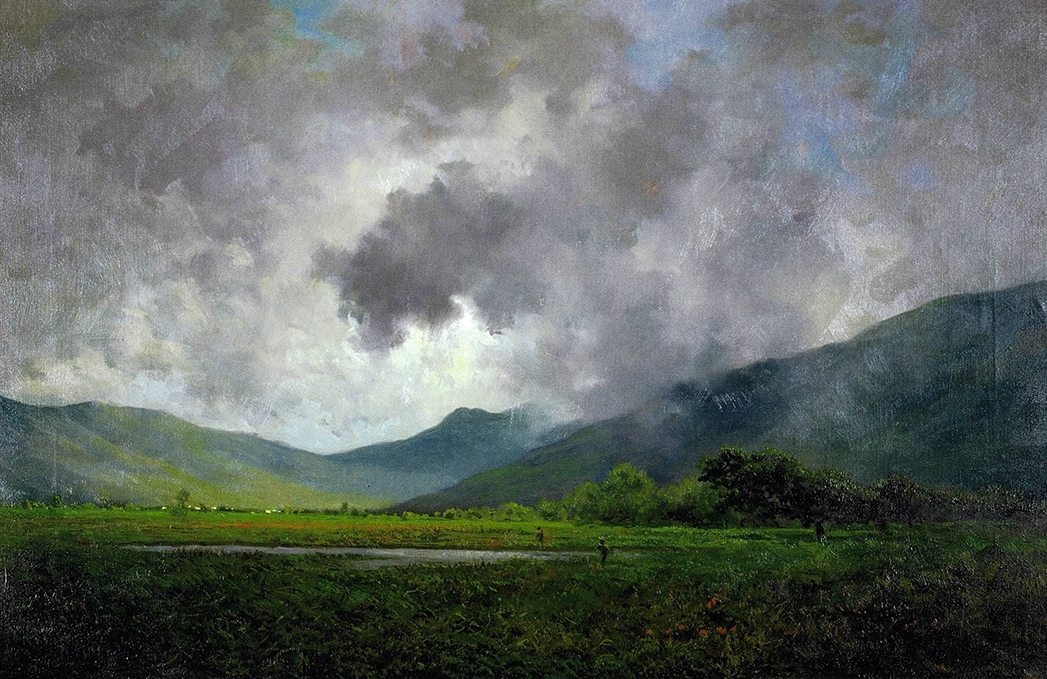
Image: “April Showers, Napa Valley” by Jules Tavernier. Oil on canvas, circa 1880-1884 [Public Domain via Wikimedia Commons].

Spring Green, or Your April Book of Days

And here now is your belated Convivio Book of Days calendar for April. Cover star: “Beech Trees in Springtime,” an 1897 oil painting by Christian Zacho. It is filled with the ephemeral spring green of newly leafed trees, which, if you are lucky, you will be seeing a fair amount of in the coming weeks, as spring comes into its own. An annual bit of wonder and renewal. We see it even here, in this strange green land, in an albeit subtle way: passing by a stand of bald cypress, for instance, as we drive across the state on Alligator Alley. It is a fine time to take a drive or to take a walk and see something new and fresh and green.

We find ourselves, too, in the midst of an important week, across cultures and spiritual traditions: Ramadan continues and at sundown tonight, Passover begins. And it is Holy Week, a week of complexity and mystery in which the forty days of Lent, which we’ve been immersed in since Ash Wednesday, will come to a close. It began last Sunday with Palm Sunday. Thursday will bring Holy Thursday, or Maundy Thursday, when tradition would have us visit three churches in the moonlit night, Friday will bring Good Friday, when we commemorate the passion of Christ, and Saturday the vigil through which we wend our way toward Easter.

What I know about Ramadan is not much and what I know about Passover is perhaps just a bit more, and is mostly is in relation to my Catholic upbringing and to Passover’s connexion to the Easter story. I know that Passover commemorates the liberation of the Israelites from their slavery in Egypt, and I know what a friend told me once, which has always resonated with me about the holiday: “We are traveling through the desert with our ancestors via a table filled with metaphor and symbolism.” The meal is the seder, the same meal that Jesus celebrated with his disciples in the upper room on that Holy Thursday night before he died. Pesach is the Hebrew name for Passover, and Pesach informs the name for Easter in many languages. Hence our Italian word for the day and season: Pasqua. And while Ramadan roams the calendar, falling a few weeks earlier each year, Pesach, Pasqua, and a full- or near-full Paschal moon are all constant companions based on the timing of the spring equinox.

The Last Supper is the Passover meal in the upper room that is commemorated at the Mass for Holy Thursday. Each year, as Lent begins, I think to myself, “This is the year I’m going to do things right.” I imagine myself taking the time to give the forty days their proper space and time, to be more mindful, and give them more reverence. And each year those forty day zip by and I find myself here, at this junction where Lent runs headlong into Holy Week, and I realize I just have these few days left to make things right. Holy Thursday is my night to do this. I drag Seth along with me, if he has it in him, on a Holy Thursday pilgrimage that my grandmother taught me: as the rest of the world is contemplating sleep, we will head out into the night and visit three churches. The churches that know Grandma’s ways will keep their doors open late into the night, or even throughout the night until morning. The moon is our companion through this pilgrimage, along with a few other hearty souls who visit the churches with us. The churches will be dim but warm with candle glow and quiet and the presence, to me at least, of all the loved ones I bring with me in my heart. I sit, I kneel, I pray, I ponder. It is a night like no other, the strongest bridge I know between realms. We each, of course, bring to it what we bring, but this is what my Holy Thursdays, my Maundy Thursdays, are like, and I feel truly at home in the mystery.

IT MAY BE NOT TOO LATE to order things from our website for Easter. We ship US Priority Mail, which is two days to most domestic destinations, so chances are good you’ll have your order by Saturday. Locals, of course, we can deliver to you or you can come pick up at our front porch. It’s a little too warm these days to ship our German chocolates for Easter, but locals: I don’t know that there’s anywhere else nearby where you’ll find German milk chocolate bunnies and German marzipan bunnies. We have a few left of each. Plus Ukrainian pysanky, wooden bunnies and splint wood baskets and paper mache eggs from Germany, handmade egg-shaped candles from Sweden…. many Easter delights await you at Convivio Bookworks! CLICK HERE to shop. And use discount code BUNNY at checkout to get $10 off your purchase of $85 on all our offerings, plus free domestic shipping!

AND WON’T YOU JOIN ME this Friday, Good Friday, via Zoom for Real Mail Fridays? It’s a weekly online social I host for the Jaffe Center for Book Arts. Good Friday is an odd day for a social, I know, so the approach I’m planning is this: a more subdued soundtrack for the first two hours, and then we’ll devote the final hour of our gathering to a most sublime recording called “Lamentations: Holy Week in Provence.” It’s by the Boston Camerata. “Lamentations” is a most beautiful piece of music, and we will play it uninterrupted from 4:00 Eastern to the close of our online social. We do bill Real Mail Fridays as a letter writing social, but the folks who join us each week from around the globe do all kinds of interesting things during our time together. We’ll begin as we always do, at 2:00 Eastern. Come and go as you please but do consider joining us for “Lamentations” beginning at 4. No matter your faith tradition or your beliefs, it is a most special way to mark the day. CLICK HERE to join us Friday between 2 and 5 Eastern.


Image: “Beech Trees in Springtime” by Christian Zacho. Oil on canvas, 1897. [Public domain] via Wikimedia Commons.


Mysterium: Holy Week

Saturday was a full day: I spent it pressure washing Mom’s patio––a full afternoon wet and soggy, hunched over a power nozzle, blasting mildew off of bricks. Every hour or so, I’d put down the nozzle, pour the murky water out of my shoes, and pick up the nozzle and start again. Toward nightfall, we ate, and after supper I could not keep my eyes open, so I went to a chaise lounge on the patio’s edge to rest my weary bones. I was sound asleep before I knew it. Just a short nap, a bit of refreshment while the coffee was brewing. I awoke just a few minutes later and before me in the night sky, beyond the pines and the clouds beyond them, was the waxing moon, bright and clear. And though over dinner we talked about baking for Easter, it didn’t really sink in until I saw that big moon. The moon’s presence before me was my portal, my concrete reminder of where we are in the round of the year: with its presence, we enter into Holy Week.

Indeed, Passover began with the setting sun on Saturday, just as I was dragging myself in from my day’s work. Passover and Holy Week are, I think, constant companions, for the Passover seder was the setting for Holy Thursday (or Maundy Thursday), which leads us to Good Friday and Easter Sunday. What I know about Passover is not much and mostly is in relation to my Catholic upbringing and to Passover’s connexion to the Easter story. I know that Passover commemorates the liberation of the Israelites from their slavery in Egypt, and I know what a friend told me once, which has always resonated with me about the holiday: “We are traveling through the desert with our ancestors via a table filled with metaphor and symbolism.” The meal is the seder, the same meal that Jesus celebrated with his disciples in the upper room on that Holy Thursday night before he died. Pesach is the Hebrew name for Passover, and, as words go, Pesach informs the name for Easter in many languages: in Italian, for instance, Easter is called Pasqua. In French, it is Pâques, in Portuguese, Páscoa, and in Spanish, Pascua. (The English word “Easter” does not share this etymological relation to Pesach. Our word for the holiday comes down from the Old English Eostre, related to the German Ostern and an Anglo-Saxon goddess whose feast day was celebrated around the Spring Equinox. But my apologies––I often find myself winding down weird linguistic roads.)

The Sunday that sets Holy Week in motion is Palm Sunday, or Passion Sunday. Father Brice at St. Paul’s used to say that “more people come to church when we give stuff away,” and it is one of those days when you do leave with a gift: the gift of palms, which some folks then take home and fashion into crosses. And while that part is nice, I’ve always felt a bit conflicted about Palm Sunday. I never understand what emotion I should be feeling, and it feels sometimes like the Cliff Notes version of Holy Week, condensed for busy people. And so I’ve never been terribly fond of the day.

It is Holy Thursday I love. It is one of the most beautiful nights of the year: a quiet and unassuming holiday/holyday, remarkable in its consistency, for the moon is always big and beautiful this night, hauntingly present, a constant companion as we make our pilgrimage in an old tradition that would have us visit three churches over the course of the evening. My grandmother, Assunta, taught me that custom, but, for some reason, not until the Holy Week after Grandpa had died. I think suddenly these old traditions meant more to her. I discovered then that the world is different at night. Churches glowing from within, moonlight reflecting on columns and limestone figures. Astonishingly quiet, serene stillness.

The actual Holy Thursday mass in most churches comes around sunset. It is the Mass of the Lord’s Supper, commemorating that Passover seder, the last supper so often depicted by artists. Jesus began by washing the feet of his disciples, a humble act accompanied by the suggestion that we, too, should not be above doing even the lowest things for others. At supper, he broke bread and passed the cup of wine: the central act of every Mass.

This year, like last, I won’t be going to any church gatherings for Holy Week and Easter. But typically, the Holy Thursday Mass I attend is a trilingual one, in English, Spanish, and Creole. It’s long and it’s crowded but I love it. It is the one Mass each year in our congregation where folks from so many diverse communities finally come together. For years I would seek out and sit next to an old Creole woman who reminded me of my grandmother, but I haven’t seen her for many years now, and I suspect she’s long gone now. And so I sit there with people I do not necessarily know and I think of my grandmother and the old Creole woman who had no idea she was so important to me.

The First Reading is in one language, the Second Reading in another, and the Gospel in the last of them. If you don’t know the language being spoken, you read along on your own. And as crowded as it is, still there are two choirs: one singing in English, the other in Creole, coming together, too, for this one night each year. The Creole songs are long and mysterious. One of them is sung to the tune of “My Old Kentucky Home.” They sing in Creole while I remember what I can from Stephen Foster’s song and each year they sing that song, I think of the small scrap of paper found in Stephen Foster’s pocket after he died. On it, he had scribbled five touching words: Dear friends and gentle hearts. That’s exactly how I feel each year on this night.

The Mass ends with the transfer of the Blessed Sacrament to the chapel while the congregation sings the Pange Lingua, acapella. Its more proper name is Pange Lingua Gloriosi Corporis Mysterium, an old hymn written in Latin by St. Thomas Aquinas in the 13th century. “Mysterium” is very appropriate, for this is a night wrapped in mystery and beauty, both of which truly begin once the Pange Lingua is done. There is no real end to the Mass. A small bit of chaos ensues as church workers begin to prepare for the Good Friday services the next day. People get up and leave, others mill about, and it’s noisy hustle and hubbub for a good 20 minutes until, eventually, the noise fades away as the church empties to just a few hardy souls who are there to sit. Some are in prayer, some are in reflection. Most, perhaps, are like me: doing some of all those things but also just being part of something bigger than ourselves, as it should be, in the company of others.

The tradition varies, apparently. The one that Grandma passed down to us is to visit three churches on this night. But I’ve heard of some people visiting seven churches. Both are magical numbers: 3 for the Trinity, of course, and for the three aspects of the Goddess (virgin, mother, crone), amongst other things, and 7 for more things than you might imagine: the seven sacraments, the seven days of creation, the seven sorrows of Mary, seven loaves and fishes… Still, three churches is plenty. Grandma may have been pious but she was not a martyr.

Our pilgrimage each year typically takes Seth and me from the trilingual Mass at St. Anne’s, the small old church surrounded by the tall buildings of Downtown West Palm Beach, across the lagoon to the much grander St. Edward’s in Palm Beach, which rivals the Vatican, then down the road to Bethesda by the Sea, where each year we wander the grounds, looking at the gargoyles and the crypts and the fountain, and we look for the boar in the stained glass window that shines onto the courtyard. We make these rounds each year on this night, sitting, kneeling, and me, I remember all those who have gone before us doing this very same thing. This is the value of ceremony and tradition to me: this connexion across time and space. And no matter where I go this night, the moon is there tagging along, trusted companion, never tiring, illuminating the night and the trees as much as the churches themselves illuminate their stained glass windows shining out from within. No one after lighting a lamp puts it under the bushel basket, but on the lamp stand, and it gives light to all in the house.

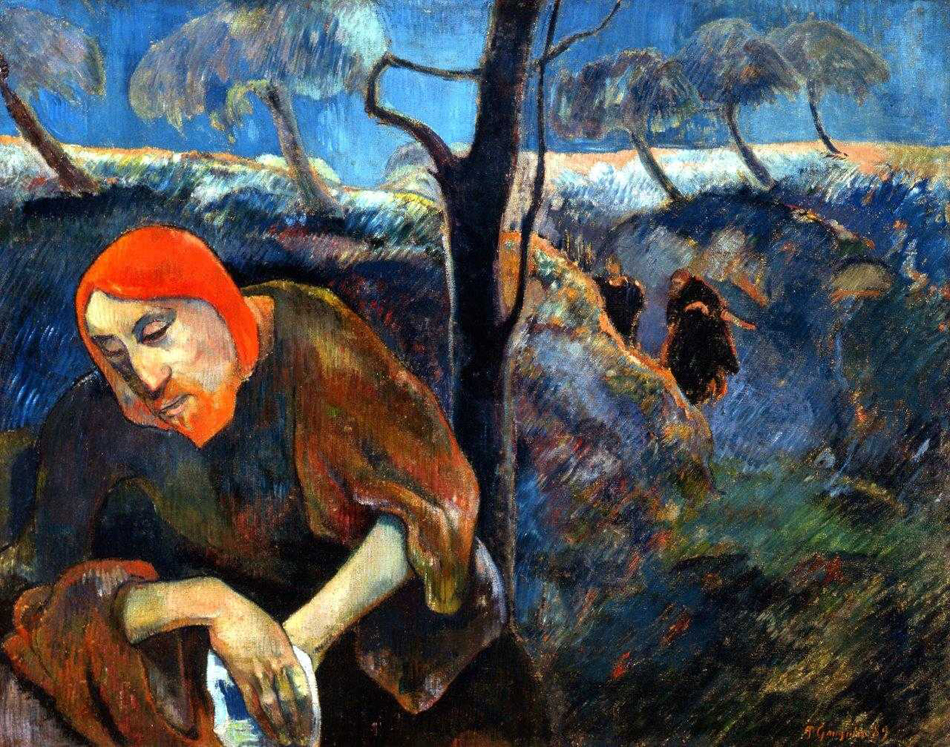
Image: “Christ on the Mount of Olives” by Paul Gauguin. Oil on canvas, 1889 [Public Domain via Wikimedia Commons].


SPRINGTIME STOCK-UP SALE continues for this week and maybe just a bit longer past Easter Sunday and Easter Monday at our website. Use discount code BUNNY at checkout for $10 off when you spend $65 on everything in the shop. Lots of beautiful handicrafts for Easter to welcome the season from Germany, Poland, and the Ukraine. Plus a deal for the locals with a lower minimum: use discount code LOCAL5 at checkout for $5 off $25 when you choose the pick up option and pick up at our front porch. Click here to shop!