Category Archives: St. David’s Day

La Quaresima, or Your March Book of Days

And now it is March, and here is your printable Convivio Book of Day calendar for the month. It is the month of spring in the Northern Hemisphere, and the month of lent. Forty days, not including Sundays, and they cover March from start to finish. It is the month of many famous saints’ days: St. Patrick’s Day, and St. Joseph’s Day, and St. Urho’s Day, and at the start on this First of March, St. David’s Day, sacred to Wales. The first few days of March that follow St. David’s Day are given to saints who are ancient and largely forgotten here on Earth: St. Chad on the Second of March and St. Winnal on the Third. The three days taken together play a part in old weather lore. St. Winnal’s Day especially is generally expected to be particularly stormy:

First comes David,
Next comes Chad,
Then comes Winnal,
Roaring mad.

But since it is St. David’s Day today, and since it is a Sunday, it’s a good day, I feel, to make Welsh Cakes, which is what I’m planning to do. Here is our recipe:

WELSH CAKES

It’s not uncommon to find recipes for Welsh Cakes that call for regular granulated sugar, butter, and nutmeg, but the traditional recipe will add lard to the mix, use caster sugar in place of the regular sugar, and will be flavored with the more mysterious flavor of mace. If you want the best Welsh Cakes, stick to the traditional version. If you can’t find caster sugar, make your own: pulse regular granulated sugar in a blender until very fine. Do not use powdered confectioners’ sugar, which has added corn starch.

3 cups all purpose flour
½ cup caster sugar
1 ½ teaspoons baking powder
1 teaspoon ground mace
½ teaspoon cinnamon
½ teaspoon salt
6 tablespoons lard
6 tablespoons butter
¾ cup dried currants
2 eggs, beaten lightly
3 to 4 tablespoons milk
granulated sugar

Whisk together the flour, caster sugar, baking powder, mace, cinnamon, and salt in a mixing bowl, then work in the butter and lard with your fingers until the mixture has the texture of course crumbs. It’s ok if some larger chunks of butter remain. Mix in the currants. Add the beaten egg, working it into the mixture, adding just enough milk to form a soft dough that is not too sticky. Wrap; chill in the refrigerator for 30 minutes or until you are ready to make the cakes.

Turn the dough out onto a floured board and roll to a thickness of about ¼”. Using a biscuit cutter (scalloped, if you have one), cut into rounds. Gather up any remnants to roll out again and cut more cakes.

Heat a lightly buttered skillet (cast iron works great) over low to medium heat, cooking the cakes until each side is lightly browned (about 3 to 4 minutes… if they’re cooking quicker than that, lower the heat). Let the cakes cool for a minute or two, then set each in a bowl of granulated sugar, allowing sugar to coat both sides and the edges. Best served warm, split, with butter and jam, or, for a more savory treat, with cheese and leeks––leeks being one of the traditional Welsh symbols of this day, along with daffodils.

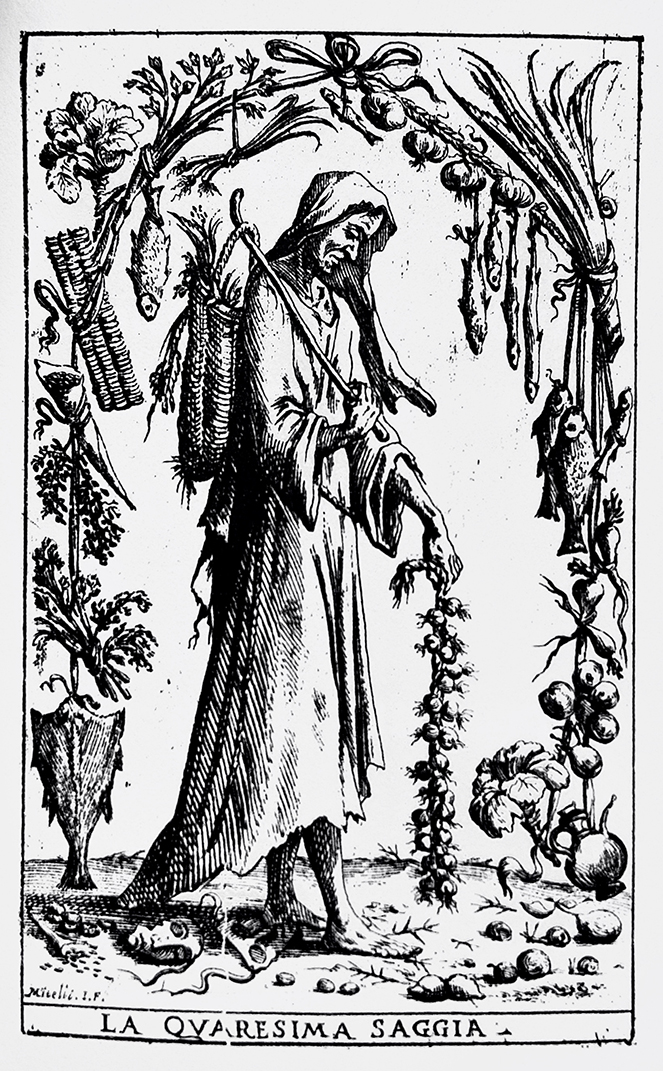
As for la Quaresima, that is the Italian for lent, and it is such a beautiful word, especially placed against our stark and spare word of only four letters. It rolls off the tongue like a flower: Quaresima. Her symbol in Italy is an old, thin woman, the opposite of the rotund man with a necklace of sausages around his neck, who is the symbol for Carnevale, the time we have just left behind last week with the start of Quaresima. She is known as La Vecchia, and we have made her this month’s cover star. She is here to remind us, like lent does, that our time on Earth is short. So make the most of it. Love each day.

Image: La Vecchia is also known as La Quaresima Saggia, the old sage of lent. Engraving by Guiseppe Maria Mitelli, late 17th century.
 

Daffodils, Leeks, & Your March Book of Days

If you should see someone wearing a daffodil or a leek on his lapel today, that’s because it’s St. David’s Day, sacred to Wales, and leeks and daffodils are part of the tradition for the day. While I do love leeks, I can’t quite imagine wearing one on my lapel. St. David’s Day ushers in March each year, and this year, March ushers in Lent. It’s a few more days of carnival parties, which will all culminate on Tuesday, which is Mardi Gras, Shrove Tuesday. There will be pancakes for supper that night, and then the next day, it will be Lent. It’s a busy week to come.

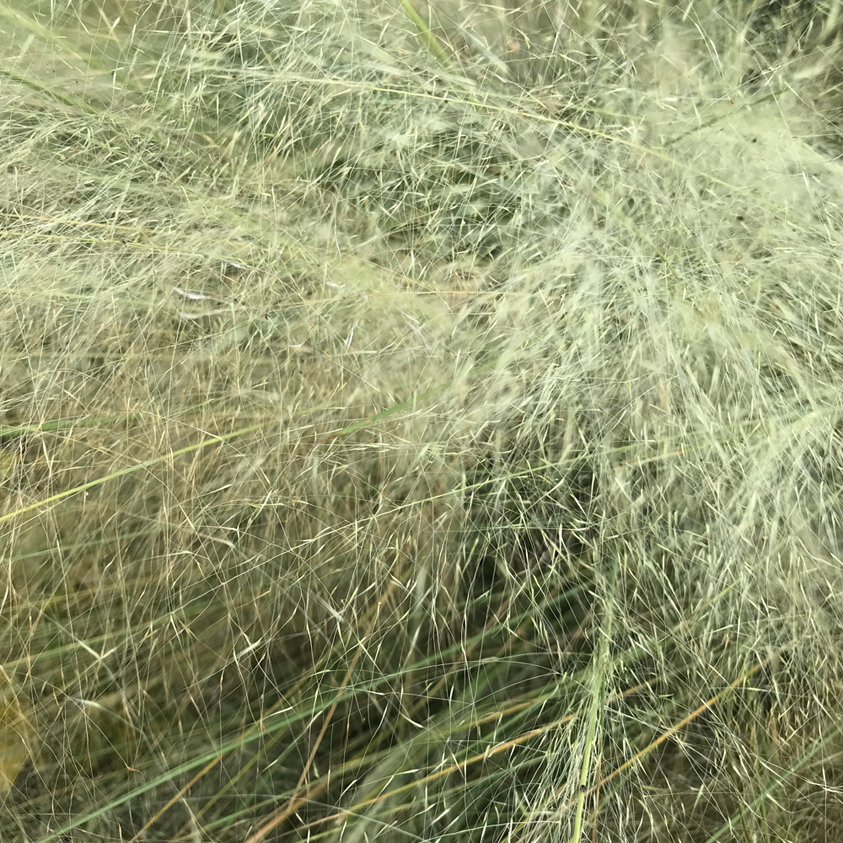
But here on this St. David’s Day, this First of March, comes now your Convivio Book of Days calendar for March. It is, as usual, a printable PDF that you can print out on standard US Letter paper. It’s a fine companion to the blog. The month’s cover star is some billowing Florida grass, harbinger of spring… which will be arriving later this month. Enjoy!


Humpty Dumpties, Welsh Cakes, & Your March Book of Days

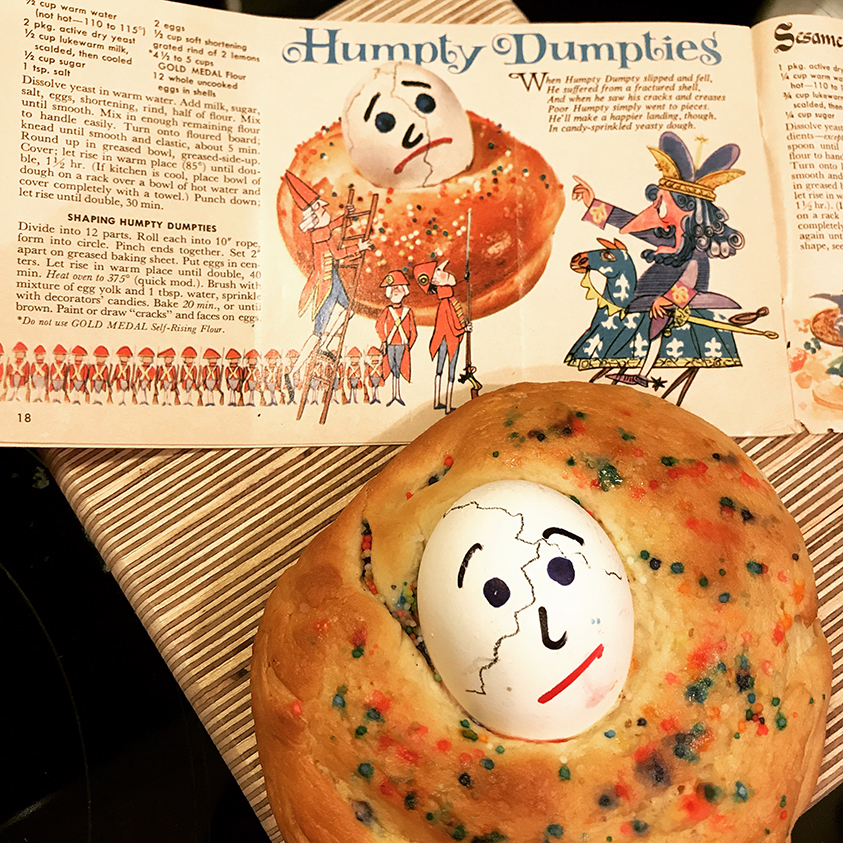
Here is March, brought in by St. David’s Day each year, sacred to Wales. Here, too, is the March edition of your Convivio Book of Days Calendar, our monthly gift to you, a nice companion to the blog. It’s a printable PDF on standard US letter size paper. Cover star this month: one of the Humpty Dumpties we make each Easter at home. The recipe comes from a booklet that came with Gold Medal flour back in the 60s. Mom thought back then they would be a nice addition to our Easter celebration, and we’ve been making them ever since. The dough is sweet, yeasty, and lemony; I draw the faces each year. My mom and sister and I will no doubt be making them this year one day during Holy Week, at the end of the month, in the days before Easter. You can make them, too; just follow the recipe in the photograph (click on the photo to make it larger).

Today, though, is St. David’s Day, a fine day to bake Welsh Cakes. More on that later. Dydd Gŵyl Dewi Hapus is the St. David’s Day greeting in Welsh, but in English, a simple “Happy St. David’s Day” will do. In Wales, it is a day of national pride and national celebration, similar to St. Patrick’s Day in Ireland. It is a day of leeks and daffodils. Both are similar in name in Welsh, and of course it is springtime, so the daffodils by now perhaps are blooming beautifully. As for the leeks, this goes back to ancient battle in Wales in which St. David himself is said to have advised the Welsh troops to wear leeks in their caps in order to distinguish themselves from the Saxon troops they were fighting. The leek has since become a symbol of Welsh national pride.

This animosity between the Celtic Welsh and the Saxon-descended English went on for some time. I’m not sure if bakers in England are still making gingerbread taffies for St. David’s Day, but it was a long standing tradition to make these cookies in mockery of the day. The taffies depicted a Welshman riding a goat. There is an old story, as well, of a man on horseback in the north of Wales who comes to a river that he wishes to cross. There was a man working the field nearby, so he asked, in English, if it was safe to cross the river and the laborer replied, in English, that it was indeed. The horse, however, knew better, and refused to pass into the river. So the man upon the horse asked the laborer once again if it was safe to cross the river, this time in Welsh. “Oh, I beg your pardon, sir,” said the man on the ground. “I thought you were an Englishman.”

And so the English made their gingerbread taffies, and hung effigies of Welshmen for St. David’s Day, while in Wales, the folks celebrated in kinder ways, still to this day, with parades and the wearing of national costumes and of course leeks and daffodils. And perhaps the baking of those Welsh Cakes I mentioned earlier. Here’s a recipe for Welsh Cakes from the folks at King Arthur Flour; the one suggestion I might make is that Welsh Cakes often have a scalloped edge, so if you are making them and if you happen to have a scalloped biscuit cutter on hand, you might want to use that one instead of a plain circle. You might serve them with butter or, for a more savory treat, with cheese and leeks.

I love leeks and I love Wales, though I’ve never been there. But I have seen pictures and it looks so utterly beautiful there, and I have heard the language in word and song, and I love the poetry of Dylan Thomas, and the books of Gregynog Press, or Gwasg Gregynog as it’s called there, and while I don’t have a bit of Welsh anything in me, I have long been enthralled by the place. And so Happy St. David’s Day: Dydd Gŵyl Dewi Hapus!

Seth and I will soon be adding some new arrivals for Easter to our catalog pages: new pysanky eggs from Poland and Ukraine and new paper Easter eggs from Germany to fill with goodies. Everything handmade by traditional artisans. Check back soon at conviviocatalog.conviviobookworks.com!