Author Archives: John Cutrone

Love & Lent

It’s Valentine’s Day and it’s also the first day of Lent. That’s one of the dangers of a February holiday like Valentine’s Day: sometimes it falls on a fasting day. A really nice dinner is a traditional part of many Valentine’s Day celebrations; sometimes, like this year, Lent shows up as an unwelcome guest at the table. Whether you fast or not is up to you. I certainly won’t say anything.

Nonetheless, with the passing of Fat Tuesday, the excess of Carnival is done. It’s now Ash Wednesday, the beginning of Lent, a forty day journey of penitence, fasting, and almsgiving. The idea of abstaining from meat and things of the flesh (milk, cheese, eggs) during Lent was instituted by Pope Gregory in the late 6th century as a way of helping his flock prepare for Easter and the miracle of spring by mirroring Jesus’s forty days of fasting in the desert. But although it is a season of denial imposed by religious belief, the fact is that in earlier times this was a season of scarcity in general. Folks did their best each fall during harvest time to store away food and provisions to last through the winter, but by this time of year, these things were beginning to get scarce. The salted meat would be running low, the eggs running out. There’s not much to gather in the wild and not much is growing yet in the fields. In the Northern Hemisphere, we are just beginning at this point to spring out of winter. In times past, if you were lucky, you’d still have a decent quantity of flour in the barrel and a good store of dried beans, root vegetables, and dried fruits and nuts and hopefully some salted fish. Even without a decree from the Pope, some fasting would almost always be necessary to get your family through the remaining weeks of winter.

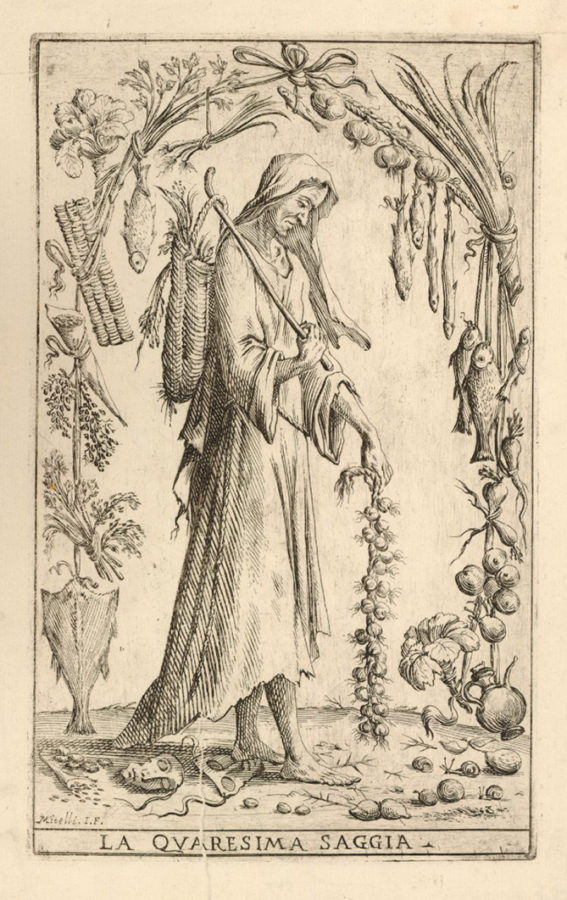
As I mentioned in the Book of Days chapter two days ago, titled “Fat Tuesday,” the traditional symbol of Carnevale in Italy is a plump man wearing a necklace of sausages about his neck. He is in stark contrast to the traditional symbol of Lent: a gaunt old woman, all skin and bones. She is known as La Vecchia. Her time gets the name Quaresima, which sounds so much more lovely than our stark English word Lent. Sometimes La Vecchia takes the form of a baked loaf of bread in the shape of a skinny old woman with seven legs. One leg is broken off with each passing Sunday of Lent, a calendar of sorts, marking the passage of this spare season.

Nowadays, most Catholics simply abstain from meat on Fridays during Lent. Restrictions have loosened a lot over the years, perhaps in direct proportion with our abilities to keep food on the table at all times of the year. The restrictions are mostly now just symbolic. But the custom we have of dyeing eggs at Easter comes directly out of the old ways of Lent: folks were so excited to welcome eggs back into their daily diet each spring, they celebrated by dyeing them with natural dyes like beetroot, chamomile flowers, red cabbage, and onion skins. I still like dyeing eggs with these things of nature.

Being a time of spare solemness, it is not surprising that there are not many celebratory foods that accompany Lent. There is one, however: The humble pretzel. At their most basic, pretzels are made with just three ingredients, all Lenten-friendly: flour, salt, and water. It is thought that the name “pretzel” is derived from the Latin bracellae: “little arms,” essentially, evoking the prayer posture of early Christians, who prayed with their arms crossed over the chest. Go ahead, try it right now, then look down at your chest: classic pretzel shape. This penitential bread––again, so common nowadays so as to be nothing special––has a history that goes back many many centuries. The first pretzels were thought to be made in the 6th century. Some historians think they go back three centuries more.

Connexions like these are, I think, so fascinating. That a common pretzel can have such interesting roots (and deep ones, at that) and mark our celebratory days (or penitential ones, in this case) is such a wonderful thing.

Love is at the heart of our table no matter the meal or the season, even in the humble dishes that make up our meals during Lent. Perhaps there is no better Valentine’s Day than one that falls on Ash Wednesday, when we are reminded that we are made from the earth and to earth we shall return. The time is short. Ash Wednesday is, at its core, a day to remember the brevity of things and to understand that we are here to love and to lift each other up. These forty days of Lent are a good time, I feel, to focus not on what we deprive ourselves, but on what we can do to enrich the lives of others. So go on: Love with all your might.


Image: “La Quaresima Saggia” by Giuseppe Maria Mitelli. Engraving, c.17th century. The haggard old woman of Lent, trodding upon the remnants of Carnevale, framed by the foods of her season: fish and snails, onions and other root crops, beans, and I’m pretty sure those are cardoon stalks at the top right.
 

Fat Tuesday

The Carnevale of Venezia, or the Carnival of Venice, began this year on the last Saturday of January and soon, on Tuesday, it will draw to a close. Tuesday brings Shrove Tuesday, or Mardi Gras in French––Fat Tuesday. There are certain cities that we think of as central to Carnival: certainly Venice, Rio de Janeiro, and New Orleans. But Carnival is a celebration that is known far and wide, especially through Europe and Latin America.

My family is not a Carnival people––it’s just not a tradition my grandparents brought with them from their Italian villages. But Carnival is important. It is the last great indulgence before the arrival of Lent, forty days marked by somberness and penitence––and, in times past, a time of strict dietary restrictions. Carnival season, in fact, takes its name from the Latin carne levamen–– “Good-bye to the flesh.” Traditionally, the supply of meat would be finished during Carnevale until spring, and so it truly was a goodbye to the flesh, and a farewell to the provisions of winter. The traditional symbol of Carnevale in Italy is a plump man wearing a necklace of sausages about his neck. It is in stark contrast to the traditional symbol of Lent: a gaunt old woman, all skin and bones.

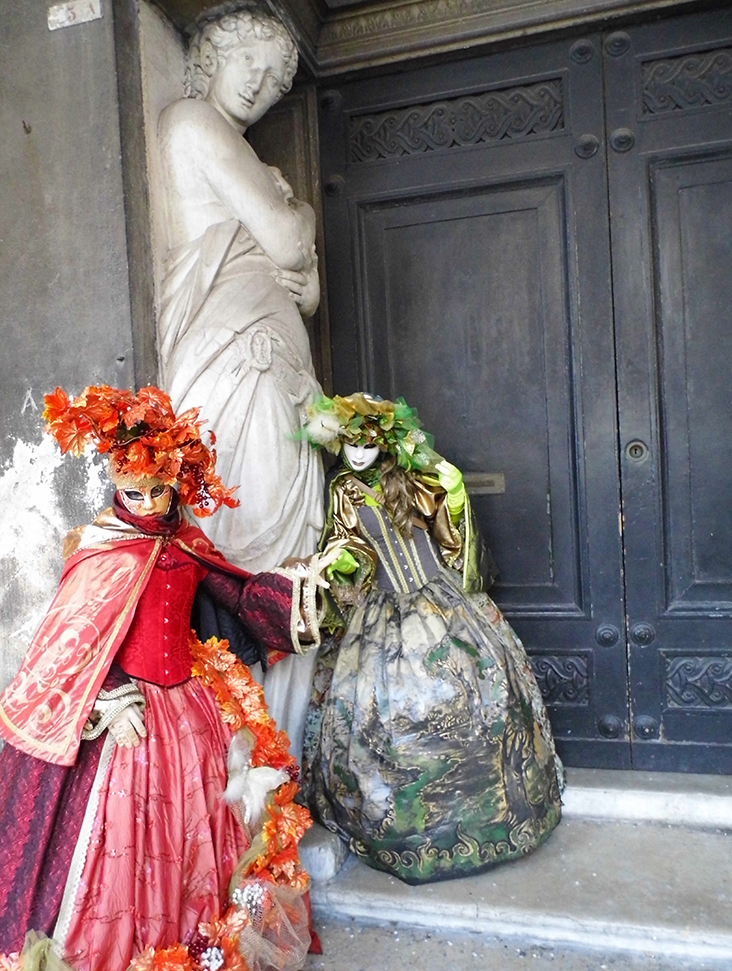
I love the costumes and the masks of a traditional Venetian Carnevale. It is a celebration of excess and the costumes, elaborate as they are, encourage this. Who knows who is behind each of those masks? Carnevale in Italy has its connections to celebrations of the new year, which, for the early Romans, was the First of March. The costumes and the masks come out of this tradition, for they were part of the Roman New Year celebration. The old year was dying, the new one being born. Out of that chaos came a festival of excess, and masks provided anonymity. The Romans eventually moved the start of the year to January 1, but old habits die hard: The costumes and the masks then and now give us license to be whomever we wish, at least for a little while.

In England and in the United States, Shrove Tuesday means one thing: Pancakes for supper. The meal is an easy way of using up all the eggs, milk, and sugar that remained in the larder before the 40 fasting days of Lent commenced. In Germany, the tradition for the Tuesday before Lent calls for doughnuts, and the night there is known as Fasnacht or Faschnacht. The idea is the same: using up all the remaining lard, sugar, and butter before Lent begins. But whether it is pancakes or doughnuts, there is something special about eating breakfast for dinner, or about eating homemade doughnuts after dinner. It’s a little something, nothing dramatic, just something that marks the day, something celebratory, reminding us of the importance of enjoying what we have. Once Ash Wednesday arrives, Lent will, for forty days, remind us of the brevity of things. The reality is we are very fortunate and we should do our best to remember the gifts we’ve been given… like this, another Mardi Gras, another Fasnacht, another Shrove Tuesday. And as they say in New Orleans, Laissez les bon temps rouler!


Image: “Festa delle Marie,” by a German photographer who goes by the name fotogoocom, was taken at the Carnevale of Venezia in 2015. Used with gratitude through Creative Commons via Wikimedia Commons.


One Year Since

And so we’ve made one full revolution around the sun since my dad passed away. I’ve been a little uncertain just how to approach this week; I knew it would not be an easy one. I know everything I did last year on February 7th, 8th, and 9th. These things are imprinted on my memory. Seth and I were with friends at a concert of the Philadelphia Orchestra at the Kravis Center in West Palm Beach on the night of the 7th. Rachmaninoff and Shostakovich were on the program. I was there but I was equally not, as I sat there in the box, worried about my dad, acknowledging for the first time, as I listened to the Rachmaninoff piano concerto, that maybe he was not going to get better. On the 8th, Seth and I went to see Dad in the morning at the rehabilitation center he’d been at since late January. He was in good spirits. We left, for we had to go to work, and we had breakfast at a nearby bagel place, a place with a chain to keep the people in line in check, a place that drained the energy from me. But we ate there all the same. And then we parted, Seth and I, he to his job and me to mine. All day long I worked but I wanted to leave to go see Dad. Late in the afternoon, I did. When I arrived at his room, he was surrounded by nurses. They were moving him to Medical ICU. “To keep better watch on him,” they said. I watched from a corner of the room as they made things ready for the move. Dad seemed ok. I walked alongside his bed as they rolled him down the corridors, down the elevator, into the ICU, where I was told to wait outside. I called my mom and sister, and I called Seth. They came and waited with me in the waiting area. We finally got inside, late in the evening, to visit with Dad. He seemed ok then, too. We talked some, but he was tired. And then the ICU nurse came and told us it was time to go. We didn’t want to, but we had to, I guess. We said goodnight to Dad. We each kissed him. We each said, “I love you.” He told us he loved us, too. We went to eat, at Brewzzis, probably their last customers of the night. We had the same waiter that served us a few nights earlier, when my cousin Al came to visit Dad, the night that Dad was so animated and so much like his usual self, it was hard to remember he had had a stroke. The waiter remembered us. When we were done, we said goodnight in the parking lot; my sister and my mom went home, Seth and I went home. We fed the cat. We showered. We went to bed. We kissed each other goodnight. I fell asleep. Sometime past midnight, the phone rang. I jumped out of bed. I answered. It was my sister; Dad had gone into cardiac arrest. We rushed to the hospital. We met my mom and sister there, all of us anxious, nervous. It was after hours, so they wouldn’t let us in. We explained. We waited, and waited, and waited. Finally, a security guard came and took us to ICU. We opened the door. The nurse calmly told us she was so sorry. And that was that.

My dad had been diagnosed with cancer years before. It was prostate cancer that had spread to the bones. But never did he “seem” to have cancer. He never had chemo, he never lost weight, he never lost his hair, all the things that I had thought, in my limited knowledge, came with the disease. He carried on, just as he always did. He had spinal stenosis, too, and it got more difficult for him to walk as the years passed. A cane would have been a great help, but he was too proud to use one. Dad never liked to call attention to himself. He began radiation treatments at the start of January last year, to help control the cancer that was beginning to spread more rapidly. His doctor said that he was responding really well to the treatments. There’s a bell there at the center that folks who complete their treatments ring––a right of passage of sorts. I was excited for Dad to ring the bell after his last treatment. He laughed at me. “I’m not ringing that bell,” he said. To him, ringing a big brass bell was no better than being seen with a cane.

He never did ring it. He had a stroke the morning he was supposed to have his last radiation treatment, which is what brought him to the hospital in Boca Raton and a week later to the rehabilitation center in Delray Beach. He even took his stroke in stride. There was going to be a long road of therapy ahead to learn how to walk again, but his speech was fine. He was a master at making us think all was well. In the end, I think he checked out on his own terms. He did so gently and in his own perfect timing. We said goodnight, we said our I love yous, and he went to sleep. Who can ask for better than that?

I wish I wasn’t so nice about quietly waiting all those hours in the waiting area while he was alone in ICU. I did what I was told, and think they just forgot about me, and it bothers me sometimes that I just sat there. I wish I had known to call my nephews. But things didn’t seem that bad. I wish we had been there with him at the very end, all of us. But we weren’t.

Dad gave us so many gifts over his lifetime, and the last one he gave us was a peaceful transition. Actually, it wasn’t the last gift he gave us. There have been so many little things that have happened over the course of this past year, coincidences maybe, but some have been just too coincidental. I never know when these gifts will come, but they do. It is my job, I think, to be open to them, to believe that there are occasional passings across that bridge that keep us connected. And so I meander through this week of memories, bumping through each day of it, not sure what to do or what not to do. Maybe some of you are going through weeks like this of your own. I’m right there with you; I understand. There is no right or wrong way to do any of this. We just do it. And we hope we do it well, pushing through to a week that holds different memories, as the planet we stand upon keeps spinning and traveling around the star that holds us and gathers us in.

*       *      *      *

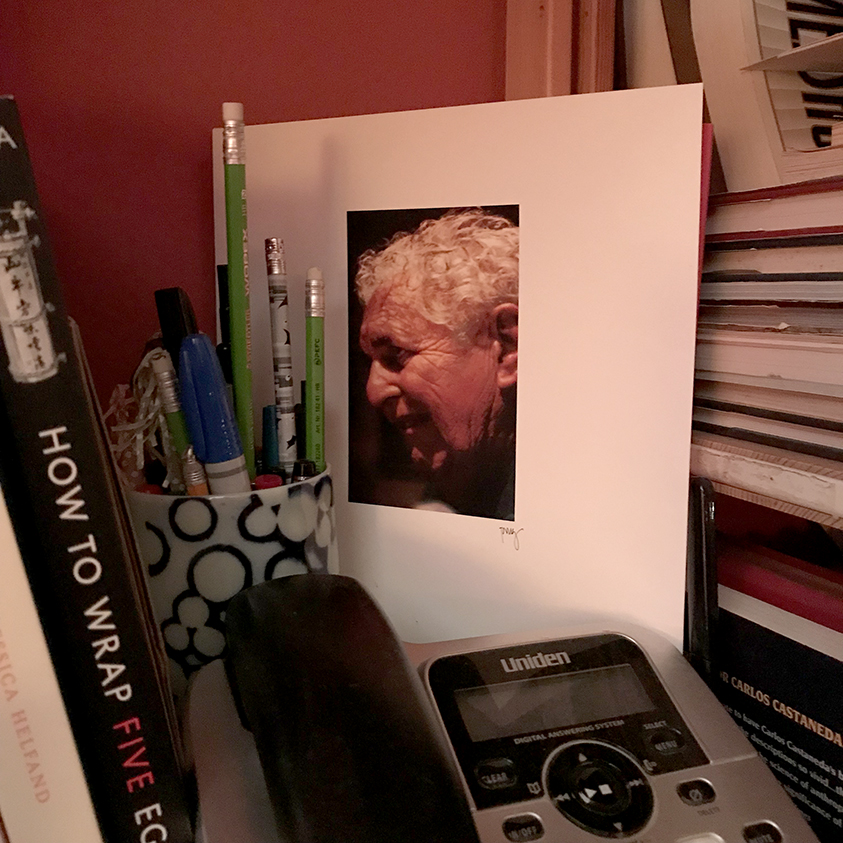
Opening image: Seth and I keep this photograph of my dad in the bookcase in our living room. Paula Marie Gourley was the photographer, three or four years ago, snapping the picture of Dad in his home, which always was his favorite place to be.

Dad loved home, but he also loved cars. Dad was an auto mechanic most of his life––a Doctor of Engines, he would say, or a Doctor of Automobiles. In 1974, he bought a burgundy Cadillac Coupe De Ville. Not long after the new car purchase, the three of us were in the car, Mom, Dad, and me. Mom just happened to reach across the dashboard for something, and as her hand passed in front of the radio, the station changed. We all agreed that that was pretty odd, but sure enough, when she reached over a second time, again the radio station changed. It happened again and again and we decided it was Mom’s diamond ring that was causing this. I happened to have a ring in those days, too, with a little ruby and a little diamond. I waved my ring in front of the radio and the station changed for me, too. For months, Mom and I believed our rings had the power to move the radio dial in that 1974 Cadillac.

Turns out there was a button on the driver’s side floor that controlled the radio. Each time one of us passed our ring in front of the radio, Dad would secretly step on the button to activate the station change. We were convinced it was some sort of magic, the diamonds operating on a higher frequency. That was my dad, though: he dealt in magic of a practical sort, and helped you believe you could do anything you wanted to do.