Category Archives: Ramadan

A Pilgrim in this World

It’s Tuesday, February 17. This year, it is a day of celebration across many traditions and across vast expanses of this old earth. Chinese Lunar New Year begins today: it is the year of the Fire Horse. Ramadan is expected to begin this evening, if the new moon is seen in the sky, and it is expected to make its appearance tonight. And in this house, it is Shrove Tuesday: the final day of the Carnival Season: Mardi Gras, Fat Tuesday, Pancake Tuesday: it is the night we have pancakes for supper. Tomorrow, when we rise, it will be Ash Wednesday. The Lenten Season will have begun: forty days of reflection and of abstaining, best we can, from excess. But that is not today. Shrove Tuesday is the day we use up all the provisions in the larder that we traditionally would not consume during the Lenten fast.

From the time when I was a boy, Lent meant no meat on Fridays, which, let’s face it, is not much to give up. In earlier times, though, the restrictions on food during Lent were quite extensive, and not just on Fridays, but all the days of Lent: no eggs, no meat, no lard, no milk, no cheese, no sugar… not much of anything truly enjoyable. Beans and pulses and vegetables and fish were acceptable, but not much else was on the table this time of year.

Sacrifice is not something we often think of, especially in this day and age, when we can find pretty much anything we want, whenever we want it. Fresh cherries in February? No problem, they’ve been flown here to your local supermarket from Argentina’s warm summer days. A slice of cheesecake from a bakery in New York flown overnight to you in Albuquerque? Also no problem. There’s no real need to eat seasonally, if you don’t want to, and if you’ve got the do-re-mi, you can get anything your heart desires delivered to your doorstep. The value of Lent, though, is that restraint is encouraged, and this idea that perhaps we should not have anything we want, whenever we want it, is, perhaps, a worthy quality, and one we should be mindful of at least every now and then. This is Lent. Lent is that reminder to be mindful.

It is also a good reminder to be kind, and respectful, and compassionate, because Lent is also a good reminder that we each are dust and to dust we shall return. Each of us. You and me in our comfortable houses. The kid who lives under the overpass. The immigrant trying to make it here and send a few bucks to the family back in the old country. The ones who get deported. The childish, disrespectful, grifting power-hungry blowhard in the White House. I don’t like calling people names, but come on: I can’t think of anyone I’d least like to be trapped in an elevator with. We all are dust and to dust we shall return. In the space between, why not just be kind and compassionate and honest and respectful to the other pilgrims in this world? As Father Seamus would recite, from memory, standing before the congregation, fingers grasping the sleeves of his vestments:

Lord, I believe in you: increase my faith.
I trust in you: strengthen my trust.
I love you: let me love you more and more.
I am sorry for my sins: deepen my sorrow.

I worship you as my first beginning,
I long for you as my last end,
I praise you as my constant helper,
And call on you as my loving protector.

I want to do what you ask of me:
In the way you ask,
For as long as you ask,
Because you ask it.

Let me love you, my Lord and my God,
And see myself as I really am:
A pilgrim in this world,
A Christian called to respect and love
All whose lives I touch.

This, to me, sums things up nicely. It is a good blueprint for a firm foundation, a good roadmap for our journey, whether we are Christian or Muslim or Jewish or Buddhist or Pagan or Agnostic or any thing we are. Change the words and make it right for you: Let me see myself as I really am: A pilgrim in this world, called to respect and love all whose lives I touch.

Anyway, I will think of these things tonight as we light the candles at our table and sit down to pancakes for our supper. And I will think of all of you, and wish only good things for you. We are all the same. We are all dust and to dust we shall return. That dust, mind you, came from the stars. It is some brilliant stuff.

N.B.: The original Convivio Book of Days calendar for February 2026 mistakenly placed the start of Ramadan at February 28… which, of course, was the date of the start of Ramadan in 2025. I’m still having trouble remembering it’s 2026. I’ve since updated the February calendar with the correct date for the start of Ramadan. Click here for that corrected calendar. 

Image: Cosmic dust in our Milky Way Galaxy, as photographed by NASA/ESA Hubble Space Telescope. This cosmic dust is a concentration of elements that are responsible for the formation of stars in our galaxy and throughout the universe. Public domain via Wikimedia Commons.

THIS WEEKEND at the SHOP
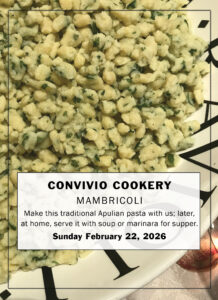
It’s Street Painting Festival time here in Lake Worth! If you’re coming to Lake Worth Beach for the event this Saturday and Sunday, why not make a little detour on your way in or out of town to come visit us at Convivio Bookworks? We’ll be open on Saturday, February 21, from 11 AM to 4 PM, and on Sunday, February 22, from 1 to 4 PM. We’ll be serving homemade Italian sweet treats and our own Löfbergs Swedish Coffee while you shop. Earlier on Sunday, we’ll be teaching a Convivio Cookery workshop: Come learn something new (and get your dinner ready while you’re at it) at our Mambricoli Pasta Making workshop on Sunday from 11 AM to 1 PM. So delicious and so easy! CLICK HERE for details and registration and to see what else is new at our Workshops page. And come see us at the Midnight Sun Festival! We’ll have a pop-up shop there on Friday, February 27, Saturday, February 28, and Sunday, March 1. This festival celebrating Finnish and Scandinavian culture is held annually at Bryant Park, on the Lake Worth Lagoon in Downtown Lake Worth Beach.

 

Daffodils, or Your March Book of Days

And now it is March. The month begins this year with a new moon and Ramadan, the lunar monthlong celebration in the Islamic calendar focused on daytime fasting, good deeds, and prayer. It’s a holiday dependent on the local first sighting of the crescent moon, so it began yesterday in some places, and begins today in others, and possibly even tomorrow in yet other places. All month long, observers will enjoy a big meal, called suhoor, each day before the sun rises, and won’t take any food or water until the sun sets. When it does, the fast is broken usually with a date, and then another big meal, this one called iftar. And so it will go, all through the lunar month, through all the phases of the moon, until the sighting of the next crescent moon, when Ramadan ends and Eid al-Fitr begins: three days of feasting and gift-giving and remembrance of all that Ramadan taught us.

Whilst Ramadan is a movable holiday, one that comes earlier and earlier each year, one constant holiday on the First of March each year is St. David’s Day. The day is sacred to Wales. It’s a day for leeks and daffodils, but even better: for Welsh Cakes. Here’s our recipe; serve the cakes with strong tea with milk and sugar:

W E L S H   C A K E S

It’s not uncommon to find recipes for Welsh Cakes that call for regular granulated sugar, butter, and nutmeg, but the traditional recipe will add lard to the mix, use caster sugar in place of the regular sugar, and will be flavored with the more mysterious flavor of mace. If you want the best Welsh Cakes, stick to the traditional version. If you can’t find caster sugar, make your own: pulse regular granulated sugar in a blender until very fine. Do not use powdered confectioners’ sugar, which has added corn starch.

3 cups all purpose flour
½ cup caster sugar
1 ½ teaspoons baking powder
1 teaspoon ground mace
½ teaspoon cinnamon
½ teaspoon salt
6 tablespoons lard
6 tablespoons butter
¾ cup dried currants
2 eggs, beaten lightly
3 to 4 tablespoons milk
granulated sugar

Whisk together the flour, caster sugar, baking powder, mace, cinnamon, and salt in a mixing bowl, then work in the butter and lard with your fingers until the mixture has the texture of course crumbs. It’s ok if some larger chunks of butter remain. Mix in the currants. Add the beaten egg, working it into the mixture, adding just enough milk to form a soft dough that is not too sticky. Wrap; chill in the refrigerator for 30 minutes or until you are ready to make the cakes.

Turn the dough out onto a floured board and roll to a thickness of about ¼”. Using a biscuit cutter (scalloped, if you have one), cut into rounds. Gather up any remnants to roll out again and cut more cakes.

Heat a lightly buttered skillet (cast iron works great) over low to medium heat, cooking the cakes until each side is lightly browned (about 3 to 4 minutes… if they’re cooking quicker than that, lower the heat). Let the cakes cool for a minute or two, then set each in a bowl of granulated sugar, allowing sugar to coat both sides and the edges. Best served warm, split, with butter and jam, or, for a more savory treat, with cheese and leeks, at a table set with a small vase of daffodils.

The daffodils are traditional for St. David’s Day in Wales, as are leeks, and if you’re there today, you may find folks wearing one or the other in their lapels. The legend of the leeks goes back to an ancient battle in Wales in which St. David himself is said to have advised the Welsh troops to wear leeks in their caps in order to distinguish themselves from the Saxon troops they were fighting. This animosity between the Celtic Welsh and the Saxon-descended English went on for some time, and there’s an old story about a man traveling on horseback in the north of Wales who comes to a river that he wishes to cross. There was another fellow working the field nearby, so the man on horseback asked, in English, if it was safe to cross the river and the laborer replied, in English, that it was indeed. The horse, however, knew better, and refused to pass into the river. So the man upon the horse asked the laborer once again if it was safe to cross the river, this time in Welsh. “Oh, I beg your pardon, sir,” said the man on the ground. “I thought you were an Englishman.”

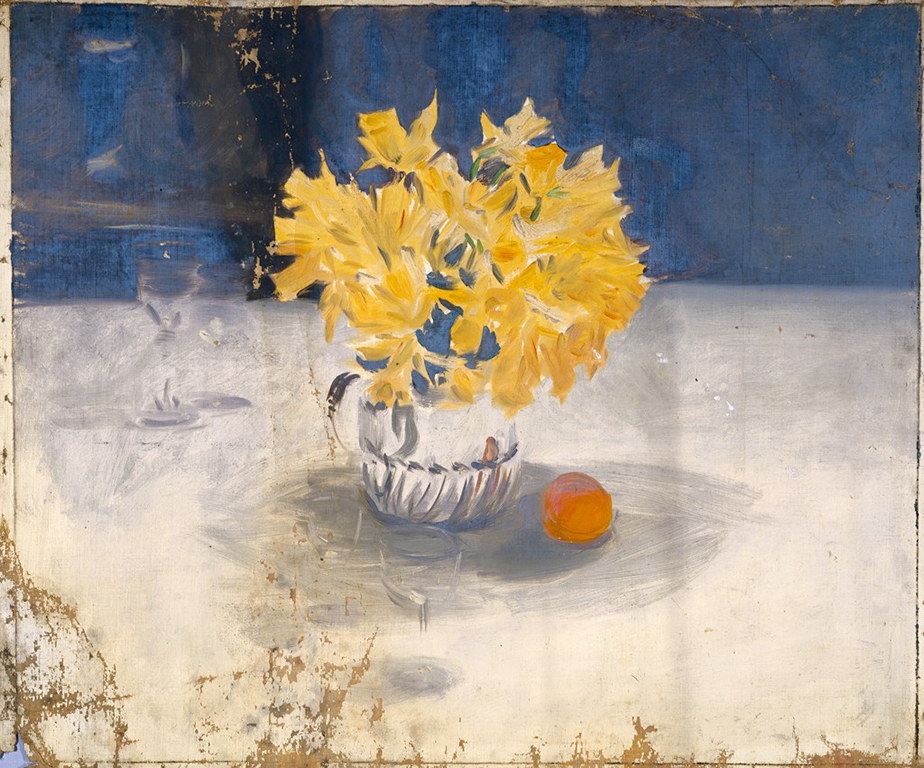
Let’s hope the animosity has by now subsided. I love leeks, but it’s the daffodils that I’ve chosen to focus upon for your Convivio Book of Days calendar for March. The calendar is our monthly gift to you, a printable PDF and a fine companion to this blog. March this year will be dominated by the forty days of Lent, and on Tuesday night, we’ll be eating pancakes for Shrove Tuesday, the night that brings an end to the Carnival season. Ash Wednesday the next morning will usher in our annual season of penitence: a season that came out of necessity in times past, but this year, perhaps this somber time has its place for those of us who feel a need to step back from the madness of the world. Forty days to attempt to make sense of what’s become of things, to reflect, to reset, to understand what is most important to us and to decide how we wish to live our lives: by the strange examples we see daily these days from the people who are supposed to be role models and exemplars of respect and integrity and compassion, or by our own internal compass that comes from both spine and heart.

COME TO THE SHOP!
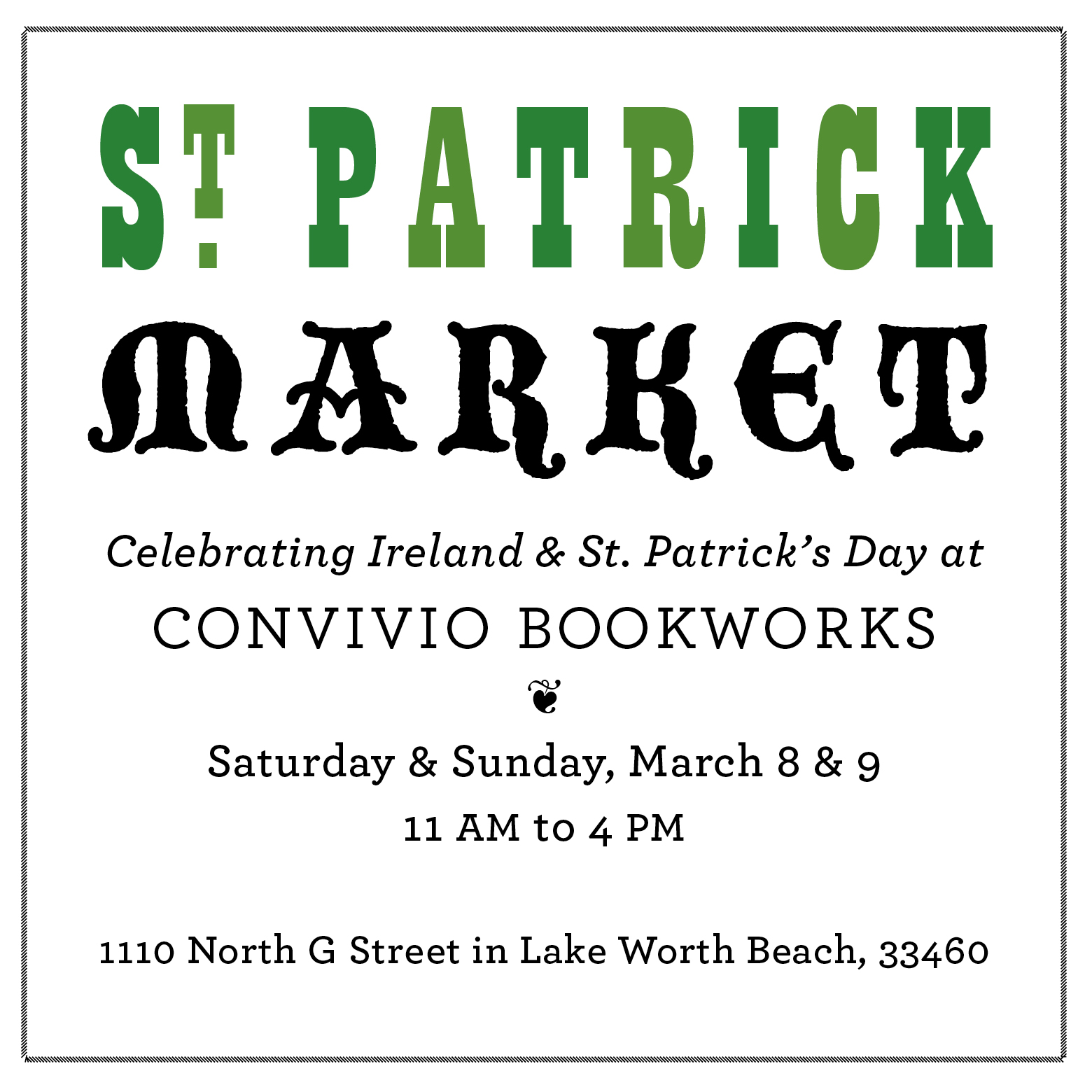
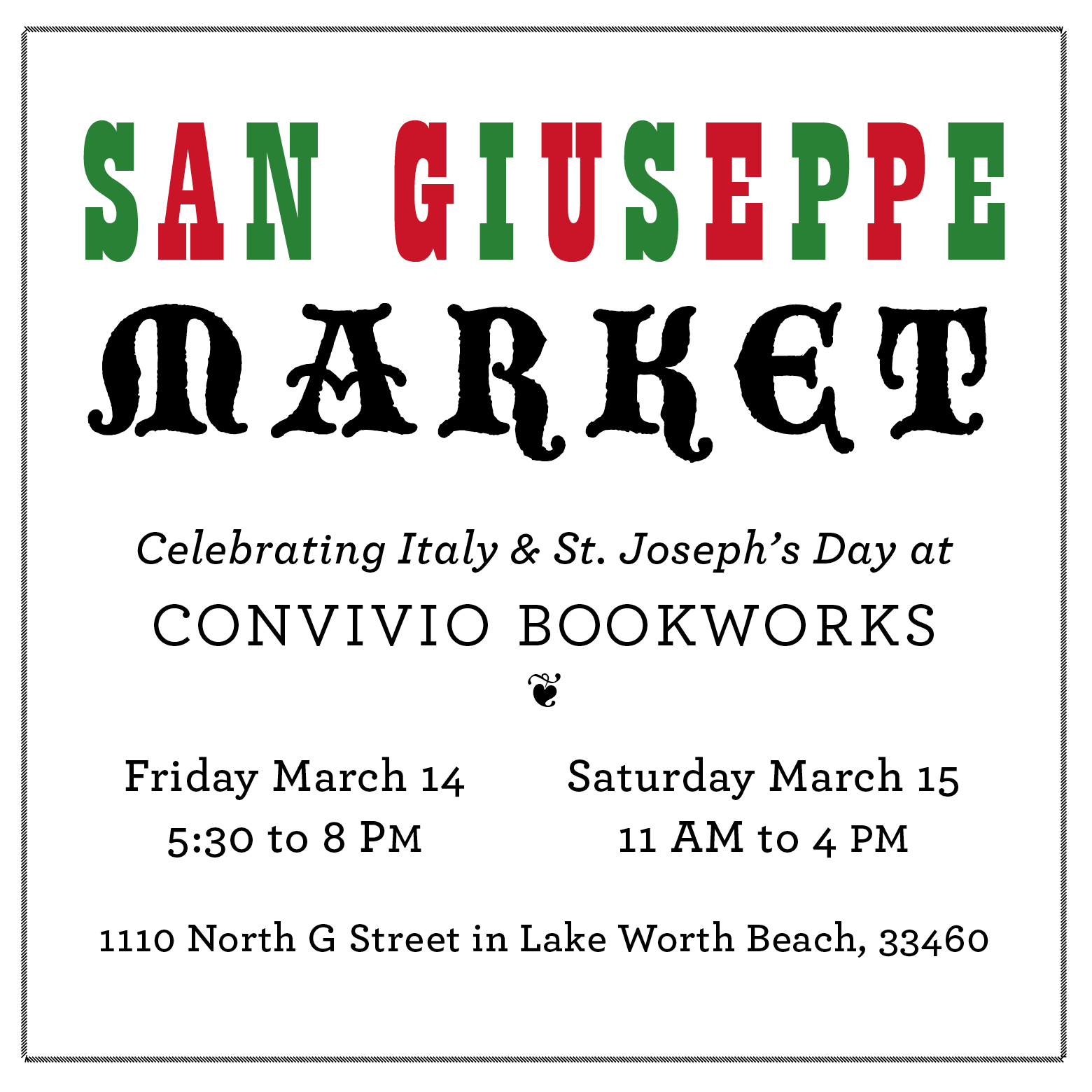
Locals: the shop is open Saturdays from 11 AM to 4 PM at 1110 North G Street, Lake Worth Beach, FL 33460. (Do take note, though, that we’ll be closed Saturday March 22 and Saturday March 29.) And we’ve got two special events for you in March. First up, it’s our St. Patrick Market on Saturday & Sunday, March 8 & 9, from 11 AM to 4 PM each day. We’ll be playing Celtic music and featuring our offerings for St. Patrick’s Day and for St. Brigid’s Day and serving homemade Irish soda bread and our own Löfbergs Swedish Coffee while you shop. The following week, come back for our San Giuseppe Market on Friday evening, March 14, from 5:30 to 8:30 PM, and on Saturday, March 15, from 11 AM to 4 PM. At this event, we’ll be playing Italian music and featuring our offerings from Italy and serving our Löfbergs Coffee with homemade Zeppole di San Giuseppe, the classic Italian pastry that we enjoy once each year to celebrate St. Joseph’s Day. Both events should be great fun. You’ll love what we have in store for you! As for the rest of you, you’ll find all these offerings (minus the soda bread and zeppole, sorry) when you visit our online shop. We appreciate your support! (Click the images below to make them larger.)

Image: Daffodils in a Vase by John Singer Sargent. Oil on canvas, circa early 1890s [Public domain, via Wikimedia Commons.]

Spring Green, or Your April Book of Days

And here now is your belated Convivio Book of Days calendar for April. Cover star: “Beech Trees in Springtime,” an 1897 oil painting by Christian Zacho. It is filled with the ephemeral spring green of newly leafed trees, which, if you are lucky, you will be seeing a fair amount of in the coming weeks, as spring comes into its own. An annual bit of wonder and renewal. We see it even here, in this strange green land, in an albeit subtle way: passing by a stand of bald cypress, for instance, as we drive across the state on Alligator Alley. It is a fine time to take a drive or to take a walk and see something new and fresh and green.

We find ourselves, too, in the midst of an important week, across cultures and spiritual traditions: Ramadan continues and at sundown tonight, Passover begins. And it is Holy Week, a week of complexity and mystery in which the forty days of Lent, which we’ve been immersed in since Ash Wednesday, will come to a close. It began last Sunday with Palm Sunday. Thursday will bring Holy Thursday, or Maundy Thursday, when tradition would have us visit three churches in the moonlit night, Friday will bring Good Friday, when we commemorate the passion of Christ, and Saturday the vigil through which we wend our way toward Easter.

What I know about Ramadan is not much and what I know about Passover is perhaps just a bit more, and is mostly is in relation to my Catholic upbringing and to Passover’s connexion to the Easter story. I know that Passover commemorates the liberation of the Israelites from their slavery in Egypt, and I know what a friend told me once, which has always resonated with me about the holiday: “We are traveling through the desert with our ancestors via a table filled with metaphor and symbolism.” The meal is the seder, the same meal that Jesus celebrated with his disciples in the upper room on that Holy Thursday night before he died. Pesach is the Hebrew name for Passover, and Pesach informs the name for Easter in many languages. Hence our Italian word for the day and season: Pasqua. And while Ramadan roams the calendar, falling a few weeks earlier each year, Pesach, Pasqua, and a full- or near-full Paschal moon are all constant companions based on the timing of the spring equinox.

The Last Supper is the Passover meal in the upper room that is commemorated at the Mass for Holy Thursday. Each year, as Lent begins, I think to myself, “This is the year I’m going to do things right.” I imagine myself taking the time to give the forty days their proper space and time, to be more mindful, and give them more reverence. And each year those forty day zip by and I find myself here, at this junction where Lent runs headlong into Holy Week, and I realize I just have these few days left to make things right. Holy Thursday is my night to do this. I drag Seth along with me, if he has it in him, on a Holy Thursday pilgrimage that my grandmother taught me: as the rest of the world is contemplating sleep, we will head out into the night and visit three churches. The churches that know Grandma’s ways will keep their doors open late into the night, or even throughout the night until morning. The moon is our companion through this pilgrimage, along with a few other hearty souls who visit the churches with us. The churches will be dim but warm with candle glow and quiet and the presence, to me at least, of all the loved ones I bring with me in my heart. I sit, I kneel, I pray, I ponder. It is a night like no other, the strongest bridge I know between realms. We each, of course, bring to it what we bring, but this is what my Holy Thursdays, my Maundy Thursdays, are like, and I feel truly at home in the mystery.

IT MAY BE NOT TOO LATE to order things from our website for Easter. We ship US Priority Mail, which is two days to most domestic destinations, so chances are good you’ll have your order by Saturday. Locals, of course, we can deliver to you or you can come pick up at our front porch. It’s a little too warm these days to ship our German chocolates for Easter, but locals: I don’t know that there’s anywhere else nearby where you’ll find German milk chocolate bunnies and German marzipan bunnies. We have a few left of each. Plus Ukrainian pysanky, wooden bunnies and splint wood baskets and paper mache eggs from Germany, handmade egg-shaped candles from Sweden…. many Easter delights await you at Convivio Bookworks! CLICK HERE to shop. And use discount code BUNNY at checkout to get $10 off your purchase of $85 on all our offerings, plus free domestic shipping!

AND WON’T YOU JOIN ME this Friday, Good Friday, via Zoom for Real Mail Fridays? It’s a weekly online social I host for the Jaffe Center for Book Arts. Good Friday is an odd day for a social, I know, so the approach I’m planning is this: a more subdued soundtrack for the first two hours, and then we’ll devote the final hour of our gathering to a most sublime recording called “Lamentations: Holy Week in Provence.” It’s by the Boston Camerata. “Lamentations” is a most beautiful piece of music, and we will play it uninterrupted from 4:00 Eastern to the close of our online social. We do bill Real Mail Fridays as a letter writing social, but the folks who join us each week from around the globe do all kinds of interesting things during our time together. We’ll begin as we always do, at 2:00 Eastern. Come and go as you please but do consider joining us for “Lamentations” beginning at 4. No matter your faith tradition or your beliefs, it is a most special way to mark the day. CLICK HERE to join us Friday between 2 and 5 Eastern.


Image: “Beech Trees in Springtime” by Christian Zacho. Oil on canvas, 1897. [Public domain] via Wikimedia Commons.