Category Archives: Lent

La Quaresima, or Your March Book of Days

And now it is March, and here is your printable Convivio Book of Day calendar for the month. It is the month of spring in the Northern Hemisphere, and the month of lent. Forty days, not including Sundays, and they cover March from start to finish. It is the month of many famous saints’ days: St. Patrick’s Day, and St. Joseph’s Day, and St. Urho’s Day, and at the start on this First of March, St. David’s Day, sacred to Wales. The first few days of March that follow St. David’s Day are given to saints who are ancient and largely forgotten here on Earth: St. Chad on the Second of March and St. Winnal on the Third. The three days taken together play a part in old weather lore. St. Winnal’s Day especially is generally expected to be particularly stormy:

First comes David,
Next comes Chad,
Then comes Winnal,
Roaring mad.

But since it is St. David’s Day today, and since it is a Sunday, it’s a good day, I feel, to make Welsh Cakes, which is what I’m planning to do. Here is our recipe:

WELSH CAKES

It’s not uncommon to find recipes for Welsh Cakes that call for regular granulated sugar, butter, and nutmeg, but the traditional recipe will add lard to the mix, use caster sugar in place of the regular sugar, and will be flavored with the more mysterious flavor of mace. If you want the best Welsh Cakes, stick to the traditional version. If you can’t find caster sugar, make your own: pulse regular granulated sugar in a blender until very fine. Do not use powdered confectioners’ sugar, which has added corn starch.

3 cups all purpose flour
½ cup caster sugar
1 ½ teaspoons baking powder
1 teaspoon ground mace
½ teaspoon cinnamon
½ teaspoon salt
6 tablespoons lard
6 tablespoons butter
¾ cup dried currants
2 eggs, beaten lightly
3 to 4 tablespoons milk
granulated sugar

Whisk together the flour, caster sugar, baking powder, mace, cinnamon, and salt in a mixing bowl, then work in the butter and lard with your fingers until the mixture has the texture of course crumbs. It’s ok if some larger chunks of butter remain. Mix in the currants. Add the beaten egg, working it into the mixture, adding just enough milk to form a soft dough that is not too sticky. Wrap; chill in the refrigerator for 30 minutes or until you are ready to make the cakes.

Turn the dough out onto a floured board and roll to a thickness of about ¼”. Using a biscuit cutter (scalloped, if you have one), cut into rounds. Gather up any remnants to roll out again and cut more cakes.

Heat a lightly buttered skillet (cast iron works great) over low to medium heat, cooking the cakes until each side is lightly browned (about 3 to 4 minutes… if they’re cooking quicker than that, lower the heat). Let the cakes cool for a minute or two, then set each in a bowl of granulated sugar, allowing sugar to coat both sides and the edges. Best served warm, split, with butter and jam, or, for a more savory treat, with cheese and leeks––leeks being one of the traditional Welsh symbols of this day, along with daffodils.

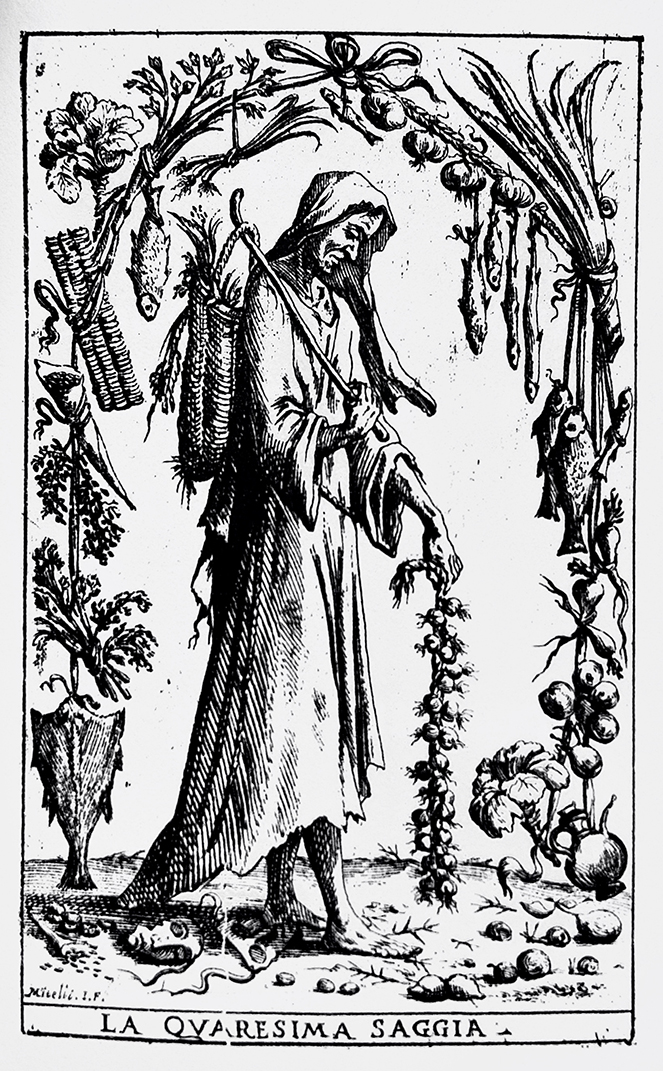
As for la Quaresima, that is the Italian for lent, and it is such a beautiful word, especially placed against our stark and spare word of only four letters. It rolls off the tongue like a flower: Quaresima. Her symbol in Italy is an old, thin woman, the opposite of the rotund man with a necklace of sausages around his neck, who is the symbol for Carnevale, the time we have just left behind last week with the start of Quaresima. She is known as La Vecchia, and we have made her this month’s cover star. She is here to remind us, like lent does, that our time on Earth is short. So make the most of it. Love each day.

Image: La Vecchia is also known as La Quaresima Saggia, the old sage of lent. Engraving by Guiseppe Maria Mitelli, late 17th century.
 

Carnevale, Shrovetide, & Pancakes for Supper

Carnevale has been going on in Venice this year since the 8th of February, and soon we come to its conclusion, along with the conclusion of all the magnificent Carnival celebrations that have been happening in the lands where Carnival is celebrated, for Tuesday next brings Mardi Gras, Shrove Tuesday, Pancake Day. The day that follows will bring Ash Wednesday and the start of Lent.

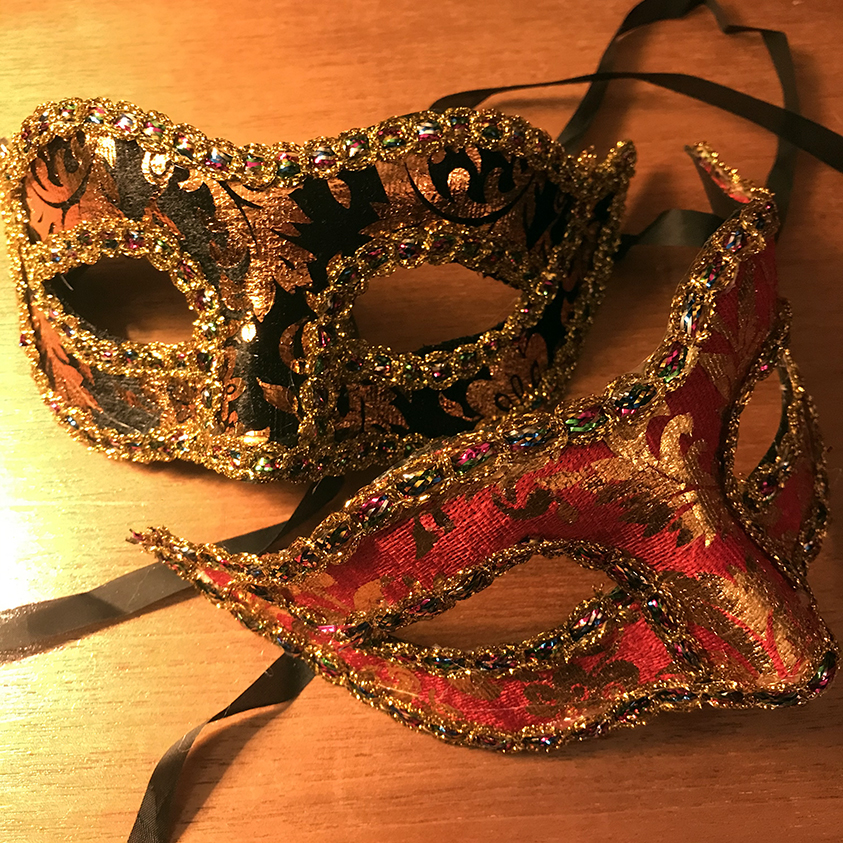
In Venice and throughout Italy, the traditional symbol for Lent is a gaunt old woman, all skin and bones. She is known as La Vecchia: The Old One. Ah, but La Vecchia won’t show up until next Wednesday once her time of Quaresima begins. For now, it is Carnevale, a time to celebrate to excess. La Vecchia’s counterpart for Carnevale is a plump, jovial fellow wearing a garland of sausages around his neck. We are here to celebrate like there is no tomorrow. Out of that come the costumes and the wigs and the masks. In Venice, these tend to be beautiful and elaborate: exquisite costumes that harken back to the glorious Renaissance and Baroque ages of the city.

Here in the States, when we think of Mardi Gras, we think of New Orleans. But there are other convivial cities where the celebration is grand, too: Mobile and Key West come to mind. We have a burgeoning New Orleans style celebration happening in recent years in nearby Fort Lauderdale, too. But for the most part in this land first settled by English Puritans, we celebrate mainly with pancakes. And while it’s no Carnevale, still, pancakes for supper is not such a bad thing. It’s called Shrovetide in the English tradition––Shrove Tuesday being the British version of Mardi Gras. It’s also known as Pancake Day. We eat pancakes for supper that day because it is a meal that uses up the last of the eggs, milk, and sugar that remained in the larder before the forty fasting days of Lent commenced. Nowadays most of the fasting is done by folks who refrain from eating meat on Fridays. But in earlier times, the fast was more widely observed and much more strict. And so the intention was to refrain from all things of the flesh: meat, eggs, cheese, milk… sex, too, was out.

La Vecchia will be here before you know it, reminding us just how short our time on this earth is. So go ahead: enjoy these days. This is what Carnevale is all about.


Tagged ,

Ocean Breeze, Palm Trees, Distant Moon

And so we are in the midst of Holy Week. It came with a shock this year, as we watched the Cathedral of Notre Dame burn in Paris, a loss for which it is for many of us impossible to find words. Holy Week is a time I hold dear, even though I don’t think of myself as a particularly religious person. I write about all these holidays, these holy days, and they hold vast spaces in my heart, and I listen to an awful lot of sacred music and I sing hymns as I go up and down staircases, just because I like them, and I feel sick about Notre Dame, but more for its beauty and history than anything else. My connexion to things religious is mostly, for better or for worse, human. I say a silent grace before meals, when I think of it, but more often than not there is already a forkful of dinner in my mouth when I am beginning to say it. And I pray, mostly when I’m driving to work each morning; at some point a few years ago I decided I could make better use of my time during my daily commute if I switched to prayer instead of all the cursing and swearing that had, up until that point, been more typical of my drive.

These things are in my DNA. As a grandson of early 20th century Italian immigrants, I grew up with St. Anthony in the backyard. In the house, there were all manner of saints and blessed virgins under glass domes on bedroom bureaus and crucifixes hanging on the walls and prayer cards with saintly images leaning on picture frames. St. Joseph, St. Rocco, St. Anthony again, the Infant of Prague, Santa Maria della Vittoria––the Black Madonna of Lucera. The year after my grandpa died, which was just after I graduated high school, there was, during Lent, forty days and nights of Adoration of the Blessed Sacrament at our neighborhood church, St. Paul’s. I wanted to keep Grandma engaged. I had no idea what Adoration was, but Grandma expressed an interest, and so I brought her the first night when Lent began. And I brought her the second night. By and by, I brought her each night that week, and each night after. I don’t think we missed once, all through those forty nights. We would sit there, she and I, in the dark candle-lit chapel. Grandma would mumble her prayers in Italian, we would chat quietly, we would sing and pray when the priest came in to sing and pray with those of us who were gathered. We made friends: Father Brice, the pastor, Father Alonso, who was from Spain and who spoke so slowly that Grandma had no trouble understanding his English, Pat McAuliffe, the woman who made sure everything in the church was in order, and who often was out of her shoes anytime you entered the sacristy unannounced. Grandma and I would go late in the evening, maybe 9:30 or 10, and stay past 11, every night for forty nights. It was one of those things I never would have imagined myself doing, but I did it for someone outside my self, I did it for Grandma, and it turned out to be one of the most special things I’ve ever experienced. Which is often the case when you step outside your self and do things for others.

It was probably those forty nights that fostered my love of churches at night. And so it is that I have come to love another of Grandma’s traditions: the visitation of three churches at night for this same overnight watch on Holy Thursday, Maundy Thursday. And still, all these years later, you will find Seth and me doing this on Holy Thursday this week, as we do each year. When we go and sit there in the still and candlelit darkness, I do pray a little, but mostly I just sit. I am right up against Seth, usually, but I also have Grandma nearby, and all the people who have come and gone in my life. We are all quiet, taking in the creaks of the building and the sounds of passers-by outside the doors and the flickering of the candles. This year, I suppose, I’ll have Notre Dame with me, as well. The heart expands, and expands.

Friday is Good Friday. I have never, in all my life, been to church for a Good Friday service. Each year I think maybe this year I’ll go. And maybe this year I will go. I have taken the day off from work, so that’s a good start toward the possibility. Friday night will, as well, begin Passover. It is a high holy week across faiths this year. Saturday brings Holy Saturday, the Easter vigil. Some years, if we have it in us, we endure the Vigil Mass, which can go on for many hours. It can begin only once darkness falls, so it is a late night. One year I really wanted to go but couldn’t for one obligation or another, so I went to the Creole service that began at 11. I was the only person there at St. Ann’s who was not Haitian. I was warmly welcomed, but my French is rusty and my Creole not much better and though I could understand only very little, still I could follow along. This, through years of experience. We sang in Creole, people shook my hand and offered me the sign of peace in Creole, and when we stepped out into the night onto the city street, it was well past 1 in the morning. I felt light and at peace. Again, one of the most special things I’ve experienced.

And maybe this is what I love about Holy Week. No matter how far I’ve strayed, I always feel welcome in the churches I visit on my journey this week, especially on Holy Thursday, that somber yet beautiful night through which many of them will keep their doors open clear through to the next morning, for we are invited: to keep watch, and to be present. The distant moon, our constant companion. Along with it, the ocean breeze, the silhouettes of palms. It is the most beautiful time of year here in Lake Worth. Open, welcoming, warm. As Lent concludes and we ponder the mysteries of this week and as we approach Easter… this warm, welcome openness I wish for you, as well.


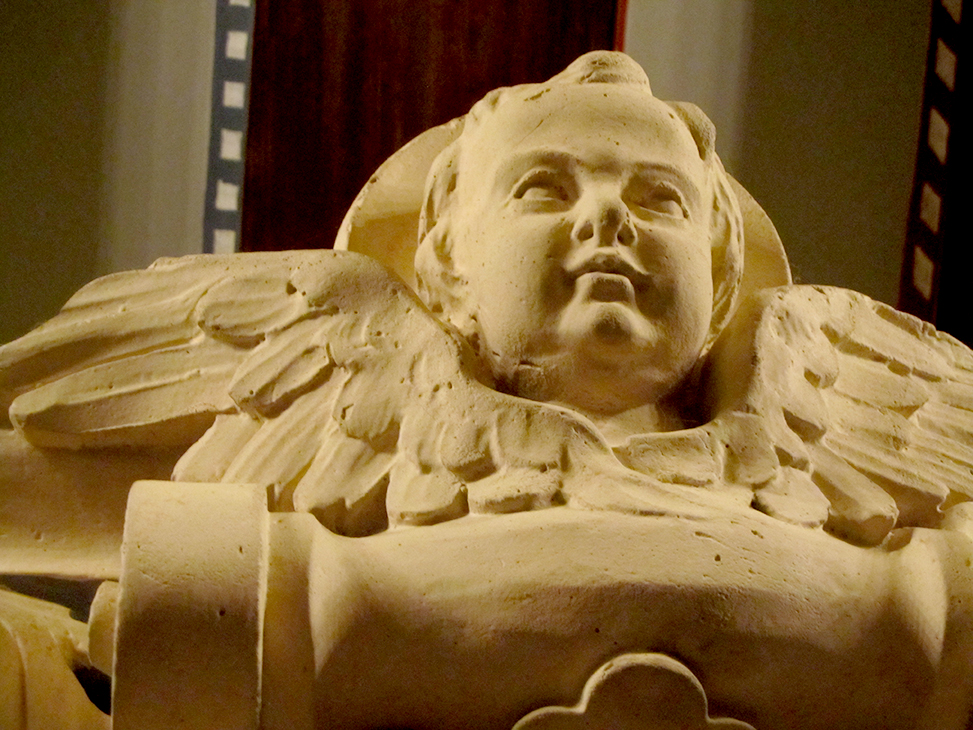
Image: When I am visiting churches on Holy Thursday night, I like to wander around. I’m not sure if it’s sanctioned or not, but nonetheless Seth and I tend to wend our way into chapels, peep into unlocked doors, ascend staircases. This angel greeted us in an upper choir loft of one of those churches, perhaps St. Ann’s in West Palm Beach or St. Edward’s or Bethesda by the Sea on Palm Beach.

Music for the week: Several years ago, the Boston Camerata released a wonderful collection of songs for Holy Week. It’s called “Lamentations: Holy Week in Provence.” It is exquisite.